SSC Tenses Questions with Answers, Rules and Signal Words
Rahul Kumar
SSC Exam Expert & Content Editor
Table of Contents
- 1.What Are Tenses?
- 2.Tense Table and Signal Words
- 3.Set 1: Basic Tenses (Q1–Q7)
- 4.Set 2: Perfect and Continuous Forms (Q8–Q14)
- 5.Set 3: Conditionals and Exam-Level Questions (Q15–Q21)
- 6.Signal Words and Common Errors
- 7.Common Mistakes in Tenses
- 8.How to Practice These 21 Questions
- 9.Related Topics to Study Next
- 10.Frequently Asked Questions
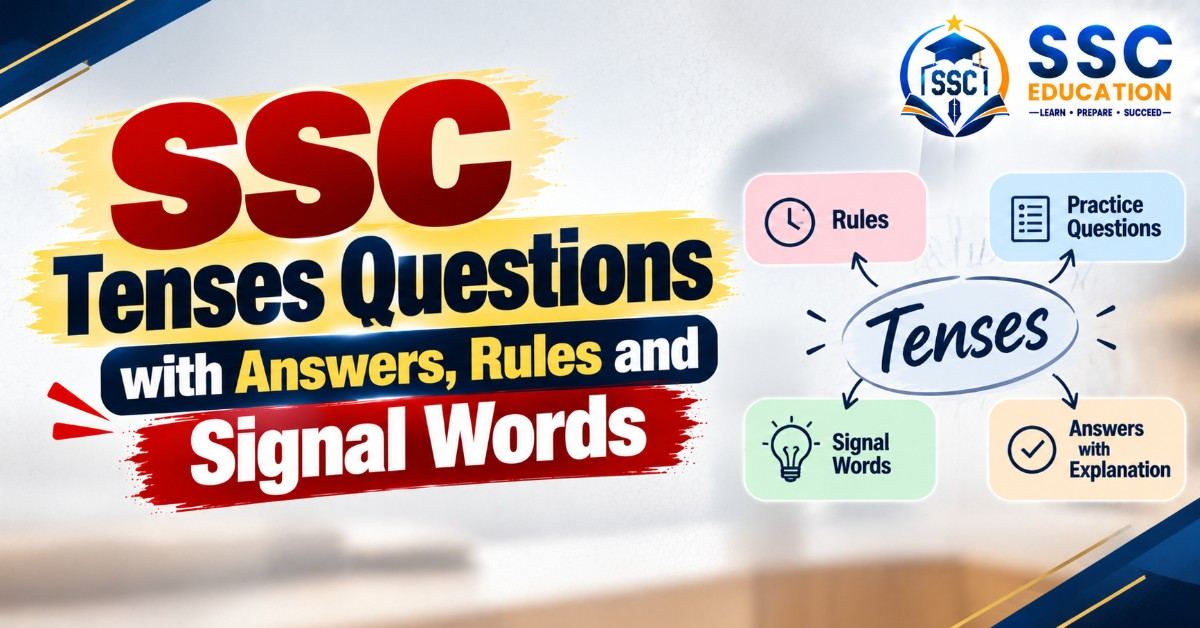
Practice 21 SSC tenses questions with answers, rules and signal words. Covers simple, continuous, perfect and perfect continuous tenses and conditional sentences for CGL, CHSL, MTS and CPO.
Tenses are the base of English grammar and a major source of questions in SSC fill in the blanks, error spotting and sentence improvement. If you know the form and the signal words of each tense, you can pick the correct verb in a few seconds. This practice paper gives you a tense table, the most useful rules and 21 questions with answers and short explanations.
What Are Tenses?
A tense shows the time of an action. There are three main times (present, past and future), and each has four forms (simple, continuous, perfect and perfect continuous), which gives 12 tenses.
Tense Table and Signal Words
| Tense | Form | Example | Signal words |
|---|---|---|---|
| Simple present | V1 (s/es) | She goes to school. | every day, always, usually |
| Present continuous | is/am/are + V-ing | She is going now. | now, at present, look! |
| Present perfect | has/have + V3 | She has gone. | already, just, yet, since, for |
| Present perfect continuous | has/have been + V-ing | She has been going for an hour. | since, for, how long |
| Simple past | V2 | She went yesterday. | yesterday, ago, last week |
| Past continuous | was/were + V-ing | She was going when I called. | while, when (interrupted action) |
| Past perfect | had + V3 | She had gone before I came. | before, by the time, after |
| Past perfect continuous | had been + V-ing | She had been going for an hour. | for, since (in the past) |
| Simple future | will + V1 | She will go tomorrow. | tomorrow, next week |
| Future continuous | will be + V-ing | She will be going at 5. | at this time tomorrow |
| Future perfect | will have + V3 | She will have gone by 5. | by tomorrow, by next month |
| Future perfect continuous | will have been + V-ing | She will have been going for an hour. | by then, for (future) |
- Use the simple present for universal truths (the sun rises in the east).
- Use the simple present in if-clauses about the future: If it rains, we will stay at home.
- Use since + point of time and for + period with the perfect tenses.
- Stative verbs such as know, like and want are not used in the continuous form.
- For unreal conditions use were: If I were you, I would accept.
Set 1: Basic Tenses (Q1–Q7)
Q1. She ___ (go) to school every day.
Answer: goes
Solution: Simple present for a daily habit.
Q2. They ___ (play) cricket now.
Answer: are playing
Solution: Now shows the present continuous.
Q3. I ___ (finish) my work already.
Answer: have finished
Solution: Already needs the present perfect.
Q4. He ___ (write) a letter yesterday.
Answer: wrote
Solution: Yesterday needs the simple past.
Q5. We ___ (watch) TV when the light went off.
Answer: were watching
Solution: A past action was interrupted by another.
Q6. By the time he came, I ___ (leave).
Answer: had left
Solution: The earlier past action uses the past perfect.
Q7. She ___ (complete) the work by tomorrow.
Answer: will have completed
Solution: By tomorrow needs the future perfect.
Set 2: Perfect and Continuous Forms (Q8–Q14)
Q8. The sun ___ (rise) in the east.
Answer: rises
Solution: A universal truth uses the simple present.
Q9. I ___ (know) him since 2010.
Answer: have known
Solution: Since needs the present perfect, and know is a stative verb.
Q10. He ___ (live) in Delhi for five years.
Answer: has lived
Solution: For a period needs the present perfect.
Q11. When I reached the station, the train ___ (leave).
Answer: had left
Solution: The train left before I reached.
Q12. She ___ (study) for two hours when I called.
Answer: had been studying
Solution: A continuous action before another past action.
Q13. They ___ (build) a bridge next year.
Answer: will build
Solution: Next year needs the simple future.
Q14. Look! The baby ___ (cry).
Answer: is crying
Solution: Look shows an action happening now.
Set 3: Conditionals and Exam-Level Questions (Q15–Q21)
Q15. If it rains, we ___ (stay) at home.
Answer: will stay
Solution: If + simple present gives will + base verb.
Q16. If I were you, I ___ (accept) the offer.
Answer: would accept
Solution: An unreal condition gives would.
Q17. He said that he ___ (be) busy.
Answer: was
Solution: Reported speech changes is to was.
Q18. By next month, she ___ (work) here for ten years.
Answer: will have been working
Solution: Future perfect continuous with for.
Q19. I ___ (not/see) him since Monday.
Answer: have not seen
Solution: Since needs the present perfect.
Q20. The teacher ___ (explain) the lesson when the bell rang.
Answer: was explaining
Solution: An action in progress was interrupted.
Q21. I wish I ___ (be) a bird.
Answer: were
Solution: A wish about an unreal present uses were.
Signal Words and Common Errors
| Signal word | Tense usually used |
|---|---|
| Every day, always, usually | Simple present |
| Now, at present, currently | Present continuous |
| Already, just, yet, ever, never | Present perfect |
| Since, for | Present perfect or present perfect continuous |
| Yesterday, ago, last year | Simple past |
| While, when (an action in progress) | Past continuous |
| By the time, before (earlier action) | Past perfect |
| Tomorrow, next week, soon | Simple future |
Remember that since is used with a point in time (since 2020) and for with a period of time (for five years). Never use the simple past with "already" or "just" in standard exam English, and never use a future tense after "if" or "when" in a time clause. For example, say "If it rains, we will stay home", not "If it will rain".
Common Mistakes in Tenses
- Using the simple past with since and for.
- Using the continuous form with stative verbs such as know and love.
- Using will in the if-clause.
- Mixing the order of two past actions (use the past perfect for the earlier one).
- Using have with a singular subject.
- Ignoring the signal words in the sentence.
How to Practice These 21 Questions
- Learn the 12 forms with one example for each.
- Underline the signal words in every sentence.
- Practise 10 tense questions daily.
- Revise the exceptions such as stative verbs.
Related Topics to Study Next
- Fill in the Blanks Questions
- Error Detection Questions
- Subject-Verb Agreement Questions
- SSC English Practice Set
Frequently Asked Questions
What is a tense?
A tense is the form of a verb that shows the time of an action.
How many tenses are there?
There are 12 tenses: four forms each in the present, past and future.
What is the difference between simple past and present perfect?
The simple past is for a finished action at a definite past time. The present perfect connects the past with the present and is used with since, for, already and just.
When do we use the past perfect?
We use it for the earlier of two past actions.
What is the rule for since and for?
Since is used with a point of time and for is used with a period. Both use the perfect tenses.
What are stative verbs?
They are verbs such as know, like, love and want, which are not normally used in the continuous form.
What tense is used after if?
Use the simple present in the if-clause for the future, and will in the main clause.
When do we use were in conditional sentences?
We use were for unreal or imaginary situations, such as If I were you.
How many tense questions come in SSC exams?
Three to five questions in fill in the blanks, error spotting and sentence improvement.
How can I identify the correct tense quickly?
Look at the signal words such as yesterday, already, since, for and by the time.
What is the future perfect tense?
It shows an action that will be completed before a time in the future, as in She will have finished by 5.
How should I prepare tenses for SSC exams?
Learn the table and signal words, practise daily and revise mistakes.
Rahul Kumar
SSC Exam Expert & Content Editor
Rahul is a senior SSC exam strategist with 8+ years of experience helping aspirants crack CGL, CHSL and MTS exams. He writes in-depth notification breakdowns, exam pattern guides and preparation strategies.