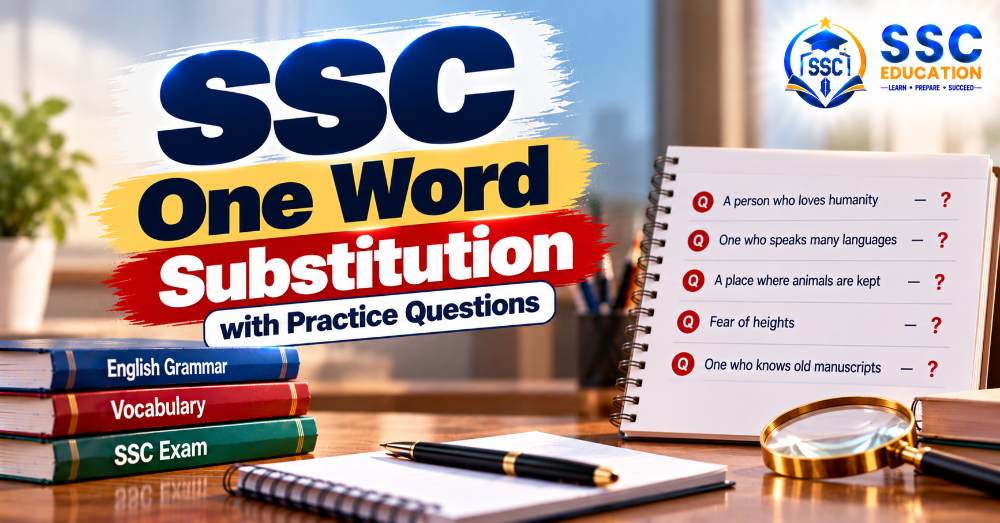
SSC One Word Substitution with Practice Questions
Rahul Kumar
SSC Exam Expert & Content Editor
Table of Contents
- 1.Practice Paper at a Glance
- 2.What Is One Word Substitution? Basic Concept in Simple Words
- 3.Important One Word Substitutions for SSC (With Meanings)
- 4.Set 1: Persons and Qualities (Q1–Q10)
- 5.Set 2: Killing, Death, Government and Places (Q11–Q20)
- 6.Set 3: Cannot Be, Quantity and Mixed Words (Q21–Q30)
- 7.Common Mistakes in One Word Substitution
- 8.How to Practice These 30 Questions
- 9.Related Topics to Study Next
- 10.Frequently Asked Questions
Learn 74 important one word substitutions for SSC with meanings and practice 30 questions with answers. Useful for CGL, CHSL, MTS and GD English vocabulary.
One Word Substitution means replacing a long phrase with a single word. It is a regular question type in SSC CGL, CHSL, MTS and GD English papers, usually with two to three questions in every shift. The same words appear again and again, so a well-organised list gives you quick marks. This practice paper gives you a list of 74 important one word substitutions with meanings, followed by 30 practice questions with answers.
Practice Paper at a Glance
| Detail | Information |
|---|---|
| Topic | One Word Substitution |
| Total questions | 30 questions in 3 sets |
| Level | Easy to exam level |
| Useful for | SSC CGL, CHSL, MTS, GD, CPO and other government exams |
| Includes | Answers, step-by-step solutions, shortcut tricks and FAQs |
| Time to attempt | 35 to 40 minutes |
What Is One Word Substitution? Basic Concept in Simple Words
In a one word substitution question, a phrase such as "a person who loves books" is given, and you have to choose the single word that has the same meaning ("bibliophile"). This tests your vocabulary and your knowledge of word roots.
- The correct word is always a single word that fully replaces the phrase.
- Many words are built from Latin and Greek roots: -cide means killing, phil- means love and mis- means hate.
- Learning words by roots and categories is faster than learning them one by one.
Important One Word Substitutions for SSC (With Meanings)
People and Their Qualities
| One word | Meaning |
|---|---|
| Atheist | One who does not believe in God |
| Autobiography | The story of one's own life written by oneself |
| Biography | The life story of a person written by another |
| Bibliophile | A lover of books |
| Misanthrope | A hater of mankind |
| Philanthropist | A lover of mankind who helps others |
| Misogynist | A hater of women |
| Optimist | One who always hopes for the best |
| Pessimist | One who always expects the worst |
| Cynic | One who sneers at others and doubts good motives |
| Egoist | A person who is self-centred |
| Altruist | One who cares for the welfare of others |
| Amateur | One who does something for pleasure and not for money |
| Hypocrite | One who pretends to be what he is not |
| Plagiarist | One who steals the writings of others |
| Kleptomaniac | One who has an irresistible urge to steal |
| Fanatic | One who has excessive and unreasoning zeal |
| Pedestrian | One who goes on foot |
| Cannibal | One who eats human flesh |
| Bachelor | An unmarried man |
| Spinster | An unmarried woman |
| Widow | A woman whose husband is dead |
| Widower | A man whose wife is dead |
| Orphan | A child who has lost both parents |
Killing, Death, Government and Places
| One word | Meaning |
|---|---|
| Fratricide | Killing of a brother |
| Patricide | Killing of a father |
| Matricide | Killing of a mother |
| Regicide | Killing of a king |
| Suicide | Killing of oneself |
| Homicide | Killing of a human being |
| Infanticide | Killing of an infant |
| Genocide | Killing of a race or large group of people |
| Insecticide | A substance that kills insects |
| Epitaph | An inscription on a tomb |
| Obituary | A notice of a person's death |
| Posthumous | Happening after death |
| Autopsy | Examination of a dead body to find the cause of death |
| Monarchy | Rule by a king or queen |
| Democracy | Government by the people |
| Autocracy | Rule by one person with absolute power |
| Aristocracy | Government by nobles |
| Bureaucracy | Government by officials |
| Anarchy | Absence of government |
| Aviary | A place where birds are kept |
| Apiary | A place where bees are kept |
| Granary | A place where grain is stored |
| Arsenal | A place where weapons are stored |
| Mortuary | A place where dead bodies are kept |
Cannot Be, Quantity and Other Words
| One word | Meaning |
|---|---|
| Illegible | That cannot be read |
| Inaudible | That cannot be heard |
| Invisible | That cannot be seen |
| Incorrigible | That cannot be corrected |
| Inevitable | That cannot be avoided |
| Impregnable | That cannot be captured |
| Invincible | That cannot be defeated |
| Indelible | That cannot be erased |
| Illiterate | One who cannot read or write |
| Insolvent | One who cannot pay his debts |
| Unanimous | With the agreement of all |
| Omnipotent | All-powerful |
| Omniscient | All-knowing |
| Omnipresent | Present everywhere |
| Polygamy | Having more than one wife or husband at a time |
| Monogamy | Having only one wife or husband |
| Extempore | Without preparation |
| Anonymous | Of unknown name |
| Contemporary | Belonging to the same time |
| Nostalgia | A longing for the past |
| Panacea | A remedy for all diseases |
| Utopia | An imaginary perfect place |
| Carnivorous | Flesh-eating |
| Herbivorous | Plant-eating |
| Omnivorous | Eating everything |
| Immortal | One who never dies |
Word Root Tricks
- -cide means killing: fratricide (brother), patricide (father), matricide (mother), regicide (king), suicide (self).
- -phile means lover: bibliophile (books), Anglophile (England).
- -phobia means fear: claustrophobia (closed places), acrophobia (heights).
- mis- means hate: misanthrope (mankind), misogynist (women).
- -cracy means rule: democracy, autocracy, aristocracy, bureaucracy.
- omni- means all: omnipotent, omniscient, omnipresent, omnivorous.
- il-, in-, im- at the start of a word often means "cannot be" or "not": illegible, inaudible, impregnable.
Set 1: Persons and Qualities (Q1–Q10)
Q1. A person who loves books
Answer: Bibliophile
Trick: Biblio means books and phile means lover.
Q2. One who hates mankind
Answer: Misanthrope
Solution: Mis means hate and anthropos means man.
Q3. One who does not believe in God
Answer: Atheist
Solution: An atheist denies the existence of God.
Q4. The story of a person's own life written by himself
Answer: Autobiography
Solution: Auto means self.
Q5. One who always expects the worst
Answer: Pessimist
Solution: The opposite of an optimist.
Q6. A person who does something for pleasure and not for money
Answer: Amateur
Solution: The opposite of a professional.
Q7. One who pretends to be what he is not
Answer: Hypocrite
Solution: A hypocrite says one thing and does another.
Q8. One who steals the writings of others
Answer: Plagiarist
Solution: Plagiarism means copying another person's work.
Q9. A person who has an irresistible urge to steal
Answer: Kleptomaniac
Solution: Klepto means steal.
Q10. One who goes on foot
Answer: Pedestrian
Solution: A pedestrian is a person walking on the road.
Set 2: Killing, Death, Government and Places (Q11–Q20)
Q11. Killing of a brother
Answer: Fratricide
Trick: Frater means brother and cide means killing.
Q12. Killing of one's own father
Answer: Patricide
Solution: Pater means father.
Q13. Killing of a king
Answer: Regicide
Solution: Rex means king.
Q14. The killing of a large group or race of people
Answer: Genocide
Solution: Geno means race.
Q15. An inscription on a tomb
Answer: Epitaph
Solution: It is written on a gravestone.
Q16. Government by the people
Answer: Democracy
Solution: Demos means people.
Q17. Rule by one person with absolute power
Answer: Autocracy
Solution: Auto means self and cracy means rule.
Q18. Absence of government
Answer: Anarchy
Solution: A state of disorder without any ruler or law.
Q19. A place where bees are kept
Answer: Apiary
Solution: Apis means bee.
Q20. A place where weapons are stored
Answer: Arsenal
Solution: An arsenal is a store or factory of arms.
Set 3: Cannot Be, Quantity and Mixed Words (Q21–Q30)
Q21. That which cannot be read
Answer: Illegible
Trick: Legible means readable and the prefix il- means not.
Q22. That which cannot be heard
Answer: Inaudible
Solution: Audible means able to be heard.
Q23. That which cannot be avoided
Answer: Inevitable
Solution: Inevitable events will certainly happen.
Q24. That which cannot be defeated
Answer: Invincible
Solution: Vincere means to conquer.
Q25. That which cannot be erased
Answer: Indelible
Solution: Delere means to destroy or erase.
Q26. One who cannot pay his debts
Answer: Insolvent
Solution: Insolvent means unable to repay debts.
Q27. All-knowing
Answer: Omniscient
Solution: Omni means all and scient means knowing.
Q28. A remedy for all diseases
Answer: Panacea
Solution: Pan means all and akos means cure.
Q29. A longing for the past
Answer: Nostalgia
Solution: It is a feeling of missing old times.
Q30. An imaginary perfect place
Answer: Utopia
Solution: A place of ideal conditions that does not really exist.
Common Mistakes in One Word Substitution
- Choosing a word that sounds similar but has a different meaning (for example, "bibliophile" and "bibliography").
- Confusing "monogamy" and "polygamy" or "autobiography" and "biography".
- Mixing up the -cide words for different relatives.
- Memorising a long list in one day without revision.
- Ignoring word roots that could help you guess.
- Not checking whether the word fully replaces the phrase.
How to Practice These 30 Questions
- Learn ten words a day from the lists and write them in a notebook.
- Use the root tricks to group words and remember them faster.
- Cover the right column and test yourself, then check the answers.
- Solve each set in 5 minutes and mark the words you miss.
- Revise your mistakes after two days and again after a week.
Related Topics to Study Next
- Idioms and Phrases
- Active and Passive Voice Questions
- SSC Synonyms and Antonyms Questions
- Antonyms Notes
Frequently Asked Questions
What is one word substitution?
One word substitution means replacing a phrase or sentence with a single word that has the same meaning, such as "a person who loves books" for "bibliophile".
How many one word substitution questions come in SSC exams?
Generally two to three questions come from one word substitution in each shift of SSC CGL, CHSL and MTS.
How can I learn one word substitutions quickly?
Learn words by roots (like -cide, -phile and omni-), group them by theme, practise ten words a day and revise them regularly.
What is the difference between autobiography and biography?
An autobiography is the story of a person's life written by that person. A biography is the story of a person's life written by someone else.
What is the difference between monogamy and polygamy?
Monogamy means having only one spouse at a time. Polygamy means having more than one spouse at a time.
What does the suffix -cide mean?
The suffix -cide means killing. For example, fratricide is the killing of a brother and suicide is the killing of oneself.
What does omnipotent mean?
Omnipotent means all-powerful, having unlimited power. Related words are omniscient (all-knowing) and omnipresent (present everywhere).
Which words are repeated most in SSC exams?
Words like bibliophile, misanthrope, philanthropist, fratricide, omnipotent, inevitable, invincible, epitaph and autocracy appear frequently in previous year papers.
What should I do if I do not know the exact word?
Use the root and prefix of the options, remove the options whose meaning is clearly different and choose the word that best fits the phrase.
How should I prepare one word substitution for SSC exams?
Learn the lists in this paper, practise daily sets, solve previous year questions and use a revision notebook for words you find difficult.
Rahul Kumar
SSC Exam Expert & Content Editor
Rahul is a senior SSC exam strategist with 8+ years of experience helping aspirants crack CGL, CHSL and MTS exams. He writes in-depth notification breakdowns, exam pattern guides and preparation strategies.