SSC Fill in the Blanks Questions with Answers (Prepositions, Articles, Tenses)
Rahul Kumar
SSC Exam Expert & Content Editor
Table of Contents
- 1.Practice Paper at a Glance
- 2.What Are Fill in the Blanks Questions? Basic Concept in Simple Words
- 3.Rules and Shortcut Tricks for Fill in the Blanks
- 4.Set 1: Prepositions (Q1–Q10)
- 5.Set 2: Articles and Tenses (Q11–Q20)
- 6.Set 3: Conjunctions and Mixed Questions (Q21–Q30)
- 7.Common Mistakes in Fill in the Blanks
- 8.How to Practice These 30 Questions
- 9.Related Topics to Study Next
- 10.Frequently Asked Questions
Practice 30 SSC fill in the blanks questions with answers and explanations. Covers prepositions, articles, tenses, conjunctions and fixed expressions for CGL, CHSL, MTS and GD English.
Fill in the Blanks questions test your grammar and vocabulary at the same time. In SSC CGL, CHSL and MTS, three to five such questions appear in every English paper, most of them based on prepositions, articles, tenses and conjunctions. This practice paper gives you the main rules and 30 practice questions with answers and explanations.
Practice Paper at a Glance
| Detail | Information |
|---|---|
| Topic | Fill in the Blanks |
| Total questions | 30 questions in 3 sets |
| Level | Easy to exam level |
| Useful for | SSC CGL, CHSL, MTS, GD, CPO and other government exams |
| Includes | Answers, step-by-step solutions, shortcut tricks and FAQs |
| Time to attempt | 35 to 40 minutes |
What Are Fill in the Blanks Questions? Basic Concept in Simple Words
In a fill in the blanks question, one or more words are missing from a sentence, and you choose the word that makes the sentence correct and meaningful. The word is chosen using the grammar rule or the meaning of the sentence.
- Grammar-based: prepositions, articles, tenses, subject-verb agreement and conjunctions.
- Vocabulary-based: the correct word is decided by the meaning of the sentence.
- Fixed expressions: some words always go together (good at, afraid of, prefer to).
Rules and Shortcut Tricks for Fill in the Blanks
Common Words with Fixed Prepositions
| Phrase | Preposition | Example |
|---|---|---|
| Good / weak / expert | at | He is good at maths. |
| Afraid / proud / fond / full | of | She is afraid of dogs. |
| Married / senior / junior / prefer / addicted | to | He is married to my cousin. |
| Congratulate / insist / depend / rely | on | I congratulated him on his success. |
| Interested / believe | in | She is interested in music. |
| Angry / different / disappointed | with / from / with | He is angry with me. |
| Beware / aware / capable / guilty | of | Beware of dogs. |
| On time (punctual) / in time (early enough) | on / in | The train arrived on time. |
Articles at a Glance
- A is used before a consonant sound (a book, a university, a one-rupee note).
- An is used before a vowel sound (an apple, an hour, an MBA).
- The is used for specific things, unique things (the sun), rivers, musical instruments (the guitar) and superlatives.
- No article is used before plural general nouns, uncountable general nouns and names of languages and meals.
Quick Rules for Tenses, Since and For, and Conjunctions
- Since is used with a point of time (since 2010, since morning). For is used with a period (for five years).
- Present perfect (have/has + V3) is used with since and for.
- If + past (were) ... would is used for unreal situations: If I were rich, I would help the poor.
- Although shows contrast and cannot be used with "but" in the same sentence.
- Neither ... nor, either ... or and not only ... but also must go in pairs.
- So that shows purpose. Too ... to shows a negative result.
Set 1: Prepositions (Q1–Q10)
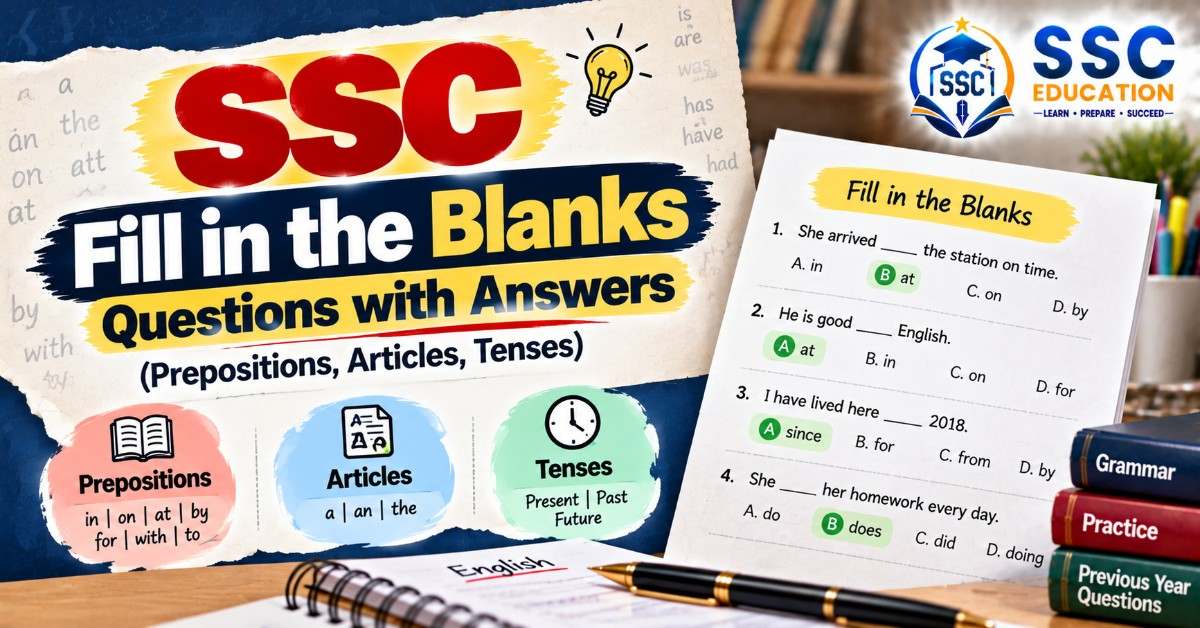
Q1. He is good ___ mathematics.
Answer: at
Solution: "Good at" is the fixed expression.
Q2. She is afraid ___ dogs.
Answer: of
Solution: "Afraid of" is the fixed expression.
Q3. The book is ___ the table.
Answer: on
Solution: "On" shows that the book is resting on the surface.
Q4. He was born ___ 2001.
Answer: in
Solution: Use "in" with years and months.
Q5. The train arrived ___ time.
Answer: on
Trick: "On time" means punctual. "In time" means early enough.
Q6. He is married ___ my cousin.
Answer: to
Solution: "Married to" is the fixed expression.
Q7. She has been waiting ___ morning.
Answer: since
Solution: "Since" is used with a point in time.
Q8. He has lived here ___ five years.
Answer: for
Trick: "For" is used with a period of time.
Q9. The cat jumped ___ the wall.
Answer: over
Solution: "Over" shows movement above and across.
Q10. I prefer tea ___ coffee.
Answer: to
Solution: "Prefer ... to" is the fixed expression.
Set 2: Articles and Tenses (Q11–Q20)
Q11. ___ honest man is respected by all.
Answer: An
Trick: "Honest" begins with a vowel sound because the h is silent.
Q12. He is ___ university student.
Answer: a
Trick: "University" begins with a "yoo" consonant sound.
Q13. ___ sun rises in the east.
Answer: The
Solution: The sun is unique, so "the" is used.
Q14. She plays ___ guitar.
Answer: the
Solution: "The" is used before musical instruments.
Q15. I have ___ MBA degree.
Answer: an
Solution: "MBA" begins with the vowel sound "em".
Q16. He ___ to school every day.
Answer: goes
Solution: A habitual action uses the simple present, and "he" takes the verb with s.
Q17. She ___ reading when I came.
Answer: was
Solution: A past continuous action was interrupted by another past action.
Q18. I ___ him since 2010.
Answer: have known
Solution: "Since" with a point of time needs the present perfect.
Q19. By next month, he ___ his course.
Answer: will have completed
Solution: "By next month" suggests the future perfect.
Q20. If I ___ rich, I would help the poor.
Answer: were
Trick: An unreal condition in the present uses "were" for all subjects.
Set 3: Conjunctions and Mixed Questions (Q21–Q30)
Q21. He worked hard ___ he could pass the exam.
Answer: so that
Solution: "So that" shows purpose.
Q22. ___ it was raining, we went out.
Answer: Although
Solution: "Although" shows contrast between two facts.
Q23. Neither he ___ I was present.
Answer: nor
Solution: "Neither" is always followed by "nor".
Q24. He is ___ weak to walk.
Answer: too
Solution: "Too ... to" shows that something is not possible.
Q25. She gave me some good ___.
Answer: advice
Solution: "Advice" is an uncountable noun and is never used in the plural.
Q26. I congratulated him ___ his success.
Answer: on
Solution: "Congratulate on" is the fixed expression.
Q27. He is addicted ___ smoking.
Answer: to
Solution: "Addicted to" is the fixed expression.
Q28. Beware ___ dogs.
Answer: of
Solution: "Beware of" is the fixed expression.
Q29. He insisted ___ paying the bill.
Answer: on
Solution: "Insist on" is the fixed expression.
Q30. She is senior ___ me.
Answer: to
Trick: "Senior to" is used for comparison, not "than".
Common Mistakes in Fill in the Blanks
- Using "than" instead of "to" with senior, junior, prefer and superior.
- Mixing "since" and "for" with the wrong tense.
- Using "a" before words that begin with a vowel sound.
- Using an unreal condition with "was" instead of "were".
- Using "but" together with "although" in the same sentence.
- Using plural forms of uncountable nouns like advice, furniture and information.
How to Practice These 30 Questions
- Learn the fixed preposition table and revise ten phrases a day.
- Revise the article rules and test yourself with ten words daily.
- Solve each set in 6 minutes without looking at the answers.
- Read the complete sentence once more after filling the blank.
- Note down the rules you missed and revise them after a week.
Related Topics to Study Next
- Direct and Indirect Speech Questions
- Subject-Verb Agreement Questions
- SSC Cloze Test Questions
- SSC Error Detection Questions
Frequently Asked Questions
What are fill in the blanks questions in SSC English?
They are questions in which a word or phrase is missing from a sentence and you choose the correct option from the given choices. They test grammar and vocabulary.
How many fill in the blanks questions come in SSC exams?
Usually three to five fill in the blanks questions come in the English section of SSC CGL, CHSL and MTS.
How do I choose the correct preposition?
Learn the fixed expressions (good at, afraid of, prefer to, married to) and use the meaning of the sentence for time and place prepositions.
What is the difference between since and for?
"Since" is used with a point of time (since 2010) and "for" is used with a period (for five years). Both are used with the present perfect.
When do I use a, an and the?
Use "a" before a consonant sound, "an" before a vowel sound and "the" for specific or unique things. The sound matters, not the spelling.
What is the difference between on time and in time?
"On time" means exactly at the scheduled time (punctual). "In time" means early enough to do something.
What is the correct use of "were" in unreal conditions?
In an unreal present condition, use "were" for all subjects, such as "If I were you" and "If he were rich".
Which conjunctions are used in pairs?
Neither ... nor, either ... or, not only ... but also, both ... and and whether ... or are used in pairs.
How can I improve in fill in the blanks?
Read English newspapers, make a notebook of phrases with prepositions, learn article rules and practise sentence-based exercises daily.
How should I prepare fill in the blanks for SSC exams?
Revise grammar rules, solve one set daily, check the explanation of every wrong answer and practise previous year questions.
Rahul Kumar
SSC Exam Expert & Content Editor
Rahul is a senior SSC exam strategist with 8+ years of experience helping aspirants crack CGL, CHSL and MTS exams. He writes in-depth notification breakdowns, exam pattern guides and preparation strategies.