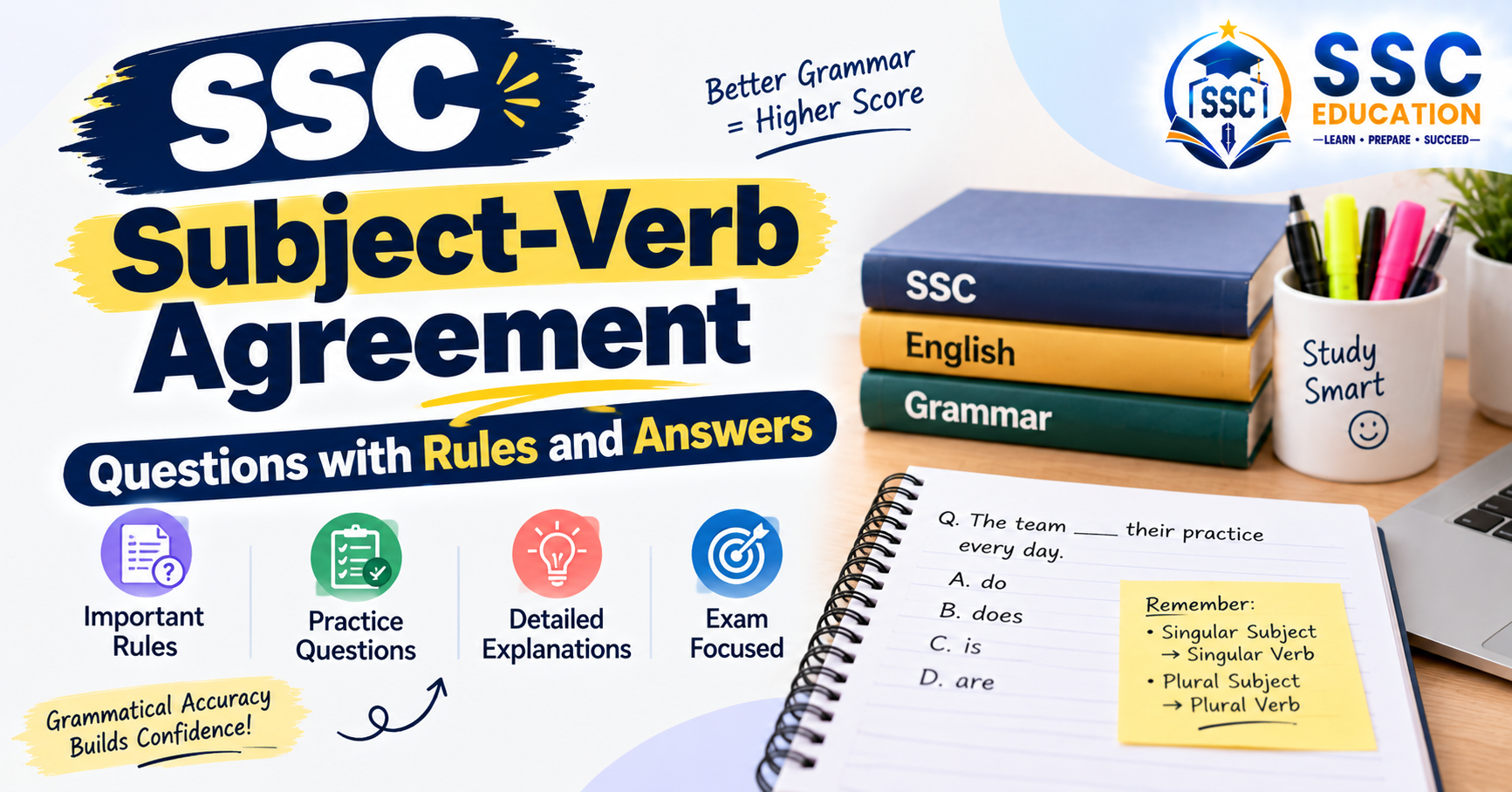
SSC Subject-Verb Agreement Questions with Rules and Answers
Rahul Kumar
SSC Exam Expert & Content Editor
Table of Contents
- 1.Practice Paper at a Glance
- 2.What Is Subject-Verb Agreement? Basic Concept in Simple Words
- 3.Rules and Shortcut Tricks for Subject-Verb Agreement
- 4.Set 1: Basic Agreement Questions (Q1–Q10)
- 5.Set 2: Collective Nouns, Amounts and Special Cases (Q11–Q20)
- 6.Set 3: Exam-Level Agreement Questions (Q21–Q30)
- 7.Common Mistakes in Subject-Verb Agreement
- 8.How to Practice These 30 Questions
- 9.Related Topics to Study Next
- 10.Frequently Asked Questions
Learn the rules of subject-verb agreement and practise 30 SSC questions with answers. Covers each, either, neither, collective nouns, along with and one of the for CGL, CHSL, MTS and GD English.
Subject-Verb Agreement (concord) is one of the most important grammar rules in SSC English. It is used in error spotting, sentence improvement and fill in the blanks, so almost every SSC English paper has two to four questions based on it. The rule is simple, but the exceptions are tricky. This practice paper gives you the main rules with examples and 30 practice questions with answers and short reasons.
Practice Paper at a Glance
| Detail | Information |
|---|---|
| Topic | Subject-Verb Agreement |
| Total questions | 30 questions in 3 sets |
| Level | Easy to exam level |
| Useful for | SSC CGL, CHSL, MTS, GD, CPO and other government exams |
| Includes | Answers, step-by-step solutions, shortcut tricks and FAQs |
| Time to attempt | 35 to 40 minutes |
What Is Subject-Verb Agreement? Basic Concept in Simple Words
The verb in a sentence must agree with its subject in number (singular or plural) and person (first, second or third). A singular subject takes a singular verb, and a plural subject takes a plural verb.
- The boy plays football. (singular subject, singular verb)
- The boys play football. (plural subject, plural verb)
- The mistake is usually made when words come between the subject and the verb, or when the subject looks plural but is singular.
Rules and Shortcut Tricks for Subject-Verb Agreement
- Each, every, either, neither, everyone, someone, nobody, anybody take a singular verb: Each of the boys has a book.
- Either ... or and neither ... nor: the verb agrees with the nearer subject. Neither he nor I am going.
- Not only ... but also: the verb agrees with the nearer subject as well.
- Along with, as well as, together with, in addition to: the verb agrees with the first subject. The teacher along with the students is going.
- One of the + plural noun takes a singular verb: One of my friends is a doctor.
- A number of + plural noun takes a plural verb. The number of + plural noun takes a singular verb.
- Many a + singular noun and more than one + singular noun take a singular verb.
- Words that look plural but are singular: news, mathematics, physics, politics, economics, measles, Gulliver's Travels.
- Plural by nature: police, cattle, people, scissors, trousers, spectacles take a plural verb.
- Collective nouns (committee, team, jury, family) take a singular verb when seen as a unit and a plural verb when members are acting separately.
- Amounts, distances and time seen as a single unit take a singular verb: Ten kilometres is a long distance.
- Two nouns joined by "and" take a plural verb unless they form a single idea (bread and butter is ready).
Set 1: Basic Agreement Questions (Q1–Q10)
Q1. The news ___ true. (is / are)
Answer: is
Trick: "News" looks plural but is a singular noun.
Q2. Each of the boys ___ a book. (has / have)
Answer: has
Solution: "Each" takes a singular verb.
Q3. Mathematics ___ my favourite subject. (is / are)
Answer: is
Solution: "Mathematics" is singular although it ends in s.
Q4. The police ___ looking for the thief. (is / are)
Answer: are
Solution: "Police" is a plural noun.
Q5. Neither of the answers ___ correct. (is / are)
Answer: is
Solution: "Neither" takes a singular verb.
Q6. The teacher along with the students ___ going on a trip. (is / are)
Answer: is
Trick: The verb agrees with the first subject "teacher" when "along with" is used.
Q7. One of my friends ___ a doctor. (is / are)
Answer: is
Solution: The subject is "one", not "friends".
Q8. Either the boy or his sisters ___ responsible. (is / are)
Answer: are
Solution: The verb agrees with the nearer subject "sisters" (plural).
Q9. Neither the manager nor the employees ___ ready. (is / are)
Answer: are
Solution: The verb agrees with the nearer subject "employees" (plural).
Q10. A number of students ___ absent today. (is / are)
Answer: are
Solution: "A number of" takes a plural verb.
Set 2: Collective Nouns, Amounts and Special Cases (Q11–Q20)
Q11. The number of students ___ increasing. (is / are)
Answer: is
Trick: "The number of" takes a singular verb.
Q12. Everyone ___ invited to the party. (is / are)
Answer: is
Solution: "Everyone" is singular.
Q13. The committee ___ announced its decision. (has / have)
Answer: has
Solution: The committee is acting as a single unit.
Q14. Ten kilometres ___ a long distance. (is / are)
Answer: is
Solution: A distance seen as a single unit takes a singular verb.
Q15. Bread and butter ___ my usual breakfast. (is / are)
Answer: is
Trick: "Bread and butter" is a single idea.
Q16. Fifty rupees ___ a small amount. (is / are)
Answer: is
Solution: An amount of money seen as a single sum takes a singular verb.
Q17. Many a student ___ failed in this exam. (has / have)
Answer: has
Solution: "Many a" is followed by a singular noun and a singular verb.
Q18. More than one candidate ___ applied for the post. (has / have)
Answer: has
Solution: "More than one" is followed by a singular noun and a singular verb.
Q19. The furniture in the rooms ___ new. (is / are)
Answer: is
Solution: "Furniture" is an uncountable noun and takes a singular verb.
Q20. The scissors ___ on the table. (is / are)
Answer: are
Solution: "Scissors" is a plural noun.
Set 3: Exam-Level Agreement Questions (Q21–Q30)
Q21. The cattle ___ grazing in the field. (is / are)
Answer: are
Solution: "Cattle" is a plural noun.
Q22. Gulliver's Travels ___ a famous book. (is / are)
Answer: is
Solution: The title of a book is singular.
Q23. My brother, along with his friends, ___ coming. (is / are)
Answer: is
Solution: The verb agrees with the first subject "brother".
Q24. She as well as her sisters ___ invited. (is / are)
Answer: is
Solution: The verb agrees with the first subject "she".
Q25. Not only the teacher but also the students ___ happy. (is / are)
Answer: are
Trick: The verb agrees with the nearer subject "students".
Q26. The quality of the mangoes ___ not good. (is / are)
Answer: is
Solution: The subject is "quality", not "mangoes".
Q27. The sum of the angles of a triangle ___ 180 degrees. (is / are)
Answer: is
Solution: The subject is "sum", which is singular.
Q28. Politics ___ his main interest. (is / are)
Answer: is
Solution: "Politics" is a singular noun.
Q29. Neither she nor I ___ going. (am / is / are)
Answer: am
Solution: The verb agrees with the nearer subject "I".
Q30. Either of the two roads ___ fine. (is / are)
Answer: is
Solution: "Either" takes a singular verb.
Common Mistakes in Subject-Verb Agreement
- Choosing the verb to agree with the noun nearest to it instead of the real subject.
- Using a plural verb after "one of the ...".
- Treating "news", "mathematics" and "politics" as plural nouns.
- Using "is" with "a number of" and "are" with "the number of" (it is the opposite).
- Ignoring "along with" and "as well as" and using a plural verb.
- Using a singular verb after "police", "cattle" and "people".
How to Practice These 30 Questions
- Learn the twelve rules and one example for each.
- In every sentence, first find the real subject and ignore words in between.
- Solve each set in 6 minutes.
- Check the reason given in each answer.
- Revise the rules you missed and repeat the paper after a week.
Related Topics to Study Next
- Fill in the Blanks Questions
- Direct and Indirect Speech Questions
- SSC Error Detection Questions
- Parts of Speech Notes
Frequently Asked Questions
What is subject-verb agreement?
It is the rule that a verb must agree with its subject in number and person. A singular subject takes a singular verb and a plural subject takes a plural verb.
How many subject-verb agreement questions come in SSC exams?
Usually two to four questions based on this rule come in the English section of SSC CGL, CHSL and MTS, directly or in error spotting.
Which words always take a singular verb?
Each, every, either, neither, everyone, someone, nobody, anyone, much and one take a singular verb.
What is the rule for either ... or and neither ... nor?
The verb agrees with the subject nearest to it. For example, Neither the boys nor the girl is present.
What is the difference between "a number of" and "the number of"?
"A number of" means many and takes a plural verb. "The number of" refers to the count and takes a singular verb.
Is "news" singular or plural?
News is a singular noun, so it takes a singular verb: The news is good.
What is the rule for "along with" and "as well as"?
The verb agrees with the first subject, not with the noun after these phrases.
Do collective nouns take a singular or plural verb?
A collective noun takes a singular verb when it acts as a unit and a plural verb when its members act individually.
What is the rule for "one of the ..."?
"One of the" is followed by a plural noun but takes a singular verb, because the subject is "one".
How should I prepare subject-verb agreement for SSC exams?
Learn the rules with examples, practise one set daily and solve error spotting questions, where this rule is tested most often.
Rahul Kumar
SSC Exam Expert & Content Editor
Rahul is a senior SSC exam strategist with 8+ years of experience helping aspirants crack CGL, CHSL and MTS exams. He writes in-depth notification breakdowns, exam pattern guides and preparation strategies.