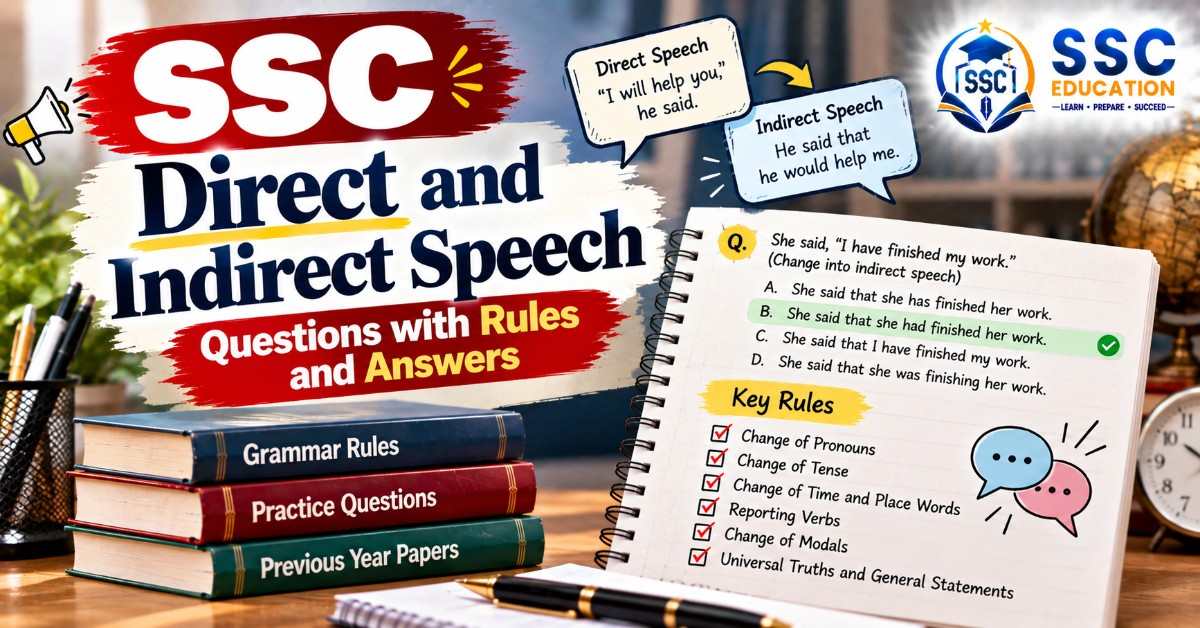
SSC Direct and Indirect Speech Questions with Rules and Answers
Rahul Kumar
SSC Exam Expert & Content Editor
Table of Contents
- 1.Practice Paper at a Glance
- 2.What Are Direct and Indirect Speech? Basic Concept in Simple Words
- 3.Rules and Change Tables for Direct and Indirect Speech
- 4.Set 1: Statements (Q1–Q10)
- 5.Set 2: Questions, Commands and Requests (Q11–Q20)
- 6.Set 3: Exclamations, Wishes and Mixed Questions (Q21–Q30)
- 7.Common Mistakes in Direct and Indirect Speech
- 8.How to Practice These 30 Questions
- 9.Related Topics to Study Next
- 10.Frequently Asked Questions
Learn the rules of direct and indirect speech and practise 30 SSC questions with answers. Covers tense, pronoun and time changes, questions, commands and exclamations for CGL, CHSL, MTS and GD English.
Direct and Indirect Speech (also called Narration) is a regular grammar topic in SSC CGL, CHSL and MTS English papers. You are asked to change a sentence from direct to indirect speech or to pick the correct reported form. The rules are limited and easy to remember once they are written in a table. This practice paper gives you the rules and 30 practice questions with answers and short explanations.
Practice Paper at a Glance
| Detail | Information |
|---|---|
| Topic | Direct and Indirect Speech |
| Total questions | 30 questions in 3 sets |
| Level | Easy to exam level |
| Useful for | SSC CGL, CHSL, MTS, GD, CPO and other government exams |
| Includes | Answers, step-by-step solutions, shortcut tricks and FAQs |
| Time to attempt | 35 to 40 minutes |
What Are Direct and Indirect Speech? Basic Concept in Simple Words
Direct speech gives the exact words of the speaker inside quotation marks: He said, "I am happy." Indirect speech (reported speech) tells what the speaker said without quoting the exact words: He said that he was happy.
- The sentence has two parts: the reporting clause (He said) and the reported clause (the words spoken).
- In indirect speech, quotation marks are removed and a linking word such as that, if, whether is used.
- The tense, pronouns and time or place words may change.
Rules and Change Tables for Direct and Indirect Speech
Tense Changes (When the Reporting Verb Is in the Past)
| Direct speech | Indirect speech |
|---|---|
| Simple present (is, am, are, plays) | Simple past (was, were, played) |
| Present continuous (is playing) | Past continuous (was playing) |
| Present perfect (has played) | Past perfect (had played) |
| Simple past (played) | Past perfect (had played) |
| Past continuous (was playing) | Past perfect continuous (had been playing) |
| Will / shall | Would / should |
| Can / may | Could / might |
Time and Place Changes
| Direct | Indirect |
|---|---|
| now | then |
| today | that day |
| tomorrow | the next day |
| yesterday | the day before |
| last night | the previous night |
| this | that |
| here | there |
| ago | before |
| come | go |
- Pronouns: first person (I, we) changes according to the subject of the reporting verb. Second person (you) changes according to the object. Third person (he, she, they) does not change.
- Universal truths and habits do not change tense: He said, "The sun rises in the east" becomes He said that the sun rises in the east.
- Questions: use "asked" and change to statement order. Use if or whether for yes/no questions and keep the question word (what, where, why) for others.
- Commands and requests: use told, ordered, advised or requested + to + verb. For negatives use "not to".
- Exclamations: use exclaimed with joy or sorrow that.
- Wishes and prayers: use wished or prayed that.
- Suggestions with let us: use proposed or suggested that we should.
Set 1: Statements (Q1–Q10)
Q1. Change into indirect speech: He said, "I am happy."
Answer: He said that he was happy.
Solution: Present tense changes to past tense (am to was) and "I" changes to "he".
Q2. Change into indirect speech: She said, "I like mangoes."
Answer: She said that she liked mangoes.
Solution: Simple present (like) changes to simple past (liked).
Q3. Change into indirect speech: Ravi said, "I have finished my work."
Answer: Ravi said that he had finished his work.
Solution: Present perfect changes to past perfect.
Q4. Change into indirect speech: They said, "We played cricket yesterday."
Answer: They said that they had played cricket the day before.
Trick: Simple past changes to past perfect, and yesterday changes to the day before.
Q5. Change into indirect speech: He said, "I will come tomorrow."
Answer: He said that he would come the next day.
Solution: Will changes to would and tomorrow changes to the next day.
Q6. Change into indirect speech: The teacher said, "The earth moves round the sun."
Answer: The teacher said that the earth moves round the sun.
Trick: This is a universal truth, so the tense does not change.
Q7. Change into indirect speech: She said, "I am reading a book now."
Answer: She said that she was reading a book then.
Solution: Present continuous changes to past continuous and now changes to then.
Q8. Change into indirect speech: He said to me, "I saw you here yesterday."
Answer: He told me that he had seen me there the day before.
Solution: Said to changes to told. Saw changes to had seen. Here changes to there.
Q9. Change into indirect speech: Meena said, "My brother is ill."
Answer: Meena said that her brother was ill.
Solution: My changes to her and is changes to was.
Q10. Change into indirect speech: He said, "I can swim."
Answer: He said that he could swim.
Solution: Can changes to could.
Set 2: Questions, Commands and Requests (Q11–Q20)
Q11. Change into indirect speech: He said to me, "Where do you live?"
Answer: He asked me where I lived.
Solution: A wh-question uses the question word and changes to statement order.
Q12. Change into indirect speech: She said to him, "Are you coming?"
Answer: She asked him if he was coming.
Trick: A yes/no question uses if or whether.
Q13. Change into indirect speech: The teacher said to the boy, "Why are you late?"
Answer: The teacher asked the boy why he was late.
Solution: Keep the question word "why" and use statement order.
Q14. Change into indirect speech: He said to her, "Do you know me?"
Answer: He asked her if she knew him.
Solution: Do you know changes to she knew and me changes to him.
Q15. Change into indirect speech: The father said to his son, "Study hard."
Answer: The father advised his son to study hard.
Solution: The imperative sentence uses advised + to + verb.
Q16. Change into indirect speech: The officer said to the clerk, "Bring the file."
Answer: The officer ordered the clerk to bring the file.
Solution: A command uses ordered + to + verb.
Q17. Change into indirect speech: She said to him, "Please help me."
Answer: She requested him to help her.
Solution: A request uses requested + to + verb.
Q18. Change into indirect speech: He said to me, "Don't make noise."
Answer: He told me not to make noise.
Solution: A negative command uses "not to".
Q19. Change into indirect speech: Mother said to him, "Will you go to the market?"
Answer: Mother asked him if he would go to the market.
Solution: Will changes to would and the question uses if.
Q20. Change into indirect speech: The captain said to the soldiers, "Stand still."
Answer: The captain ordered the soldiers to stand still.
Solution: A command uses ordered + to + verb.
Set 3: Exclamations, Wishes and Mixed Questions (Q21–Q30)
Q21. Change into indirect speech: He said, "Alas! I am ruined."
Answer: He exclaimed with sorrow that he was ruined.
Solution: The word "Alas" shows sorrow, so use exclaimed with sorrow.
Q22. Change into indirect speech: She said, "Hurrah! We have won the match."
Answer: She exclaimed with joy that they had won the match.
Solution: The word "Hurrah" shows joy.
Q23. Change into indirect speech: He said, "What a beautiful flower!"
Answer: He exclaimed that it was a very beautiful flower.
Solution: The exclamation is changed into a statement with "very".
Q24. Change into indirect speech: The saint said to him, "May God bless you."
Answer: The saint prayed that God might bless him.
Solution: A prayer or a wish uses prayed or wished and "might".
Q25. Change into indirect speech: He said to me, "Let us go for a walk."
Answer: He proposed to me that we should go for a walk.
Trick: "Let us" changes to proposed or suggested that we should.
Q26. Change into indirect speech: She said to me, "Can you lend me your pen?"
Answer: She asked me if I could lend her my pen.
Solution: Can changes to could. You changes to I, me changes to her and your changes to my.
Q27. Change into indirect speech: Ravi said to Mohan, "I shall meet you tomorrow."
Answer: Ravi told Mohan that he would meet him the next day.
Solution: Shall changes to would. I changes to he and you changes to him.
Q28. Change into indirect speech: He said, "I was playing cricket."
Answer: He said that he had been playing cricket.
Solution: Past continuous changes to past perfect continuous.
Q29. Change into indirect speech: The boy said to the teacher, "May I come in, sir?"
Answer: The boy respectfully asked the teacher if he might come in.
Solution: May changes to might and the question uses if.
Q30. Change into indirect speech: He said, "I am going to Delhi today."
Answer: He said that he was going to Delhi that day.
Solution: Am going changes to was going and today changes to that day.
Common Mistakes in Direct and Indirect Speech
- Forgetting to change the tense when the reporting verb is in the past.
- Not changing the pronouns according to the rules (first, second and third person).
- Using question word order in the reported clause (it should be statement order).
- Using "that" with a question.
- Missing the change in time and place words (now to then, here to there).
- Changing the tense for a universal truth or a habitual fact.
How to Practice These 30 Questions
- Learn the tense, time and pronoun tables first.
- Identify the type of sentence (statement, question, command, exclamation) before changing it.
- Solve Set 1 in 6 minutes, Set 2 in 8 minutes and Set 3 in 8 minutes.
- Compare your answer with the explanation and note the rule you missed.
- Revise the tables and repeat the paper after a week.
Related Topics to Study Next
- Active and Passive Voice Questions
- Subject-Verb Agreement Questions
- Fill in the Blanks Questions
- SSC Error Detection Questions
Frequently Asked Questions
What is direct and indirect speech?
Direct speech gives the exact words of the speaker in quotation marks. Indirect speech reports what the speaker said without using the exact words.
How many direct and indirect speech questions come in SSC exams?
Generally one or two questions on narration appear in each shift of SSC CGL, CHSL and MTS.
What are the tense changes in indirect speech?
Present changes to past, past changes to past perfect, will changes to would and can changes to could when the reporting verb is in the past tense.
When does the tense not change in indirect speech?
The tense does not change for universal truths, habitual facts or when the reporting verb is in the present or future tense.
How do you change a question into indirect speech?
Use asked, change the question to statement order and use if or whether for yes/no questions or the same question word for wh-questions.
How do you change a command into indirect speech?
Use told, ordered, advised or requested followed by to + verb. For negative commands use "not to".
How do you change an exclamation into indirect speech?
Use exclaimed with joy or sorrow that (or exclaimed that) and change the exclamation into a statement.
How do pronouns change in indirect speech?
The first person changes according to the subject of the reporting verb, the second person changes according to the object, and the third person does not change.
What do now, today and tomorrow change to?
Now changes to then, today to that day and tomorrow to the next day (or the following day).
How should I prepare direct and indirect speech for SSC exams?
Learn the change tables, practise different sentence types daily and solve previous year SSC narration questions.
Rahul Kumar
SSC Exam Expert & Content Editor
Rahul is a senior SSC exam strategist with 8+ years of experience helping aspirants crack CGL, CHSL and MTS exams. He writes in-depth notification breakdowns, exam pattern guides and preparation strategies.