SSC Quadratic Equations Questions with Solutions and Tricks
Rahul Kumar
SSC Exam Expert & Content Editor
Table of Contents
- 1.What Is a Quadratic Equation? Basic Concept in Simple Words
- 2.Formulas and Shortcut Tricks
- 3.Set 1: Finding the Roots (Q1–Q8)
- 4.Set 2: Sum, Product and Discriminant (Q9–Q16)
- 5.Set 3: Applications and Word Problems (Q17–Q24)
- 6.Common Mistakes in Quadratic Equations
- 7.Related Topics to Study Next
- 8.Frequently Asked Questions
Practice 24 SSC quadratic equation questions with answers and solutions. Covers factorisation, sum and product of roots, discriminant, forming equations and word problems for CGL, CHSL and MTS.
Quadratic equations are an important part of SSC algebra and are used in CGL Tier 1 and Tier 2, CHSL and many other exams. Most questions ask you to find the roots, use the sum and product of the roots or find a missing value with the help of the discriminant. If you remember three formulas and practise factorisation, each question takes less than a minute. This practice paper gives you 24 questions with answers and short solutions.
What Is a Quadratic Equation? Basic Concept in Simple Words
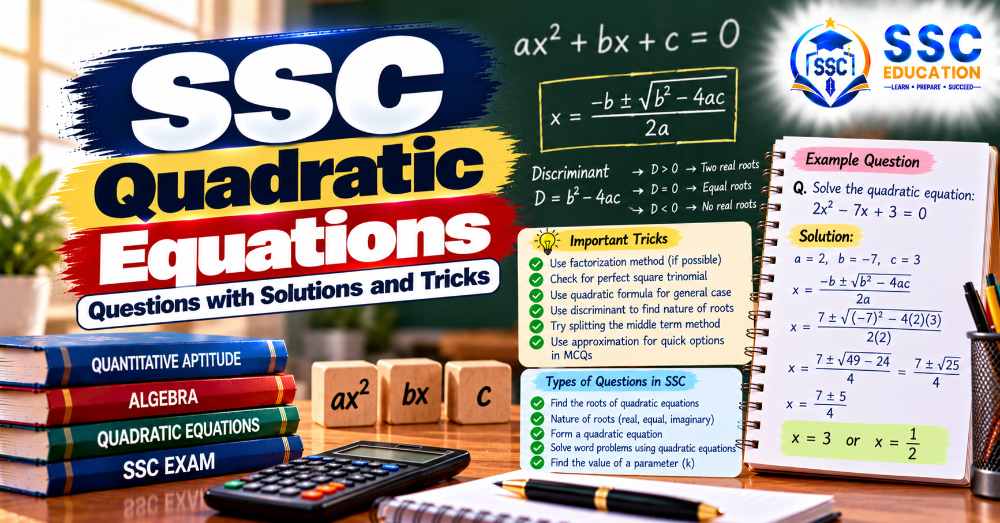
A quadratic equation is an equation of the form ax^2 + bx + c = 0, where a is not zero. It always has two roots (values of x that satisfy the equation). The roots may be real and different, real and equal, or not real at all.
- Factorisation: split the middle term and write the equation as (x - p)(x - q) = 0.
- Formula method: x = (-b plus or minus the square root of D) / 2a, where D = b^2 - 4ac.
- Nature of roots depends on the discriminant D.
Formulas and Shortcut Tricks
- Sum of roots = -b / a and product of roots = c / a.
- Discriminant D = b^2 - 4ac. If D > 0 the roots are real and different, if D = 0 they are real and equal, and if D < 0 there are no real roots.
- Equation from roots p and q: x^2 - (p + q)x + pq = 0.
- Useful identity: p^2 + q^2 = (p + q)^2 - 2pq.
- Equal roots condition: b^2 = 4ac.
- Check by substitution: put the root back in the equation to confirm the answer.
Set 1: Finding the Roots (Q1–Q8)
Q1. Find the roots of x^2 - 5x + 6 = 0.
Answer: 2 and 3
Solution: Factors: (x - 2)(x - 3) = 0.
Q2. Find the roots of x^2 - 7x + 12 = 0.
Answer: 3 and 4
Solution: (x - 3)(x - 4) = 0.
Q3. Find the roots of x^2 + 5x + 6 = 0.
Answer: -2 and -3
Solution: (x + 2)(x + 3) = 0.
Q4. Find the roots of x^2 - 9 = 0.
Answer: 3 and -3
Solution: x^2 = 9, so x = plus or minus 3.
Q5. Find the roots of x^2 - 4x = 0.
Answer: 0 and 4
Solution: x(x - 4) = 0.
Q6. Find the roots of 2x^2 - 5x + 2 = 0.
Answer: 2 and 1/2
Solution: 2x^2 - 4x - x + 2 = 2x(x - 2) - 1(x - 2) = (2x - 1)(x - 2).
Q7. Find the roots of x^2 + 2x - 15 = 0.
Answer: 3 and -5
Solution: (x + 5)(x - 3) = 0.
Q8. Find the roots of x^2 - 10x + 25 = 0.
Answer: 5 (equal roots)
Solution: (x - 5)^2 = 0, so both roots are 5.
Set 2: Sum, Product and Discriminant (Q9–Q16)
Q9. Find the sum of the roots of x^2 - 8x + 15 = 0.
Answer: 8
Trick: Sum = -b/a = 8.
Q10. Find the product of the roots of 2x^2 + 3x - 5 = 0.
Answer: -5/2
Trick: Product = c/a = -5/2.
Q11. Find the sum and product of the roots of 3x^2 - 6x + 2 = 0.
Answer: Sum = 2 and product = 2/3
Solution: Sum = 6/3 = 2 and product = 2/3.
Q12. Find the discriminant of x^2 - 6x + 9 = 0 and the nature of the roots.
Answer: D = 0, roots are real and equal
Solution: D = 36 - 36 = 0.
Q13. What is the nature of the roots of x^2 + x + 1 = 0?
Answer: No real roots
Solution: D = 1 - 4 = -3, which is negative.
Q14. What is the nature of the roots of x^2 - 5x + 4 = 0?
Answer: Real and different (1 and 4)
Solution: D = 25 - 16 = 9, which is positive.
Q15. For what value of k does x^2 - 4x + k = 0 have equal roots?
Answer: k = 4
Trick: D = 16 - 4k = 0, so k = 4.
Q16. For what values of k does x^2 + kx + 9 = 0 have equal roots?
Answer: k = 6 or -6
Solution: D = k^2 - 36 = 0, so k = plus or minus 6.
Set 3: Applications and Word Problems (Q17–Q24)
Q17. One root of x^2 - 7x + k = 0 is 3. Find k and the other root.
Answer: k = 12, other root = 4
Solution: 9 - 21 + k = 0 gives k = 12. Sum of roots is 7, so the other root = 4.
Q18. If the roots of x^2 - 5x + 6 = 0 are p and q, find p^2 + q^2.
Answer: 13
Trick: p + q = 5 and pq = 6. p^2 + q^2 = 25 - 12 = 13.
Q19. Form the quadratic equation whose roots are 2 and 5.
Answer: x^2 - 7x + 10 = 0
Solution: Sum = 7 and product = 10.
Q20. Form the quadratic equation whose roots are 3 and -4.
Answer: x^2 + x - 12 = 0
Solution: Sum = -1 and product = -12, so x^2 - (-1)x + (-12) = 0.
Q21. The sum of two numbers is 10 and their product is 21. Find the numbers.
Answer: 3 and 7
Solution: They are the roots of x^2 - 10x + 21 = 0, which gives (x - 3)(x - 7) = 0.
Q22. The product of two consecutive positive integers is 56. Find them.
Answer: 7 and 8
Solution: x(x + 1) = 56 gives x^2 + x - 56 = 0, so x = 7.
Q23. The area of a rectangle is 48 sq cm and its length is 2 cm more than its breadth. Find the dimensions.
Answer: Breadth = 6 cm and length = 8 cm
Solution: b(b + 2) = 48 gives b^2 + 2b - 48 = 0, so (b + 8)(b - 6) = 0 and b = 6.
Q24. If x + 1/x = 2, find x.
Answer: x = 1
Solution: x^2 - 2x + 1 = 0, so (x - 1)^2 = 0.
Common Mistakes in Quadratic Equations
- Forgetting to move all terms to one side before factorising.
- Using the wrong sign for the sum of the roots (it is -b/a).
- Ignoring the negative root in word problems when it is allowed, or including it when length cannot be negative.
- Making an error in D = b^2 - 4ac, especially with negative values of b or c.
- Not checking the roots by substitution.
- Cancelling a common variable and losing a root (for example in x^2 = 4x).
Related Topics to Study Next
- SSC Algebra Questions
- SSC Simplification Questions
- Surds and Indices Questions
- Fractions and Decimals Questions
Frequently Asked Questions
What is a quadratic equation?
A quadratic equation is a second-degree equation of the form ax^2 + bx + c = 0, where a is not zero. It has two roots.
What is the formula to solve a quadratic equation?
The quadratic formula is x = (-b plus or minus the square root of (b^2 - 4ac)) / 2a.
What is the discriminant?
The discriminant is D = b^2 - 4ac. It tells whether the roots are real and different, real and equal or not real.
What is the sum and product of roots?
For ax^2 + bx + c = 0, the sum of the roots is -b/a and the product of the roots is c/a.
How do you find the nature of roots?
Calculate D. If D is positive, the roots are real and different. If D is zero, they are equal. If D is negative, there are no real roots.
How do you form a quadratic equation from its roots?
Use x^2 - (sum of roots)x + (product of roots) = 0.
What is the condition for equal roots?
The roots are equal when b^2 = 4ac, that is, when D = 0.
How many quadratic equation questions come in SSC exams?
Usually one or two questions come in CGL Tier 1 and Tier 2 under algebra. In some exams they appear in the form of word problems.
Which is faster: factorisation or the formula?
Factorisation is faster when the numbers are small. Use the formula when the roots are not whole numbers.
Can a quadratic equation have only one root?
It has two roots always. When D = 0, both roots are equal, so it looks like one root.
How do I solve word problems on quadratic equations?
Assume the unknown as x, form an equation from the given condition, simplify it into ax^2 + bx + c = 0 and solve. Reject values that do not make sense.
How should I prepare quadratic equations for SSC exams?
Learn the formulas, practise factorisation, solve word problems and practise previous year algebra questions.
Rahul Kumar
SSC Exam Expert & Content Editor
Rahul is a senior SSC exam strategist with 8+ years of experience helping aspirants crack CGL, CHSL and MTS exams. He writes in-depth notification breakdowns, exam pattern guides and preparation strategies.