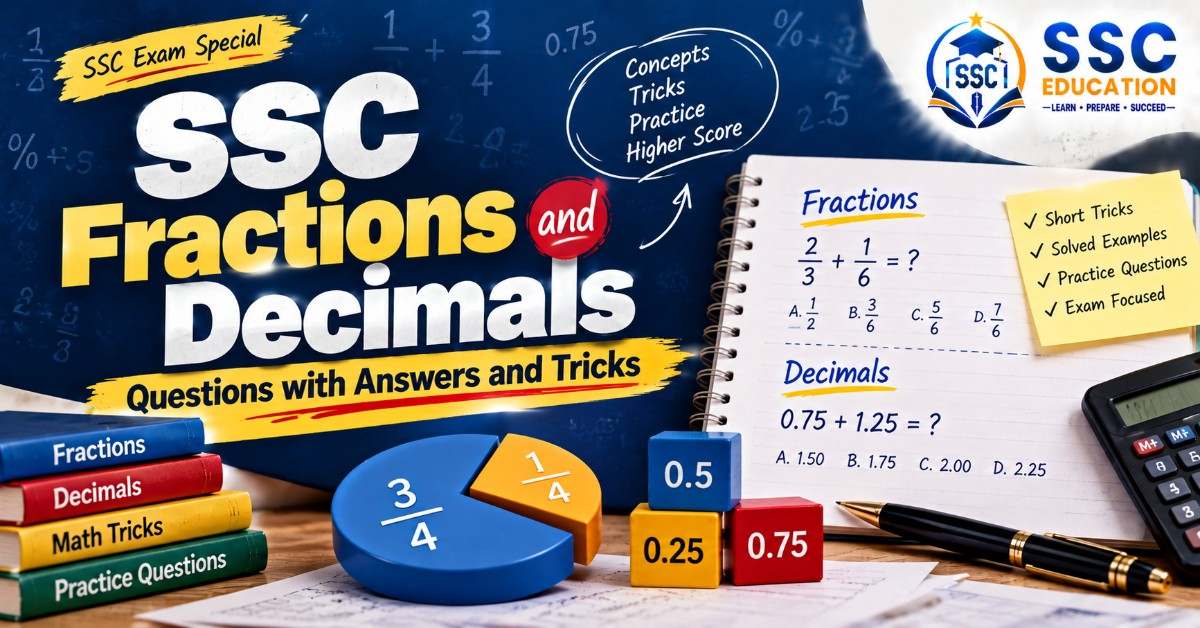
SSC Fractions and Decimals Questions with Answers and Tricks
Rahul Kumar
SSC Exam Expert & Content Editor
Table of Contents
- 1.Practice Paper at a Glance
- 2.What Are Fractions and Decimals? Basic Concept in Simple Words
- 3.Fraction-Decimal Table and Shortcut Tricks
- 4.Set 1: Basic Operations on Fractions and Decimals (Q1–Q10)
- 5.Set 2: Recurring Decimals, Comparison and Word Problems (Q11–Q20)
- 6.Set 3: Exam-Level Questions (Q21–Q30)
- 7.Common Mistakes in Fractions and Decimals
- 8.How to Practice These 30 Questions
- 9.Related Topics to Study Next
- 10.Frequently Asked Questions
Practice 30 SSC fractions and decimals questions with answers and short solutions. Covers operations, comparison, recurring decimals, word problems and simplification tricks for CGL, CHSL, MTS and GD.
Fractions and Decimals are the base of every calculation in SSC Quantitative Aptitude: simplification, percentage, data interpretation and profit and loss all use them. If you are comfortable with fractions and decimals, you will save a lot of time across the paper. This practice paper gives you 30 questions with answers and short solutions, along with the fraction-decimal table and the key rules for recurring decimals.
Practice Paper at a Glance
| Detail | Information |
|---|---|
| Topic | Fractions and Decimals |
| Total questions | 30 questions in 3 sets |
| Level | Easy to exam level |
| Useful for | SSC CGL, CHSL, MTS, GD, CPO and other government exams |
| Includes | Answers, step-by-step solutions, shortcut tricks and FAQs |
| Time to attempt | 35 to 40 minutes |
What Are Fractions and Decimals? Basic Concept in Simple Words
A fraction shows a part of a whole, written as numerator / denominator. A decimal is another way to write a fraction using a decimal point, such as 0.5 for 1/2.
- Proper fraction: numerator is smaller than the denominator (3/5). Improper fraction: numerator is greater (7/4). Mixed fraction: a whole number with a fraction (1 3/4).
- Terminating decimal ends after some digits (0.25). Recurring decimal repeats digits forever (0.333...).
- Every fraction can be written as a decimal, and every terminating or recurring decimal can be written as a fraction.
Fraction-Decimal Table and Shortcut Tricks
| Fraction | Decimal | Percentage |
|---|---|---|
| 1/2 | 0.5 | 50% |
| 1/3 | 0.333... | 33.33% |
| 1/4 | 0.25 | 25% |
| 1/5 | 0.2 | 20% |
| 1/6 | 0.1666... | 16.67% |
| 1/8 | 0.125 | 12.5% |
| 3/8 | 0.375 | 37.5% |
| 5/8 | 0.625 | 62.5% |
| 7/8 | 0.875 | 87.5% |
| 1/9 | 0.111... | 11.11% |
| 1/11 | 0.0909... | 9.09% |
- Adding fractions: take the LCM of the denominators.
- Dividing by a fraction: multiply by its reciprocal.
- Comparing fractions: convert to decimals or cross-multiply (a/b > c/d if ad > bc).
- Pure recurring decimal 0.abab... = ab / 99. For example, 0.4545... = 45/99 = 5/11.
- Mixed recurring decimal 0.1666...: (all digits - non-repeating digits) / (9s for repeating digits and 0s for non-repeating). Here (16 - 1)/90 = 1/6.
- Decimal multiplication: multiply as whole numbers and count the total decimal places. Decimal division: shift the decimal point in both numbers by the same places.
- Of means multiply: 2/3 of 3/4 of 120 = 2/3 x 3/4 x 120.
- Fraction of a number increased or decreased: n + n/5 = 6n/5.
Set 1: Basic Operations on Fractions and Decimals (Q1–Q10)
Q1. Find the value of 3/4 + 2/5.
Answer: 1 3/20 (23/20)
Solution: LCM = 20. 15/20 + 8/20 = 23/20 = 1 3/20.
Q2. Find the value of 5/6 - 1/3.
Answer: 1/2
Solution: 5/6 - 2/6 = 3/6 = 1/2.
Q3. Find the value of 2/3 x 9/10.
Answer: 3/5
Solution: (2 x 9) / (3 x 10) = 18/30 = 3/5.
Q4. Find the value of 7/8 divided by 7/16.
Answer: 2
Solution: 7/8 x 16/7 = 2.
Q5. Which is the largest among 2/3, 3/4, 5/6 and 7/9?
Answer: 5/6
Trick: Decimals: 0.667, 0.75, 0.833 and 0.778. The largest is 5/6.
Q6. Convert 0.375 into a fraction.
Answer: 3/8
Solution: 0.375 = 375/1,000 = 3/8.
Q7. Find the value of 0.125 + 0.25 + 0.5.
Answer: 0.875
Solution: 0.125 + 0.25 + 0.5 = 0.875.
Q8. Find the value of 1.2 x 0.5.
Answer: 0.6
Solution: 12 x 5 = 60. With two decimal places in total, 0.6.
Q9. Find the value of 4.5 divided by 0.9.
Answer: 5
Solution: Shift the decimal point: 45 / 9 = 5.
Q10. Find the value of 0.0036 divided by 0.06.
Answer: 0.06
Solution: 36 / 600 = 0.06.
Set 2: Recurring Decimals, Comparison and Word Problems (Q11–Q20)
Q11. Express 0.333... as a fraction.
Answer: 1/3
Solution: 0.333... = 3/9 = 1/3.
Q12. Express 0.4545... as a fraction in the simplest form.
Answer: 5/11
Trick: 0.4545... = 45/99 = 5/11.
Q13. Express 0.1666... as a fraction.
Answer: 1/6
Trick: (16 - 1) / 90 = 15/90 = 1/6.
Q14. Arrange 3/5, 5/8 and 7/12 in ascending order.
Answer: 7/12, 3/5, 5/8
Solution: Decimals: 0.6, 0.625 and 0.583. Ascending order is 0.583, 0.6, 0.625.
Q15. Find the value of (3/4 of 80) - (2/5 of 50).
Answer: 40
Solution: 3/4 of 80 = 60 and 2/5 of 50 = 20. 60 - 20 = 40.
Q16. Find the value of 1/2 + 1/4 + 1/8 + 1/16.
Answer: 15/16
Solution: 8/16 + 4/16 + 2/16 + 1/16 = 15/16.
Q17. A man spends 3/8 of his salary on rent and 1/4 on food. What fraction of the salary is left?
Answer: 3/8
Solution: Spent = 3/8 + 2/8 = 5/8. Left = 1 - 5/8 = 3/8.
Q18. Find the value of (0.2)^2 + (0.3)^2.
Answer: 0.13
Solution: 0.04 + 0.09 = 0.13.
Q19. Find the value of 0.5 x 0.05 x 0.005.
Answer: 0.000125
Solution: 5 x 5 x 5 = 125 with 6 decimal places, so 0.000125.
Q20. Find the value of 2/3 of 3/4 of 120.
Answer: 60
Solution: 3/4 of 120 = 90. 2/3 of 90 = 60.
Set 3: Exam-Level Questions (Q21–Q30)
Q21. If 3/5 of a number is 45, find the number.
Answer: 75
Solution: Number = 45 x 5/3 = 75.
Q22. A number increased by 1/5 of itself gives 72. Find the number.
Answer: 60
Solution: n x 6/5 = 72, so n = 72 x 5/6 = 60.
Q23. The sum of two fractions is 11/12 and one of them is 1/3. Find the other.
Answer: 7/12
Solution: 11/12 - 4/12 = 7/12.
Q24. Find the value of (1/2 + 1/3) divided by (1/2 - 1/3).
Answer: 5
Trick: (5/6) / (1/6) = 5.
Q25. Find the value of (0.6^3 + 0.4^3) / (0.6^2 - 0.6 x 0.4 + 0.4^2).
Answer: 1
Trick: Using a^3 + b^3 = (a + b)(a^2 - ab + b^2), the result is a + b = 0.6 + 0.4 = 1.
Q26. Find the value of 0.777... + 0.222...
Answer: 1
Solution: 7/9 + 2/9 = 9/9 = 1.
Q27. Round off 3.14159 to 3 decimal places.
Answer: 3.142
Solution: The fourth decimal digit is 5, so round up: 3.142.
Q28. Find the average of 0.5, 0.25 and 0.75.
Answer: 0.5
Solution: Sum = 1.5. Average = 1.5 / 3 = 0.5.
Q29. Find the value of 0.12 x 0.003.
Answer: 0.00036
Solution: 12 x 3 = 36 with 5 decimal places in total, so 0.00036.
Q30. 7/8 of a number is 14 more than 3/4 of the same number. Find the number.
Answer: 112
Solution: (7/8 - 6/8) x n = 14, so n / 8 = 14 and n = 112.
Common Mistakes in Fractions and Decimals
- Adding numerators and denominators separately (1/2 + 1/3 is not 2/5).
- Forgetting to take the reciprocal while dividing fractions.
- Counting the wrong number of decimal places after multiplying decimals.
- Not converting mixed fractions into improper fractions before multiplying.
- Reducing a fraction incorrectly by cancelling terms that are added.
- Comparing fractions only by their denominators.
How to Practice These 30 Questions
- Memorise the fraction-decimal table and percentage values.
- Solve Set 1 in 6 minutes to build calculation speed.
- In Set 2, practise converting recurring decimals into fractions.
- In Set 3, use the algebra identities wherever the pattern matches.
- Revise your mistakes and repeat the paper after one week.
Related Topics to Study Next
- Surds and Indices Questions
- SSC Simplification Questions
- SSC Percentage Questions
- Number System Questions
Frequently Asked Questions
What is the difference between a fraction and a decimal?
A fraction shows a part of a whole as numerator / denominator, while a decimal shows the same part using a decimal point, such as 3/4 = 0.75.
How do you convert a recurring decimal into a fraction?
For 0.ab repeating, write ab / 99. For a mixed recurring decimal, subtract the non-repeating digits from the full digits and divide by 9s for the repeating part and 0s for the non-repeating part.
How do you compare fractions quickly?
Convert them into decimals, or cross-multiply: a/b is greater than c/d if a x d is greater than b x c.
How do you add and subtract fractions?
Find the LCM of the denominators, convert each fraction to that denominator and then add or subtract the numerators.
How do you divide by a fraction?
Multiply by the reciprocal of the fraction you are dividing by. For example, 7/8 divided by 7/16 = 7/8 x 16/7 = 2.
How do you multiply decimals?
Ignore the decimal points, multiply as whole numbers and put the decimal point so that the answer has as many decimal places as the two numbers together.
Which fraction-decimal values should I memorise?
Memorise 1/2 to 1/12 as decimals and percentages (1/8 = 0.125, 1/6 = 0.1666..., 1/9 = 0.111...). This is useful in percentage and DI.
What does "of" mean in fraction questions?
"Of" means multiplication. For example, 2/3 of 90 = 2/3 x 90 = 60.
How many fraction and decimal questions come in SSC exams?
Fractions and decimals are used in simplification, percentage and DI. Direct questions are one or two, but the chapter supports many other topics.
How should I prepare fractions and decimals for SSC exams?
Practise daily calculations, learn the table and the shortcuts for recurring decimals, and solve simplification sets regularly.
Rahul Kumar
SSC Exam Expert & Content Editor
Rahul is a senior SSC exam strategist with 8+ years of experience helping aspirants crack CGL, CHSL and MTS exams. He writes in-depth notification breakdowns, exam pattern guides and preparation strategies.