SSC Surds and Indices Questions with Solutions and Formulas
Rahul Kumar
SSC Exam Expert & Content Editor
Table of Contents
- 1.Practice Paper at a Glance
- 2.What Are Surds and Indices? Basic Concept in Simple Words
- 3.Laws of Indices, Surd Rules and Shortcut Tricks
- 4.Set 1: Laws of Indices and Basic Surds (Q1–Q10)
- 5.Set 2: Rationalisation, Equations and Simplification (Q11–Q20)
- 6.Set 3: Exam-Level Surds and Indices Questions (Q21–Q30)
- 7.Common Mistakes in Surds and Indices
- 8.How to Practice These 30 Questions
- 9.Related Topics to Study Next
- 10.Frequently Asked Questions
Practice 30 SSC surds and indices questions with answers, laws of indices and rationalisation formulas. Includes simplification, comparison and equation problems for CGL, CHSL, MTS and GD.
Surds and Indices is a short but important chapter that supports algebra, simplification and many other topics in SSC Quantitative Aptitude. Questions on laws of indices, simplification of surds and rationalisation appear in CGL, CHSL and MTS papers every year. This practice paper gives you the key laws and 30 questions with answers and short solutions.
Practice Paper at a Glance
| Detail | Information |
|---|---|
| Topic | Surds and Indices |
| Total questions | 30 questions in 3 sets |
| Level | Easy to exam level |
| Useful for | SSC CGL, CHSL, MTS, GD, CPO and other government exams |
| Includes | Answers, step-by-step solutions, shortcut tricks and FAQs |
| Time to attempt | 35 to 40 minutes |
What Are Surds and Indices? Basic Concept in Simple Words
Indices (also called powers or exponents) tell how many times a number is multiplied by itself. In a^n, a is the base and n is the index. A surd is an irrational root of a number, such as the square root of 2 or the cube root of 5, that cannot be written as an exact fraction.
- In 2^5, the base is 2 and the index is 5, so the value is 2 x 2 x 2 x 2 x 2 = 32.
- A root is written as a power: the square root of a = a^(1/2) and the cube root of a = a^(1/3).
- The square root of 4 is not a surd because it equals 2, but the square root of 2 is a surd.
Laws of Indices, Surd Rules and Shortcut Tricks
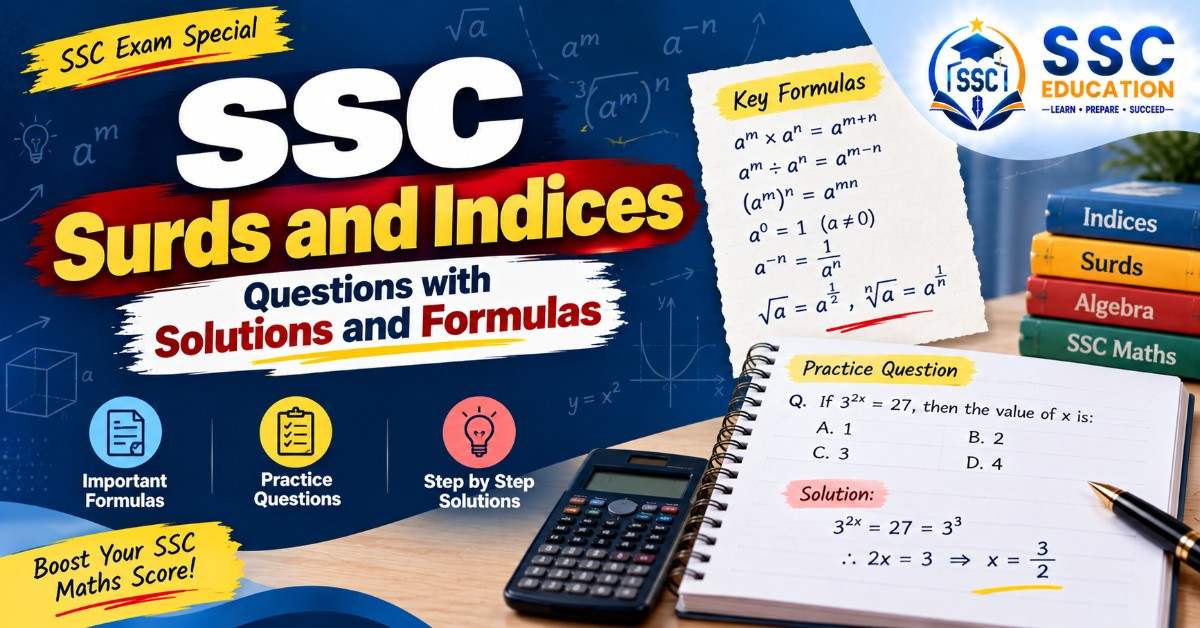
- a^m x a^n = a^(m + n) and a^m / a^n = a^(m - n).
- (a^m)^n = a^(mn), (ab)^n = a^n x b^n and (a/b)^n = a^n / b^n.
- a^0 = 1 (for a not zero) and a^(-n) = 1 / a^n.
- a^(m/n) = the nth root of a^m. For example, 27^(2/3) = 3^2 = 9.
- Same base on both sides: if a^x = a^y, then x = y.
- Surd rules: root a x root b = root (ab), root a / root b = root (a/b) and (root a)^2 = a.
- Rationalisation: 1 / (root a + root b) = (root a - root b) / (a - b) and 1 / (root a - root b) = (root a + root b) / (a - b).
- (a + b)(a - b) = a^2 - b^2 helps to remove surds from the denominator.
- Square root of a + 2 root b: find two numbers x and y with x + y = a and xy = b. Then the answer is root x + root y.
- Comparing surds: make the indices equal by taking the LCM and compare the numbers.
Set 1: Laws of Indices and Basic Surds (Q1–Q10)
Q1. Find the value of 2^5 x 2^3.
Answer: 256
Solution: 2^(5 + 3) = 2^8 = 256.
Q2. Find the value of 3^7 / 3^4.
Answer: 27
Solution: 3^(7 - 4) = 3^3 = 27.
Q3. Find the value of (5^2)^3.
Answer: 15,625
Solution: 5^(2 x 3) = 5^6 = 15,625.
Q4. Find the value of 7^0 + 2^(-1).
Answer: 3/2
Solution: 7^0 = 1 and 2^(-1) = 1/2. Sum = 3/2.
Q5. Find the value of 16^(1/2).
Answer: 4
Solution: The square root of 16 is 4.
Q6. Find the value of 27^(2/3).
Answer: 9
Trick: 27^(1/3) = 3 and 3^2 = 9.
Q7. Find the value of 8^(-2/3).
Answer: 1/4
Trick: 8^(1/3) = 2, so 8^(2/3) = 4 and 8^(-2/3) = 1/4.
Q8. Simplify the square root of 50.
Answer: 5 root 2
Solution: Root 50 = root (25 x 2) = 5 root 2.
Q9. Find the value of root 3 x root 12.
Answer: 6
Solution: Root 36 = 6.
Q10. Find the value of root 72 / root 2.
Answer: 6
Solution: Root (72/2) = root 36 = 6.
Set 2: Rationalisation, Equations and Simplification (Q11–Q20)
Q11. Rationalise: 1 / (root 3 + root 2).
Answer: Root 3 - root 2
Trick: Multiply by (root 3 - root 2). The denominator is 3 - 2 = 1.
Q12. Find the value of (root 5 + 2)(root 5 - 2).
Answer: 1
Solution: Using (a + b)(a - b) = a^2 - b^2: 5 - 4 = 1.
Q13. If 2^x = 32, find x.
Answer: 5
Solution: 32 = 2^5, so x = 5.
Q14. If 3^(x + 1) = 81, find x.
Answer: 3
Solution: 81 = 3^4. So x + 1 = 4 and x = 3.
Q15. Simplify (2^3 x 2^4) / 2^5.
Answer: 4
Solution: 2^(3 + 4 - 5) = 2^2 = 4.
Q16. Which is greater: root 2 or the cube root of 3?
Answer: Cube root of 3
Trick: Root 2 = 2^(3/6) = 8^(1/6) and cube root of 3 = 3^(2/6) = 9^(1/6). Since 9 > 8, the cube root of 3 is greater.
Q17. Find the value of the square root of (7 + 2 root 10).
Answer: Root 5 + root 2
Trick: Find x + y = 7 and xy = 10, so x = 5 and y = 2. The answer is root 5 + root 2.
Q18. Find the value of (root 3 + 1)^2.
Answer: 4 + 2 root 3
Solution: (root 3)^2 + 1 + 2 root 3 = 3 + 1 + 2 root 3 = 4 + 2 root 3.
Q19. Rationalise: 1 / (root 7 - root 6).
Answer: Root 7 + root 6
Solution: Multiply by (root 7 + root 6). The denominator is 7 - 6 = 1.
Q20. If 5^(2x) = 625, find x.
Answer: 2
Solution: 625 = 5^4. So 2x = 4 and x = 2.
Set 3: Exam-Level Surds and Indices Questions (Q21–Q30)
Q21. If x = 3 + 2 root 2, find the value of x + 1/x.
Answer: 6
Trick: 1/x = 3 - 2 root 2 (rationalise). Sum = 6.
Q22. Find the value of the square root of 0.0016.
Answer: 0.04
Solution: 0.0016 = 16/10,000. Root = 4/100 = 0.04.
Q23. Find the value of 81^(-1/4).
Answer: 1/3
Solution: 81^(1/4) = 3, so the answer is 1/3.
Q24. Find the value of (2^2)^3 x 2^(-4).
Answer: 4
Solution: 2^6 x 2^(-4) = 2^2 = 4.
Q25. Given that root 3 = 1.732, find the value of 1/root 3 correct to 3 decimal places.
Answer: 0.577
Solution: 1/root 3 = root 3 / 3 = 1.732 / 3 = 0.577.
Q26. Find the value of the square root of (12 + root (12 + root (12 + ...))).
Answer: 4
Trick: Let x = the expression. x^2 = 12 + x, so x^2 - x - 12 = 0 and x = 4.
Q27. If 2^a = 4^b, find a / b.
Answer: 2
Solution: 4^b = 2^(2b), so a = 2b and a / b = 2.
Q28. Find the value of 25^(3/2).
Answer: 125
Solution: 25^(1/2) = 5 and 5^3 = 125.
Q29. Find the value of (root 2 + root 3)^2 + (root 2 - root 3)^2.
Answer: 10
Trick: Sum = 2(a^2 + b^2) = 2(2 + 3) = 10.
Q30. Find the value of 1/(2 + root 3) + 1/(2 - root 3).
Answer: 4
Trick: Sum = (2 - root 3 + 2 + root 3) / (4 - 3) = 4.
Common Mistakes in Surds and Indices
- Adding the indices when multiplying different bases.
- Forgetting that a negative index means a reciprocal.
- Making errors in rationalisation (changing the sign in the wrong place).
- Writing root (a + b) = root a + root b, which is wrong.
- Not simplifying surds fully before adding or subtracting them.
- Not making the base the same before comparing indices.
How to Practice These 30 Questions
- Learn the laws of indices and the surd rules and write them in one page.
- Memorise squares up to 30 and cubes up to 12.
- Solve Set 1 in 6 minutes, Set 2 in 10 minutes and Set 3 in 12 minutes.
- Use the (a + b)(a - b) shortcut wherever possible.
- Revise your mistakes after one day and repeat the paper after a week.
Related Topics to Study Next
- Number System Questions
- SSC Algebra Questions
- SSC Simplification Questions
- Fractions and Decimals Questions
Frequently Asked Questions
What are surds and indices?
Indices are powers (like 2^5) and surds are irrational roots (like root 2). Together they form a chapter that deals with exponents, roots and their simplification.
What are the laws of indices?
The main laws are a^m x a^n = a^(m + n), a^m / a^n = a^(m - n), (a^m)^n = a^(mn), a^0 = 1 and a^(-n) = 1 / a^n.
What is a surd?
A surd is a root of a number that cannot be written as an exact fraction, such as root 2 or the cube root of 5. Roots such as root 4 are not surds.
What is rationalisation?
Rationalisation is removing the surd from the denominator by multiplying the numerator and the denominator by the conjugate, for example (root a - root b) for (root a + root b).
How do you compare two surds?
Convert both to the same index by taking the LCM of the indices, then compare the numbers under the root. For example root 2 and cube root 3 become 8^(1/6) and 9^(1/6).
How do you find the square root of a + 2 root b?
Find two numbers x and y such that x + y = a and xy = b. Then the square root is root x + root y.
How many surds and indices questions come in SSC exams?
Usually one or two questions come directly from surds and indices, and the concept is also used in algebra and simplification.
What is the value of any number raised to zero?
Any non-zero number raised to the power zero is 1.
How do I solve equations with indices?
Make the bases the same on both sides and equate the indices. For example, 3^(x + 1) = 81 = 3^4 gives x + 1 = 4.
How should I prepare surds and indices for SSC exams?
Learn the laws and rules, practise rationalisation and comparison questions, memorise squares and cubes and solve mixed simplification sets.
Rahul Kumar
SSC Exam Expert & Content Editor
Rahul is a senior SSC exam strategist with 8+ years of experience helping aspirants crack CGL, CHSL and MTS exams. He writes in-depth notification breakdowns, exam pattern guides and preparation strategies.