SSC Simple Interest and Compound Interest Questions with Solutions
Rahul Kumar
SSC Exam Expert & Content Editor
Table of Contents
- 1.Practice Paper at a Glance
- 2.What Are Simple Interest and Compound Interest? Basic Concept in Simple Words
- 3.Formulas and Shortcut Tricks for SSC SI and CI
- 4.Set 1: Simple Interest Questions (Q1–Q10)
- 5.Set 2: Compound Interest Questions (Q11–Q20)
- 6.Set 3: Mixed SI and CI Questions (Q21–Q30)
- 7.Common Mistakes in Simple and Compound Interest
- 8.How to Practice These 30 Questions
- 9.Related Topics to Study Next
- 10.Frequently Asked Questions
Practice 30 SSC simple interest and compound interest questions with answers, formulas and quick solutions. Includes CI-SI difference, half-yearly interest and doubling problems for CGL, CHSL, MTS and GD.
Simple Interest (SI) and Compound Interest (CI) are steady scoring topics in SSC Quantitative Aptitude. Most questions are direct formula applications, and a few small shortcuts (like the CI-SI difference formula) can save you a full minute. This practice paper gives you 30 questions with answers and quick solutions, starting from basic SI problems and moving to compound interest and mixed questions.
Practice Paper at a Glance
| Detail | Information |
|---|---|
| Topic | Simple Interest and Compound Interest |
| Total questions | 30 questions in 3 sets |
| Level | Easy to exam level |
| Useful for | SSC CGL, CHSL, MTS, GD, CPO and other government exams |
| Includes | Answers, step-by-step solutions, shortcut tricks and FAQs |
| Time to attempt | 35 to 40 minutes |
What Are Simple Interest and Compound Interest? Basic Concept in Simple Words
When you lend or deposit money, the extra money you receive is interest. The original money is the principal (P), the yearly percentage is the rate (R) and the duration is the time (T).
- Simple interest is calculated on the original principal every year, so it is the same each year.
- Compound interest is calculated on the principal plus the interest already earned, so it grows faster every year.
- Amount (A) = Principal + Interest.
Formulas and Shortcut Tricks for SSC SI and CI
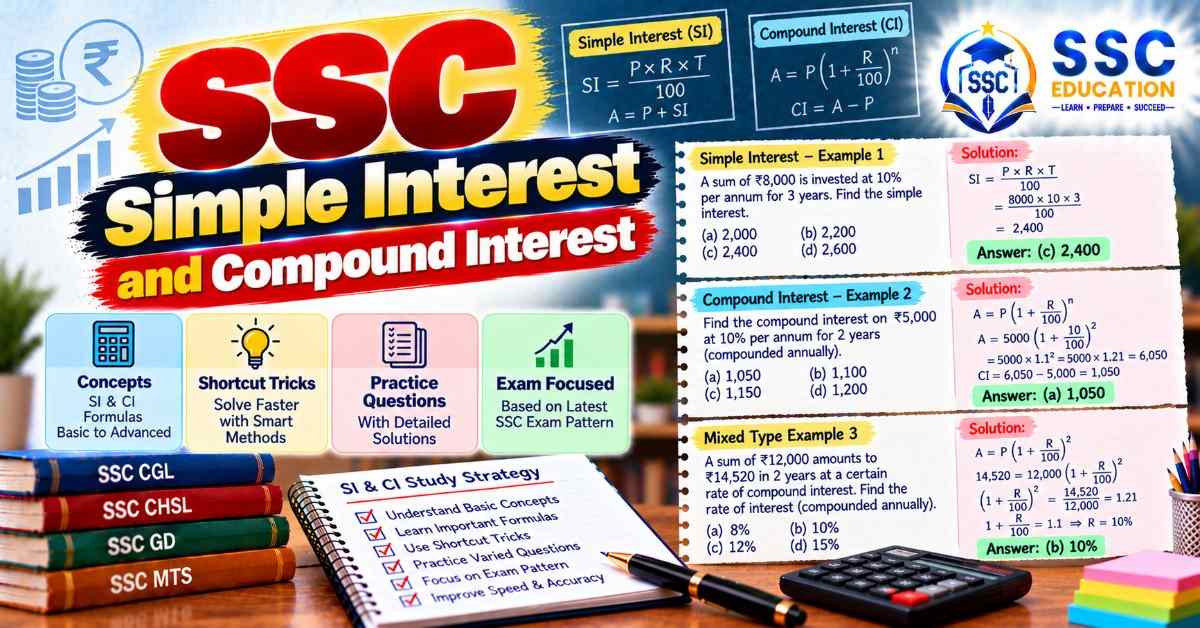
- Simple interest = (P x R x T) / 100 and Amount = P + SI.
- Compound interest amount A = P (1 + R/100)^n and CI = A - P.
- Half-yearly: use rate R/2 and time 2n. Quarterly: use rate R/4 and time 4n.
- CI - SI for 2 years = P (R/100)^2.
- CI - SI for 3 years = P (R/100)^2 (3 + R/100).
- Doubling or tripling in SI: if a sum doubles in n years, R = 100/n percent. If it becomes k times, R = (k - 1) x 100 / n.
- In CI, if a sum becomes k times in n years, it becomes k^m times in m x n years.
- Two years CI at x percent is the same as two successive increases of x percent: 10 percent twice is 21 percent.
- Memorise: 1.1^2 = 1.21, 1.1^3 = 1.331, 1.05^2 = 1.1025, 1.05^3 = 1.157625, 1.2^2 = 1.44 and 1.04^2 = 1.0816.
Set 1: Simple Interest Questions (Q1–Q10)
Q1. Find the simple interest on Rs 5,000 at 8% per annum for 3 years.
Answer: Rs 1,200
Solution: SI = (5,000 x 8 x 3) / 100 = Rs 1,200.
Q2. What principal will earn Rs 600 as simple interest in 4 years at 5% per annum?
Answer: Rs 3,000
Solution: P = (SI x 100) / (R x T) = (600 x 100) / (5 x 4) = Rs 3,000.
Q3. At what rate of simple interest will Rs 2,000 become Rs 2,600 in 3 years?
Answer: 10% per annum
Solution: SI = 600. R = (600 x 100) / (2,000 x 3) = 10%.
Q4. In how many years will Rs 4,000 earn Rs 960 as simple interest at 6% per annum?
Answer: 4 years
Solution: T = (960 x 100) / (4,000 x 6) = 4 years.
Q5. Find the amount on Rs 8,000 at 7.5% simple interest for 2 years.
Answer: Rs 9,200
Solution: SI = (8,000 x 7.5 x 2) / 100 = 1,200. Amount = 8,000 + 1,200 = Rs 9,200.
Q6. A sum of money doubles itself in 10 years at simple interest. What is the rate of interest?
Answer: 10% per annum
Trick: SI equals the principal in 10 years. R = 100 / 10 = 10%.
Q7. A sum becomes 3 times itself in 8 years at simple interest. What is the rate?
Answer: 25% per annum
Trick: SI = 2P. R = (2 x 100) / 8 = 25%.
Q8. Find the simple interest on Rs 1,500 at 4% per annum for 6 months.
Answer: Rs 30
Solution: T = 0.5 year. SI = (1,500 x 4 x 0.5) / 100 = Rs 30.
Q9. A sum amounts to Rs 6,600 in 2 years and Rs 7,500 in 5 years at simple interest. Find the sum.
Answer: Rs 6,000
Trick: SI for 3 years = 7,500 - 6,600 = 900, so SI per year = 300. Principal = 6,600 - 2 x 300 = Rs 6,000.
Q10. Ravi borrows Rs 5,000 at 6% simple interest and lends it at 8% simple interest for 2 years. What is his gain?
Answer: Rs 200
Solution: Gain = 5,000 x (8 - 6)% x 2 = Rs 200.
Set 2: Compound Interest Questions (Q11–Q20)
Q11. Find the compound interest on Rs 5,000 at 10% per annum for 2 years.
Answer: Rs 1,050
Solution: Amount = 5,000 x 1.21 = 6,050. CI = 6,050 - 5,000 = Rs 1,050.
Q12. Find the amount on Rs 8,000 at 5% compound interest for 2 years.
Answer: Rs 8,820
Solution: Amount = 8,000 x 1.1025 = Rs 8,820.
Q13. Find the compound interest on Rs 10,000 at 20% per annum for 2 years.
Answer: Rs 4,400
Solution: Amount = 10,000 x 1.44 = 14,400. CI = Rs 4,400.
Q14. Find the difference between compound interest and simple interest on Rs 2,000 at 10% for 2 years.
Answer: Rs 20
Trick: Difference = P (R/100)^2 = 2,000 x 0.01 = Rs 20.
Q15. Find the difference between CI and SI on Rs 5,000 at 8% per annum for 2 years.
Answer: Rs 32
Trick: Difference = 5,000 x (0.08)^2 = 5,000 x 0.0064 = Rs 32.
Q16. A sum of money doubles in 3 years at compound interest. In how many years will it become 8 times?
Answer: 9 years
Trick: 8 = 2^3, so time = 3 x 3 = 9 years.
Q17. Find the compound interest on Rs 4,000 for 1 year at 20% per annum, compounded half-yearly.
Answer: Rs 840
Solution: Rate = 10% per half-year, periods = 2. Amount = 4,000 x 1.21 = 4,840. CI = Rs 840.
Q18. What is the amount on Rs 16,000 at 10% per annum compounded annually for 3 years?
Answer: Rs 21,296
Solution: Amount = 16,000 x 1.331 = Rs 21,296.
Q19. Find the difference between CI and SI on Rs 1,000 at 10% per annum for 3 years.
Answer: Rs 31
Trick: Difference = P (R/100)^2 (3 + R/100) = 1,000 x 0.01 x 3.1 = Rs 31.
Q20. Find the compound interest on Rs 2,500 at 4% per annum for 2 years.
Answer: Rs 204
Solution: Amount = 2,500 x 1.0816 = 2,704. CI = 2,704 - 2,500 = Rs 204.
Set 3: Mixed SI and CI Questions (Q21–Q30)
Q21. At what rate of compound interest per annum will Rs 1,000 become Rs 1,210 in 2 years?
Answer: 10% per annum
Solution: (1 + R/100)^2 = 1.21, so 1 + R/100 = 1.1 and R = 10%.
Q22. The simple interest on a sum for 2 years at 10% per annum is Rs 400. Find the compound interest on the same sum for the same time and rate.
Answer: Rs 420
Solution: P = (400 x 100) / (10 x 2) = 2,000. CI = 2,000 x 0.21 = Rs 420.
Q23. The difference between CI and SI on a sum for 2 years at 5% per annum is Rs 15. Find the sum.
Answer: Rs 6,000
Trick: P x (0.05)^2 = 15, so P = 15 / 0.0025 = Rs 6,000.
Q24. A sum of money amounts to Rs 1,331 in 3 years at 10% per annum compound interest. Find the sum.
Answer: Rs 1,000
Solution: P = 1,331 / 1.331 = Rs 1,000.
Q25. Find the simple interest on Rs 12,000 at 10% per annum for 5 years.
Answer: Rs 6,000
Solution: SI = (12,000 x 10 x 5) / 100 = Rs 6,000.
Q26. Find the amount on Rs 9,000 at 4% per annum compound interest for 2 years.
Answer: Rs 9,734.40
Solution: Amount = 9,000 x 1.0816 = Rs 9,734.40.
Q27. A sum becomes 1.5 times itself in 5 years at simple interest. In how many years will it become 2.5 times itself?
Answer: 15 years
Trick: SI of 0.5P takes 5 years, so SI per year = 0.1P. For 2.5 times, SI = 1.5P, so time = 15 years.
Q28. A lends Rs 10,000 to B at 5% simple interest and B lends it to C at 7% simple interest. Find the gain of B in 3 years.
Answer: Rs 600
Solution: Gain = 10,000 x (7 - 5)% x 3 = Rs 600.
Q29. In how many years will Rs 8,000 become Rs 9,261 at 5% per annum compound interest?
Answer: 3 years
Solution: 8,000 x 1.05^3 = 8,000 x 1.157625 = 9,261. So n = 3 years.
Q30. Rs 20,000 is invested partly at 8% and partly at 10% simple interest. The total yearly interest is Rs 1,760. How much is invested at 8%?
Answer: Rs 12,000
Solution: Let x be at 8%. 0.08x + 0.10(20,000 - x) = 1,760, so 2,000 - 0.02x = 1,760 and x = Rs 12,000.
Common Mistakes in Simple and Compound Interest
- Using the simple interest formula when the question clearly says compound interest.
- Forgetting to subtract the principal from the amount to get the compound interest.
- Not changing the rate and time for half-yearly or quarterly compounding.
- Taking the time in months without converting it into years.
- Using the CI - SI formula for 2 years in a 3-year question.
- Making calculation errors in powers like 1.1^3. Memorise the common values instead.
How to Practice These 30 Questions
- Memorise the formulas and the table of common powers (1.1^2, 1.1^3, 1.05^2 and so on).
- Solve Set 1 in 8 minutes to build speed in direct SI formula questions.
- Attempt Set 2 and try to use the CI - SI shortcut wherever the question asks for a difference.
- Finish Set 3 in 15 minutes and check each answer using the reverse method.
- Re-attempt the questions you got wrong after 24 hours.
Related Topics to Study Next
Frequently Asked Questions
What is the formula for simple interest?
Simple interest = (Principal x Rate x Time) / 100, where the rate is per year and the time is in years. The amount is the principal plus the simple interest.
What is the formula for compound interest?
Amount = P (1 + R/100)^n and Compound interest = Amount - Principal. Here P is the principal, R is the annual rate and n is the number of years.
What is the difference between simple interest and compound interest?
Simple interest is calculated only on the original principal, so it stays the same each year. Compound interest is calculated on the principal plus the interest already earned, so it increases every year.
What is the shortcut for the difference between CI and SI?
For 2 years, CI - SI = P (R/100)^2. For 3 years, CI - SI = P (R/100)^2 (3 + R/100). This avoids calculating CI and SI separately.
How do you calculate compound interest half-yearly?
Divide the annual rate by 2 and multiply the number of years by 2. Then apply the normal compound interest formula with the new rate and time.
How do you find the time in which a sum doubles?
In simple interest, a sum doubles in 100 / R years. In compound interest, solve (1 + R/100)^n = 2 using the given options or the rule of 72 for a rough estimate.
How many SI and CI questions come in SSC CGL?
Generally one to three questions per shift come from simple and compound interest, and they are often direct and quick to solve.
How do I solve interest questions without a calculator?
Learn the powers of common rates (10 percent, 5 percent, 20 percent), convert interest into successive percentage change, and use the CI - SI shortcut for difference questions.
Is compound interest the same as successive percentage change?
Yes. Compounding annually at x percent for 2 years is the same as two successive increases of x percent, which gives (x + x + x^2/100) percent.
How should I prepare SI and CI for SSC exams?
Revise the formulas, memorise common powers, solve one set daily, learn the shortcuts for difference and doubling questions and then practise previous year papers to check speed and accuracy.
Rahul Kumar
SSC Exam Expert & Content Editor
Rahul is a senior SSC exam strategist with 8+ years of experience helping aspirants crack CGL, CHSL and MTS exams. He writes in-depth notification breakdowns, exam pattern guides and preparation strategies.