SSC Average Questions with Shortcut Tricks and Solutions
Rahul Kumar
SSC Exam Expert & Content Editor
Table of Contents
- 1.Practice Paper at a Glance
- 2.What Is Average? Basic Concept in Simple Words
- 3.Formulas and Shortcut Tricks for SSC Average
- 4.Set 1: Basic Average Questions (Q1–Q10)
- 5.Set 2: Joining, Leaving and Replacement Questions (Q11–Q20)
- 6.Set 3: Mixed and Application Questions (Q21–Q30)
- 7.Common Mistakes in Average Questions
- 8.How to Practice These 30 Questions
- 9.Related Topics to Study Next
- 10.Frequently Asked Questions
Practice 30 SSC average questions with answers, shortcut tricks and solutions. Covers sum method, replacement, consecutive numbers, weighted average and age problems for CGL, CHSL, MTS and GD.
Average is one of the easiest chapters in SSC Quantitative Aptitude, and it appears in the Tier 1 paper of CGL, CHSL, MTS and GD almost every year. The concept is simple, but the questions get tricky when a person joins or leaves a group or when two groups are combined. This practice paper gives you 30 average questions with answers and short solutions, along with the formulas and tricks that save time in the exam.
Practice Paper at a Glance
| Detail | Information |
|---|---|
| Topic | Average |
| Total questions | 30 questions in 3 sets |
| Level | Easy to exam level |
| Useful for | SSC CGL, CHSL, MTS, GD, CPO and other government exams |
| Includes | Answers, step-by-step solutions, shortcut tricks and FAQs |
| Time to attempt | 35 to 40 minutes |
What Is Average? Basic Concept in Simple Words
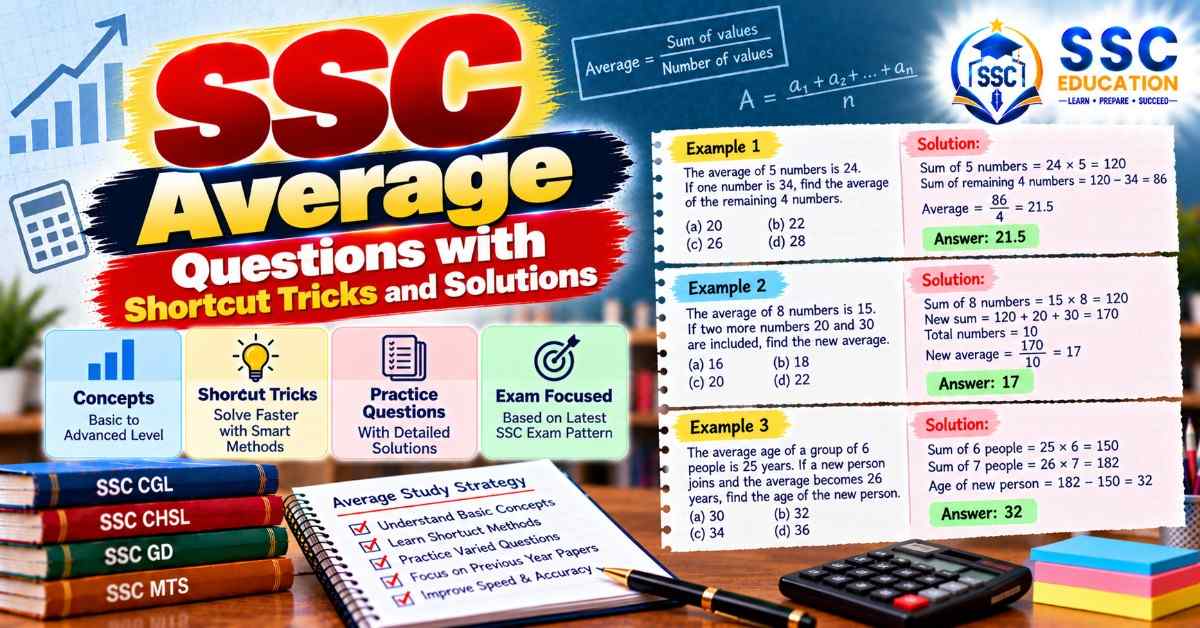
The average (or mean) of a set of numbers tells you the central value if all the items were equal. Average = Sum of all observations / Number of observations.
- If you know the average and the number of items, you can find the total: Sum = Average x Number of items.
- Most average questions are solved by moving between the sum and the average.
- When a new item is added or an item is replaced, only the sum changes, so work with the sum.
Formulas and Shortcut Tricks for SSC Average
- Average of first n natural numbers = (n + 1) / 2.
- Average of first n even numbers = n + 1 and first n odd numbers = n.
- Consecutive numbers: the average of an odd count of consecutive numbers is the middle number. For an even count it is the average of the two middle numbers.
- Add or subtract the same number from every item: the average changes by the same number. Multiply or divide every item by a number: the average is multiplied or divided by that number.
- New item joins: if the average of n items rises by x after one new item joins, the new item = old average + (n + 1) x x.
- Replacement: if the average of n items rises by x when one item is replaced, new item = old item + n x x.
- Weighted average = (n1 x a1 + n2 x a2) / (n1 + n2).
- Average speed = total distance / total time. For equal distances at speeds x and y, it is 2xy / (x + y).
- Age problems: when a member leaves or joins, work with the total ages and remember that every member becomes younger or older by the same time period.
Set 1: Basic Average Questions (Q1–Q10)
Q1. Find the average of 12, 18, 24, 30 and 36.
Answer: 24
Solution: Sum = 120. Average = 120 / 5 = 24.
Q2. What is the average of the first 10 natural numbers?
Answer: 5.5
Trick: Average = (n + 1) / 2 = 11 / 2 = 5.5.
Q3. What is the average of the first 20 even natural numbers?
Answer: 21
Trick: Average of first n even numbers = n + 1 = 21.
Q4. What is the average of the first 15 odd natural numbers?
Answer: 15
Trick: Average of first n odd numbers = n = 15.
Q5. The average of 5 numbers is 20. What is their sum?
Answer: 100
Solution: Sum = Average x Number = 20 x 5 = 100.
Q6. The average of 6 numbers is 25. If one number 40 is removed, what is the new average?
Answer: 22
Solution: Sum = 150. After removing 40, sum = 110 for 5 numbers. Average = 110 / 5 = 22.
Q7. The average of 4 numbers is 30. If each number is increased by 5, what is the new average?
Answer: 35
Trick: The average also increases by 5, so it becomes 35.
Q8. The average of 8 numbers is 12. If every number is multiplied by 3, what is the new average?
Answer: 36
Trick: The average is also multiplied by 3, so 12 x 3 = 36.
Q9. The average of 5 consecutive numbers is 42. Find the largest number.
Answer: 44
Trick: The middle number is 42, so the numbers are 40, 41, 42, 43 and 44. Largest = 44.
Q10. The average of 7 consecutive even numbers is 30. Find the smallest number.
Answer: 24
Solution: The middle (4th) number is 30, so the numbers are 24, 26, 28, 30, 32, 34 and 36. Smallest = 24.
Set 2: Joining, Leaving and Replacement Questions (Q11–Q20)
Q11. The average age of 20 students is 15 years. When the teacher's age is included, the average increases by 1. Find the age of the teacher.
Answer: 36 years
Solution: Sum of 21 persons = 21 x 16 = 336. Sum of 20 students = 300. Teacher = 336 - 300 = 36 years.
Q12. The average weight of 8 men increases by 2 kg when a man weighing 60 kg is replaced by a new man. Find the weight of the new man.
Answer: 76 kg
Trick: New man = 60 + 8 x 2 = 76 kg.
Q13. The average of 11 results is 50. The average of the first 6 results is 49 and of the last 6 results is 52. Find the sixth result.
Answer: 56
Solution: Sixth result = (6 x 49) + (6 x 52) - (11 x 50) = 294 + 312 - 550 = 56.
Q14. The average of 5 numbers is 27. If one number is excluded, the average becomes 25. Find the excluded number.
Answer: 35
Solution: Sum of 5 = 135. Sum of 4 = 100. Excluded number = 135 - 100 = 35.
Q15. The average marks of 30 students is 60. If the marks of 10 students whose average is 70 are removed, what is the average of the remaining students?
Answer: 55
Solution: Total = 1,800. Removed = 700. Remaining total = 1,100 for 20 students. Average = 55.
Q16. A batsman has an average of 32 runs after 10 innings. He scores 76 in the 11th innings. What is his new average?
Answer: 36
Solution: Total after 10 innings = 320. New total = 396. Average = 396 / 11 = 36.
Q17. The average of the first three of four numbers is 12 and the average of the last three is 15. If the last number is 18, find the first number.
Answer: 9
Trick: Sum of first three = 36 and sum of last three = 45. So last - first = 9. First = 18 - 9 = 9.
Q18. The average of 9 numbers is 30. The average of the first 5 is 25 and of the last 5 is 33. Find the 5th number.
Answer: 20
Solution: 5th number = (5 x 25) + (5 x 33) - (9 x 30) = 125 + 165 - 270 = 20.
Q19. The average of three numbers is 20. If two of them are 18 and 24, find the third number.
Answer: 18
Solution: Sum = 60. Third = 60 - 18 - 24 = 18.
Q20. The average of 50 numbers is 38. If two numbers 45 and 55 are discarded, what is the average of the remaining numbers?
Answer: 37.5
Solution: Total = 1,900. After removing 100, total = 1,800 for 48 numbers. Average = 37.5.
Set 3: Mixed and Application Questions (Q21–Q30)
Q21. A car travels at 40 km/h for the first 2 hours and at 60 km/h for the next 3 hours. Find its average speed for the whole journey.
Answer: 52 km/h
Solution: Distance = 80 + 180 = 260 km. Time = 5 hours. Average speed = 260 / 5 = 52 km/h.
Q22. The average of 7 consecutive numbers is 20. Find the largest number.
Answer: 23
Trick: The numbers are 17 to 23, so the largest is 23.
Q23. The average age of a family of 5 members is 30 years. If the youngest member is 6 years old, what was the average age of the family at the time of his birth?
Answer: 30 years
Solution: Present total of the other 4 = 150 - 6 = 144. At the birth, each of them was 6 years younger, so their total was 144 - 24 = 120. Average of 4 = 30 years.
Q24. A man spends Rs 150 per day for the first 4 days and Rs 120 per day for the next 6 days. What is his average daily expense for the 10 days?
Answer: Rs 132
Solution: Total = 600 + 720 = 1,320. Average = 1,320 / 10 = Rs 132.
Q25. The average of 4 consecutive odd numbers is 12. Find the largest number.
Answer: 15
Trick: The numbers are 9, 11, 13 and 15. Largest = 15.
Q26. The average marks of 30 students is 80 and of another 20 students is 70. What is the average of all 50 students?
Answer: 76
Trick: Weighted average = (30 x 80 + 20 x 70) / 50 = 3,800 / 50 = 76.
Q27. The average of x, x + 2, x + 4, x + 6 and x + 8 is 11. Find the value of x.
Answer: 7
Solution: The middle term x + 4 is the average, so x + 4 = 11 and x = 7.
Q28. The average marks of a student in 5 subjects is 60. What marks must he score in the sixth subject to make the average 65?
Answer: 90
Solution: Total needed = 6 x 65 = 390. Present total = 300. Required marks = 90.
Q29. What is the average of the first five multiples of 7?
Answer: 21
Solution: Multiples: 7, 14, 21, 28, 35. Average = the middle term = 21.
Q30. The average temperature of Monday, Tuesday and Wednesday is 38 degrees and of Tuesday, Wednesday and Thursday is 40 degrees. If the temperature on Thursday was 42 degrees, find the temperature on Monday.
Answer: 36 degrees
Solution: Mon + Tue + Wed = 114 and Tue + Wed + Thu = 120. So Thu - Mon = 6. Mon = 42 - 6 = 36 degrees.
Common Mistakes in Average Questions
- Dividing by the wrong number of items after adding or removing a number.
- Forgetting to find the total first when a value is replaced.
- Taking a simple average of two averages when the group sizes are different (use weighted average).
- Treating the change in average as the change in the total.
- Using the formula for odd numbers when the question asks for even numbers.
- Not including the person added or removed in the count.
How to Practice These 30 Questions
- Learn the formulas and the shortcut table before starting the paper.
- Always convert averages into sums when anything changes in the group.
- Solve each set in a timer: 8, 12 and 12 minutes for the three sets.
- Check your answer by recalculating the average with the new numbers.
- Review your mistakes after 24 hours and repeat the paper after a week.
Related Topics to Study Next
- Ratio and Proportion Questions
- Time, Speed and Distance Questions
- Number System Questions
- SSC Previous Year Papers
Frequently Asked Questions
What is the formula for average?
Average = Sum of all observations / Number of observations. You can also write Sum = Average x Number of observations, which is useful in most average questions.
What is the average of the first n natural numbers?
The average of the first n natural numbers is (n + 1) / 2. For example, the average of the first 10 natural numbers is 5.5.
How do you find the average of consecutive numbers?
For an odd number of consecutive numbers, the average is the middle number. For an even number, it is the average of the two middle numbers.
What is weighted average?
Weighted average is used when the groups have different sizes. It is calculated as (n1 x a1 + n2 x a2) / (n1 + n2), where n is the number of items and a is the average of each group.
What happens to the average when a number is added to every item?
The average increases by the same number. If every item is multiplied by a number, the average is also multiplied by it.
How do you solve replacement questions in average?
If a member is replaced and the average changes by x for n members, then the difference between the new and old values is n x x.
How do you find average speed?
Average speed = Total distance / Total time. For equal distances at speeds x and y, it is 2xy / (x + y), not the simple average.
How many average questions come in SSC CGL?
Usually one or two direct questions come from average in each shift, and average is also used inside age, speed and data interpretation questions.
What is the shortcut for the average of an arithmetic progression?
The average of an arithmetic progression is the average of the first and last term, which is also the middle term when the number of terms is odd.
How should I prepare average for SSC exams?
Practise questions on joining and leaving, replacement and weighted average, learn the shortcut formulas and solve one timed set daily until you can finish each set without mistakes.
Rahul Kumar
SSC Exam Expert & Content Editor
Rahul is a senior SSC exam strategist with 8+ years of experience helping aspirants crack CGL, CHSL and MTS exams. He writes in-depth notification breakdowns, exam pattern guides and preparation strategies.