SSC Races and Circular Tracks Questions with Answers and Tricks
Rahul Kumar
SSC Exam Expert & Content Editor
Table of Contents
Practice 19 SSC races and circular track questions with answers and solutions. Covers beating by distance or time, head start, meeting points and LCM problems for CGL, CHSL and MTS.
Races and circular tracks are an application of time, speed and distance and are asked in SSC CGL and CHSL papers. The questions are about who beats whom and by how much, how much head start is needed and when two runners meet on a circular track. The key tools are the speed ratio, relative speed and LCM. This practice paper gives you 19 questions with answers and short solutions.
Basic Ideas in Races and Circular Tracks
In a race, the runner who finishes first is the winner. The winning margin is given as a distance (A beats B by 10 m) or as a time (A beats B by 5 seconds).
- Beats by distance: when A finishes the race, B is behind by that distance.
- Beats by time: B reaches the finishing point after A by that time.
- Head start: the distance or time allowed to the slower runner at the start.
- On a circular track, runners can meet again at any point or at the starting point.
Formulas and Shortcut Tricks
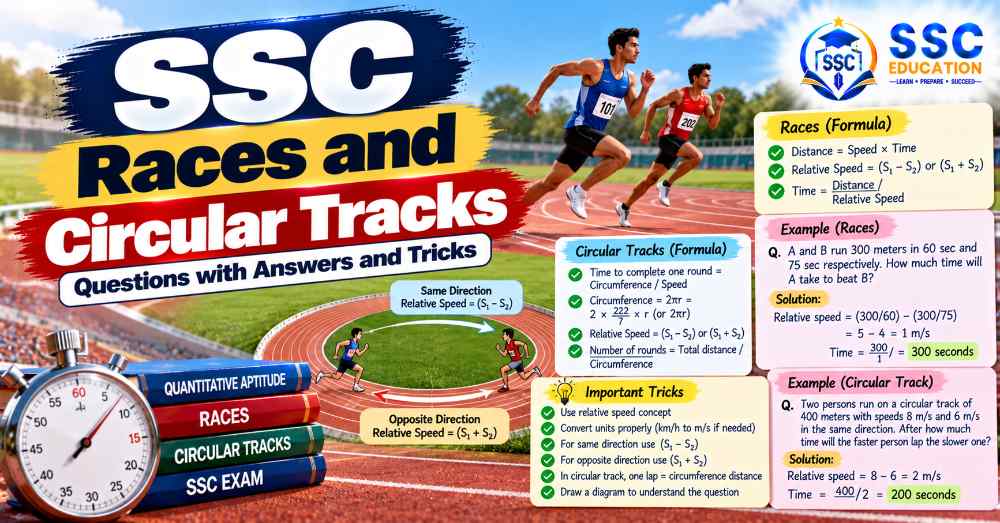
- If A beats B by x metres in a race of d metres, the ratio of speeds A : B = d : (d - x).
- Beats by time t means B needs t more seconds: B's time = A's time + t.
- Same direction on a circular track: first meeting after L / (v1 - v2). Opposite direction: after L / (v1 + v2).
- Meeting at the starting point for runners with lap times a and b: LCM of a and b.
- Number of meetings in a time T = T / (time between meetings).
- In successive races, chain the ratios: if A : B and B : C are known, find A : C.
Set 1: Straight Races (Q1–Q7)
Q1. In a 100 m race, A beats B by 10 m. If A takes 40 seconds, find B's speed.
Answer: 2.25 m/s
Solution: B covers 90 m in 40 seconds, so speed = 90 / 40 = 2.25 m/s.
Q2. A runs 1 km in 4 minutes and B runs it in 5 minutes. By how many metres does A beat B?
Answer: 200 m
Solution: In 4 minutes B covers 800 m.
Q3. A beats B by 30 m in a 300 m race. Find the ratio of their speeds.
Answer: 10 : 9
Trick: Speed ratio = 300 : 270.
Q4. In a 1 km race, A beats B by 100 m or 25 seconds. Find the time taken by A.
Answer: 225 seconds
Solution: B's speed = 100 / 25 = 4 m/s, so B takes 250 seconds and A takes 250 - 25 = 225 seconds.
Q5. In a 100 m race, A gives B a start of 20 m and they finish together. Find the ratio of their speeds.
Answer: 5 : 4
Solution: A runs 100 m while B runs 80 m.
Q6. A runs 100 m in 12 seconds and B in 15 seconds. By how many metres does A beat B?
Answer: 20 m
Solution: In 12 seconds, B covers 80 m.
Q7. In a 400 m race, A finishes 5 seconds ahead of B. If A takes 50 seconds, find B's time.
Answer: 55 seconds
Solution: B takes 50 + 5 = 55 seconds.
Set 2: Circular Tracks (Q8–Q14)
Q8. Two persons start from the same point on a 400 m circular track with speeds 5 m/s and 3 m/s in the same direction. When do they meet?
Answer: After 200 seconds
Trick: Time = 400 / (5 - 3) = 200 seconds.
Q9. The same two persons run in opposite directions. When do they meet?
Answer: After 50 seconds
Solution: Time = 400 / (5 + 3) = 50 seconds.
Q10. Two runners on a 500 m track run in opposite directions at 6 m/s and 4 m/s. When do they meet for the first time?
Answer: After 50 seconds
Solution: 500 / 10 = 50 seconds.
Q11. Two runners take 40 seconds and 60 seconds to complete one round of a track. When will they meet at the starting point again?
Answer: After 120 seconds
Trick: LCM of 40 and 60 = 120.
Q12. Two runners run in the same direction at 7 m/s and 4 m/s on a 360 m track. When does the faster one meet the slower one?
Answer: After 120 seconds
Solution: 360 / 3 = 120 seconds.
Q13. A and B run at 10 m/s and 8 m/s on a 600 m track in the same direction. After how many seconds does A lap B and how many rounds does A complete?
Answer: After 300 seconds; 5 rounds
Solution: Time = 600 / 2 = 300 s. A covers 3,000 m = 5 rounds.
Q14. Three runners take 12, 18 and 24 minutes for one round. After how many minutes will they meet at the start?
Answer: After 72 minutes
Solution: LCM of 12, 18 and 24 = 72.
Set 3: Exam-Level Questions (Q15–Q19)
Q15. Two runners run in opposite directions on a 300 m track at 4 m/s and 6 m/s. How many times do they meet in 10 minutes?
Answer: 20 times
Solution: They meet every 300 / 10 = 30 seconds, so 600 / 30 = 20 times.
Q16. Two runners run in the same direction at 8 m/s and 5 m/s on a 450 m track. How many times does the faster runner pass the slower one in 15 minutes?
Answer: 6 times
Solution: Time between meetings = 450 / 3 = 150 seconds. 900 / 150 = 6.
Q17. Two runners start from the same point on a 200 m track in opposite directions and first meet after 20 seconds. If their speeds are in the ratio 3 : 2, find the speeds.
Answer: 6 m/s and 4 m/s
Solution: Sum of speeds = 200 / 20 = 10 m/s, divided in the ratio 3 : 2.
Q18. In a 1 km race, A beats B by 50 m and B beats C by 100 m. By how many metres does A beat C?
Answer: 145 m
Trick: When A runs 1,000 m, B runs 950 m and C runs 950 x 0.9 = 855 m. A beats C by 145 m.
Q19. In a 200 m race, A beats B by 20 m and C by 38 m. By how many metres does B beat C?
Answer: 20 m
Solution: When A runs 200 m, B runs 180 m and C runs 162 m. B : C = 10 : 9, so in 200 m B beats C by 20 m.
Common Mistakes in Races and Circular Tracks
- Taking the ratio of speeds as the ratio of the distances by which a runner is beaten.
- Adding the speeds for the same direction on a circular track.
- Forgetting to convert minutes into seconds before using speeds in m/s.
- Using the sum of lap times instead of the LCM.
Related Topics to Study Next
- Problems on Trains
- Boats and Streams
- Pipes and Cisterns
- SSC Percentage Questions with Shortcut Tricks
Frequently Asked Questions
What does "A beats B by 10 m" mean?
It means that when A reaches the finishing line, B is 10 m behind.
How do I find the speed ratio in a race?
If A beats B by x in a race of d, the speed ratio A : B = d : (d - x).
What is a head start?
It is the advantage given to the slower runner at the start, in distance or time.
When do two runners meet on a circular track in the same direction?
After L / (v1 - v2), where L is the length of the track.
When do two runners meet on a circular track in opposite directions?
After L / (v1 + v2).
How do I find when runners meet at the starting point?
Find the LCM of the times taken for one round.
What is the difference between beating by distance and by time?
Beating by distance is the gap in metres at the finish. Beating by time is the gap in seconds between the finishing times.
How do I solve successive race questions?
Find the speed ratios for each pair and combine them to compare the first and the last runners.
How many races and circular track questions come in SSC exams?
Usually one question per shift comes from this topic, within time, speed and distance.
Do I need to know relative speed?
Yes. Relative speed is used to find the meeting time of two runners.
Is the formula the same for walkers and runners?
Yes. The same formulas apply to walkers, runners and cyclists.
How should I prepare this topic for SSC exams?
Learn the formulas, practise different types of questions and revise time, speed and distance.
Rahul Kumar
SSC Exam Expert & Content Editor
Rahul is a senior SSC exam strategist with 8+ years of experience helping aspirants crack CGL, CHSL and MTS exams. He writes in-depth notification breakdowns, exam pattern guides and preparation strategies.