SSC Boats and Streams Questions with Solutions and Tricks
Rahul Kumar
SSC Exam Expert & Content Editor
Table of Contents
- 1.Practice Paper at a Glance
- 2.What Are Boats and Streams? Basic Concept in Simple Words
- 3.Formulas and Shortcut Tricks for SSC Boats and Streams
- 4.Set 1: Basic Boats and Streams Questions (Q1–Q10)
- 5.Set 2: Round Trip, Ratio and Mixed Questions (Q11–Q20)
- 6.Set 3: Exam-Level Boats and Streams Questions (Q21–Q30)
- 7.Common Mistakes in Boats and Streams
- 8.How to Practice These 30 Questions
- 9.Related Topics to Study Next
- 10.Frequently Asked Questions
Practice 30 SSC boats and streams questions with answers and solutions. Covers upstream, downstream, speed of boat and stream, round trips and ratio problems for CGL, CHSL, MTS and GD.
Boats and Streams is a direct application of Time, Speed and Distance, and it appears in SSC CGL, CHSL and MTS papers regularly. All questions are based on two ideas: the boat goes faster with the stream and slower against it. With four formulas, you can solve nearly every question in this chapter in less than a minute. This practice paper gives you 30 boats and streams questions with answers and short solutions.
Practice Paper at a Glance
| Detail | Information |
|---|---|
| Topic | Boats and Streams |
| Total questions | 30 questions in 3 sets |
| Level | Easy to exam level |
| Useful for | SSC CGL, CHSL, MTS, GD, CPO and other government exams |
| Includes | Answers, step-by-step solutions, shortcut tricks and FAQs |
| Time to attempt | 35 to 40 minutes |
What Are Boats and Streams? Basic Concept in Simple Words
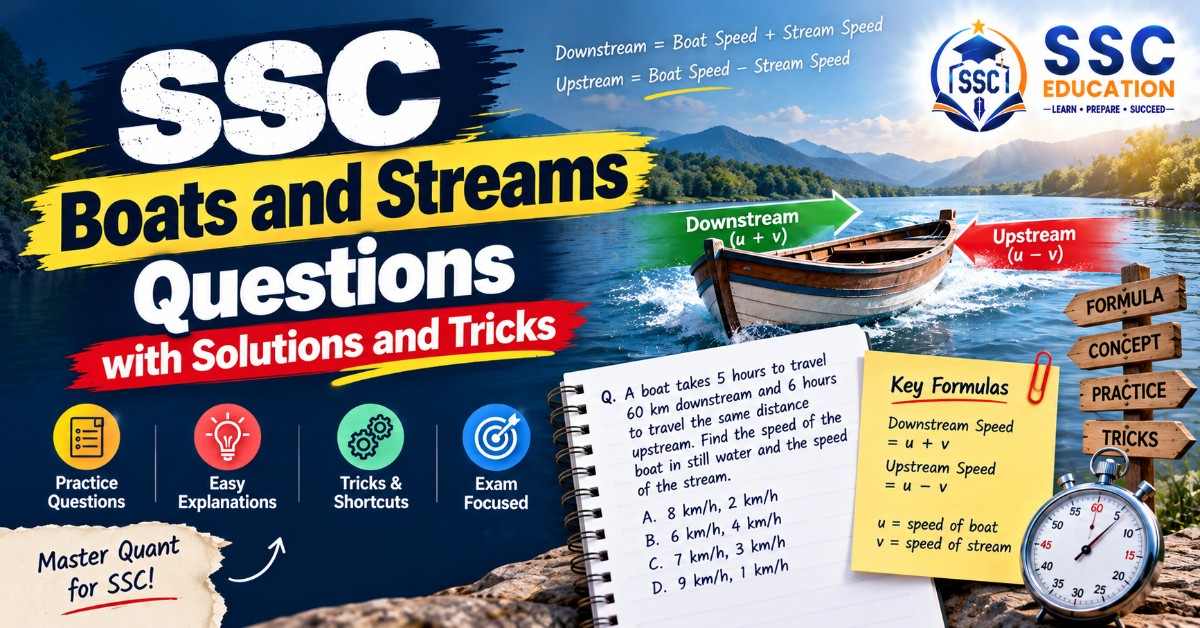
A boat moving in a river is affected by the flow of water. The speed of the boat in still water is u and the speed of the stream is v.
- Downstream means moving in the direction of the stream. The stream helps the boat.
- Upstream means moving against the stream. The stream slows the boat.
- Still water speed is the speed of the boat if there is no current.
- The speed of the stream is always less than the speed of the boat, otherwise the boat cannot move upstream.
Formulas and Shortcut Tricks for SSC Boats and Streams
- Downstream speed (D) = u + v and upstream speed (U) = u - v.
- Speed in still water u = (D + U) / 2 and speed of stream v = (D - U) / 2.
- Round trip average speed over the same distance = 2DU / (D + U).
- Time ratio: for the same distance, time is inversely proportional to speed. If time upstream is n times the time downstream, then u : v = (n + 1) : (n - 1).
- Speed ratio: if D : U = a : b, then u : v = (a + b) : (a - b).
- Round trip time for a distance d = d / D + d / U.
- Floating objects move with the speed of the stream.
- Use the TSD basics: Distance = Speed x Time, and convert all units into km and hours before solving.
Set 1: Basic Boats and Streams Questions (Q1–Q10)
Q1. The speed of a boat in still water is 10 km/h and the speed of the stream is 2 km/h. Find the downstream speed.
Answer: 12 km/h
Solution: Downstream = 10 + 2 = 12 km/h.
Q2. The speed of a boat is 15 km/h in still water and the stream flows at 3 km/h. How long will the boat take to cover 36 km downstream?
Answer: 2 hours
Solution: Downstream speed = 18 km/h. Time = 36 / 18 = 2 hours.
Q3. The downstream speed of a boat is 18 km/h and the upstream speed is 12 km/h. Find the speed of the boat in still water.
Answer: 15 km/h
Trick: u = (18 + 12) / 2 = 15 km/h.
Q4. A man rows at 5 km/h in still water and the stream flows at 1 km/h. How long will he take to row 20 km upstream?
Answer: 5 hours
Solution: Upstream speed = 5 - 1 = 4 km/h. Time = 20 / 4 = 5 hours.
Q5. The speed of a boat in still water is 12 km/h and the stream flows at 4 km/h. How long will it take to go 48 km upstream?
Answer: 6 hours
Solution: Upstream speed = 8 km/h. Time = 48 / 8 = 6 hours.
Q6. A boat covers 24 km downstream in 2 hours and 16 km upstream in 2 hours. Find the speed of the stream.
Answer: 2 km/h
Solution: Downstream = 12 km/h and upstream = 8 km/h. Stream = (12 - 8) / 2 = 2 km/h.
Q7. The speed of a boat in still water is 9 km/h and the speed of the stream is 3 km/h. Find the ratio of downstream speed to upstream speed.
Answer: 2 : 1
Solution: Downstream = 12 and upstream = 6, so the ratio is 12 : 6 = 2 : 1.
Q8. The speed of a boat is 8 km/h and the stream flows at 2 km/h. How long will the boat take to go 30 km downstream and return?
Answer: 8 hours
Solution: Downstream time = 30 / 10 = 3 hours and upstream time = 30 / 6 = 5 hours. Total = 8 hours.
Q9. A man can row 6 km/h in still water. He takes twice as long to row upstream as downstream. Find the speed of the stream.
Answer: 2 km/h
Trick: 6 + v = 2(6 - v), so 3v = 6 and v = 2 km/h.
Q10. A boat travels 15 km downstream in 1.5 hours and 10 km upstream in 2 hours. Find the speed of the boat in still water.
Answer: 7.5 km/h
Solution: Downstream = 10 km/h and upstream = 5 km/h. u = (10 + 5) / 2 = 7.5 km/h.
Set 2: Round Trip, Ratio and Mixed Questions (Q11–Q20)
Q11. A boat covers 60 km downstream in 4 hours and returns in 6 hours. Find the speed of the stream.
Answer: 2.5 km/h
Solution: Downstream = 15 km/h and upstream = 10 km/h. Stream = (15 - 10) / 2 = 2.5 km/h.
Q12. The downstream speed of a boat is 20 km/h and the upstream speed is 12 km/h. Find the average speed for the round trip.
Answer: 15 km/h
Trick: Average speed = 2 x 20 x 12 / 32 = 15 km/h.
Q13. A man rows upstream in three times the time he takes downstream. If the stream flows at 3 km/h, find the speed of the boat in still water.
Answer: 6 km/h
Trick: u : v = (3 + 1) : (3 - 1) = 2 : 1. Since v = 3, u = 6 km/h.
Q14. The distance between two places is 40 km. A boat with a still water speed of 9 km/h and a stream speed of 1 km/h goes from one place to the other and returns. Find the total time taken.
Answer: 9 hours
Solution: Downstream = 10 km/h so time = 4 hours. Upstream = 8 km/h so time = 5 hours. Total = 9 hours.
Q15. A boat goes 80 km downstream in 8 hours. If the speed in still water is 8 km/h, find the time taken to go 80 km upstream.
Answer: 13 1/3 hours
Solution: Downstream = 10 km/h, so the stream = 2 km/h. Upstream = 6 km/h. Time = 80 / 6 = 13 1/3 hours.
Q16. The speed of a boat in still water is 11 km/h and the stream flows at 5 km/h. How far will the boat go upstream in 3 hours?
Answer: 18 km
Solution: Upstream speed = 6 km/h. Distance = 6 x 3 = 18 km.
Q17. A man rows 12 km upstream in 3 hours and returns downstream in 1 hour 20 minutes. Find the speed of the stream.
Answer: 2.5 km/h
Solution: Upstream = 4 km/h. Downstream = 12 / (4/3) = 9 km/h. Stream = (9 - 4) / 2 = 2.5 km/h.
Q18. The speed of a boat in still water is 4.5 km/h and the speed of the stream is 1.5 km/h. How long will it take to go 12 km upstream?
Answer: 4 hours
Solution: Upstream speed = 3 km/h. Time = 12 / 3 = 4 hours.
Q19. The speed of a boat in still water and the speed of the stream are in the ratio 5 : 1. The boat covers 36 km downstream in 4 hours. Find the speed of the boat in still water.
Answer: 7.5 km/h
Solution: Downstream = 6x = 9 km/h, so x = 1.5. Boat = 5 x 1.5 = 7.5 km/h.
Q20. A man rows to a place 48 km away and back in 14 hours. He can row 4 km with the stream in the same time as 3 km against it. Find the speed of the stream.
Answer: 1 km/h
Solution: D : U = 4 : 3, so u : v = 7 : 1. Let u = 7v. Time = 48/(8v) + 48/(6v) = 14/v = 14, so v = 1 km/h.
Set 3: Exam-Level Boats and Streams Questions (Q21–Q30)
Q21. The downstream speed of a boat is 14 km/h and the upstream speed is 6 km/h. How long will it take to go 24 km upstream?
Answer: 4 hours
Solution: Time = 24 / 6 = 4 hours.
Q22. A boat covers 36 km downstream in 3 hours and 36 km upstream in 6 hours. Find the speed of the boat in still water.
Answer: 9 km/h
Solution: Downstream = 12 km/h and upstream = 6 km/h. u = (12 + 6) / 2 = 9 km/h.
Q23. The speed of a boat in still water is 7.5 km/h and the stream flows at 2.5 km/h. How long will it take to go 20 km downstream and 10 km upstream?
Answer: 4 hours
Solution: Downstream time = 20 / 10 = 2 hours and upstream time = 10 / 5 = 2 hours. Total = 4 hours.
Q24. The upstream speed of a boat is 8 km/h and the speed of the stream is 2 km/h. Find the downstream speed.
Answer: 12 km/h
Solution: Speed of the boat = 8 + 2 = 10 km/h. Downstream = 10 + 2 = 12 km/h.
Q25. Two ports are 60 km apart. A boat takes 5 hours to go downstream and 10 hours to return upstream. Find the speed of the stream.
Answer: 3 km/h
Solution: Downstream = 12 km/h and upstream = 6 km/h. Stream = (12 - 6) / 2 = 3 km/h.
Q26. A man rows 10 km upstream in 2.5 hours and returns in 1 hour 40 minutes. Find the speed of the boat in still water.
Answer: 5 km/h
Solution: Upstream = 4 km/h. Downstream = 10 / (5/3) = 6 km/h. u = (4 + 6) / 2 = 5 km/h.
Q27. The speed of a boat in still water is 15 km/h and the stream flows at 5 km/h. The boat goes downstream for 2 hours and then upstream for 2 hours. How far is it from the starting point?
Answer: 20 km
Solution: Downstream distance = 20 x 2 = 40 km. Upstream distance = 10 x 2 = 20 km. Distance from start = 40 - 20 = 20 km.
Q28. A boat covers a distance downstream in 1 hour and the same distance upstream in 1.5 hours. If the speed of the boat in still water is 10 km/h, find the speed of the stream.
Answer: 2 km/h
Solution: D : U = 3 : 2. (10 + v) : (10 - v) = 3 : 2, so 20 + 2v = 30 - 3v and v = 2 km/h.
Q29. The speed of a boat in still water is 20 km/h and the speed of the stream is 4 km/h. Find the average speed for the round trip over the same distance.
Answer: 19.2 km/h
Trick: D = 24 and U = 16. Average = 2 x 24 x 16 / 40 = 19.2 km/h.
Q30. A boat can travel 30 km upstream and 44 km downstream in 10 hours. It can also travel 40 km upstream and 55 km downstream in 13 hours. Find the speed of the boat in still water.
Answer: 8 km/h
Solution: Let U and D be the speeds. 30/U + 44/D = 10 and 40/U + 55/D = 13. Solving gives U = 5 and D = 11. Boat speed = (5 + 11) / 2 = 8 km/h and stream = 3 km/h.
Common Mistakes in Boats and Streams
- Using upstream speed for the downstream journey, or the other way round.
- Taking the speed of the stream as the difference of the boat speeds without dividing by 2.
- Forgetting to add both the journeys in a round trip question.
- Using a simple average of downstream and upstream speeds for the average speed.
- Mixing minutes and hours in the same equation.
- Using the speed of the stream as larger than the boat speed.
How to Practice These 30 Questions
- Memorise the four main formulas (D, U, u and v).
- Solve Set 1 in 6 minutes to build confidence.
- In Set 2, convert minutes to hours before solving.
- Check each answer by recomputing the time with the speeds you found.
- Revise the time, speed and distance basics before attempting this paper.
Related Topics to Study Next
- Time, Speed and Distance Questions
- Problems on Trains Questions
- Pipes and Cisterns Questions
- SSC Previous Year Papers
Frequently Asked Questions
What is the formula for upstream and downstream speed?
Downstream speed = speed of boat + speed of stream. Upstream speed = speed of boat - speed of stream.
How do you find the speed of a boat in still water?
Speed of the boat in still water = (downstream speed + upstream speed) / 2.
How do you find the speed of the stream?
Speed of the stream = (downstream speed - upstream speed) / 2.
What is the average speed in a round trip with a stream?
Average speed = 2 x D x U / (D + U), where D and U are the downstream and upstream speeds.
If the time upstream is n times the time downstream, what is the relation between speeds?
The ratio of the boat speed to the stream speed is (n + 1) : (n - 1).
How many boats and streams questions come in SSC exams?
Generally one question comes from boats and streams in each shift of SSC CGL, CHSL and MTS.
What is the speed of a floating object in a stream?
A floating object moves with the speed of the stream because it has no speed of its own.
Is boats and streams a part of time, speed and distance?
Yes. It is an application of the same formula Distance = Speed x Time with an extra factor of the stream speed.
What should I do if the question gives time in minutes?
Convert the time into hours (divide by 60) so that the speeds in km/h and the distances in km match.
How should I prepare boats and streams for SSC exams?
Learn the four formulas, practise one set daily, solve round trip and ratio questions and take mixed TSD tests.
Rahul Kumar
SSC Exam Expert & Content Editor
Rahul is a senior SSC exam strategist with 8+ years of experience helping aspirants crack CGL, CHSL and MTS exams. He writes in-depth notification breakdowns, exam pattern guides and preparation strategies.