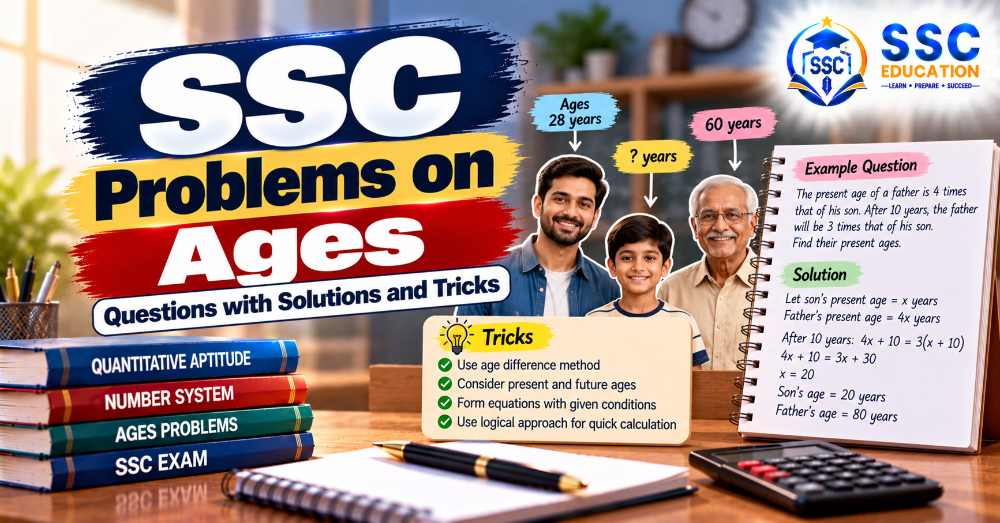
SSC Problems on Ages Questions with Solutions and Tricks
Rahul Kumar
SSC Exam Expert & Content Editor
Table of Contents
- 1.Practice Paper at a Glance
- 2.What Are Problems on Ages? Basic Concept in Simple Words
- 3.Rules and Shortcut Tricks for SSC Age Questions
- 4.Set 1: Basic Age Questions (Q1–Q10)
- 5.Set 2: Past and Future Age Equations (Q11–Q20)
- 6.Set 3: Mixed and Exam-Level Age Questions (Q21–Q30)
- 7.Common Mistakes in Age Questions
- 8.How to Practice These 30 Questions
- 9.Related Topics to Study Next
- 10.Frequently Asked Questions
Practice 30 SSC problems on ages with answers and solutions. Covers present, past and future age equations, age ratios and average age problems for CGL, CHSL, MTS and GD.
Problems on Ages is a quick and scoring chapter in SSC Quantitative Aptitude. One question usually appears in each shift of CGL, CHSL and MTS, and most can be solved by forming one or two simple equations. This practice paper gives you 30 age questions with answers and short solutions, along with the key rules and tricks to avoid common mistakes.
Practice Paper at a Glance
| Detail | Information |
|---|---|
| Topic | Problems on Ages |
| Total questions | 30 questions in 3 sets |
| Level | Easy to exam level |
| Useful for | SSC CGL, CHSL, MTS, GD, CPO and other government exams |
| Includes | Answers, step-by-step solutions, shortcut tricks and FAQs |
| Time to attempt | 35 to 40 minutes |
What Are Problems on Ages? Basic Concept in Simple Words
Age questions give relationships between the ages of two or more persons at different times (past, present and future) and ask you to find the present or future age.
- The difference between the ages of two persons always remains the same, whatever the year.
- If a person's present age is x, his age after n years is x + n and his age n years ago was x - n.
- In ratio-based questions, take the present ages as ax and bx and form an equation using the other condition.
Rules and Shortcut Tricks for SSC Age Questions
- Assume the present age of the younger person (or the smaller ratio part) as x.
- Age gap is constant: if A is 12 years older than B now, he will be 12 years older after any number of years.
- Ratio of ages: if the present ratio is a : b, present ages = ax and bx. After n years the ages are ax + n and bx + n.
- Total of ages after n years of k persons = present total + n x k.
- Average age of a group after n years = present average + n (if no one joins or leaves).
- Average age when a member leaves: use the total age method (total = average x number).
- Birth of a child: when a child is born, the age of every member counted earlier increases by the age of the child.
- Option check: in multiple-choice questions, put the options in the conditions to verify the answer quickly.
Set 1: Basic Age Questions (Q1–Q10)
Q1. A is 5 years older than B and the sum of their ages is 35. Find the age of A.
Answer: 20 years
Solution: Let B = x. Then x + x + 5 = 35, so x = 15 and A = 20 years.
Q2. A father is 3 times as old as his son. The sum of their ages is 48 years. Find the age of the father.
Answer: 36 years
Solution: Son = 48 / 4 = 12 years. Father = 3 x 12 = 36 years.
Q3. The present ages of two persons are in the ratio 3 : 4. After 5 years the ratio will be 4 : 5. Find the age of the younger person.
Answer: 15 years
Solution: (3x + 5) / (4x + 5) = 4/5, so 15x + 25 = 16x + 20 and x = 5. Younger = 3 x 5 = 15 years.
Q4. A father is 40 years old and his son is 10 years old. After how many years will the father be twice as old as the son?
Answer: 20 years
Solution: 40 + x = 2(10 + x), so 40 + x = 20 + 2x and x = 20 years.
Q5. The sum of the ages of A and B is 50 years. Five years ago the ratio of their ages was 3 : 2. Find the present age of A.
Answer: 29 years
Solution: Sum 5 years ago = 50 - 10 = 40. A = 40 x 3/5 = 24 and B = 16 then. Present age of A = 24 + 5 = 29 years.
Q6. The average age of 3 persons is 20 years. What will be their average age after 5 years?
Answer: 25 years
Trick: The average also increases by 5, so it becomes 25 years.
Q7. The ages of A and B are in the ratio 5 : 7 and the difference between them is 8 years. Find the age of B.
Answer: 28 years
Solution: Difference of 2 parts = 8, so 1 part = 4. B = 7 x 4 = 28 years.
Q8. Ten years ago, a father was 5 times as old as his son. Now he is 3 times as old as his son. Find the present age of the son.
Answer: 20 years
Solution: Let son = s and father = 3s. 3s - 10 = 5(s - 10), so 2s = 40 and s = 20 years.
Q9. A mother is 3 times as old as her daughter. After 10 years, she will be twice as old as her daughter. Find the daughter's present age.
Answer: 10 years
Solution: 3d + 10 = 2(d + 10), so d = 10 years.
Q10. A is 3 years older than B and 3 years younger than C. The sum of the ages of the three is 63 years. Find the age of C.
Answer: 24 years
Solution: Let B = x, A = x + 3 and C = x + 6. 3x + 9 = 63, so x = 18 and C = 24 years.
Set 2: Past and Future Age Equations (Q11–Q20)
Q11. Eight years ago, A was 3 times as old as B. After 4 years, A will be twice as old as B. Find the present age of A.
Answer: 44 years
Solution: a - 8 = 3(b - 8) gives a = 3b - 16. a + 4 = 2(b + 4) gives a = 2b + 4. So 3b - 16 = 2b + 4, b = 20 and a = 44 years.
Q12. The present ages of Ram and Shyam are in the ratio 4 : 5. After 6 years, the sum of their ages will be 66 years. Find the present age of Shyam.
Answer: 30 years
Solution: 9x + 12 = 66, so x = 6. Shyam = 5 x 6 = 30 years.
Q13. The ratio of the present ages of A and B is 3 : 5. After 4 years the ratio will be 2 : 3. Find the present age of A.
Answer: 12 years
Solution: (3x + 4) / (5x + 4) = 2/3, so 9x + 12 = 10x + 8 and x = 4. A = 12 years.
Q14. The sum of the present ages of a father and his son is 60 years. Six years ago, the father was 5 times as old as the son. Find the present age of the son.
Answer: 14 years
Solution: f - 6 = 5(s - 6), so f = 5s - 24. With f + s = 60: 6s = 84 and s = 14 years.
Q15. The average age of 5 members of a family is 24 years. If the youngest member is 4 years old, what was the average age of the family at the time of his birth?
Answer: 25 years
Solution: Total now = 120. Others' total = 116. At his birth, each of the 4 others was 4 years younger: 116 - 16 = 100. Average = 100 / 4 = 25 years.
Q16. A's age is one-third of his father's age and the father is 24 years older than A. Find the age of A.
Answer: 12 years
Solution: Father - A = 2/3 of the father's age = 24, so father = 36 and A = 12 years.
Q17. In 10 years A will be twice as old as B was 10 years ago. If A is 9 years older than B, find the present age of B.
Answer: 39 years
Solution: a + 10 = 2(b - 10) and a = b + 9. So b + 19 = 2b - 20 and b = 39 years.
Q18. A father is 30 years older than his son. After 5 years he will be 3 times as old as the son. Find the present age of the son.
Answer: 10 years
Solution: s + 35 = 3(s + 5), so 2s = 20 and s = 10 years.
Q19. The ages of two persons differ by 12 years and are in the ratio 5 : 3. Find the age of the younger person.
Answer: 18 years
Solution: 2 parts = 12, so 1 part = 6. Younger = 3 x 6 = 18 years.
Q20. The present ages of A and B are in the ratio 2 : 3. After 9 years the ratio will be 3 : 4. Find the present age of B.
Answer: 27 years
Solution: (2x + 9) / (3x + 9) = 3/4, so 8x + 36 = 9x + 27 and x = 9. B = 27 years.
Set 3: Mixed and Exam-Level Age Questions (Q21–Q30)
Q21. The sum of the ages of a mother and her daughter is 50 years. After 5 years the mother will be 4 times as old as the daughter. Find the present age of the daughter.
Answer: 7 years
Solution: m = 50 - d. 50 - d + 5 = 4(d + 5), so 55 - d = 4d + 20 and d = 7 years.
Q22. A boy's age 5 years from now will be 3 times his age 5 years ago. Find his present age.
Answer: 10 years
Solution: x + 5 = 3(x - 5), so x + 5 = 3x - 15 and x = 10 years.
Q23. A is 10 years older than B. Five years ago A was twice as old as B. Find the present age of A.
Answer: 25 years
Solution: a = b + 10 and a - 5 = 2(b - 5). So b + 5 = 2b - 10 and b = 15. A = 25 years.
Q24. The average age of 30 students in a class is 12 years. When the teacher's age is included the average becomes 13 years. Find the age of the teacher.
Answer: 43 years
Trick: Total with teacher = 31 x 13 = 403. Total of students = 360. Teacher = 43 years.
Q25. The ages of three siblings are in the ratio 2 : 3 : 5 and their sum is 50 years. Find the age of the eldest.
Answer: 25 years
Solution: One part = 50 / 10 = 5. Eldest = 5 x 5 = 25 years.
Q26. The ratio of the ages of a father and son is 7 : 2 and the father is 25 years older than the son. Find the age of the father.
Answer: 35 years
Solution: Difference of 5 parts = 25, so 1 part = 5. Father = 7 x 5 = 35 years.
Q27. The sum of the ages of 4 children born at intervals of 3 years each is 50 years. Find the age of the youngest child.
Answer: 8 years
Trick: Ages are x, x + 3, x + 6 and x + 9. 4x + 18 = 50, so x = 8 years.
Q28. The age of A is 20% more than that of B. If B is 30 years old, find the age of A.
Answer: 36 years
Solution: A = 30 x 1.2 = 36 years.
Q29. A father is 4 times as old as his son. After 20 years he will be twice as old as the son. Find the present age of the father.
Answer: 40 years
Solution: 4s + 20 = 2(s + 20), so 2s = 20 and s = 10. Father = 40 years.
Q30. Five years ago, a father was 7 times as old as his son. After 5 years, he will be 3 times as old as the son. Find the present age of the son.
Answer: 10 years
Solution: f = 7s - 30 and f + 5 = 3(s + 5). So 7s - 25 = 3s + 15 and s = 10 years.
Common Mistakes in Age Questions
- Using the present age in place of the age after or before some years.
- Forgetting that the age difference stays constant.
- Adding the years once when there are two or more persons in the sum of ages.
- Mixing up "years ago" with "years hence".
- Making sign errors in equations like a - 5 = 2(b - 5).
- Not checking the final answer in the original conditions.
How to Practice These 30 Questions
- Write the present age as x and fill the other ages in a small table.
- Always write the condition in words before forming an equation.
- Solve Set 1 in 8 minutes, Set 2 in 12 minutes and Set 3 in 12 minutes.
- Verify your answer by putting it back into the question.
- Revise ratio and linear equations before starting this paper.
Related Topics to Study Next
Frequently Asked Questions
What are problems on ages?
Problems on ages are word problems in which the ages of persons at different times are related through ratios, sums or multiples. You find the unknown age using equations.
How many age questions come in SSC exams?
Generally one age question appears per shift in SSC CGL, CHSL and MTS, often combined with ratio or average.
What is the basic rule for age problems?
The difference between the ages of two persons always remains the same. Add n to each age for n years later and subtract n for n years ago.
How do I solve age questions with ratios?
Take the present ages as ax and bx, form an equation using the second condition (after or before some years) and solve for x.
How do I find the average age after some years?
If nobody joins or leaves the group, the average age after n years is the present average plus n.
How do I solve age questions when a child is born?
The family average changes with the new member. Use the total age method: total ages of all members before + age of the new member.
What is the shortcut to solve age questions in the exam?
Use the options. Put each option into the conditions and select the one that satisfies all the statements. This is often faster than forming equations.
What is the difference between "after 5 years" and "5 years ago"?
"After 5 years" means you add 5 to the present age. "5 years ago" means you subtract 5 from the present age.
Are age questions related to linear equations?
Yes. Most age questions reduce to a linear equation in one or two variables, so basic algebra is useful.
How should I prepare problems on ages for SSC exams?
Learn the rules, practise one set daily with equations and the option method, and revise ratio and average before attempting mixed questions.
Rahul Kumar
SSC Exam Expert & Content Editor
Rahul is a senior SSC exam strategist with 8+ years of experience helping aspirants crack CGL, CHSL and MTS exams. He writes in-depth notification breakdowns, exam pattern guides and preparation strategies.