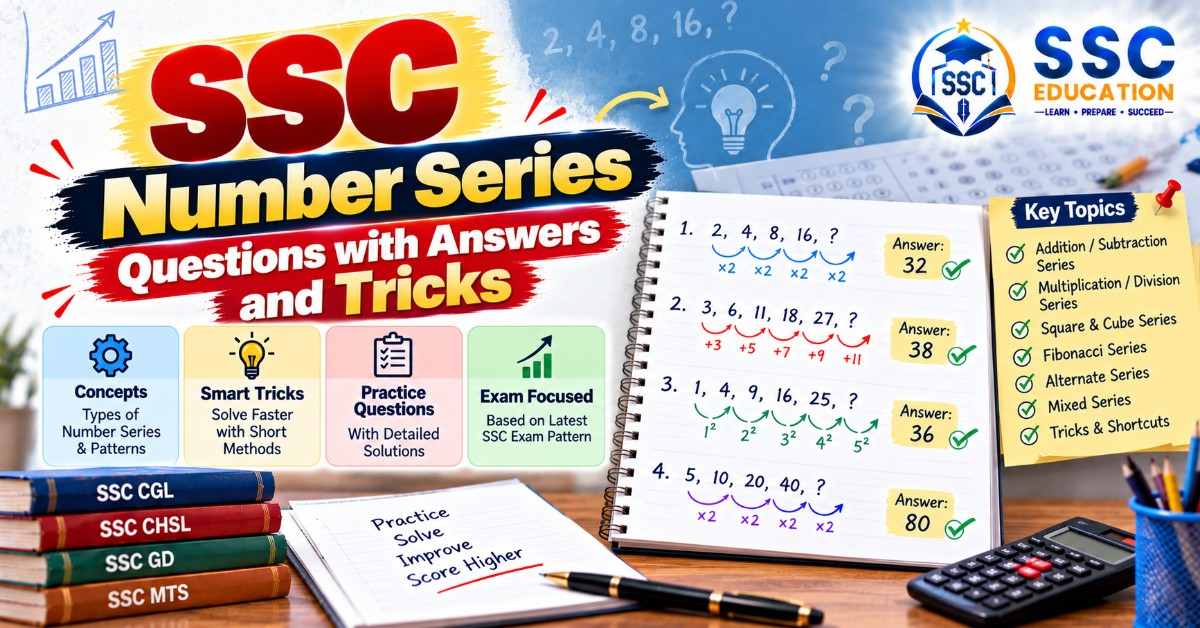
SSC Number Series Questions with Answers and Tricks
Rahul Kumar
SSC Exam Expert & Content Editor
Table of Contents
- 1.Practice Paper at a Glance
- 2.What Is a Number Series? Basic Concept in Simple Words
- 3.Patterns and Shortcut Tricks for SSC Number Series
- 4.Set 1: Basic Number Series (Q1–Q10)
- 5.Set 2: Difference, Multiplication and Mixed Patterns (Q11–Q20)
- 6.Set 3: Wrong Number, Alternate and Letter Series (Q21–Q30)
- 7.Common Mistakes in Number Series
- 8.How to Practice These 30 Questions
- 9.Related Topics to Study Next
- 10.Frequently Asked Questions
Practice 30 SSC number series questions with answers, patterns and tricks. Covers difference, multiplication, square, cube, prime, wrong-number and letter series for CGL, CHSL, MTS and GD.
Number Series questions check your ability to find a hidden pattern in a sequence of numbers. They appear in the SSC reasoning section every year and are quick to solve once you know the common patterns. This practice paper gives you 30 number series questions with answers and short solutions, starting from simple patterns and moving to squares, cubes, wrong-number and letter series.
Practice Paper at a Glance
| Detail | Information |
|---|---|
| Topic | Number Series (Reasoning) |
| Total questions | 30 questions in 3 sets |
| Level | Easy to exam level |
| Useful for | SSC CGL, CHSL, MTS, GD, CPO and other government exams |
| Includes | Answers, step-by-step solutions, shortcut tricks and FAQs |
| Time to attempt | 35 to 40 minutes |
What Is a Number Series? Basic Concept in Simple Words
A number series is a list of numbers that follows a rule. Your task is to find the rule and then find the missing or next number. Most series follow one of these rules.
- Addition or subtraction of a fixed number (arithmetic series).
- Multiplication or division by a fixed number (geometric series).
- Increasing differences such as +3, +5, +7.
- Squares, cubes or numbers close to them (n^2 + 1, n^3 - 1).
- Two mixed patterns such as x2 + 1 or alternate series.
- Special series: prime numbers, Fibonacci series and factorials.
Patterns and Shortcut Tricks for SSC Number Series
- First take the difference between consecutive numbers. If the differences are the same, it is an arithmetic series.
- If the differences change, take the difference of differences (second difference) or check for squares and cubes.
- If the numbers grow quickly, try multiplication with a small addition or subtraction (x2 + 1, x3 - 2).
- Learn the squares up to 30 and the cubes up to 12 so that you recognise them quickly.
- Fibonacci series: each number is the sum of the previous two (1, 1, 2, 3, 5, 8, 13, 21).
- Prime series: 2, 3, 5, 7, 11, 13, 17, 19, 23, 29.
- For wrong number series, find the pattern from the majority of terms and spot the term that breaks it.
- For alternate series, split the terms into odd and even positions and solve each separately.
- Letter series: convert letters to positions (A = 1 to Z = 26) and use the same techniques.
Set 1: Basic Number Series (Q1–Q10)
Q1. Find the next number: 2, 4, 6, 8, ?
Answer: 10
Solution: The series increases by 2 each time.
Q2. Find the next number: 3, 6, 12, 24, ?
Answer: 48
Solution: Each number is multiplied by 2.
Q3. Find the next number: 1, 4, 9, 16, 25, ?
Answer: 36
Trick: These are squares of 1, 2, 3, 4, 5, so the next is 6^2 = 36.
Q4. Find the next number: 100, 91, 82, 73, ?
Answer: 64
Solution: The series decreases by 9 each time.
Q5. Find the next number: 2, 5, 10, 17, 26, ?
Answer: 37
Trick: Differences are 3, 5, 7, 9, so the next difference is 11. 26 + 11 = 37. (The terms are n^2 + 1.)
Q6. Find the next number: 1, 8, 27, 64, ?
Answer: 125
Trick: These are cubes of 1, 2, 3, 4, so the next is 5^3 = 125.
Q7. Find the next number: 7, 14, 28, 56, ?
Answer: 112
Solution: Each number is multiplied by 2.
Q8. Find the next number: 2, 3, 5, 7, 11, 13, ?
Answer: 17
Solution: This is the series of prime numbers. After 13 comes 17.
Q9. Find the next number: 120, 99, 80, 63, 48, ?
Answer: 35
Trick: The terms are 11^2 - 1, 10^2 - 1, 9^2 - 1, 8^2 - 1, 7^2 - 1 and the next is 6^2 - 1 = 35.
Q10. Find the next number: 1, 2, 6, 24, 120, ?
Answer: 720
Solution: These are factorials 1!, 2!, 3!, 4!, 5! and the next is 6! = 720.
Set 2: Difference, Multiplication and Mixed Patterns (Q11–Q20)
Q11. Find the next number: 4, 7, 12, 19, 28, ?
Answer: 39
Solution: Differences are 3, 5, 7, 9, so the next difference is 11. 28 + 11 = 39.
Q12. Find the next number: 3, 5, 9, 17, 33, ?
Answer: 65
Trick: Each term = previous x 2 - 1. 33 x 2 - 1 = 65.
Q13. Find the next number: 2, 6, 12, 20, 30, ?
Answer: 42
Trick: The terms are n(n + 1): 1x2, 2x3, 3x4, 4x5, 5x6 and the next is 6x7 = 42.
Q14. Find the next number: 5, 11, 23, 47, ?
Answer: 95
Solution: Each term = previous x 2 + 1. 47 x 2 + 1 = 95.
Q15. Find the next number: 1, 3, 7, 15, 31, ?
Answer: 63
Solution: Each term = previous x 2 + 1. 31 x 2 + 1 = 63. (The terms are 2^n - 1.)
Q16. Find the next number: 12, 13, 16, 21, 28, ?
Answer: 37
Solution: Differences are 1, 3, 5, 7, so the next difference is 9. 28 + 9 = 37.
Q17. Find the next number: 0, 3, 8, 15, 24, ?
Answer: 35
Solution: The terms are n^2 - 1: 1 - 1, 4 - 1, 9 - 1, 16 - 1, 25 - 1 and the next is 36 - 1 = 35.
Q18. Find the next number: 2, 12, 36, 80, 150, ?
Answer: 252
Solution: The terms are n^2 (n + 1): 1x2, 4x3, 9x4, 16x5, 25x6 and the next is 36 x 7 = 252.
Q19. Find the next number: 5, 6, 8, 11, 15, 20, ?
Answer: 26
Solution: Differences are 1, 2, 3, 4, 5, so the next difference is 6. 20 + 6 = 26.
Q20. Find the next number: 100, 98, 94, 86, 70, ?
Answer: 38
Solution: Differences are 2, 4, 8, 16, so the next difference is 32. 70 - 32 = 38.
Set 3: Wrong Number, Alternate and Letter Series (Q21–Q30)
Q21. Find the wrong number in the series: 3, 8, 15, 24, 34, 48.
Answer: 34
Solution: The terms are n^2 - 1 for n = 2 to 7: 3, 8, 15, 24, 35, 48. So 34 is wrong.
Q22. Find the wrong number in the series: 1, 2, 6, 24, 120, 700.
Answer: 700
Solution: The terms are factorials 1, 2, 6, 24, 120 and the next should be 720. So 700 is wrong.
Q23. Find the next number in the alternate series: 2, 5, 4, 7, 6, 9, ?
Answer: 8
Trick: The odd-position terms are 2, 4, 6 (+2) and the even-position terms are 5, 7, 9 (+2). The next odd-position term is 8.
Q24. Find the next number: 1, 1, 2, 3, 5, 8, 13, ?
Answer: 21
Solution: This is the Fibonacci series. 8 + 13 = 21.
Q25. Find the next number: 2, 3, 5, 9, 17, ?
Answer: 33
Solution: Differences are 1, 2, 4, 8, so the next difference is 16. 17 + 16 = 33.
Q26. Find the next letter: A, C, E, G, ?
Answer: I
Solution: Each letter moves 2 steps forward (1, 3, 5, 7, 9), so the next is I.
Q27. Find the next letter: B, E, H, K, ?
Answer: N
Solution: Each letter moves 3 steps forward (2, 5, 8, 11, 14), so the next is N.
Q28. Find the next letter: Z, X, V, T, ?
Answer: R
Solution: Each letter moves 2 steps backward (26, 24, 22, 20, 18), so the next is R.
Q29. Find the next group: AZ, BY, CX, DW, ?
Answer: EV
Solution: The first letters move forward (A, B, C, D, E) and the second letters move backward (Z, Y, X, W, V).
Q30. Find the next group: ACE, BDF, CEG, ?
Answer: DFH
Solution: Each letter in the group moves one step forward from the previous group, so the next group is DFH.
Common Mistakes in Number Series
- Checking only the first two numbers and not testing the pattern on all the terms.
- Missing that the series is a mixture of two operations.
- Not recognising squares, cubes and factorials quickly.
- Applying the pattern to the wrong position in alternate series.
- Calculating differences with careless arithmetic mistakes.
- Wasting too much time on one question instead of moving on.
How to Practice These 30 Questions
- Memorise squares up to 30, cubes up to 12 and the first ten primes.
- Always start with the difference between consecutive terms.
- Solve each set in 10 minutes and note the types of pattern you missed.
- Make a notebook of new patterns you find in practice papers.
- Repeat the paper after seven days and try to finish faster.
Related Topics to Study Next
Frequently Asked Questions
What is a number series in reasoning?
A number series is a sequence of numbers arranged by a rule. You need to find that rule and use it to find the next or missing number or to spot a wrong number.
How many number series questions come in SSC exams?
Usually one to three number series questions are asked in the SSC CGL and CHSL reasoning sections, although the number varies by shift.
What are the most common number series patterns?
The most common patterns are fixed difference, increasing differences, multiplication, multiplication with addition, squares, cubes, prime numbers, Fibonacci and factorials.
How do I find the pattern quickly?
Check the difference between terms first. If it is not constant, check the second difference, the ratio, or the closeness to squares and cubes.
What is a wrong number series?
In a wrong number series, one number does not follow the pattern of the others. You must find the pattern from the other terms and identify the wrong one.
What is the Fibonacci series?
The Fibonacci series starts with 1, 1 and each next term is the sum of the previous two: 1, 1, 2, 3, 5, 8, 13, 21 and so on.
How do I solve letter series?
Convert the letters into numbers (A = 1 to Z = 26), find the pattern as in a number series and convert the answer back into letters.
Do I need to memorise squares and cubes?
Yes. Knowing squares up to 30 and cubes up to 12 helps you recognise patterns instantly and saves a lot of time.
What if two patterns are mixed in a series?
Split the series into two parts (odd and even positions) or look for a two-step rule like multiply and add. Test the rule on every term.
How should I prepare number series for SSC exams?
Learn the patterns, solve one set daily, track the pattern types you miss and take sectional tests to build speed.
Rahul Kumar
SSC Exam Expert & Content Editor
Rahul is a senior SSC exam strategist with 8+ years of experience helping aspirants crack CGL, CHSL and MTS exams. He writes in-depth notification breakdowns, exam pattern guides and preparation strategies.