SSC Coding-Decoding Questions with Answers and Tricks
Rahul Kumar
SSC Exam Expert & Content Editor
Table of Contents
- 1.Practice Paper at a Glance
- 2.What Is Coding-Decoding? Basic Concept in Simple Words
- 3.Tricks and Shortcuts for SSC Coding-Decoding
- 4.Set 1: Letter Shifting and Basic Codes (Q1–Q10)
- 5.Set 2: Pattern, Word and Substitution Codes (Q11–Q20)
- 6.Set 3: Advanced and Exam-Level Coding Questions (Q21–Q30)
- 7.Common Mistakes in Coding-Decoding
- 8.How to Practice These 30 Questions
- 9.Related Topics to Study Next
- 10.Frequently Asked Questions
Practice 30 SSC coding-decoding questions with answers, solutions and tricks. Covers letter shifting, reverse alphabet, word and number codes and symbol substitution for CGL, CHSL, MTS and GD.
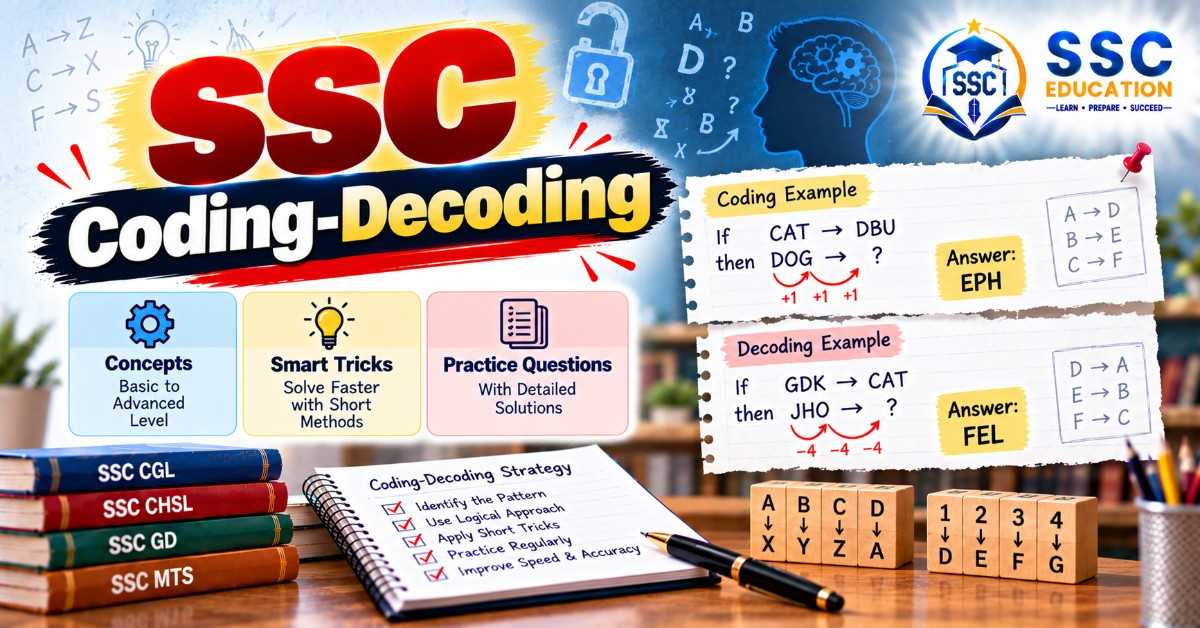
Coding-Decoding is a very common topic in the SSC reasoning section. Two to four questions appear in almost every shift of CGL, CHSL, MTS and GD, and they are among the easiest to score once you recognise the pattern. This practice paper has 30 coding-decoding questions with answers and short solutions, covering letter shifting, reverse alphabet, word codes, number codes and symbol substitution.
Practice Paper at a Glance
| Detail | Information |
|---|---|
| Topic | Coding-Decoding (Reasoning) |
| Total questions | 30 questions in 3 sets |
| Level | Easy to exam level |
| Useful for | SSC CGL, CHSL, MTS, GD, CPO and other government exams |
| Includes | Answers, step-by-step solutions, shortcut tricks and FAQs |
| Time to attempt | 35 to 40 minutes |
What Is Coding-Decoding? Basic Concept in Simple Words
In coding-decoding, a word, number or statement is changed into a code using a hidden rule. You have to find the rule from the given example and then apply it to a new word. The common types are:
- Letter shifting: each letter moves forward or backward by a fixed number of places.
- Opposite or reverse alphabet: A becomes Z, B becomes Y and so on.
- Word reversal and position-based codes.
- Number or value coding: letters are replaced by their position values.
- Word-to-code (substitution): compare statements to find the code for each word.
- Mathematical operator substitution: signs are swapped and the expression is solved.
Tricks and Shortcuts for SSC Coding-Decoding
- Write the alphabet with positions (A = 1 to Z = 26) in your rough work. It makes shifting and opposite letters quick.
- Opposite letter of a letter at position n is at position (27 - n). So A and Z, B and Y, M and N are pairs.
- Check the first two letters of the example to find the shift (for example +1, +2 or alternating +1 and -1).
- If the pattern increases (+1, +2, +3...), apply it to every letter in the same order.
- Wrap around: after Z comes A again. Y + 5 = D.
- For word-code questions, find the word common to two statements and the code common to the same two statements.
- For operator substitution, rewrite the expression with the real signs first and then solve using BODMAS.
- Sum of position values: write the value of each letter and add them. Do not guess.
Set 1: Letter Shifting and Basic Codes (Q1–Q10)
Q1. If CAT is written as DBU in a code, how is DOG written in that code?
Answer: EPH
Solution: Each letter moves one step forward (+1). D to E, O to P and G to H.
Q2. If BOOK is coded as CPPL, how will LAMP be coded?
Answer: MBNQ
Solution: Each letter is shifted +1: L to M, A to B, M to N and P to Q.
Q3. If ROSE is coded as TQUG, how is FLOWER coded?
Answer: HNQYGT
Solution: Each letter is shifted +2: F to H, L to N, O to Q, W to Y, E to G and R to T.
Q4. If APPLE is coded as ZKKOV (opposite letters), how is PEN coded?
Answer: KVM
Trick: Opposite letters: P to K, E to V and N to M.
Q5. If MONDAY is coded as NPOEBZ, how is SUNDAY coded?
Answer: TVOEBZ
Solution: Each letter is shifted +1: S to T, U to V, N to O, D to E, A to B and Y to Z.
Q6. If DELHI is written as IHLED, how is MUMBAI written?
Answer: IABMUM
Solution: The word is written in reverse order. MUMBAI reversed is IABMUM.
Q7. If A = 1, B = 2, C = 3 and so on, find the value of the word DOG.
Answer: 26
Solution: D = 4, O = 15 and G = 7. Sum = 26.
Q8. If CAT is coded as 24 (using position values), how is DOG coded?
Answer: 26
Solution: CAT = 3 + 1 + 20 = 24. DOG = 4 + 15 + 7 = 26.
Q9. In a code, EXAM is written as FZDQ. How is STUDY written in the same code?
Answer: TVXHD
Trick: Shifts are +1, +2, +3, +4 and +5 for the 1st to 5th letters. S+1 = T, T+2 = V, U+3 = X, D+4 = H and Y+5 = D.
Q10. In a code, BRAIN is written as DTCKP. How is CHILD written in the same code?
Answer: EJKNF
Solution: Each letter is shifted +2: C to E, H to J, I to K, L to N and D to F.
Set 2: Pattern, Word and Substitution Codes (Q11–Q20)
Q11. If GO is written as IQ in a code, how is COME written?
Answer: EQOG
Solution: Each letter is shifted +2: C to E, O to Q, M to O and E to G.
Q12. In a code where A = 26, B = 25, C = 24 and so on, what is the value of D?
Answer: 23
Trick: Opposite position of D (4th letter) = 27 - 4 = 23.
Q13. If 2 is coded as 5, 3 as 10 and 4 as 17, how will 5 be coded?
Answer: 26
Solution: The pattern is n^2 + 1. For 5: 25 + 1 = 26.
Q14. If + means x, x means -, division sign means + and - means division, find 8 + 6 x 4 (div) 12 - 2.
Answer: 50
Trick: Replace the signs: 8 x 6 - 4 + 12 / 2 = 48 - 4 + 6 = 50.
Q15. In a code, "tea is hot" is written as "ka na ra", "hot water" as "ra pa" and "water is cold" as "pa na ya". What is the code for "is"?
Answer: na
Trick: The word "is" is common to the first and third statements. The code common to both is "na".
Q16. Using the same code language, what is the code for "water"?
Answer: pa
Solution: "Water" is common to the second and third statements. The code common to both is "pa".
Q17. If MADRAS is coded as NBESBT, how is BOMBAY coded?
Answer: CPNCBZ
Solution: Each letter is shifted +1: B to C, O to P, M to N, B to C, A to B and Y to Z.
Q18. If LIGHT is coded as MKHJU, how is NIGHT coded?
Answer: OKHJU
Trick: The shifts are +1, +2, +1, +2, +1. N+1 = O, I+2 = K, G+1 = H, H+2 = J and T+1 = U.
Q19. If PENCIL is coded as OFMDHM, how is ERASER coded?
Answer: DSZTDS
Trick: The pattern is -1, +1, -1, +1... E-1 = D, R+1 = S, A-1 = Z, S+1 = T, E-1 = D and R+1 = S.
Q20. If SCHOOL is coded as VFKRRO (+3 for each letter), how is BOOK coded?
Answer: ERRN
Solution: Each letter is shifted +3: B to E, O to R, O to R and K to N.
Set 3: Advanced and Exam-Level Coding Questions (Q21–Q30)
Q21. If A = 1, B = 2, ... Z = 26, find the sum of the position values of the word SSC.
Answer: 41
Solution: S = 19, S = 19 and C = 3. Sum = 41.
Q22. What is the opposite letter of F in the English alphabet?
Answer: U
Trick: F is the 6th letter. Opposite position = 27 - 6 = 21, which is U.
Q23. If CLOCK is coded as DNRGP, how is TIMER coded?
Answer: UKPIW
Solution: The shifts are +1, +2, +3, +4 and +5. T+1 = U, I+2 = K, M+3 = P, E+4 = I and R+5 = W.
Q24. If APPLE has the value 50 (A = 1, P = 16, L = 12, E = 5), what is the value of PEAR?
Answer: 40
Solution: P = 16, E = 5, A = 1 and R = 18. Sum = 40.
Q25. If DOG is coded as WLT, how is CAT coded?
Answer: XZG
Trick: This is the opposite letter code: C to X, A to Z and T to G.
Q26. If FRIEND is coded as HUMJTK, how is CANDLE coded?
Answer: EDRIRL
Solution: The shifts are +2, +3, +4, +5, +6 and +7. C+2 = E, A+3 = D, N+4 = R, D+5 = I, L+6 = R and E+7 = L.
Q27. If P means +, Q means -, R means x and S means division, find 12 R 3 P 8 S 4 Q 5.
Answer: 33
Trick: Replace: 12 x 3 + 8 / 4 - 5 = 36 + 2 - 5 = 33.
Q28. If RAIN is coded as UDLQ, how is SNOW coded?
Answer: VQRZ
Solution: Each letter is shifted +3: S to V, N to Q, O to R and W to Z.
Q29. In a code language, CAB is written as 312 and BAD is written as 214. How is DAB written?
Answer: 412
Solution: Each letter is replaced by its position: C = 3, A = 1, B = 2 and D = 4. DAB = 4, 1, 2 = 412.
Q30. If the letters of the word SCHOOL are arranged in alphabetical order, which letter will be third from the right end?
Answer: O
Solution: Alphabetical order: C, H, L, O, O, S. Third from the right is O.
Common Mistakes in Coding-Decoding
- Applying only +1 to all the letters without checking the full example.
- Forgetting to wrap around after Z (Y + 5 should become D).
- Mixing up forward and backward shifting.
- Not noting the pattern when the shifts change for every position.
- Making addition errors in position-value questions.
- Ignoring BODMAS after replacing the operator signs.
How to Practice These 30 Questions
- Write the alphabet with positions on your rough sheet before starting.
- Identify the type of coding from the example in the first 10 seconds.
- Solve Set 1 in 8 minutes, Set 2 in 12 minutes and Set 3 in 12 minutes.
- Verify the rule on every letter of the example before applying it.
- Review mistakes after 24 hours and repeat the paper after a week.
Related Topics to Study Next
- Number Series Questions
- Direction and Distance Questions
- SSC Blood Relation Questions
- SSC Previous Year Papers
Frequently Asked Questions
What is coding-decoding in reasoning?
Coding-decoding is a reasoning topic where a word, number or statement is converted into a code using a hidden rule. You find the rule from an example and apply it to another word.
How many coding-decoding questions come in SSC exams?
Generally two to four coding-decoding questions are asked in the reasoning section of SSC CGL, CHSL, MTS and GD papers.
What are the types of coding-decoding?
The main types are letter shifting, opposite letter coding, reversal, position-value coding, word substitution and mathematical operator substitution.
What is opposite letter coding?
In opposite letter coding, every letter is replaced by the letter at the same distance from the other end of the alphabet. A becomes Z, B becomes Y, C becomes X and so on.
How do I find the opposite letter quickly?
The position of the opposite letter is 27 minus the position of the given letter. For example, F is the 6th letter, so its opposite is the 21st letter, U.
How do I solve word-code questions?
Find the word that is common to two statements and the code that is common to the same two statements. Use this to find the code of each word step by step.
What should I do if the shifting pattern changes in every letter?
Write the shift for each letter (+1, +2, +3 or alternating signs) from the example and apply the same sequence to the new word.
How do I solve operator substitution questions?
Replace the given symbols with their real meanings in the expression, then solve using BODMAS. Always write the new expression before calculating.
What is the best way to avoid mistakes in coding-decoding?
Write the alphabet with positions, check the rule on every letter of the example, and recheck your answer by decoding the result back.
How should I prepare coding-decoding for SSC exams?
Practise one set of each type every day, memorise the opposite letter pairs and then take timed mock tests to improve speed.
Rahul Kumar
SSC Exam Expert & Content Editor
Rahul is a senior SSC exam strategist with 8+ years of experience helping aspirants crack CGL, CHSL and MTS exams. He writes in-depth notification breakdowns, exam pattern guides and preparation strategies.