SSC Mixture and Alligation Questions with Tricks and Solutions
Rahul Kumar
SSC Exam Expert & Content Editor
Table of Contents
- 1.Practice Paper at a Glance
- 2.What Is Mixture and Alligation? Basic Concept in Simple Words
- 3.Formulas and Shortcut Tricks for SSC Mixture and Alligation
- 4.Set 1: Basic Mixture and Mean Price Questions (Q1–Q10)
- 5.Set 2: Alligation Rule and Replacement Questions (Q11–Q20)
- 6.Set 3: Mixed and Exam-Level Questions (Q21–Q30)
- 7.Common Mistakes in Mixture and Alligation
- 8.How to Practice These 30 Questions
- 9.Related Topics to Study Next
- 10.Frequently Asked Questions
Practice 30 SSC mixture and alligation questions with answers, the alligation rule and shortcut tricks. Covers mean price, replacement, milk-water and alloy problems for CGL, CHSL, MTS and GD.
Mixture and Alligation is a short but scoring chapter in SSC Quantitative Aptitude. Most questions can be solved in 20 to 30 seconds using the alligation cross method, and the replacement formula takes care of the rest. This practice paper gives you 30 mixture and alligation questions with answers and short solutions, covering price mixtures, milk and water, replacement and alloys.
Practice Paper at a Glance
| Detail | Information |
|---|---|
| Topic | Mixture and Alligation |
| Total questions | 30 questions in 3 sets |
| Level | Easy to exam level |
| Useful for | SSC CGL, CHSL, MTS, GD, CPO and other government exams |
| Includes | Answers, step-by-step solutions, shortcut tricks and FAQs |
| Time to attempt | 35 to 40 minutes |
What Is Mixture and Alligation? Basic Concept in Simple Words
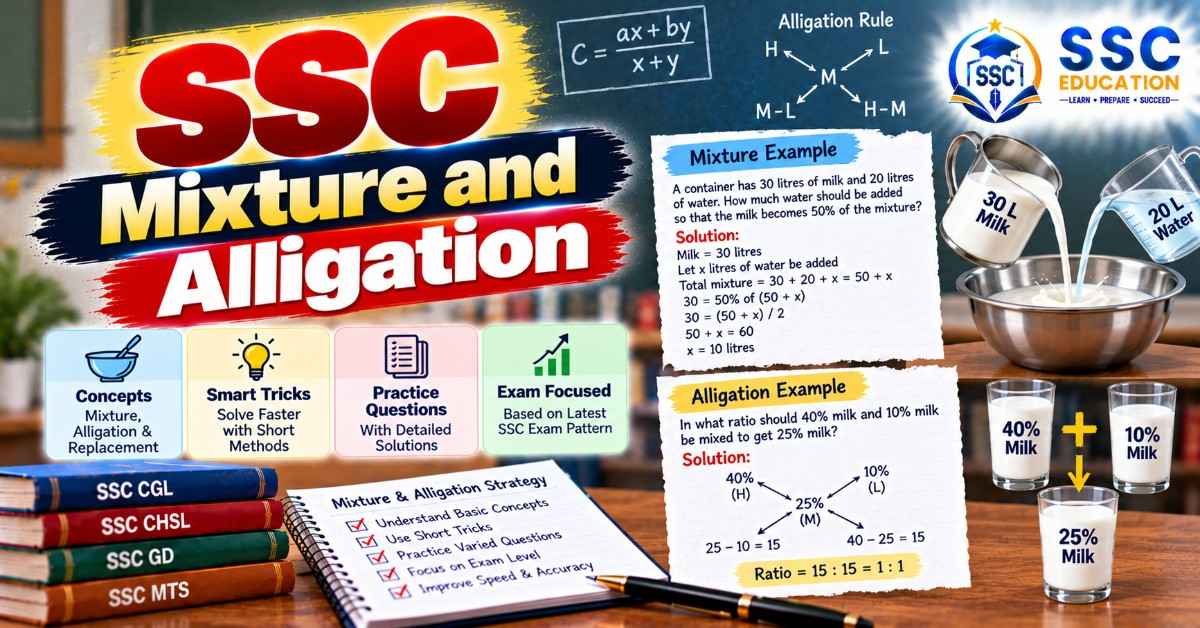
A mixture is formed when two or more things (liquids, grains, metals) are mixed in a certain ratio. Alligation is a quick rule to find the ratio in which two things should be mixed to get a mixture of a desired average value (price, concentration or quality).
- The mean value always lies between the cheaper and dearer values.
- Alligation finds the ratio of quantities from the differences of the values.
- It works for price, speed, percentage, profit and many other averages.
Formulas and Shortcut Tricks for SSC Mixture and Alligation
- Alligation rule: (Quantity of cheaper) : (Quantity of dearer) = (Dearer price - Mean price) : (Mean price - Cheaper price).
- Mean price = (Q1 x P1 + Q2 x P2) / (Q1 + Q2).
- Replacement formula: if a vessel contains x litres of pure liquid and y litres are removed and replaced with water n times, the pure liquid left = x (1 - y/x)^n.
- Water in milk is taken as a liquid with price 0 and concentration 0 percent. Pure milk is 100 percent.
- Profit in mixtures: first find the cost price of the mixture and then use the selling price to find the profit percentage.
- Adding a pure component: use the unchanged amount of the other component to form an equation.
- Alloys: add the quantities of each metal separately and then find the new ratio.
- Speed alligation: if a journey is made at two speeds, the ratio of times is (higher speed - average) : (average - lower speed).
Set 1: Basic Mixture and Mean Price Questions (Q1–Q10)
Q1. 20 kg of rice at Rs 30 per kg is mixed with 30 kg of rice at Rs 40 per kg. Find the price per kg of the mixture.
Answer: Rs 36
Solution: Total cost = 600 + 1,200 = 1,800. Quantity = 50 kg. Price = 1,800 / 50 = Rs 36.
Q2. In what ratio should sugar at Rs 40 per kg be mixed with sugar at Rs 50 per kg to get a mixture worth Rs 46 per kg?
Answer: 2 : 3
Trick: Cheaper : Dearer = (50 - 46) : (46 - 40) = 4 : 6 = 2 : 3.
Q3. A mixture of 20 litres contains milk and water in the ratio 3 : 2. Find the quantity of milk and water.
Answer: Milk = 12 litres and water = 8 litres
Solution: Milk = 20 x 3/5 = 12 litres and water = 20 x 2/5 = 8 litres.
Q4. A 30 litre mixture contains milk and water in the ratio 2 : 1. How much water should be added to make the ratio 1 : 1?
Answer: 10 litres
Solution: Milk = 20 litres and water = 10 litres. For a 1 : 1 ratio, water must be 20 litres, so add 10 litres.
Q5. Two liquids costing Rs 12 and Rs 18 per litre are mixed in the ratio 1 : 2. Find the price of the mixture per litre.
Answer: Rs 16
Solution: Price = (1 x 12 + 2 x 18) / 3 = 48 / 3 = Rs 16.
Q6. 5 kg of tea at Rs 100 per kg is mixed with 15 kg of tea at Rs 60 per kg. Find the price of the mixture per kg.
Answer: Rs 70
Solution: Total cost = 500 + 900 = 1,400. Price = 1,400 / 20 = Rs 70.
Q7. In what ratio should water be mixed with milk costing Rs 40 per litre so that the mixture is worth Rs 32 per litre?
Answer: 1 : 4
Trick: Water (price 0) : Milk = (40 - 32) : (32 - 0) = 8 : 32 = 1 : 4.
Q8. A 40 litre mixture contains 10% water. How much milk is there in it?
Answer: 36 litres
Solution: Milk = 90% of 40 = 36 litres.
Q9. A 60 litre mixture has milk and water in the ratio 7 : 3. How much water must be added to make the ratio 7 : 5?
Answer: 12 litres
Solution: Milk = 42 litres and water = 18 litres. For 7 : 5, water = 42 x 5/7 = 30 litres. Add 30 - 18 = 12 litres.
Q10. Two varieties of rice costing Rs 20 and Rs 30 per kg are mixed in the ratio 3 : 2. Find the price of the mixture per kg.
Answer: Rs 24
Solution: Price = (3 x 20 + 2 x 30) / 5 = 120 / 5 = Rs 24.
Set 2: Alligation Rule and Replacement Questions (Q11–Q20)
Q11. In what ratio should wheat at Rs 24 per kg be mixed with wheat at Rs 30 per kg to get a mixture worth Rs 28 per kg?
Answer: 1 : 2
Trick: Cheaper : Dearer = (30 - 28) : (28 - 24) = 2 : 4 = 1 : 2.
Q12. In what ratio must water be mixed with milk costing Rs 12 per litre so that selling the mixture at Rs 12 per litre gives a 20% profit?
Answer: 1 : 5
Trick: Cost of the mixture = 12 / 1.2 = Rs 10 per litre. Water : Milk = (12 - 10) : (10 - 0) = 2 : 10 = 1 : 5.
Q13. A 30 litre solution has 20% alcohol. How much pure alcohol must be added to make it 25% alcohol?
Answer: 2 litres
Solution: Alcohol = 6 litres. (6 + x) / (30 + x) = 1/4, so 24 + 4x = 30 + x and x = 2 litres.
Q14. A 40 litre mixture has milk and water in the ratio 3 : 1. How much water must be added to make the ratio 1 : 1?
Answer: 20 litres
Solution: Milk = 30 litres and water = 10 litres. For 1 : 1, water = 30 litres. Add 20 litres.
Q15. Two vessels contain milk and water in the ratio 2 : 3 and 3 : 2. If equal quantities from both are mixed, find the ratio of milk to water in the new mixture.
Answer: 1 : 1
Solution: Take 5 litres from each. Milk = 2 + 3 = 5 litres and water = 3 + 2 = 5 litres. So the ratio is 1 : 1.
Q16. 20 kg of an alloy has copper and tin in the ratio 3 : 1 and 40 kg of another alloy has them in the ratio 1 : 1. If both are melted together, find the ratio of copper to tin.
Answer: 7 : 5
Solution: Copper = 15 + 20 = 35 kg and tin = 5 + 20 = 25 kg. Ratio = 35 : 25 = 7 : 5.
Q17. 15 litres of a 40% acid solution is mixed with 5 litres of an 80% acid solution. Find the percentage of acid in the new mixture.
Answer: 50%
Solution: Acid = 6 + 4 = 10 litres in 20 litres. Percentage = 10 / 20 x 100 = 50%.
Q18. How much water must be added to 10 litres of 40% alcohol solution to make it 25% alcohol?
Answer: 6 litres
Solution: Alcohol = 4 litres. Total needed = 4 / 0.25 = 16 litres. Water to add = 16 - 10 = 6 litres.
Q19. A vessel contains 60 litres of milk. 12 litres are withdrawn and replaced with water. The same is done once more. How much milk is left in the vessel?
Answer: 38.4 litres
Trick: Milk left = 60 x (1 - 12/60)^2 = 60 x (4/5)^2 = 60 x 0.64 = 38.4 litres.
Q20. A container has 40 litres of pure milk. 4 litres are taken out and replaced with water, and this is repeated once more. How much pure milk remains?
Answer: 32.4 litres
Trick: Milk left = 40 x (1 - 4/40)^2 = 40 x 0.81 = 32.4 litres.
Set 3: Mixed and Exam-Level Questions (Q21–Q30)
Q21. Rice at Rs 36 per kg and Rs 44 per kg are mixed in the ratio 3 : 2. Find the average price per kg.
Answer: Rs 39.20
Solution: Price = (3 x 36 + 2 x 44) / 5 = (108 + 88) / 5 = 196 / 5 = Rs 39.20.
Q22. In what ratio should tea at Rs 62 per kg be mixed with tea at Rs 72 per kg so that the mixture is worth Rs 64.50 per kg?
Answer: 3 : 1
Trick: Cheaper : Dearer = (72 - 64.50) : (64.50 - 62) = 7.5 : 2.5 = 3 : 1.
Q23. 100 g of a 10% salt solution is mixed with 200 g of a 25% salt solution. Find the percentage of salt in the mixture.
Answer: 20%
Solution: Salt = 10 + 50 = 60 g in 300 g. Percentage = 20%.
Q24. A merchant mixes two types of rice costing Rs 40 and Rs 60 per kg in the ratio 3 : 2 and sells the mixture at Rs 54 per kg. Find his profit percentage.
Answer: 12.5%
Solution: Cost price = (3 x 40 + 2 x 60) / 5 = Rs 48. Profit = 6 / 48 x 100 = 12.5%.
Q25. A container has 30 litres of milk. 6 litres of milk are taken out and replaced with water. Find the ratio of milk to water.
Answer: 4 : 1
Solution: Milk = 24 litres and water = 6 litres. Ratio = 4 : 1.
Q26. A 20 litre mixture has milk and water in the ratio 4 : 1. How much milk must be added to make the ratio 9 : 1?
Answer: 20 litres
Solution: Milk = 16 litres and water = 4 litres. For 9 : 1, milk = 36 litres. Add 20 litres.
Q27. A person covers 120 km in 2 hours, travelling partly by car at 40 km/h and the rest by train at 80 km/h. Find the distance covered by train.
Answer: 80 km
Trick: Average speed = 60 km/h. Time ratio car : train = (80 - 60) : (60 - 40) = 1 : 1, so 1 hour each. Train distance = 80 x 1 = 80 km.
Q28. Sugar at Rs 36 per kg and Rs 44 per kg is mixed to get a mixture worth Rs 42 per kg. If 12 kg of the cheaper sugar is used, how much of the dearer sugar is used?
Answer: 36 kg
Solution: Cheaper : Dearer = (44 - 42) : (42 - 36) = 2 : 6 = 1 : 3. Dearer = 12 x 3 = 36 kg.
Q29. In what ratio should a 20% acid solution be mixed with a 50% acid solution to get a 30% acid solution?
Answer: 2 : 1
Trick: 20% : 50% = (50 - 30) : (30 - 20) = 20 : 10 = 2 : 1.
Q30. A 20 litre mixture of milk and water is in the ratio 3 : 1. 4 litres of the mixture are removed and replaced with water. How much milk is now in the mixture?
Answer: 12 litres
Solution: Milk = 15 litres and water = 5 litres. In 4 litres of mixture, milk = 3 litres. Milk left = 12 litres.
Common Mistakes in Mixture and Alligation
- Writing the alligation differences in the wrong order (cheaper and dearer get swapped).
- Forgetting to treat water as a liquid with price 0 or concentration 0 percent.
- Using the replacement formula when the quantity removed is not equal each time.
- Not adding the common element of both quantities in the new mixture.
- Finding the percentage profit on the selling price instead of the cost price.
- Not checking that the mean value lies between the two given values.
How to Practice These 30 Questions
- Practise the alligation cross diagram until it becomes automatic.
- Solve Set 1 in 6 minutes to check your basics.
- Use the replacement formula in Set 2 and check each answer by direct calculation once.
- Attempt Set 3 in 12 minutes and try to find two different methods for at least three questions.
- Revise your mistakes and attempt the paper again after a week.
Related Topics to Study Next
- Ratio and Proportion Questions
- SSC Profit and Loss Questions
- Average Questions
- SSC Previous Year Papers
Frequently Asked Questions
What is alligation in maths?
Alligation is a quick method to find the ratio in which two or more ingredients at different prices or concentrations must be mixed to get a mixture of a given mean value.
What is the alligation rule?
Cheaper quantity : Dearer quantity = (Dearer price - Mean price) : (Mean price - Cheaper price). The mean price must lie between the two prices.
What is the replacement formula?
If a vessel contains x litres of a pure liquid and y litres are removed and replaced by water n times, the quantity of pure liquid left is x (1 - y/x)^n.
How do you solve milk and water questions?
Convert the ratio into quantities, treat water as the liquid with zero price or zero percent milk, and use either the alligation rule or an equation for the quantity added or removed.
Where is alligation used besides mixtures?
Alligation can be used for average speed, average age, profit and loss, simple interest on two parts of a sum and many other average-based questions.
How many mixture and alligation questions come in SSC CGL?
Usually one or two questions come from this chapter per shift, and the chapter is quick to solve once you know the cross method.
How do you find the profit in a mixture question?
First find the cost price of the mixture from the quantities and prices of its components, then compare it with the selling price to find the profit or loss percentage on the cost price.
What is the difference between mixture and alligation?
A mixture question gives the quantities and asks for the mean value, while an alligation question gives the mean value and asks for the ratio of the quantities.
What is the best way to practise mixture and alligation?
Start with price mixtures, move to milk and water and replacement, and then attempt acid, alloy and speed questions. Solve one set daily with a timer.
How should I prepare mixture and alligation for SSC exams?
Learn the cross method and replacement formula, solve topic-wise sets, make a list of formula-based shortcuts and test yourself with previous year SSC papers.
Rahul Kumar
SSC Exam Expert & Content Editor
Rahul is a senior SSC exam strategist with 8+ years of experience helping aspirants crack CGL, CHSL and MTS exams. He writes in-depth notification breakdowns, exam pattern guides and preparation strategies.