SSC Heights and Distances Questions with Solutions and Tricks
Rahul Kumar
SSC Exam Expert & Content Editor
Table of Contents
- 1.Angle of Elevation and Depression in Simple Words
- 2.Formulas and Shortcut Tricks
- 3.Set 1: Basic Questions (Q1–Q7)
- 4.Set 2: Depression and Two-Position Problems (Q8–Q14)
- 5.Set 3: Exam-Level Questions (Q15–Q19)
- 6.Common Mistakes in Heights and Distances
- 7.Related Topics to Study Next
- 8.Frequently Asked Questions
Practice 19 SSC heights and distances questions with answers and solutions. Covers angle of elevation and depression, towers, ladders, kites and two-position problems for CGL, CHSL and CPO.
Heights and distances is a scoring part of SSC trigonometry. A question usually gives an angle of elevation or depression and asks for the height of a tower or the distance of an object. If you draw a right triangle and use the tan ratio, most questions are solved in under a minute. This practice paper gives you 19 questions with answers and short solutions.
Angle of Elevation and Depression in Simple Words
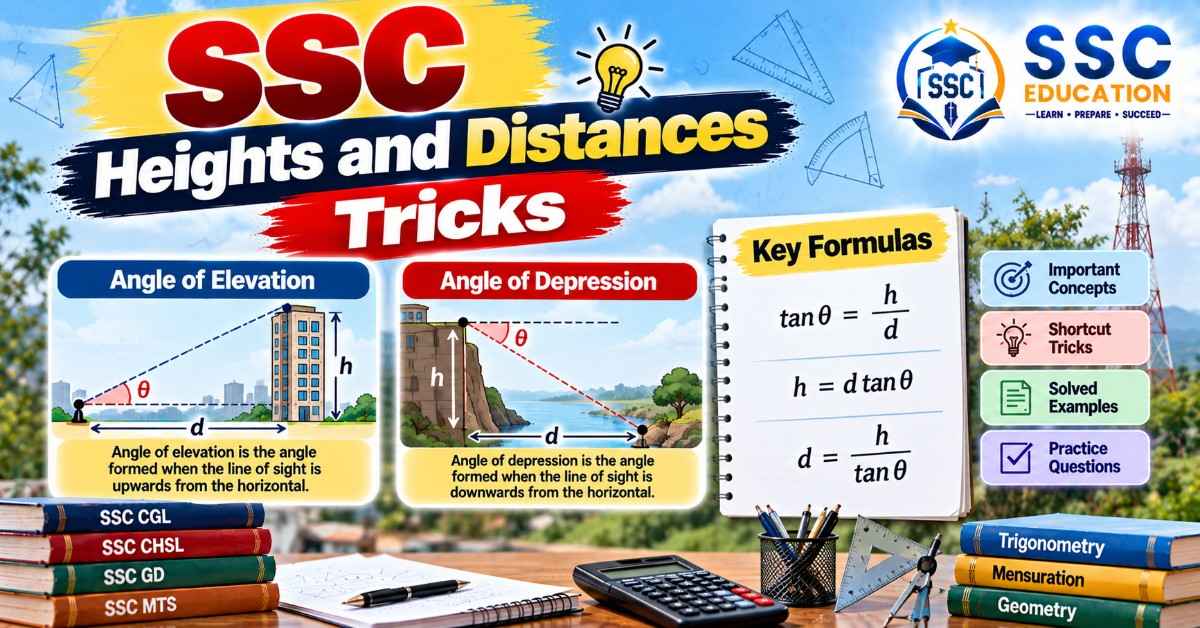
When you look up at an object, the angle between your line of sight and the horizontal is the angle of elevation. When you look down, the angle between your line of sight and the horizontal is the angle of depression.
- The angle of elevation from A to B is equal to the angle of depression from B to A (alternate angles).
- Both angles are always measured from the horizontal, never from the vertical.
- Most problems form a right triangle with the height as the perpendicular and the distance as the base.
Formulas and Shortcut Tricks
- tan theta = height / distance. Use sin when the length of the string or ladder is given, and cos when the base and the length are given.
- Standard values: tan 30 = 1/root 3, tan 45 = 1 and tan 60 = root 3.
- Two-position problems: write the distance in terms of the height for each position and subtract.
- If the elevations from two points on the same line are complementary, height = square root of (d1 x d2).
- For a 45 degree angle, the height equals the distance.
- Always draw the figure and mark the known angle and side before calculating.
Set 1: Basic Questions (Q1–Q7)
Q1. The shadow of a 10 m pole is 10 m long. Find the angle of elevation of the sun.
Answer: 45 degrees
Solution: tan theta = 10/10 = 1.
Q2. From a point 20 m from the foot of a tower, the angle of elevation of the top is 60 degrees. Find the height.
Answer: 20 root 3 m (about 34.6 m)
Solution: Height = 20 x tan 60 = 20 root 3 m.
Q3. A 10 m long ladder makes 60 degrees with the ground. How high does it reach on the wall?
Answer: 5 root 3 m (about 8.66 m)
Solution: Height = 10 x sin 60.
Q4. The angle of elevation of the top of a 50 m tower from a point is 45 degrees. Find the distance of the point from the tower.
Answer: 50 m
Solution: At 45 degrees, distance = height.
Q5. The shadow of a pole is 12 root 3 m when the angle of elevation of the sun is 30 degrees. Find the height of the pole.
Answer: 12 m
Solution: Height = 12 root 3 x tan 30 = 12 m.
Q6. A kite is at a height of 60 m and its string makes 30 degrees with the horizontal. Find the length of the string.
Answer: 120 m
Solution: String = 60 / sin 30 = 120 m.
Q7. A man 1.8 m tall casts a shadow 2.4 m long. At the same time a tree casts a shadow 16 m long. Find the height of the tree.
Answer: 12 m
Trick: 1.8 / 2.4 = h / 16, so h = 12 m.
Set 2: Depression and Two-Position Problems (Q8–Q14)
Q8. From the top of a 100 m tower, the angle of depression of a car is 45 degrees. How far is the car from the foot of the tower?
Answer: 100 m
Solution: At 45 degrees, distance = height.
Q9. From the top of a 75 m cliff, the angle of depression of a boat is 30 degrees. Find its distance from the foot of the cliff.
Answer: 75 root 3 m (about 129.9 m)
Solution: Distance = 75 / tan 30 = 75 root 3 m.
Q10. The angle of elevation of the top of a tower from a point 30 m away is 30 degrees. Find the height.
Answer: 10 root 3 m (about 17.3 m)
Solution: Height = 30 x tan 30 = 30 / root 3 = 10 root 3 m.
Q11. A tree breaks and its top touches the ground 10 m from the foot, making 30 degrees with the ground. Find the original height of the tree.
Answer: 10 root 3 m
Solution: Break height = 10 tan 30 and broken part = 10 / cos 30. Total = 30 / root 3 = 10 root 3 m.
Q12. A 6 m pole has a shadow of 2 root 3 m. Find the angle of elevation of the sun.
Answer: 60 degrees
Solution: tan theta = 6 / (2 root 3) = root 3.
Q13. A ladder 10 m long has its foot 6 m from a wall. How high does it reach?
Answer: 8 m
Solution: Height = square root of (100 - 36) = 8 m.
Q14. An observer sees the top of a tower at 45 degrees. After moving 20 m closer, the angle becomes 60 degrees. Find the height of the tower.
Answer: 10(3 + root 3) m (about 47.3 m)
Trick: d = h and d - 20 = h / root 3. So h(1 - 1/root 3) = 20 and h = 10(3 + root 3) m.
Set 3: Exam-Level Questions (Q15–Q19)
Q15. From a lighthouse 60 m high, the angles of depression of two ships on the same side are 45 and 30 degrees. Find the distance between the ships.
Answer: 60(root 3 - 1) m (about 43.9 m)
Solution: Distances are 60 and 60 root 3.
Q16. The angles of elevation of the top of a tower from two points 4 m and 9 m from its foot (on the same line) are complementary. Find the height.
Answer: 6 m
Trick: Height = square root of (4 x 9) = 6 m.
Q17. The angle of elevation of an aeroplane from a point is 60 degrees and its height is 3,000 m. Find its horizontal distance.
Answer: 1,000 root 3 m (about 1,732 m)
Solution: Distance = 3,000 / tan 60.
Q18. The base of a tower is 40 m from a point and tan theta = 3/4 for the angle of elevation. Find the height.
Answer: 30 m
Solution: Height = 40 x 3/4 = 30 m.
Q19. The angle of elevation of A from B is 25 degrees. What is the angle of depression of B from A?
Answer: 25 degrees
Solution: Alternate angles are equal.
Common Mistakes in Heights and Distances
- Measuring the angle from the vertical instead of the horizontal.
- Using sin or cos where tan is needed.
- Mixing the angle of elevation and the angle of depression.
- Forgetting the height of the observer in some questions.
Related Topics to Study Next
Frequently Asked Questions
What is the angle of elevation?
It is the angle between the horizontal and the line of sight when you look up at an object.
What is the angle of depression?
It is the angle between the horizontal and the line of sight when you look down at an object.
Are the angles of elevation and depression equal?
Yes. The angle of elevation from A to B is equal to the angle of depression from B to A.
Which trigonometric ratio is used most in heights and distances?
The tan ratio, because tan theta = height / distance.
What are the values of tan 30, 45 and 60?
tan 30 = 1/root 3, tan 45 = 1 and tan 60 = root 3.
How do I solve a two-position problem?
Write the distance of each position in terms of the height and use the given difference to find the height.
What is the trick for complementary angles?
If the angles of elevation from two points on the same line are complementary, the height is the square root of the product of the two distances.
What is a shadow problem?
It is a question in which the angle of elevation of the sun is used with the length of the shadow to find the height.
How many heights and distances questions come in SSC exams?
Usually one to three questions come in CGL Tier 1 and Tier 2 and in CHSL and CPO.
Do I need to draw a diagram?
Yes. A diagram helps you avoid mistakes in the angle and the sides.
What if the angle is not a standard angle?
In SSC exams, the angles are usually standard (30, 45, 60) or tan values are given.
How should I prepare heights and distances for SSC exams?
Learn trigonometric values, practise drawing figures and solve previous year questions.
Rahul Kumar
SSC Exam Expert & Content Editor
Rahul is a senior SSC exam strategist with 8+ years of experience helping aspirants crack CGL, CHSL and MTS exams. He writes in-depth notification breakdowns, exam pattern guides and preparation strategies.