SSC Biology Questions with Answers: Cell, Human Body, Diseases and Vitamins
Rahul Kumar
SSC Exam Expert & Content Editor
Table of Contents
- 1.Key Concepts to Remember
- 2.Vitamins and Deficiency Diseases
- 3.Important Organs, Diseases and Their Causes
- 4.Set 1: Cell and Human Body (Q1–Q7)
- 5.Set 2: Vitamins and Nutrition (Q8–Q14)
- 6.Set 3: Diseases, Blood and Plants (Q15–Q21)
- 7.Digestion, Blood Circulation and Plant Facts
- 8.Simple Revision Method for Biology
- 9.Common Mistakes in Biology
- 10.How to Practice These 21 Questions
- 11.Related Topics to Study Next
- 12.Frequently Asked Questions
Practice 21 SSC biology questions with answers on the cell, human body, vitamins, diseases and plants, with fact tables and short explanations for CGL, CHSL, MTS and GD exams.
Biology gives many easy marks in SSC General Science. The questions come from the cell, the human body, vitamins, diseases and plants. This practice paper gives you fact tables and 21 questions with answers and short explanations, so that you can revise the most repeated facts in one sitting.
Key Concepts to Remember
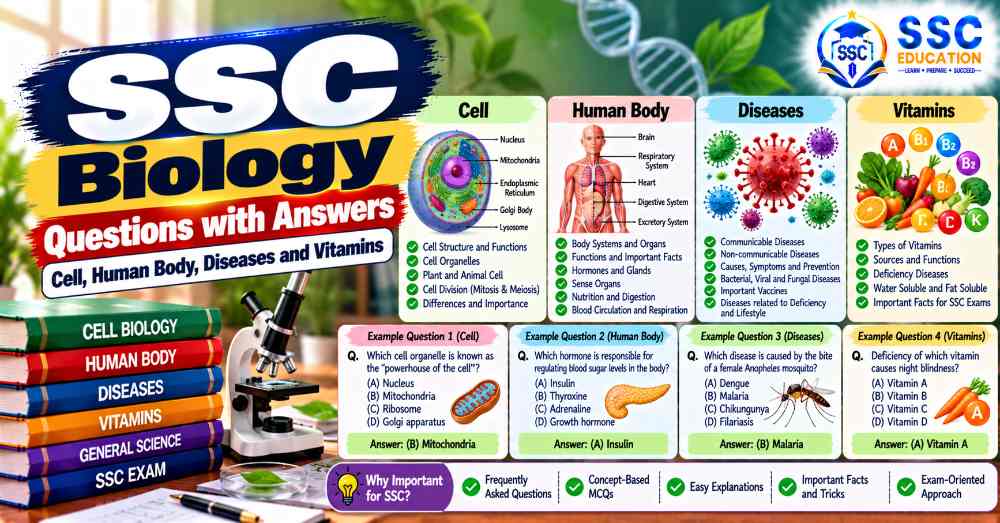
- The cell is the basic unit of life, and the mitochondria are called the powerhouse of the cell.
- The nucleus controls the cell and carries the genes. Plant cells have a cell wall and chloroplasts, while animal cells do not.
- Blood has red cells (carry oxygen), white cells (fight infection) and platelets (help clotting).
- The heart has four chambers, and the normal adult heart beats about 72 times a minute.
Vitamins and Deficiency Diseases
| Vitamin | Deficiency disease |
|---|---|
| Vitamin A | Night blindness |
| Vitamin B1 (Thiamine) | Beri-beri |
| Vitamin B2 (Riboflavin) | Cracks at the corners of the mouth |
| Vitamin B3 (Niacin) | Pellagra |
| Vitamin B12 | Pernicious anaemia |
| Vitamin C | Scurvy |
| Vitamin D | Rickets in children and osteomalacia in adults |
| Vitamin E | Weak muscles and sterility |
| Vitamin K | Delayed blood clotting |
| Iodine | Goitre |
| Iron | Anaemia |
| Calcium | Weak bones and teeth |
| Protein | Kwashiorkor |
| Protein and energy | Marasmus |
Important Organs, Diseases and Their Causes
| Topic | Fact |
|---|---|
| Largest organ of the body | Skin |
| Largest gland | Liver |
| Longest bone | Femur (thigh bone) |
| Smallest bone | Stapes (in the ear) |
| Number of bones in an adult | 206 |
| Normal blood pressure | 120/80 mm of Hg |
| Blood group discovered by | Karl Landsteiner |
| Universal donor | O negative |
| Universal recipient | AB positive |
| Malaria | Caused by Plasmodium, spread by the female Anopheles mosquito |
| Dengue | Caused by a virus, spread by the Aedes mosquito |
| Tuberculosis | Caused by a bacterium (Mycobacterium tuberculosis) |
| Cholera and typhoid | Bacterial diseases |
| Polio, measles and AIDS | Viral diseases |
Biology questions in SSC are direct and repeat often, so the two tables above are enough to answer a large part of the paper. Remember the difference between a bacterial and a viral disease, because many questions ask you to pick the odd one out. Also remember that photosynthesis takes place in the chloroplasts of green plants, that plants take in carbon dioxide and release oxygen during the day, and that the plant hormone auxin controls growth.
Set 1: Cell and Human Body (Q1–Q7)
Q1. Which organelle is called the powerhouse of the cell?
Answer: Mitochondria
Solution: They release energy during respiration.
Q2. Who discovered the cell?
Answer: Robert Hooke
Solution: He observed cork cells in 1665.
Q3. Which is the largest organ of the human body?
Answer: Skin
Solution: It protects the body.
Q4. Which is the longest bone in the human body?
Answer: Femur
Solution: It is the thigh bone.
Q5. How many bones are there in an adult human body?
Answer: 206
Solution: A baby has about 300.
Q6. Which is the largest gland in the human body?
Answer: Liver
Solution: It also makes bile.
Q7. How many chambers are there in the human heart?
Answer: Four
Solution: Two atria and two ventricles.
Set 2: Vitamins and Nutrition (Q8–Q14)
Q8. Deficiency of which vitamin causes scurvy?
Answer: Vitamin C
Solution: It is found in citrus fruits and amla.
Q9. Deficiency of which vitamin causes night blindness?
Answer: Vitamin A
Solution: Carrots and papaya are good sources.
Q10. Deficiency of which vitamin causes rickets?
Answer: Vitamin D
Solution: Sunlight helps the body make it.
Q11. Deficiency of which vitamin causes beri-beri?
Answer: Vitamin B1
Solution: It is also called thiamine.
Q12. Which vitamin helps in blood clotting?
Answer: Vitamin K
Solution: Green leafy vegetables are rich in it.
Q13. Deficiency of iodine causes which disease?
Answer: Goitre
Solution: Iodised salt prevents it.
Q14. Deficiency of iron causes which disease?
Answer: Anaemia
Solution: Haemoglobin is low.
Set 3: Diseases, Blood and Plants (Q15–Q21)
Q15. Which mosquito spreads malaria?
Answer: Female Anopheles
Solution: The parasite is Plasmodium.
Q16. Which of these is a viral disease: typhoid, polio, cholera or tuberculosis?
Answer: Polio
Solution: The others are bacterial.
Q17. Who discovered the blood groups?
Answer: Karl Landsteiner
Solution: He did so in 1901.
Q18. Which blood group is called the universal donor?
Answer: O negative
Solution: It has no A or B antigens.
Q19. In which part of the plant cell does photosynthesis take place?
Answer: Chloroplast
Solution: It contains chlorophyll.
Q20. Which gas do plants take in during photosynthesis?
Answer: Carbon dioxide
Solution: They release oxygen.
Q21. Which pigment gives the green colour to leaves?
Answer: Chlorophyll
Solution: It absorbs sunlight.
Digestion, Blood Circulation and Plant Facts
| Topic | Fact |
|---|---|
| Digestion of starch begins in | The mouth (by salivary amylase) |
| Digestion of protein begins in | The stomach (by pepsin) |
| Most digestion and absorption takes place in | The small intestine |
| Largest part of the brain | Cerebrum |
| Organ that filters blood | Kidney |
| Functional unit of the kidney | Nephron |
| Hormone that controls blood sugar | Insulin (from the pancreas) |
| Hormone called the fight or flight hormone | Adrenaline |
| Pacemaker of the heart | Sinoatrial node |
| Process of loss of water from leaves | Transpiration |
| Study of fungi | Mycology |
| Father of Biology | Aristotle |
Questions on the human body often ask about the organ that does a particular job, so learn the job of each major organ in one line. Remember that the pancreas makes both digestive juices and insulin, and that a deficiency of insulin causes diabetes.
Simple Revision Method for Biology
Do not read biology as a long chapter. Split it into five blocks: cell, human body systems, nutrition and vitamins, diseases, and plant life. Spend one day on each block, then use the 21 questions of this paper to test yourself. For every question you miss, write the answer in a small notebook. Reading that notebook for ten minutes before the exam is more useful than reading a whole book again.
Common Mistakes in Biology
- Mixing the deficiency diseases of vitamin B1, B3 and B12.
- Confusing bacterial and viral diseases.
- Writing the wrong mosquito for dengue and malaria.
- Mixing the largest organ (skin) with the largest gland (liver).
- Forgetting the number of bones in an adult and a baby.
- Confusing the universal donor and the universal recipient.
How to Practice These 21 Questions
- Learn the vitamin table first.
- Make a list of bacterial and viral diseases.
- Solve one set daily.
- Revise the wrong answers weekly.
Related Topics to Study Next
- SSC Science Questions
- Human Body Biology Questions
- 1000 Important SSC GK Questions
- SSC CGL Tier 1 Mini Mock
Frequently Asked Questions
Which vitamin deficiency causes scurvy?
Vitamin C.
Which vitamin deficiency causes night blindness?
Vitamin A.
Which organelle is the powerhouse of the cell?
Mitochondria.
Which is the largest organ of the human body?
Skin.
Which is the longest bone?
The femur.
How many bones are in an adult human body?
206.
Which mosquito spreads malaria?
The female Anopheles.
Which is the universal blood donor?
O negative.
Is polio a viral or bacterial disease?
Viral.
How many biology questions come in SSC exams?
Usually three to five in General Science.
Which biology topics are most important for SSC?
Vitamins, diseases, the human body and the cell.
How should I prepare biology for SSC exams?
Learn the tables, revise daily and practise questions.
Rahul Kumar
SSC Exam Expert & Content Editor
Rahul is a senior SSC exam strategist with 8+ years of experience helping aspirants crack CGL, CHSL and MTS exams. He writes in-depth notification breakdowns, exam pattern guides and preparation strategies.