SSC Human Body Biology Questions with Answers
Rahul Kumar
SSC Exam Expert & Content Editor
Table of Contents
- 1.Practice Paper at a Glance
- 2.Human Body Basics for SSC Exams
- 3.Important Fact Tables for SSC Human Body Biology
- 4.Set 1: Organs and Systems (Q1–Q10)
- 5.Set 2: Blood and Vitamins (Q11–Q20)
- 6.Set 3: Hormones, Digestion, Brain and Diseases (Q21–Q30)
- 7.Common Mistakes in Human Body Biology
- 8.How to Practice These 30 Questions
- 9.Related Topics to Study Next
- 10.Frequently Asked Questions
Revise important human body facts and practise 30 SSC human body biology questions with answers. Covers bones, blood, vitamins, hormones, digestion, brain and diseases for CGL, CHSL, MTS and GD.
Human Body and Biology is one of the most scoring parts of SSC General Science. Two to four questions in every shift of CGL, CHSL, MTS and GD come from biology, and most are straight facts: the number of bones, vitamins and diseases, hormones and glands. This practice paper gives you important fact tables and 30 practice questions with answers and short explanations.
Practice Paper at a Glance
| Detail | Information |
|---|---|
| Topic | Human Body and Biology (General Science) |
| Total questions | 30 questions in 3 sets |
| Level | Easy to exam level |
| Useful for | SSC CGL, CHSL, MTS, GD, CPO and other government exams |
| Includes | Answers, step-by-step solutions, shortcut tricks and FAQs |
| Time to attempt | 35 to 40 minutes |
Human Body Basics for SSC Exams
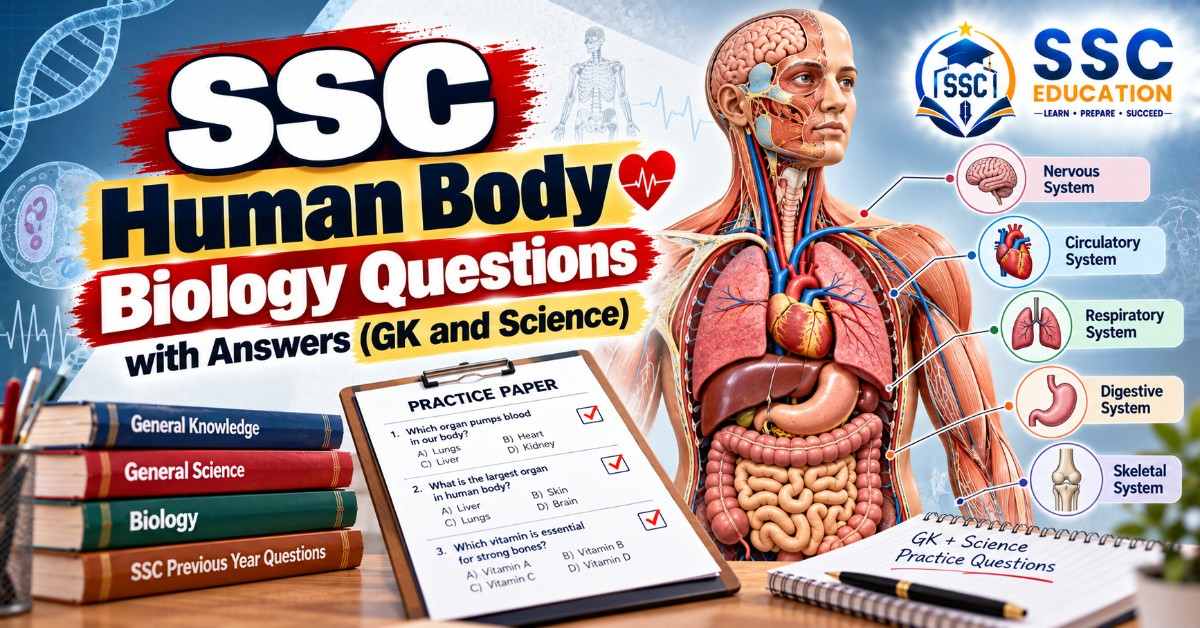
The human body is made of cells, tissues, organs and organ systems. For the SSC exam, you should know the major systems and their main facts.
- Skeletal system: 206 bones in an adult, 300 in a newborn baby.
- Circulatory system: heart, blood and blood vessels. The heart has 4 chambers.
- Digestive system: mouth, stomach, small and large intestine, liver and pancreas.
- Respiratory system: nose, trachea and lungs.
- Excretory system: kidneys, ureters, bladder and urethra.
- Nervous system: brain, spinal cord and nerves. Endocrine system: glands that make hormones.
Important Fact Tables for SSC Human Body Biology
Vitamins and Deficiency Diseases
| Vitamin | Deficiency disease | Source |
|---|---|---|
| Vitamin A (Retinol) | Night blindness | Carrot, milk, liver |
| Vitamin B1 (Thiamine) | Beriberi | Whole grains, pulses |
| Vitamin B2 (Riboflavin) | Cracks at the lips and mouth corners | Milk, eggs |
| Vitamin B12 | Pernicious anaemia | Meat, fish, milk |
| Vitamin C (Ascorbic acid) | Scurvy | Citrus fruits, amla |
| Vitamin D | Rickets in children and osteomalacia in adults | Sunlight, fish liver oil |
| Vitamin E | Reproductive problems | Vegetable oils, nuts |
| Vitamin K | Delayed blood clotting | Green leafy vegetables |
Endocrine Glands and Hormones
| Gland | Hormone | Function |
|---|---|---|
| Pituitary (master gland) | Growth hormone and others | Controls other glands and growth |
| Thyroid | Thyroxine | Controls metabolism |
| Pancreas | Insulin and glucagon | Control blood sugar |
| Adrenal | Adrenaline | Fight or flight response |
| Testes | Testosterone | Male characters |
| Ovaries | Oestrogen and progesterone | Female characters |
Quick Facts Table
| Fact | Answer |
|---|---|
| Bones in an adult | 206 |
| Largest bone | Femur (thigh bone) |
| Smallest bone | Stapes (in the ear) |
| Largest organ | Skin |
| Largest gland | Liver |
| Normal body temperature | 37 degrees C (98.6 degrees F) |
| Normal heart rate | About 72 beats per minute |
| Normal blood pressure | 120/80 mm Hg |
| Life span of RBC | About 120 days |
| Chromosomes in a human cell | 46 (23 pairs) |
| Teeth in an adult | 32 |
Set 1: Organs and Systems (Q1–Q10)
Q1. How many bones are there in an adult human body?
Answer: 206
Solution: A newborn baby has about 300 bones, which fuse to form 206.
Q2. Which is the largest bone in the human body?
Answer: Femur (thigh bone)
Solution: The femur is the longest and strongest bone.
Q3. Which is the smallest bone in the human body?
Answer: Stapes
Solution: It is a tiny bone in the middle ear.
Q4. Which is the largest organ of the human body?
Answer: Skin
Solution: The skin covers the whole body.
Q5. Which is the largest gland in the human body?
Answer: Liver
Solution: The liver also makes bile.
Q6. What is the normal body temperature of a human being?
Answer: 37 degrees C (98.6 degrees F)
Solution: This is the average healthy temperature.
Q7. How many chambers does the human heart have?
Answer: 4
Solution: Two atria and two ventricles.
Q8. How many teeth does an adult human have?
Answer: 32
Solution: A child has 20 milk teeth.
Q9. How many chromosomes are there in a human body cell?
Answer: 46 (23 pairs)
Solution: Sex cells have 23 chromosomes.
Q10. What is the functional unit of the kidney?
Answer: Nephron
Solution: Each kidney has about a million nephrons that filter the blood.
Set 2: Blood and Vitamins (Q11–Q20)
Q11. Who discovered the ABO blood groups?
Answer: Karl Landsteiner
Solution: He discovered them in 1901.
Q12. Which blood group is called the universal donor?
Answer: O negative (O group)
Solution: It has no A or B antigens.
Q13. Which blood group is called the universal recipient?
Answer: AB positive (AB group)
Solution: It has both A and B antigens and no antibodies against them.
Q14. Which pigment gives the red colour to blood?
Answer: Haemoglobin
Solution: It carries oxygen from the lungs to the body.
Q15. What is the life span of red blood cells?
Answer: About 120 days
Solution: They are destroyed in the spleen.
Q16. Which blood cells help in blood clotting?
Answer: Platelets
Solution: Platelets are also called thrombocytes.
Q17. Deficiency of which vitamin causes night blindness?
Answer: Vitamin A
Solution: Vitamin A is needed for the retina.
Q18. Deficiency of which vitamin causes scurvy?
Answer: Vitamin C
Solution: Scurvy causes bleeding gums.
Q19. Deficiency of which vitamin causes rickets?
Answer: Vitamin D
Solution: Vitamin D helps the body absorb calcium.
Q20. Deficiency of which vitamin causes beriberi?
Answer: Vitamin B1 (Thiamine)
Solution: Beriberi affects nerves and the heart.
Set 3: Hormones, Digestion, Brain and Diseases (Q21–Q30)
Q21. Which gland secretes insulin?
Answer: Pancreas
Solution: Insulin controls blood sugar.
Q22. Which gland secretes thyroxine?
Answer: Thyroid gland
Solution: Thyroxine controls metabolism.
Q23. Which gland is called the master gland?
Answer: Pituitary gland
Solution: It controls many other glands.
Q24. Which enzyme in saliva starts the digestion of starch?
Answer: Salivary amylase (ptyalin)
Solution: Starch digestion begins in the mouth.
Q25. Which enzyme in the stomach digests proteins?
Answer: Pepsin
Solution: Pepsin works in the acidic juice of the stomach.
Q26. Which part of the brain controls balance and posture?
Answer: Cerebellum
Solution: The cerebellum coordinates movement.
Q27. Which hormone prepares the body for fight or flight?
Answer: Adrenaline
Solution: It is secreted by the adrenal glands.
Q28. Deficiency of insulin causes which disease?
Answer: Diabetes mellitus
Solution: Blood sugar level rises.
Q29. Which organism causes malaria and by which mosquito is it spread?
Answer: Plasmodium, spread by the female Anopheles mosquito
Solution: Plasmodium is a protozoan parasite.
Q30. Which bacterium causes tuberculosis (TB)?
Answer: Mycobacterium tuberculosis
Solution: TB mainly affects the lungs.
Common Mistakes in Human Body Biology
- Mixing up the deficiency diseases of vitamins A, C and D.
- Confusing the largest gland (liver) with the largest organ (skin).
- Calling the pituitary a hormone instead of a gland.
- Forgetting the numbers (206 bones, 32 teeth, 46 chromosomes).
- Mixing viruses, bacteria and protozoa as causes of diseases.
- Not revising tables regularly.
How to Practice These 30 Questions
- Learn the three tables first and revise them daily for a week.
- Make small flash cards for vitamins and hormones.
- Solve one set daily and note the facts that you missed.
- Link each fact with a mnemonic or picture.
- Revise with previous year General Science questions.
Related Topics to Study Next
Frequently Asked Questions
How many human body questions come in SSC exams?
Usually two to four biology questions come in the General Science part of SSC CGL, CHSL, MTS and GD papers, many of them on the human body.
How many bones are there in the human body?
An adult has 206 bones. A newborn baby has about 300 bones, many of which fuse as the child grows.
What is the largest organ of the human body?
The skin is the largest organ. The liver is the largest internal organ and gland.
Which vitamin deficiency causes which disease?
Vitamin A causes night blindness, B1 beriberi, C scurvy, D rickets and K delayed blood clotting.
What is the normal blood pressure?
Normal blood pressure is about 120/80 mm Hg, which is systolic over diastolic pressure.
Which blood group is the universal donor?
O negative is the universal donor, and AB positive is the universal recipient.
Which gland is called the master gland?
The pituitary gland is called the master gland because it controls other endocrine glands.
What is the function of the liver?
The liver makes bile, stores glycogen, processes nutrients and removes toxins from the blood.
Which diseases are caused by bacteria and which by viruses?
Tuberculosis, cholera and typhoid are bacterial. Dengue, polio, measles and COVID-19 are viral. Malaria is caused by a protozoan.
How should I prepare human body biology for SSC exams?
Learn the tables, practise facts daily, revise with flash cards and solve previous year General Science questions.
Rahul Kumar
SSC Exam Expert & Content Editor
Rahul is a senior SSC exam strategist with 8+ years of experience helping aspirants crack CGL, CHSL and MTS exams. He writes in-depth notification breakdowns, exam pattern guides and preparation strategies.