SSC AP and GP (Progressions) Questions with Solutions and Formulas
Rahul Kumar
SSC Exam Expert & Content Editor
Table of Contents
- 1.What Are AP and GP in Simple Words?
- 2.Formulas and Shortcut Tricks
- 3.Set 1: Arithmetic Progression (Q1–Q7)
- 4.Set 2: Geometric Progression (Q8–Q14)
- 5.Set 3: Mixed Questions (Q15–Q21)
- 6.Formula Revision
- 7.Common Mistakes in Progressions
- 8.How to Practice These 21 Questions
- 9.Related Topics to Study Next
- 10.Frequently Asked Questions
Practice 21 SSC AP and GP questions with answers and solutions. Covers nth term, sum of terms, infinite GP, means and word problems for CGL Tier 2, CHSL and other exams.
Arithmetic Progression (AP) and Geometric Progression (GP) are series with a fixed pattern. They appear in SSC CGL Tier 2 and in other exams as direct formula questions and as word problems on savings and growth. With four formulas, most questions are solved quickly. This practice paper gives you 21 questions with answers and short solutions.
What Are AP and GP in Simple Words?
In an AP, each term is obtained by adding a fixed number (the common difference d), like 3, 7, 11, 15. In a GP, each term is obtained by multiplying by a fixed number (the common ratio r), like 2, 4, 8, 16.
Formulas and Shortcut Tricks
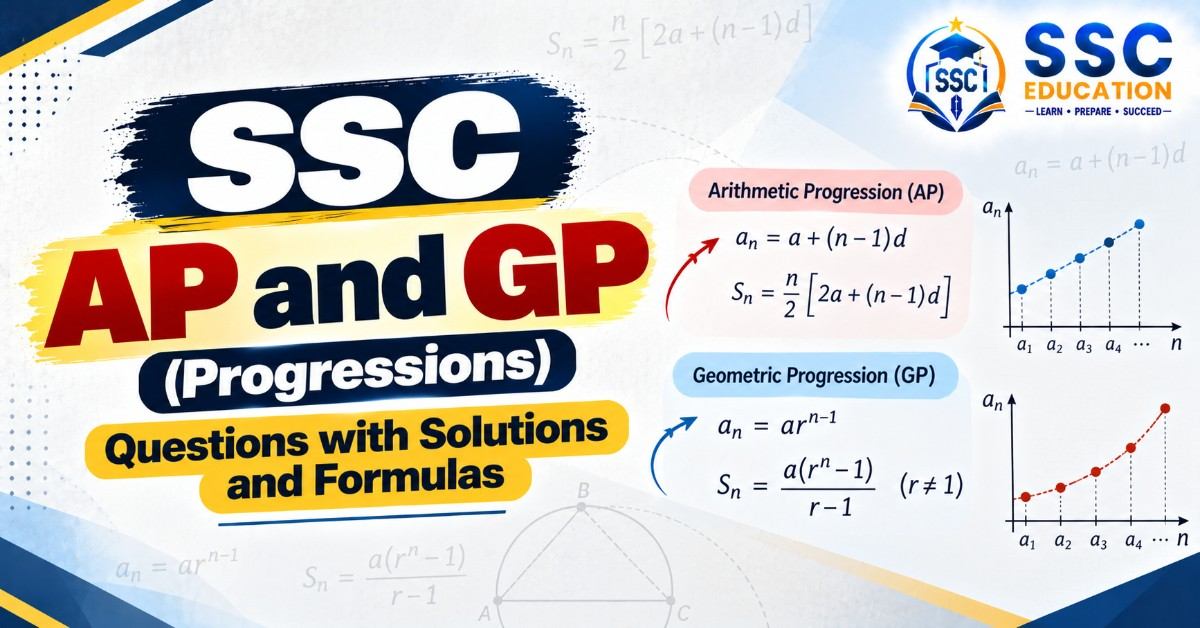
- AP: nth term = a + (n - 1)d. Sum of n terms = n/2 x [2a + (n - 1)d] = n/2 x (first + last).
- GP: nth term = a x r^(n - 1). Sum of n terms = a(r^n - 1)/(r - 1) for r > 1.
- Infinite GP (when r is between -1 and 1): sum = a / (1 - r).
- Three numbers in AP: take them as a - d, a and a + d. In GP: a/r, a and ar.
- Number of terms in an AP = (last - first) / d + 1.
- AM and GM of two numbers: AM = (x + y)/2 and GM = square root of (xy).
Set 1: Arithmetic Progression (Q1–Q7)
Q1. Find the 10th term of 3, 7, 11, ...
Answer: 39
Solution: a = 3 and d = 4, so 3 + 9 x 4 = 39.
Q2. Find the sum of the first 20 terms of 2, 5, 8, ...
Answer: 610
Solution: Sum = 20/2 x [4 + 19 x 3] = 10 x 61 = 610.
Q3. Find the sum of the first 50 natural numbers.
Answer: 1,275
Solution: Sum = 50/2 x (1 + 50) = 1,275.
Q4. Which term of 5, 9, 13, ... is 81?
Answer: 20th term
Solution: 5 + (n - 1) x 4 = 81, so n - 1 = 19 and n = 20.
Q5. Find the sum of all multiples of 5 from 5 to 100.
Answer: 1,050
Solution: There are 20 terms, so sum = 20/2 x (5 + 100) = 1,050.
Q6. Three numbers in AP have the sum 21 and the product 315. Find them.
Answer: 5, 7 and 9
Trick: Take 7 - d, 7 and 7 + d. 7(49 - d^2) = 315 gives d = 2.
Q7. In an AP, the 6th term is 17 and the 11th term is 32. Find the first term and d.
Answer: a = 2 and d = 3
Solution: 5d = 15, so d = 3 and a = 17 - 15 = 2.
Set 2: Geometric Progression (Q8–Q14)
Q8. Find the 8th term of 2, 4, 8, ...
Answer: 256
Solution: 2 x 2^7 = 256.
Q9. Find the sum of the first 6 terms of 3, 6, 12, ...
Answer: 189
Solution: 3 x (2^6 - 1) / (2 - 1) = 189.
Q10. Find the sum of the infinite series 1 + 1/2 + 1/4 + ...
Answer: 2
Trick: a = 1 and r = 1/2, so sum = 1 / (1 - 1/2) = 2.
Q11. Find the sum of the infinite GP 6, 2, 2/3, ...
Answer: 9
Solution: r = 1/3, so sum = 6 / (2/3) = 9.
Q12. Find the common ratio of 5, 15, 45, ...
Answer: 3
Solution: 15 / 5 = 3.
Q13. Which term of 2, 6, 18, ... is 486?
Answer: 6th term
Solution: 2 x 3^(n - 1) = 486, so 3^(n - 1) = 243 = 3^5 and n = 6.
Q14. Three numbers in GP have the sum 14 and the product 64. Find them.
Answer: 2, 4 and 8
Solution: The middle term cubed = 64, so the middle term is 4. Then 4/r + 4 + 4r = 14 gives r = 2.
Set 3: Mixed Questions (Q15–Q21)
Q15. Find the sum of the first 15 odd numbers.
Answer: 225
Solution: Sum of first n odd numbers = n^2.
Q16. Find the sum of 1 + 3 + 5 + ... + 99.
Answer: 2,500
Solution: There are 50 odd numbers, so sum = 50^2.
Q17. Find the AM and GM of 4 and 16.
Answer: AM = 10 and GM = 8
Solution: AM = 20/2 and GM = square root of 64.
Q18. Insert 3 arithmetic means between 2 and 18.
Answer: 6, 10 and 14
Solution: d = (18 - 2) / 4 = 4.
Q19. How many terms are there in 7, 13, 19, ..., 121?
Answer: 20
Solution: (121 - 7) / 6 + 1 = 20.
Q20. A man saves Rs 100 in the first month and Rs 20 more every month. How much does he save in 12 months?
Answer: Rs 2,520
Solution: Sum = 12/2 x [200 + 11 x 20] = 6 x 420 = 2,520.
Q21. A population of 1,000 doubles every year. What is it after 5 years?
Answer: 32,000
Solution: 1,000 x 2^5 = 32,000.
Formula Revision
| Item | Formula |
|---|---|
| nth term of an AP | a + (n - 1)d |
| Sum of n terms of an AP | n/2 x [2a + (n - 1)d] |
| nth term of a GP | a x r^(n - 1) |
| Sum of n terms of a GP (r not 1) | a(r^n - 1) / (r - 1) |
| Sum of an infinite GP (|r| less than 1) | a / (1 - r) |
| Arithmetic mean of two numbers | (a + b) / 2 |
| Geometric mean of two numbers | square root of (ab) |
Check whether the series is an AP or a GP by looking at the difference and the ratio of the first three terms.
Common Mistakes in Progressions
- Using n instead of (n - 1) in the nth term formula.
- Applying the infinite GP formula when r is not between -1 and 1.
- Mixing up the AP and GP sum formulas.
- Making arithmetic errors with powers of 2 and 3.
- Forgetting to add 1 when counting terms.
- Not choosing a - d, a, a + d for the three-number problems.
How to Practice These 21 Questions
- Memorise the four formulas.
- Practise 10 questions on each type daily.
- Solve each set in 8 minutes.
- Revise the mistakes after one day.
Related Topics to Study Next
- SSC Algebra Questions
- SSC Simplification Questions
- Surds and Indices Questions
- SSC Percentage Questions with Shortcut Tricks
Frequently Asked Questions
What is an arithmetic progression?
It is a sequence in which each term differs from the previous term by a fixed number called the common difference.
What is a geometric progression?
It is a sequence in which each term is obtained by multiplying the previous term by a fixed number called the common ratio.
What is the nth term of an AP?
nth term = a + (n - 1)d.
What is the sum of an AP?
Sum = n/2 x [2a + (n - 1)d] or n/2 x (first term + last term).
What is the nth term of a GP?
nth term = a x r^(n - 1).
What is the sum of a GP?
Sum of n terms = a(r^n - 1)/(r - 1) for r not equal to 1.
When can we find the sum of an infinite GP?
When the common ratio r is between -1 and 1. The sum is a / (1 - r).
How do I assume three numbers in AP?
Take them as a - d, a and a + d.
What is the relation between AM and GM?
AM is always greater than or equal to GM for positive numbers.
How many progression questions come in SSC exams?
One or two questions come in CGL Tier 2 and some other exams.
How do I find the number of terms of an AP?
Number of terms = (last term - first term) / d + 1.
How should I prepare progressions for SSC exams?
Learn the formulas, solve direct and word problems and revise previous year questions.
Rahul Kumar
SSC Exam Expert & Content Editor
Rahul is a senior SSC exam strategist with 8+ years of experience helping aspirants crack CGL, CHSL and MTS exams. He writes in-depth notification breakdowns, exam pattern guides and preparation strategies.