
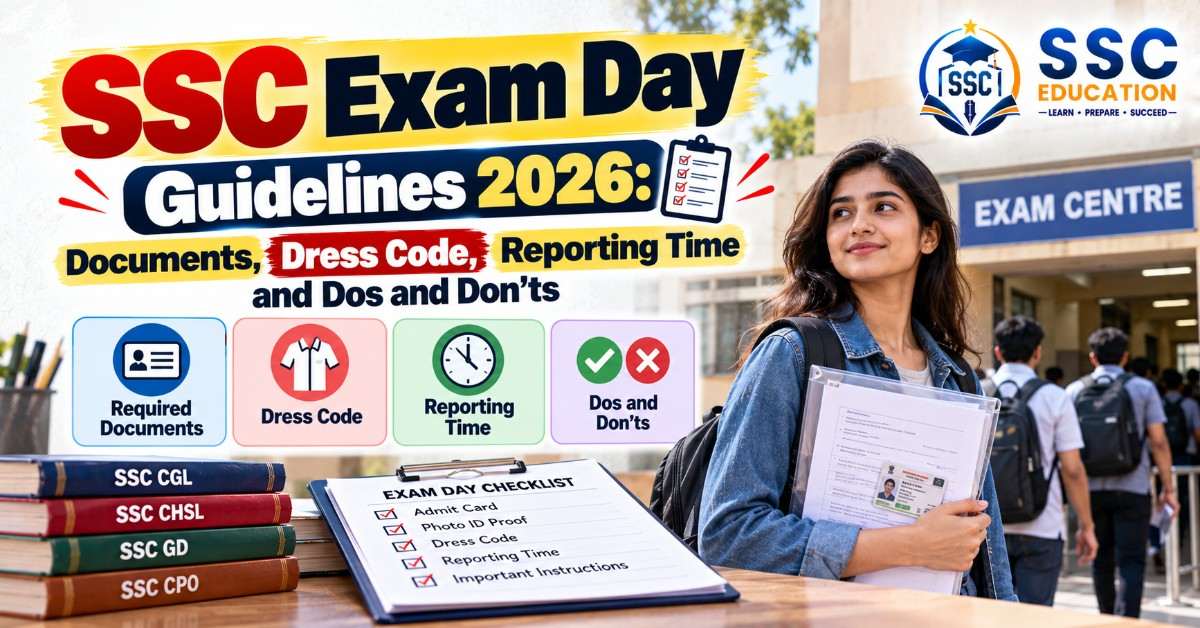
SSC Exam Day Guidelines 2026: Documents, Dress Code, Reporting Time and Dos and Don'ts
Rahul Kumar
SSC Exam Expert & Content Editor
Table of Contents
- 1.Documents to Carry
- 2.Reporting Time and Reaching the Centre
- 3.Dress Code
- 4.Items Allowed and Not Allowed
- 5.Inside the Exam Hall: Computer-Based Test Tips
- 6.Mental Preparation on the Exam Day
- 7.After the Exam
- 8.The Night Before the Exam: A Checklist
- 9.At the Exam Centre: Entry, Frisking and Seating
- 10.Handling Panic or Technical Problems in the CBT
- 11.Exam-Day Mistakes That Cost Marks
- 12.Last-Minute Mental Checklist Before You Start the Test
- 13.Free Practice Papers to Prepare for This Topic
- 14.Frequently Asked Questions (FAQs)
Complete SSC exam day checklist with documents to carry, reporting time, dress code, items not allowed in the exam hall and tips to stay calm and manage the computer-based test.
A small mistake on the exam day can cost you a whole year of preparation. Missing a document, reaching late or carrying a banned item can stop you from entering the exam hall. This SSC exam day guide gives you a simple checklist for the documents, the dress code, the reporting time and the exam hall rules, along with tips for the computer-based test.
Documents to Carry
- Admit card printout (clear and complete).
- One original valid photo ID, such as Aadhaar card, PAN card, voter ID, driving licence or passport, as per the instructions in the admit card.
- Photograph if the admit card asks for pasting a photo.
- Any other document asked in the notice, for example the PwD certificate or the scribe documents.
- Keep all documents in a transparent folder.
Reporting Time and Reaching the Centre
- Check the reporting time and the gate closing time on the admit card.
- Reach the exam centre at least 60 to 90 minutes before the reporting time, especially if it is far.
- If the centre is in a new area, check the route one day before.
- Candidates who arrive after the gate closes are not allowed to enter.
Dress Code
- Wear light and comfortable clothes with half sleeves.
- Avoid heavy ornaments, bangles, rings, watches and belts with big buckles.
- Wear simple footwear such as slippers or sandals instead of shoes with thick soles.
- Follow the specific instructions on the admit card.
Items Allowed and Not Allowed
| Allowed | Not allowed |
|---|---|
| Admit card and photo ID | Mobile phones and smart watches |
| A transparent water bottle | Calculators, calculator watches and digital devices |
| A ball pen (if specified) | Bags, wallets and paper slips |
| Medical devices with permission | Headphones, Bluetooth devices and electronic gadgets |
| Passport size photographs | Jewellery and metal items |
| Hand sanitiser (small, transparent) | Food items except those allowed for medical reasons |
The rules can be different for each exam and centre. Follow the instructions on the admit card.
Inside the Exam Hall: Computer-Based Test Tips
- Read the instructions on the screen carefully before you start.
- Check that the mouse and keyboard work, and call the invigilator if there is a problem.
- Use the on-screen buttons properly: Save and Next, Mark for Review and Clear Response.
- Answer the easy questions first and mark the difficult ones for review.
- Keep an eye on the timer and do not spend more than a minute on a question.
- Do not click on the final submit button until you are ready to finish.
- Attempt questions with the negative marking in mind and avoid blind guessing.
Mental Preparation on the Exam Day
- Sleep well the night before and avoid late-night revision.
- Have a light breakfast and drink water.
- Do not learn new topics on the exam day; only revise your short notes.
- Stay positive and do not worry about the other candidates.
- If one section goes badly, do not lose heart. Focus on the next section.
After the Exam
- Note down the questions that you remember for analysis.
- Wait for the official answer key and calculate your probable score.
- Start preparing for the next stage (Tier 2 or skill test) without waiting for the result.
The Night Before the Exam: A Checklist
- Keep your admit card, ID, photographs and a transparent pen in one folder.
- Check the route and the travel time to the exam centre again.
- Pack a transparent water bottle if allowed and a light snack for after the exam.
- Set two alarms and keep your clothes ready.
- Revise only your short notes for 30 minutes and then go to sleep.
- Avoid watching exam discussion videos or reading rumours on social media.
At the Exam Centre: Entry, Frisking and Seating
At the gate, you will be asked to show your admit card and ID. Your documents are checked, you may be frisked and your thumb impression or biometric details may be taken to match the record. Follow the staff instructions politely and do not argue about small rules. After entering the centre, you will be shown your seat or computer number. Check the system carefully, make sure that your name and photograph are shown correctly on the screen and wait for the start of the exam. Do not touch the keyboard or the mouse before you are told to log in. If any problem occurs, raise your hand and inform the invigilator immediately.
- Biometric or photograph verification is a standard step in many centres.
- Rough sheets are given in the hall and must be returned.
- Talking to other candidates or looking at their screen is strictly prohibited.
Handling Panic or Technical Problems in the CBT
- If the computer hangs or the screen freezes, do not press keys again and again. Raise your hand and call the invigilator.
- If the system is changed, the time you lost is generally added as per the rules, so stay calm.
- If you feel panic, close your eyes for 10 seconds, take three deep breaths and return to the question.
- If you have a medical problem, inform the invigilator without delay.
Panic is the biggest enemy of your performance. Candidates who stay calm and follow the instructions usually manage their time much better than those who panic.
Exam-Day Mistakes That Cost Marks
- Starting with a difficult question and wasting time.
- Clicking the wrong button, such as "Submit" before reviewing the answers.
- Not marking questions for review and losing track of unattempted questions.
- Looking at the clock too often instead of working steadily.
- Guessing many questions in a panic in the last five minutes.
Last-Minute Mental Checklist Before You Start the Test
Before you click the start button, take 20 seconds to settle your mind. Check that you know the order in which you will attempt the sections, the time you plan to spend on each section and the rule for skipping questions. Remind yourself that no single question can decide your result and that a calm mind solves more questions than a worried one. If you have prepared well, trust your preparation and focus on one question at a time. After the exam, avoid discussing answers with other candidates immediately, because it only creates stress. Wait for the official answer key and plan your next step from there.
Free Practice Papers to Prepare for This Topic
Reading is only half of the preparation. Put what you have learnt into practice with these free topic-wise practice papers on SSC Education. Each paper has questions with answers and solutions, so you can check your level and improve step by step.
- SSC CGL Tier 1 Mini Mock: 25 High-Weightage History & Polity Questions
- SSC Reasoning Practice Set with Answers (Top 100 Questions)
- SSC English Practice Set with Answers (2026)
- 100 SSC Percentage Questions with Shortcut Tricks
- SSC Time and Work Questions with Solutions and Tricks
- SSC Coding-Decoding Questions with Answers and Tricks
- SSC Idioms and Phrases with Meanings and Practice Questions
You can also browse all SSC practice papers and solve the previous year question papers for exam-level practice.
Frequently Asked Questions (FAQs)
1. What documents are required for the SSC exam?
You need the admit card printout and an original valid photo ID. Some exams require a photograph or other documents as per the admit card.
2. Which ID is valid for the SSC exam?
Aadhaar, PAN card, voter ID, driving licence, passport and other IDs mentioned in the admit card are valid. The name must match the admit card.
3. What is the dress code for the SSC exam?
Wear light and simple clothes, preferably with half sleeves, and avoid heavy accessories and big belts. Follow the instructions on the admit card.
4. Can I carry a mobile phone to the SSC exam centre?
Mobile phones are not allowed inside the exam hall. It is better not to bring valuable items to the centre.
5. Can I carry a water bottle in the SSC exam?
A transparent water bottle is generally allowed. Check the notice for the exam.
6. What is the reporting time for the SSC exam?
The reporting time is written on the admit card. Reach at least one hour before the time.
7. Can I enter the SSC exam hall after the gate closes?
No. Candidates who arrive after the gate closing time are not allowed to enter.
8. Is rough paper provided in the SSC CBT exam?
Rough sheets are generally provided at the centre and have to be returned after the exam. Follow the centre instructions.
9. What should I do if the computer hangs during the exam?
Inform the invigilator at once. The system will be changed and the lost time is usually adjusted as per the rules.
10. Is negative marking applicable in SSC exams?
Yes. Most SSC exams have negative marking for wrong answers, so attempt questions carefully.
Rahul Kumar
SSC Exam Expert & Content Editor
Rahul is a senior SSC exam strategist with 8+ years of experience helping aspirants crack CGL, CHSL and MTS exams. He writes in-depth notification breakdowns, exam pattern guides and preparation strategies.