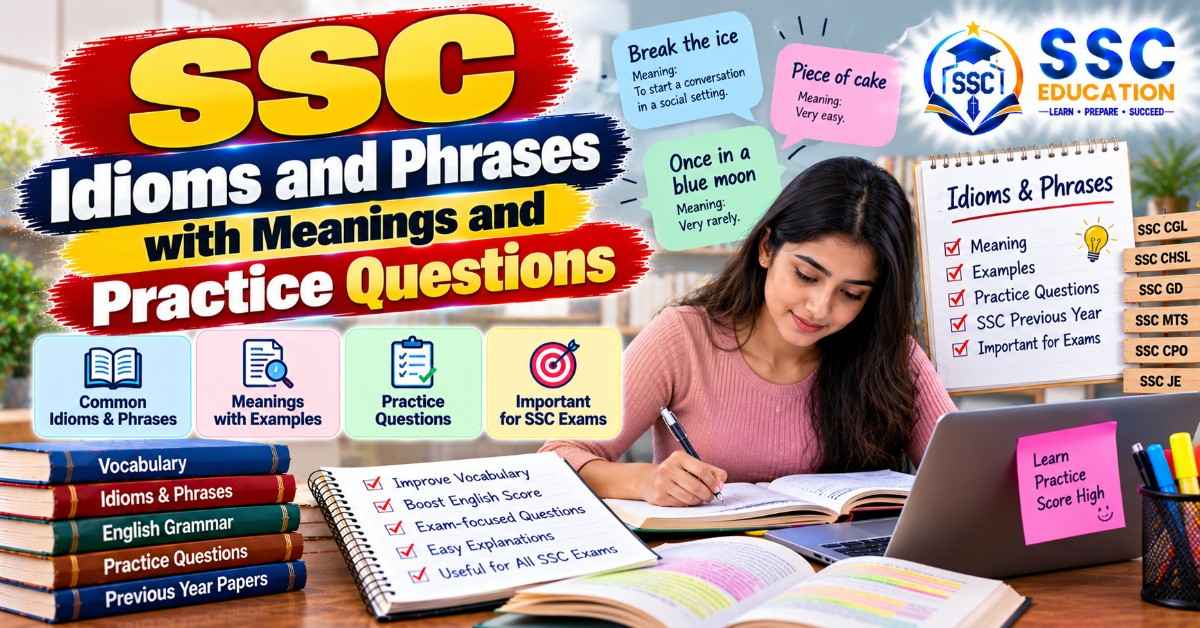
SSC Idioms and Phrases with Meanings and Practice Questions
Rahul Kumar
SSC Exam Expert & Content Editor
Table of Contents
- 1.Practice Paper at a Glance
- 2.What Are Idioms and Phrases? Basic Concept in Simple Words
- 3.Important Idioms and Phrases List for SSC (With Meanings)
- 4.Set 1: Idiom Meanings (Basic) (Q1–Q10)
- 5.Set 2: Idiom Meanings (Medium) (Q11–Q20)
- 6.Set 3: Choose the Correct Idiom (Fill in the Blanks) and Mixed Questions (Q21–Q30)
- 7.Common Mistakes in Idioms and Phrases
- 8.How to Practice These 30 Questions
- 9.Related Topics to Study Next
- 10.Frequently Asked Questions
Learn 56 important idioms and phrases for SSC with meanings and practice 30 questions with answers. A useful list for CGL, CHSL, MTS and GD English vocabulary.
Idioms and Phrases is one of the most reliable scoring areas in SSC English. Two to four questions are asked in every shift of CGL, CHSL and MTS, and many idioms repeat from year to year. This practice paper gives you a list of 56 frequently asked idioms with simple meanings, followed by 30 practice questions with answers. Learn the list first and then test yourself.
Practice Paper at a Glance
| Detail | Information |
|---|---|
| Topic | Idioms and Phrases |
| Total questions | 30 questions in 3 sets |
| Level | Easy to exam level |
| Useful for | SSC CGL, CHSL, MTS, GD, CPO and other government exams |
| Includes | Answers, step-by-step solutions, shortcut tricks and FAQs |
| Time to attempt | 35 to 40 minutes |
What Are Idioms and Phrases? Basic Concept in Simple Words
An idiom is a group of words whose meaning is different from the meaning of the individual words. For example, "to break the ice" does not mean to break real ice. It means to start a conversation. A phrase is a group of words that works as one unit in a sentence.
- Idioms are used in fixed form. You cannot change the words.
- You must learn the figurative meaning, not the literal meaning.
- In the exam you are given an idiom and four meanings, and you choose the correct one.
Important Idioms and Phrases List for SSC (With Meanings)
Idioms Starting with A to G
| Idiom | Meaning |
|---|---|
| A blessing in disguise | Something that seems bad but turns out good |
| A piece of cake | A very easy task |
| Add fuel to the fire | Make a bad situation worse |
| All ears | Listening very carefully |
| At the eleventh hour | At the last moment |
| Bite the bullet | Face a difficult situation bravely |
| Break the ice | Start a conversation in an awkward situation |
| Burn the midnight oil | Work or study late into the night |
| By leaps and bounds | Very quickly |
| Call it a day | Stop working for the day |
| Cry over spilt milk | Regret something that cannot be changed |
| Cut corners | Do something cheaply or by skipping steps |
| Down in the dumps | Sad and depressed |
| Draw a blank | Fail to remember or find something |
| Eat humble pie | Apologise and accept one's mistake |
| Face the music | Accept the consequences of one's actions |
| Fish in troubled waters | Take advantage of a confused situation |
| Flash in the pan | A brief success that does not last |
| Foot the bill | Pay the expenses |
| Get cold feet | Become nervous before doing something |
Idioms Starting with H to R
| Idiom | Meaning |
|---|---|
| Hit the nail on the head | Say or do exactly the right thing |
| Hold your horses | Wait and be patient |
| In hot water | In trouble |
| In the nick of time | Just in time |
| Jump the gun | Act too early |
| Keep your chin up | Stay cheerful in difficulty |
| Let the cat out of the bag | Reveal a secret by mistake |
| Make both ends meet | Manage with a limited income |
| Once in a blue moon | Very rarely |
| Out of the blue | Unexpectedly |
| Pull someone's leg | Tease or joke with someone |
| Rain cats and dogs | Rain very heavily |
| Read between the lines | Understand the hidden meaning |
| Red-letter day | A memorable and happy day |
| Rule of thumb | A rough guide based on experience |
| Spill the beans | Reveal a secret |
| Take the bull by the horns | Face a problem boldly |
| The last straw | The final problem that makes a situation unbearable |
| Throw in the towel | Give up |
| Beat around the bush | Avoid coming to the main point |
More Important Idioms
| Idiom | Meaning |
|---|---|
| To bell the cat | Undertake a risky task |
| To cry wolf | Raise a false alarm |
| Under the weather | Slightly ill |
| Walk on air | Be extremely happy |
| A bolt from the blue | A sudden and unpleasant surprise |
| A dark horse | An unexpected winner or a person with hidden talent |
| Apple of one's eye | A very dear or favourite person |
| Bed of roses | A comfortable and easy situation |
| Cock and bull story | An unbelievable story |
| Achilles heel | A weak point |
| Birds of a feather | People with similar tastes |
| Child's play | Something very easy |
| Dog in the manger | A selfish person who stops others from enjoying something |
| Gift of the gab | Ability to speak well and persuade |
| Tooth and nail | With great effort and energy |
| Turn a deaf ear | Ignore what is said |
- Learn five idioms a day and use each in your own sentence.
- Group idioms by theme (anger, happiness, secrets, hard work, failure) to remember them easily.
- Use the context of the sentence when the idiom has two meanings.
- Eliminate literal meanings of the words first.
Set 1: Idiom Meanings (Basic) (Q1–Q10)
Q1. What is the meaning of the idiom "A blessing in disguise"?
Answer: Something that looks bad but turns out good
Solution: It describes an apparent misfortune that has a good result.
Q2. What is the meaning of "A piece of cake"?
Answer: A very easy task
Solution: It means something that can be done with no effort.
Q3. What is the meaning of "To add fuel to the fire"?
Answer: To make a bad situation worse
Solution: Adding fuel increases a fire, so it means making the problem bigger.
Q4. What is the meaning of "At the eleventh hour"?
Answer: At the last moment
Solution: Eleventh hour means the final moment before a deadline.
Q5. What is the meaning of "To break the ice"?
Answer: To start a conversation in an awkward situation
Solution: It means to remove the initial shyness between people.
Q6. What is the meaning of "To burn the midnight oil"?
Answer: To study or work late at night
Solution: It comes from using oil lamps late at night.
Q7. What is the meaning of "To cry over spilt milk"?
Answer: To regret something that cannot be changed
Solution: Spilt milk cannot be recovered, so crying over it is useless.
Q8. What is the meaning of "To eat humble pie"?
Answer: To apologise and accept one's mistake
Solution: It means to humbly admit that you were wrong.
Q9. What is the meaning of "To face the music"?
Answer: To accept the consequences of one's actions
Solution: It means to face the punishment or criticism.
Q10. What is the meaning of "To get cold feet"?
Answer: To become nervous before doing something
Solution: It describes sudden fear before an important action.
Set 2: Idiom Meanings (Medium) (Q11–Q20)
Q11. What is the meaning of "To hit the nail on the head"?
Answer: To say or do exactly the right thing
Solution: It means to be exactly correct about something.
Q12. What is the meaning of "Once in a blue moon"?
Answer: Very rarely
Solution: A blue moon is a rare event, so the idiom means almost never.
Q13. What is the meaning of "To let the cat out of the bag"?
Answer: To reveal a secret by mistake
Solution: It means to disclose a secret accidentally.
Q14. What is the meaning of "To make both ends meet"?
Answer: To manage with a limited income
Solution: It means to earn just enough to cover the expenses.
Q15. What is the meaning of "Out of the blue"?
Answer: Unexpectedly
Solution: It describes something that happens without warning.
Q16. What is the meaning of "To pull someone's leg"?
Answer: To tease or joke with someone
Solution: It is a friendly joke, not an actual pull.
Q17. What is the meaning of "To read between the lines"?
Answer: To understand the hidden meaning
Solution: It means to find what is not clearly written.
Q18. What is the meaning of "To spill the beans"?
Answer: To reveal a secret
Solution: It means to disclose confidential information.
Q19. What is the meaning of "To take the bull by the horns"?
Answer: To face a problem boldly
Solution: It means to deal with a difficult situation directly and bravely.
Q20. What is the meaning of "To throw in the towel"?
Answer: To give up
Solution: It means to admit defeat and stop trying.
Set 3: Choose the Correct Idiom (Fill in the Blanks) and Mixed Questions (Q21–Q30)
Q21. Choose the correct idiom: The news of his selection came ___ (suddenly and unexpectedly).
Answer: Out of the blue
Solution: The idiom "out of the blue" means unexpectedly.
Q22. Choose the correct idiom: Stop ___ and tell me what you actually want (avoid the main point).
Answer: Beating around the bush
Solution: To beat around the bush means to avoid coming to the main point.
Q23. Choose the correct idiom: She was ___ when she heard that she had topped the exam (extremely happy).
Answer: Walking on air
Solution: To walk on air means to be extremely happy.
Q24. What is the meaning of "A dark horse"?
Answer: An unexpected winner or a person with hidden talent
Solution: A dark horse is a person whose abilities are not widely known.
Q25. What is the meaning of "Apple of one's eye"?
Answer: A very dear or favourite person
Solution: It describes someone who is deeply loved.
Q26. What is the meaning of "A cock and bull story"?
Answer: An unbelievable story
Solution: It is a false or exaggerated story that is hard to believe.
Q27. What is the meaning of "Achilles heel"?
Answer: A weak point
Solution: It is the one weakness of an otherwise strong person.
Q28. What is the meaning of "Dog in the manger"?
Answer: A selfish person who stops others from enjoying something he cannot use
Solution: It describes a person who spoils the enjoyment of others out of selfishness.
Q29. What is the meaning of "To turn a deaf ear"?
Answer: To ignore what is said
Solution: It means to refuse to listen.
Q30. What is the meaning of "Tooth and nail"?
Answer: With great effort and energy
Solution: It means fighting very hard for something.
Common Mistakes in Idioms and Phrases
- Taking the literal meaning of the words instead of the idiom meaning.
- Confusing similar-sounding idioms such as "spill the beans" and "let the cat out of the bag" with a different idiom.
- Learning idioms without examples and forgetting their meanings.
- Not revising old idioms while learning new ones.
- Ignoring the context of the sentence while choosing the meaning.
- Spending too much time on one idiom in the exam.
How to Practice These 30 Questions
- Learn five idioms a day from the list and write one sentence for each.
- Cover the meaning column and test yourself from the idiom column.
- Solve each set of 10 questions in about 6 minutes.
- Mark the idioms you missed and revise them every second day.
- Read a newspaper editorial and underline the idioms you find.
Related Topics to Study Next
- One Word Substitution
- Active and Passive Voice Questions
- SSC Synonyms and Antonyms Questions
- Synonyms Notes
Frequently Asked Questions
What are idioms and phrases?
Idioms and phrases are fixed groups of words whose meaning is different from the literal meaning of the words. For example, "to spill the beans" means to reveal a secret.
How many idioms and phrases questions come in SSC exams?
Generally two to four questions come from idioms and phrases in each shift of SSC CGL, CHSL and MTS.
How can I learn idioms quickly?
Learn five idioms every day, make your own sentence for each one, group them by theme and revise them regularly using flashcards or a notebook.
Are the same idioms repeated in SSC exams?
Yes, many idioms repeat across years and shifts. Learning previous year idioms is one of the best preparation methods.
What is the difference between an idiom and a phrase?
An idiom has a figurative meaning that cannot be understood from its words, while a phrase is a group of words that works together in a sentence and may or may not have a figurative meaning.
What is the best way to remember idiom meanings?
Create a short story or picture for each idiom, link it with a similar idiom and revise it after one day, one week and one month.
What is the meaning of "once in a blue moon"?
It means something that happens very rarely.
What is the meaning of "the last straw"?
It means the final problem or event that makes a situation unbearable.
How do I solve idiom questions when I do not know the idiom?
Use the context of the sentence, remove the options that are clearly literal or unrelated and choose the meaning that fits the situation best.
How should I prepare idioms and phrases for SSC exams?
Learn the idiom list, practise one set daily, revise your mistakes and solve previous year idiom questions to get used to the pattern.
Rahul Kumar
SSC Exam Expert & Content Editor
Rahul is a senior SSC exam strategist with 8+ years of experience helping aspirants crack CGL, CHSL and MTS exams. He writes in-depth notification breakdowns, exam pattern guides and preparation strategies.