
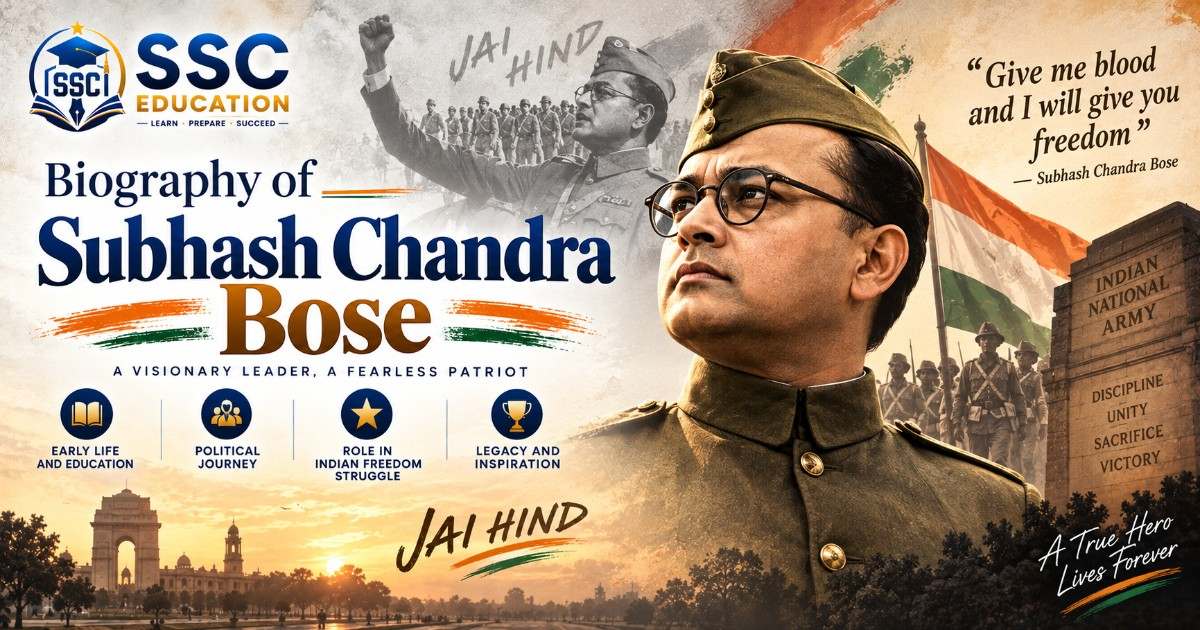
Biography of Subhash Chandra Bose
Rahul Kumar
SSC Exam Expert & Content Editor
Table of Contents
- 1.Introduction
- 2.Quick Facts: Subhash Chandra Bose
- 3.Early Life and Family
- 4.Schooling and the Influence of Ravenshaw
- 5.Presidency College and the Oaten Incident
- 6.Cambridge and the Indian Civil Service
- 7.Under Chittaranjan Das: Journalism and the Calcutta Corporation
- 8.Rising in the Congress (1927–1932)
- 9.Years in Europe (1933–1936)
- 10.President of the Congress: Haripura and Tripuri
- 11.The Forward Bloc and the House Arrest
- 12.The Great Escape (January 1941)
- 13.Bose in Germany (1941–1943)
- 14.The Indian National Army: Origins
- 15.The Provisional Government of Free India (21 October 1943)
- 16.Imphal, Kohima and the Retreat (1944–1945)
- 17.Bose's Death: The Official Account (18 August 1945)
- 18.Disbelief, Inquiries and Debates
- 19.The INA Trials and the End of British Rule
- 20.Ideas and Ideology
- 21.Criticism and Controversy
- 22.Legacy and Honours
- 23.Personality and Leadership Style
- 24.Lesser-Known Facts about Subhas Chandra Bose
- 25.Timeline of Subhas Chandra Bose's Life
- 26.Why Subhas Chandra Bose Is Important for SSC and Other Competitive Exams
- 27.Related Reading
- 28.Conclusion
- 29.Frequently Asked Questions
Complete biography of Subhas Chandra Bose (Netaji): early life, ICS resignation, Congress presidency, escape from house arrest, INA and Azad Hind Government, death controversy, timeline and 24 FAQs for SSC exams.
Introduction
Subhas Chandra Bose (23 January 1897 – 18 August 1945, according to the official account), revered as Netaji ("respected leader"), was one of the most charismatic and controversial leaders of the Indian freedom struggle. He passed the Indian Civil Service examination and then resigned from it, twice served as President of the Indian National Congress, quarrelled with Gandhi over the methods of the struggle, escaped from house arrest in Calcutta in 1941 and travelled through Afghanistan and the Soviet Union to Nazi Germany, and finally led the Indian National Army and a provisional Government of Free India from Southeast Asia. His slogans "Jai Hind" and "Dilli Chalo" are still heard in India today.
Bose's life raises questions that Indians continue to debate: How far could the freedom struggle rely on foreign military help? Was armed struggle a realistic alternative to non-violence? And what really happened to him in August 1945? This biography follows his career from a middle-class Cuttack household to the jungles of Burma and Manipur, explains the history of the INA, sets out the official account of his death and the debates around it, and includes a detailed revision guide and FAQs for SSC and other competitive examinations.
Quick Facts: Subhash Chandra Bose
| Nationality | Indian |
|---|---|
| Best Known For | Freedom fighter and founder-leader of the Azad Hind Fauj (Indian National Army); known as Netaji |
| Born | 23 January 1897, Cuttack, Orissa Division, Bengal Presidency (now Odisha) |
| Died | 18 August 1945 (officially, after an air crash at Taihoku, Taiwan); the circumstances remain debated |
| Father | Janakinath Bose, a lawyer |
| Mother | Prabhavati Devi |
| Family | The ninth of fourteen children |
| Spouse | Emilie Schenkl (married in 1937); daughter Anita Bose Pfaff (born 1942) |
| Education | Ravenshaw Collegiate School, Presidency College, Scottish Church College (B.A. in Philosophy), Cambridge University |
| Civil Service | Passed the ICS examination in 1920 (fourth rank) and resigned in 1921 |
| Political Mentor | Chittaranjan Das (Deshbandhu) |
| Congress Presidency | Haripura session (1938); re-elected at Tripuri (1939) |
| Party Founded | All India Forward Bloc (1939) |
| Army Led | Indian National Army (Azad Hind Fauj) |
| Slogans | "Jai Hind", "Dilli Chalo" |
| Books | The Indian Struggle (1935), An Indian Pilgrim |
Early Life and Family
Subhas Chandra Bose was born on 23 January 1897 in Cuttack, then a part of the Bengal Presidency and now in Odisha, in a large and well-to-do Bengali Kayastha family. His father, Janakinath Bose, was a successful lawyer and government pleader who later became a leading citizen of Cuttack, and his mother, Prabhavati Devi, came from a respected family of Calcutta. Subhas was the ninth of fourteen children and the sixth son, and he grew up in a house filled with brothers, sisters and cousins. His elder brother, Sarat Chandra Bose, became a noted barrister and political figure and remained his closest supporter throughout his life.
The family was affluent but disciplined. Janakinath was a moderate nationalist and was fond of English education, while Prabhavati was a devoutly religious woman who filled the home with the stories of the Ramayana and the Mahabharata. As a child Subhas learned to move between two worlds: his father's world of law, English books and social respectability, and his mother's world of piety and traditional values. Later in life he would try to combine both in his political thinking, admiring modern organisation and technology while drawing on India's spiritual traditions for inspiration.
Schooling and the Influence of Ravenshaw
At the age of five, Subhas was enrolled in the Baptist Mission's Protestant European School in Cuttack, where the medium of instruction was English and most students were the children of Europeans and Anglo-Indians. He was among the few Indian boys and, by his own account, he felt the sting of being treated as a member of a subject race. In 1909 he moved to the Ravenshaw Collegiate School, where he came under the influence of the headmaster, Beni Madhab Das, a teacher of great character who taught him the value of discipline, honesty and self-respect and encouraged his interest in Indian traditions.
By his adolescence, Subhas had also begun to read the works of Swami Vivekananda and Ramakrishna, which made a profound impression. He was moved by the idea of service to the poor and by Vivekananda's call to build the nation through self-confidence. He began to spend time in meditation, visited the poor, looked after victims of epidemics and even considered becoming a monk. His family, worried, sent him to Calcutta for higher education in the hope that he would find a more practical direction.
Presidency College and the Oaten Incident
In 1913, Subhas passed the matriculation examination, standing second in the University of Calcutta, and joined the Presidency College. In Calcutta he plunged into the intellectual and political life of the city. Presidency was a centre of the nationalist ferment, and among the professors was E. F. Oaten, an Englishman who had a reputation for making disparaging remarks about Indians.
In February 1916, a group of students, including Subhas, assaulted Professor Oaten after an incident in which he was said to have insulted Indian students. Bose was identified as one of the leaders, though it is not certain whether he took part in the assault himself. The college expelled him and he was barred from all colleges affiliated to the University of Calcutta. He spent two years outside the university system before being allowed to rejoin the Scottish Church College in 1917, from where he graduated in 1919 with a first-class B.A. in Philosophy. The expulsion had a lasting effect: it made him a hero among students and confirmed his sense that the colonial system was unjust.
Cambridge and the Indian Civil Service
At his father's urging, Bose sailed for England in 1919 to prepare for the Indian Civil Service examination and joined Fitzwilliam Hall, Cambridge. He had only about eight months to prepare, a very short time for such a demanding test, but in August 1920 he passed with a fourth rank among the successful candidates, with the highest marks in English composition. It was a remarkable achievement for a young Indian, and the ICS was then the most prestigious career in the country.
Yet Bose was troubled. He wrote to his elder brother Sarat that he did not want to serve a government whose interests were opposed to those of his country. After months of thought, and following the news of the Jallianwala Bagh massacre and the launch of Gandhi's Non-Cooperation Movement, he decided to give up the service. In April 1921, he wrote to the Secretary of State for India to say that he would not take up the post, and he sailed home. His decision to forgo a life of security and prestige for the uncertain path of politics made him famous even before he had begun.
Under Chittaranjan Das: Journalism and the Calcutta Corporation
Bose returned to Bombay in July 1921 and met Gandhi soon afterwards. He was impressed by the Mahatma's personality but doubtful about the practical steps of the Non-Cooperation plan, a scepticism that would persist. It was in Calcutta that he found his true guide in Chittaranjan Das, the lawyer and Bengal Congress leader known as Deshbandhu, who asked him to head the National College and to edit the newspaper Swaraj. When Das became the first Mayor of the Calcutta Corporation in 1924, Bose was appointed its Chief Executive Officer and worked on projects such as free primary education, better healthcare and Indian names for streets. He also became editor of the paper Forward, founded by Das, and rose quickly in the Bengal Congress.
In 1924 Bose was arrested during a crackdown on revolutionaries under the Bengal Criminal Law Amendment Ordinance and, in the following year, he was sent without trial to Mandalay in Burma. He spent nearly two years in jail there, in a harsh climate and poor conditions, and contracted tuberculosis. He was released in 1927, in poor health, when the government feared that he might die in prison. The news of the death of C. R. Das in 1925 had been a great personal loss during those years.
Rising in the Congress (1927–1932)
After his release in 1927, Bose became one of the most active young leaders of the Congress. He was elected General Secretary in 1927, together with Jawaharlal Nehru, and the two became the leaders of the party's left wing, demanding complete independence rather than dominion status. At the Calcutta session of the Congress in December 1928, Bose was appointed General Officer Commanding of the Congress Volunteer Corps, and he organised the volunteers in military uniform, complete with ranks and a march-past for the president, Motilal Nehru. Gandhi thought the display excessive, but young Indians loved it. At the same session, when Gandhi pressed for a resolution accepting dominion status if it was granted within a year, Bose and Nehru opposed it and pressed for complete independence.
In 1930 Bose was elected Mayor of Calcutta while he was in prison, but was again jailed soon after and was released only in 1931 after the Gandhi–Irwin Pact. He had disagreed strongly with the pact, especially with the decision to end the civil disobedience movement without securing the release of Bhagat Singh and his comrades. In 1932 he was arrested again and was held for months in jail, where his health broke down. The government finally permitted him to go to Europe for treatment in 1933, on the condition that he did not return to India.
Years in Europe (1933–1936)
For nearly three years Bose lived in Vienna and travelled to Prague, Warsaw, Rome, Berlin, Paris and other cities. He recovered his health but used his time to establish contact with European political leaders and thinkers and to explain the Indian case. He met the Italian leader Benito Mussolini and Irish leader Eamon de Valera, and he wrote The Indian Struggle, 1920–1934, a history of the freedom movement published in London in 1935, which the British government banned in India.
In Vienna in 1934 he met Emilie Schenkl, an Austrian secretary who helped him with his writing. They fell in love and, according to most accounts, were married in secret in 1937. Their daughter, Anita, was born in November 1942, while Bose was in Germany. The marriage was kept private for years and became widely known only later.
President of the Congress: Haripura and Tripuri
Bose returned to India in 1936 and was arrested at Bombay, but was later released. In 1938 the Congress elected him president at the Haripura session in Gujarat, and he presided from January 1938. Under his leadership, the Congress set up the National Planning Committee, chaired by Nehru, to plan the economic development of independent India. He also pressed for a strong stand against British rule, arguing that Britain's difficulties in Europe were an opportunity for India, and he called for an ultimatum to the British government to grant independence within six months.
These views brought him into conflict with Gandhi and the older leadership, who wanted to avoid a confrontation while Britain was preparing for a war. In January 1939 Bose decided to contest a second term as Congress president. Gandhi opposed the move and put forward Pattabhi Sitaramayya as his candidate. In an unusually contested election, Bose won by a small margin: 1,580 votes to 1,377. Gandhi described the result as Sitaramayya's defeat as much as his own.
At the Tripuri session in March 1939, the majority of the Working Committee refused to cooperate with Bose. The Congress passed a resolution asking him to nominate his Working Committee in accordance with Gandhi's wishes, and Bose, who was also seriously ill, found it impossible to carry on. On 29 April 1939 he resigned as president and Rajendra Prasad succeeded him. The dispute reflected a fundamental disagreement over method: Bose wanted immediate mass action, while Gandhi wanted to wait and prepare.
The Forward Bloc and the House Arrest
After leaving the presidency, Bose formed the All India Forward Bloc in 1939 as a left-wing group within the Congress, aiming to rally all radical forces for the struggle against British rule. When the Second World War began in September 1939, he argued that India should take advantage of Britain's difficulty. The Congress, however, decided to cooperate conditionally and did not support his call for immediate agitation, and he was expelled from the Congress for three years for breach of discipline.
In July 1940, the government arrested him for organising a campaign to remove a monument to the Black Hole of Calcutta. He went on a hunger strike in prison, and the authorities, fearing that he would die in custody, released him and placed him under house arrest at his home on Elgin Road in Calcutta, guarded by police. It was there that he made the plan that would change his life.
The Great Escape (January 1941)
On the night of 16–17 January 1941, Bose slipped out of his heavily watched house on Elgin Road in Calcutta. Disguised as a Pathan insurance agent in a long coat, a fez cap and loose trousers, and using the name Mohammad Ziauddin, he travelled with his nephew Sisir Kumar Bose by car to Gomoh railway station in present-day Jharkhand, and from there by train to Peshawar. In the North-West Frontier Province, with the help of local Forward Bloc workers such as Mian Akbar Shah and Bhagat Ram Talwar, he made his way on foot and by lorry through the tribal territory and into Afghanistan, pretending to be a deaf and mute Pathan pilgrim.
In Kabul he waited for weeks for help. Eventually, with the assistance of the Italian and German legations, he obtained an Italian passport in the name of Orlando Mazzotta and travelled through the Soviet Union to Moscow and then to Berlin, arriving in early April 1941. The escape astonished India and the world: British authorities did not realise that he had gone until several days later, and the story of how a man under guard vanished from his own house became part of national folklore.
Bose in Germany (1941–1943)
In Germany, Bose hoped to find military and financial support for an Indian liberation army and to broadcast his message to the people of India. He was given a Special Bureau for India in the German Foreign Office, headed by Adam von Trott zu Solz, and he established the Free India Centre in Berlin. He also began broadcasts on the Azad Hind Radio, addressing listeners in India in several languages. It was in this period that his followers began to call him Netaji.
His most concrete step was the creation of the Indian Legion (Indische Legion), a unit made up of Indian prisoners of war captured by the Germans in North Africa, of whom about three thousand to four thousand volunteered. He met Adolf Hitler once, in May 1942, and found that the German leader was not willing to make an explicit commitment to Indian independence. Bose was also disappointed by the German attitude to India and by the lack of results from his efforts. The Indian Legion was later absorbed into the Waffen SS, and it did not play a significant role in the war. In November 1942, his daughter Anita was born in Vienna.
By early 1943, Bose realised that the centre of the war against Britain in India was shifting to Southeast Asia, where Japan had swept through Malaya, Singapore and Burma. He decided to go to Japan. In February 1943, he left Kiel on a German submarine, U-180, and travelled around the Cape of Good Hope. In the southwest Indian Ocean, near Madagascar, on 28 April 1943, he was transferred to a Japanese submarine, I-29, in one of the few submarine-to-submarine transfers of civilians in the war, and reached Sumatra in May.
The Indian National Army: Origins
The Indian National Army (INA), or Azad Hind Fauj, did not begin with Bose. After the fall of Malaya and Singapore in early 1942, thousands of Indian soldiers of the British Indian Army were captured by the Japanese. Major Iwaichi Fujiwara of Japanese intelligence and Captain Mohan Singh, an Indian officer who had been captured, formed the first INA in 1942, recruiting prisoners of war. However, differences between Mohan Singh and the Japanese over the army's independence led to its dissolution in December 1942. Rash Behari Bose, an older Indian revolutionary who had lived in Japan for many years, had meanwhile organised the Indian Independence League to bring together Indians in Southeast Asia.
When Subhas Chandra Bose arrived in Singapore in July 1943, Rash Behari Bose handed over the leadership of both the League and the INA to him. Bose's arrival transformed the movement. He had the stature, the oratory and the organisational ability to mobilise the large Indian civilian population of Malaya, Singapore and Burma, and thousands of civilians joined the army, donated their wealth and volunteered for service. He reorganised the INA, set up training camps, established a Women's Regiment named after Rani Lakshmibai of Jhansi, headed by Captain Lakshmi Swaminathan (later Lakshmi Sahgal), and gave the army the battle-cry of "Dilli Chalo" ("March to Delhi") and the greeting "Jai Hind".
The Provisional Government of Free India (21 October 1943)
On 21 October 1943, in Singapore, Bose announced the formation of the Azad Hind Government, the Provisional Government of Free India, with himself as Head of State, Prime Minister and Minister for War and Foreign Affairs. The government had its own cabinet, currency, postage stamps, civil code and courts. Nine Axis and Axis-aligned governments, including Japan, Germany, Italy's Salo Republic, Croatia, Burma, the Philippines and Manchukuo, recognised it. A few days later, on 23 October, it declared war on Britain and the United States.
In November 1943, Bose attended the Greater East Asia Conference in Tokyo as an observer, and Japan announced that it would hand over the Andaman and Nicobar Islands, which it had occupied, to the Azad Hind government. Bose visited Port Blair in late December 1943 and hoisted the tricolour there, and the islands were renamed Shaheed and Swaraj. In practice, however, the Japanese retained real control, and Bose's visit revealed the limits of his authority: he learned about the torture of local Indians, and the Governor-General appointed by him, Lt Col. A. D. Loganathan, later complained about the lack of administrative power.
Imphal, Kohima and the Retreat (1944–1945)
In early 1944 the INA moved to the Burma front, and Japan launched an offensive into India from Burma known as Operation U-Go, aiming at Imphal and Kohima in Manipur and Nagaland. Elements of the INA, including its Bahadur Group and units of its brigades named after Gandhi, Azad and Nehru, advanced with the Japanese. In April 1944, at Moirang in Manipur, the INA raised the Indian tricolour on Indian soil for the first time, a symbolic moment of great emotional significance.
The campaign, however, failed. The Japanese and INA forces suffered from lack of supplies, disease, the monsoon and Allied air superiority, and the British defended Imphal and Kohima successfully. By mid-1944 the Japanese were in retreat, and the INA suffered heavy losses, with a large number of its soldiers dying of starvation and disease. Bose himself continued to inspire his troops: in a famous speech he asked Indians to give him their blood and promised them freedom in return. In July 1944 he broadcast a message to Gandhi, addressing him as the "Father of our Nation" and asking for his blessings for the war of liberation. By early 1945, the INA had been pushed back through Burma, and Rangoon fell in May 1945.
Bose's Death: The Official Account (18 August 1945)
With the surrender of Japan in mid-August 1945, Bose decided to continue the struggle by seeking the help of the Soviet Union, which he thought might support Indian independence against the British. According to the widely accepted account, he left Saigon on 17 August 1945 in a Japanese bomber, together with several Japanese officers and his aide Habibur Rahman, heading towards Manchuria. The plane stopped at Taihoku (Taipei) in Japanese-ruled Taiwan for refuelling, and on 18 August it crashed just after take-off when its port engine failed. The aircraft broke in two and caught fire. Several passengers died at once, including Lieutenant General Tsunamasa Shidei; Bose, who was sitting near the fuel tanks, was drenched in petrol and suffered third-degree burns over much of his body.
He was taken to the Nanmon Military Hospital in Taihoku, where Japanese doctors treated him, and he is reported to have died between nine and ten o'clock that night, at the age of forty-eight. His body was cremated in Taipei on 20 August, and his ashes were taken to Tokyo and kept at the Renkoji Temple, where they remain today. The death was announced to the world on 23 August 1945 by Japanese news agency.
Disbelief, Inquiries and Debates
The news of the death was met with widespread disbelief in India, especially in Bengal, and rumours began within hours that Bose had survived and gone into hiding. Over the years, many theories have been put forward, from his escape to the Soviet Union to a life as a hermit in India. The Government of India has appointed three inquiries:
- The Shah Nawaz Committee (1956): Headed by Shah Nawaz Khan, a former INA officer, it concluded that Bose died in the air crash; one member, Bose's brother Suresh Chandra Bose, dissented.
- The Khosla Commission (1970): It also accepted that he died in the crash.
- The Mukherjee Commission (1999–2006): Its report stated that Bose had not died in the crash and that the ashes at Renkoji were not his. The government of the time rejected the findings.
The official position of the Government of India, as expressed in later replies to queries, is that Bose died in the crash of 1945. Historians of the period, including those who have studied Japanese, British and Indian sources, generally accept the crash account, though the debate continues in popular culture, and thousands of declassified files have been released in recent years.
The INA Trials and the End of British Rule
Although the INA failed militarily, it made a large political impact after the war. In November 1945, the British government decided to try INA officers for treason in the historic Red Fort in Delhi. The first trial involved three officers: Prem Sahgal, Gurbaksh Singh Dhillon and Shah Nawaz Khan, a Hindu, a Sikh and a Muslim, whose case was taken up by the Congress. Nehru put on his old barrister's gown after twenty-five years, and Bhulabhai Desai led the defence. The trial produced a wave of sympathy across the country, with protests in Calcutta, Bombay and other cities.
The officers were found guilty, but the Commander-in-Chief, Claude Auchinleck, commuted their sentences. In February 1946 the ratings of the Royal Indian Navy mutinied in Bombay, and there were signs of unrest even in the armed forces. Many historians argue that the INA trials and the naval mutiny convinced the British that they could no longer rely on the loyalty of the Indian army, and that this hastened their decision to leave. Bose therefore contributed to independence indirectly, through the moral effect of the INA on the country and on the soldiers.
Ideas and Ideology
Bose's thinking combined nationalism, socialism and an admiration for discipline and organisation. He believed that India needed complete independence and that it should be won by any effective means, including armed struggle. He saw the future India as a strong, modern, socialist and secular state, and he admired the efficiency of European governments as well as the dedication of Indian saints such as Ramakrishna and Vivekananda. He also advocated a period of firm central rule after independence, perhaps two decades, to overcome poverty and division, drawing inspiration from Kemal Ataturk of Turkey, a position that critics later described as authoritarian.
His views on religion were inclusive. In the INA, soldiers of all faiths ate and served together, and the language of command was Hindustani, written in Roman script. His officers included Hindus, Muslims and Sikhs, and the INA's slogan was the Hindi-Urdu Jai Hind, coined for the army by Abid Hasan Safrani. His commitment to Hindu–Muslim unity is generally regarded as sincere.
Criticism and Controversy
Bose remains a subject of debate. His willingness to seek help from Nazi Germany, Fascist Italy and Imperial Japan — regimes responsible for terrible crimes — is criticised by many scholars, who point to his silence about the persecution of Jews and other groups. Supporters respond that he was a practical nationalist who believed that the enemy of India's enemy could be a temporary ally, and that he never adopted the racial ideology of the Axis. Critics also question whether the INA campaign had any realistic chance of success and note the great suffering it caused to those who joined. Understanding these arguments does not diminish the fact of his courage and his contribution to the national movement; it places them in an honest historical context.
Legacy and Honours
- Netaji: The title, meaning respected leader, first used for him by his followers in Germany in the early 1940s, is now universally used in India.
- Parakram Diwas: The Government of India declared his birth anniversary, 23 January, as Parakram Diwas (Day of Valour) from 2021.
- Statue at India Gate: A large statue of Netaji was installed at India Gate in New Delhi in 2022.
- Andaman and Nicobar Islands: Ross Island was renamed Netaji Subhas Chandra Bose Dweep, and the islands where he hoisted the flag in 1943 are important memorials.
- Institutions: Airports, universities, roads, hospitals and parks across India, including the Netaji Subhas Chandra Bose International Airport in Kolkata, are named after him.
- Bharat Ratna: A posthumous Bharat Ratna announced in 1992 was withdrawn after a legal challenge concerning the circumstances of his death.
- Books and films: His life has been portrayed in many books, documentaries and films, and his works The Indian Struggle and An Indian Pilgrim are widely read.
- Red Fort: Museums at the Red Fort in Delhi, where the INA trials were held, now commemorate the INA and Bose.
Personality and Leadership Style
Those who met Bose remembered a man of striking intelligence, quiet dignity and enormous capacity for work. He was a compelling speaker in English, Bengali and Hindustani, and he could inspire people of different backgrounds to make great sacrifices. He lived austerely, worked long hours and insisted that his officers share the hardships of the soldiers. His INA colleagues, including Lakshmi Sahgal, Shah Nawaz Khan and A. C. Chatterji, spoke of his ability to bring Hindus, Muslims, Sikhs and Christians together into a single unit and of his easy, direct manner with ordinary soldiers.
At the same time, he was uncompromising in his goals and impatient with delay. His disagreements with Gandhi and the Congress leadership were often sharp, though it is notable that, even in his most bitter moments, he continued to describe Gandhi with respect. In the INA, the three brigades named after Gandhi, Nehru and Azad showed that he saw himself as a part of the larger national movement rather than as its rival.
Lesser-Known Facts about Subhas Chandra Bose
- He stood fourth in the ICS examination in 1920 but resigned from the service in 1921.
- He was elected Mayor of Calcutta in 1930 while in prison.
- He won the Congress presidential election of 1939 against Gandhi's candidate but was forced to resign.
- He escaped from house arrest disguised as a Pathan insurance agent and travelled to Germany through Afghanistan and the Soviet Union.
- He made a rare submarine-to-submarine transfer in the Indian Ocean in 1943.
- The INA raised the Indian tricolour at Moirang, Manipur, in April 1944.
- He addressed Gandhi as the Father of the Nation in a broadcast on 6 July 1944.
- His ashes are said to be kept at the Renkoji Temple in Tokyo.
Timeline of Subhas Chandra Bose's Life
| Year | Event |
|---|---|
| 1897 | Born at Cuttack on 23 January |
| 1913 | Joined Presidency College, Calcutta |
| 1916 | Expelled after the Oaten incident |
| 1919 | B.A. from the University of Calcutta; sailed to England |
| 1920 | Passed the ICS examination (fourth rank) |
| 1921 | Resigned from the ICS; returned to India |
| 1924 | CEO of the Calcutta Corporation; arrested; sent to Mandalay in 1925 |
| 1927 | Released; became General Secretary of the Congress |
| 1930 | Elected Mayor of Calcutta |
| 1933–36 | Lived in Europe; wrote The Indian Struggle |
| 1938 | President of the Congress at Haripura |
| 1939 | Re-elected at Tripuri; resigned; founded the Forward Bloc |
| 1941 | Escaped from house arrest (January); reached Berlin (April) |
| 1943 | Reached Southeast Asia; took over the INA (July); formed the Azad Hind Government (21 October) |
| 1944 | INA advanced into Manipur; the tricolour raised at Moirang (April) |
| 1945 | Reported to have died in an air crash at Taihoku on 18 August |
Why Subhas Chandra Bose Is Important for SSC and Other Competitive Exams
Bose is a mainstay of the modern history and general awareness papers in SSC CGL, CHSL, MTS, GD Constable and Stenographer exams, and in railway, banking and defence recruitment tests. The most commonly asked facts are listed here.
- Called Netaji; born on 23 January 1897 at Cuttack; slogans "Jai Hind" and "Dilli Chalo".
- Passed the ICS examination in 1920 and resigned in 1921; political guru was C. R. Das.
- Congress President at Haripura (1938) and Tripuri (1939); defeated Pattabhi Sitaramayya in 1939.
- Founded the Forward Bloc in 1939.
- Escaped from house arrest in January 1941; reached Berlin in April 1941.
- Took over the INA from Rash Behari Bose in Singapore in July 1943.
- Formed the Azad Hind Government on 21 October 1943; the women's unit was the Rani of Jhansi Regiment.
- Books: The Indian Struggle and An Indian Pilgrim.
- Reported death: 18 August 1945, Taihoku (Taipei), Taiwan.
A neat way to remember his career is by his three stages: the Congress leader (1921–1939), the exile in Germany (1941–1943) and the commander in Southeast Asia (1943–1945), with one key date attached to each stage.
Related Reading
Conclusion
Subhas Chandra Bose's life stands out for its daring: the choice to leave the ICS, the challenge to Gandhi's leadership, the escape from Calcutta and the creation of an army and a government-in-exile. His methods were controversial and his alliances have been criticised, but his devotion to India's independence and his ability to unite Indians of every faith under one flag are widely acknowledged. Whatever one's judgement of his choices, his story cannot be omitted from the history of the freedom struggle. For students, his life provides a rich pattern of names, years and slogans; for others, it raises enduring questions about method, ideals and sacrifice.
Frequently Asked Questions
Who was Subhas Chandra Bose?
Subhas Chandra Bose (1897–1945), known as Netaji, was an Indian nationalist who twice presided over the Congress and later led the Indian National Army and the Azad Hind Government against British rule.
When and where was Subhas Chandra Bose born?
He was born on 23 January 1897 in Cuttack, in the Bengal Presidency (now Odisha).
Why is Bose called Netaji?
Netaji means respected leader. The title was first used for him by Indian soldiers and supporters in Germany in the early 1940s and is now used across India.
Why did Bose resign from the ICS?
After passing the Indian Civil Service examination in 1920 with the fourth rank, he resigned in 1921 because he did not want to serve the British government and wanted to work for the freedom of India.
Who was Bose's political guru?
Chittaranjan Das (Deshbandhu) was his political mentor and guide in Bengal.
When was Bose elected Congress President?
He was President of the Congress at Haripura in 1938 and was re-elected at Tripuri in 1939, defeating Pattabhi Sitaramayya, but resigned in April 1939.
Why did Bose resign from the Congress presidency?
He had differences with Gandhi and the Working Committee over the approach to the British government and the war, and could not form a Working Committee acceptable to both sides.
What was the Forward Bloc?
It was a left-wing political party formed by Bose in 1939 to unite radical forces within the national movement.
How did Bose escape from India in 1941?
He escaped from house arrest in Calcutta on the night of 16–17 January 1941, disguised as a Pathan, and reached Germany via Peshawar, Kabul and the Soviet Union.
Did Bose meet Hitler?
Yes, he met Hitler once, in May 1942, but received no clear commitment on India's independence.
What is the Indian National Army?
The INA, or Azad Hind Fauj, was an Indian army raised in Southeast Asia from Indian prisoners of war and civilians; it was reorganised and led by Bose from July 1943.
Who founded the first INA?
The first INA was formed in 1942 by Captain Mohan Singh with the help of Japanese officer Major Iwaichi Fujiwara, but it was dissolved in December 1942.
Who handed over the INA leadership to Bose?
Rash Behari Bose handed over the leadership of the Indian Independence League and the INA to Subhas Chandra Bose in Singapore in July 1943.
When was the Azad Hind Government formed?
Bose announced the Provisional Government of Free India (Azad Hind Government) in Singapore on 21 October 1943.
What were the slogans given by Bose?
His most famous slogans are Jai Hind and Dilli Chalo; he is also known for his call to Indians to give him their blood in return for freedom.
What was the Rani of Jhansi Regiment?
It was the women's unit of the INA, formed in 1943 and commanded by Captain Lakshmi Swaminathan (Sahgal).
Where did the INA raise the Indian flag on Indian soil?
At Moirang in Manipur, in April 1944, the INA raised the Indian tricolour on Indian soil.
When and how did Bose die?
According to the official account, he died on 18 August 1945 in a hospital in Taihoku, Taiwan, after a plane crash; the circumstances continue to be debated.
Which committees investigated Bose's death?
The Shah Nawaz Committee (1956), the Khosla Commission (1970) and the Mukherjee Commission (1999–2006) investigated; the first two accepted the crash, while the third rejected it.
What were the INA trials?
They were courts-martial held at the Red Fort in 1945–46 against INA officers such as Prem Sahgal, Gurbaksh Singh Dhillon and Shah Nawaz Khan, which sparked nationwide protest.
Which books did Bose write?
He wrote The Indian Struggle (1935) and an unfinished autobiography, An Indian Pilgrim.
When is Parakram Diwas celebrated?
Parakram Diwas is celebrated on 23 January, Bose's birth anniversary, since 2021.
Whom did Bose marry?
He married Emilie Schenkl, an Austrian, in 1937 according to most accounts; they had a daughter, Anita Bose Pfaff.
Which dates related to Bose should I remember for SSC exams?
Remember 23 January 1897 (birth), 1938 and 1939 (Congress presidency), January 1941 (escape), July 1943 (INA), 21 October 1943 (Azad Hind Government) and 18 August 1945 (reported death).
Rahul Kumar
SSC Exam Expert & Content Editor
Rahul is a senior SSC exam strategist with 8+ years of experience helping aspirants crack CGL, CHSL and MTS exams. He writes in-depth notification breakdowns, exam pattern guides and preparation strategies.