
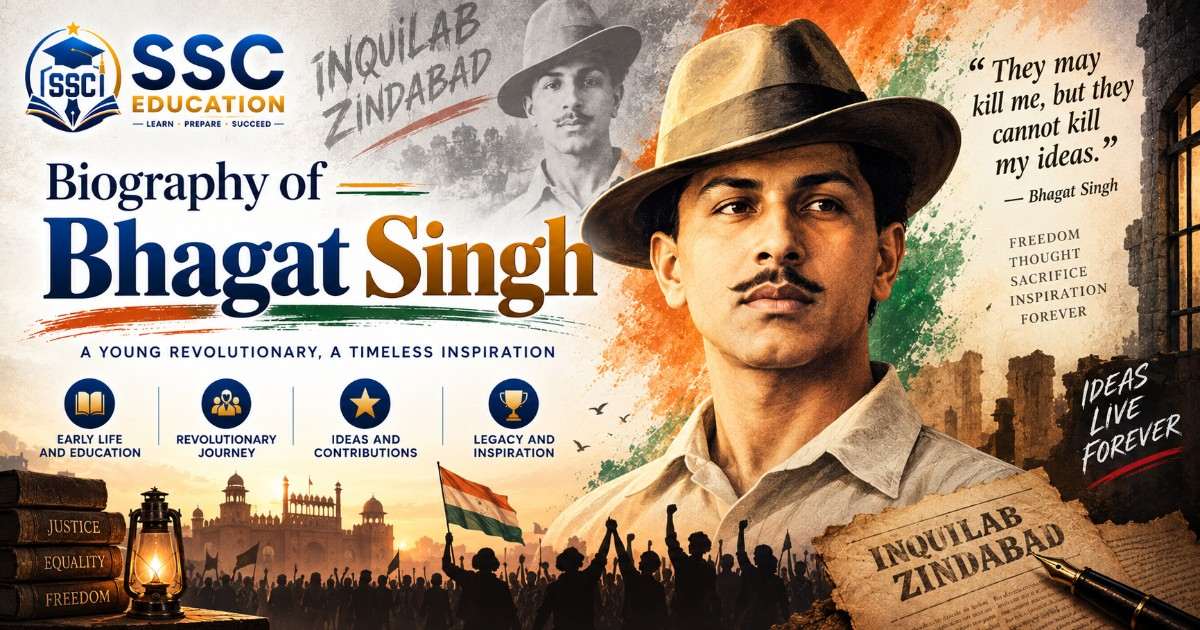
Biography of Bhagat Singh
Rahul Kumar
SSC Exam Expert & Content Editor
Table of Contents
- 1.Introduction
- 2.Quick Facts: Bhagat Singh
- 3.Early Life and Family
- 4.Education and the National College, Lahore
- 5.Naujawan Bharat Sabha and the Revolutionary Circle
- 6.The Hindustan Socialist Republican Association
- 7.The Simon Commission and the Death of Lala Lajpat Rai
- 8.The Saunders Killing (17 December 1928)
- 9.The Central Assembly Bomb (8 April 1929)
- 10.The Lahore Conspiracy Case
- 11.The Hunger Strike of 1929
- 12.The Verdict
- 13.Execution (23 March 1931)
- 14.Sukhdev Thapar and Shivaram Rajguru
- 15.Bhagat Singh's Ideas and Writings
- 16.Personality and Values
- 17.Debates about His Methods
- 18.Legacy and Memorials
- 19.Bhagat Singh and Gandhi: Two Approaches to Freedom
- 20.Bhagat Singh's Message to Young People
- 21.The Revolutionary Movement in Context
- 22.Lesser-Known Facts about Bhagat Singh
- 23.Timeline of Bhagat Singh's Life
- 24.Why Bhagat Singh Is Important for SSC and Other Competitive Exams
- 25.Related Reading
- 26.Conclusion
- 27.Frequently Asked Questions
Complete biography of Bhagat Singh (Shaheed-e-Azam): early life, HSRA, Saunders killing, Assembly bomb, hunger strike, Lahore Conspiracy Case, execution, ideas, timeline and 24 FAQs for SSC exams.
Introduction
Bhagat Singh (28 September 1907 – 23 March 1931) is remembered as Shaheed-e-Azam, the great martyr, of the Indian freedom struggle. He was hanged in Lahore Jail at the age of twenty-three, together with his comrades Sukhdev Thapar and Shivaram Rajguru, but in the short time that he was active he became one of the most influential young leaders in the country. To his admirers, he was a fearless revolutionary who chose to die rather than to plead for mercy; to historians, he was also one of the most original thinkers among India's revolutionaries, a reader of Marx and Lenin, who wrote that revolution meant not the cult of the bomb and the pistol but the change of an unjust social order.
The slogan Inquilab Zindabad ("Long live the revolution"), which he made famous, is still raised at protests and rallies across South Asia. This biography covers his childhood in a family of activists, his time at the National College in Lahore, his role in the Hindustan Socialist Republican Association, the killing of Saunders in 1928, the Assembly bomb of 1929, the hunger strike, the Lahore Conspiracy Case and the execution, along with his ideas, his legacy and a complete revision guide with FAQs for SSC and other competitive exams.
Quick Facts: Bhagat Singh
| Nationality | Indian |
|---|---|
| Best Known For | Revolutionary freedom fighter executed by the British in 1931 |
| Born | 28 September 1907 (some sources give 27 September), Banga village, Lyallpur district, Punjab, British India (now in Pakistan) |
| Died | 23 March 1931, Lahore Central Jail, aged 23 |
| Father | Sardar Kishan Singh Sandhu |
| Mother | Vidyavati Kaur |
| Uncles | Ajit Singh and Swaran Singh, both active in the nationalist movement |
| Education | Dayanand Anglo-Vedic School, Lahore; National College, Lahore |
| Organisations | Naujawan Bharat Sabha (1926), Hindustan Republican Association, Hindustan Socialist Republican Association (HSRA) |
| Famous Events | Saunders killing (17 December 1928); Central Assembly bomb (8 April 1929); 116-day hunger strike (1929) |
| Trial | Lahore Conspiracy Case |
| Executed With | Sukhdev Thapar and Shivaram Rajguru |
| Famous Slogans | "Inquilab Zindabad", "Down with Imperialism" |
| Remembered On | Shaheed Diwas, 23 March |
Early Life and Family
Bhagat Singh was born in the village of Banga in the Lyallpur district of Punjab, in a Sikh Jat family with a strong tradition of political activism. He was the second of seven children of Kishan Singh and Vidyavati. His father and two uncles, Ajit Singh and Swaran Singh, were nationalists who worked with the Ghadar movement and the Indian Association of Punjab, and Ajit Singh was among the leaders of the Pagri Sambhal Jatta agitation of 1907 and was exiled to Burma and later abroad. Family tradition says that when the boy was born, his father and uncles had just been released from jail; the child was therefore called Bhagat, the fortunate one.
Growing up in such a household meant that politics was not an abstract subject. Stories of the Ghadar revolutionaries who had been hanged in 1915, especially the young Kartar Singh Sarabha, made a deep impression. Kartar Singh Sarabha, who was executed at the age of nineteen, became one of his heroes, and he is said to have kept a picture of Sarabha with him for years. Yet Bhagat Singh's parents also cared about education, and the boy was sent to school, first in the village and then at the Dayanand Anglo-Vedic School in Lahore, where he read widely.
When he was about twelve, the Jallianwala Bagh massacre took place in Amritsar on 13 April 1919, killing hundreds of unarmed people. According to a story that is often told, the young Bhagat Singh visited the site on the following day and collected some soil from the ground, which he kept in a bottle as a reminder. Whether or not every detail is exact, the massacre became a major turning point in the thinking of his generation.
Education and the National College, Lahore
During the Non-Cooperation Movement, Bhagat Singh left the government school he was attending, following Gandhi's call. When the movement was suspended after the Chauri Chaura incident of 1922, he was disappointed, and he joined the National College in Lahore in 1923. The college had been founded by Lala Lajpat Rai and Bhai Parmanand as an alternative to government institutions, and it drew some of Punjab's brightest and most politically minded students, including Sukhdev Thapar and Bhagwati Charan Vohra. Under teachers such as Jai Chandra Vidyalankar, he studied history and politics and became a keen participant in debates and in the college's dramatic society, where he acted in patriotic plays.
Bhagat Singh was also a voracious reader. He read the history of the French and Russian revolutions, the biographies of Mazzini and Garibaldi, and, over time, the works of Marx, Engels, Lenin, Bakunin and Trotsky. The library of the Dwarka Das Library in Lahore was a favourite haunt, and it was said that he could be found there reading late into the evening. His reading led him gradually from a general nationalism to a critique of the economic and social system that underlay colonial rule.
When his family tried to arrange his marriage, Bhagat Singh left home rather than agree. In a letter to his father he wrote that his life was dedicated to the freedom of the country and that no worldly ties could hold him back. He went to Kanpur, where he found work at the newspaper Pratap, edited by the nationalist Ganesh Shankar Vidyarthi, and wrote under pseudonyms such as Balwant. Kanpur brought him into contact with older revolutionaries, including Batukeshwar Dutt and Chandra Shekhar Azad.
Naujawan Bharat Sabha and the Revolutionary Circle
After returning to Lahore, Bhagat Singh helped found the Naujawan Bharat Sabha in March 1926, of which he became the general secretary. The Sabha was a youth organisation which aimed at spreading revolutionary and socialist ideas, forging Hindu–Muslim unity and educating young people about the country's problems. It organised lectures, study circles and public meetings, and its emphasis on secularism and social equality made it different from earlier organisations of the kind. Its members took an oath to place the nation above community and religion.
Around the same time, Bhagat Singh came into contact with the Hindustan Republican Association (HRA), the revolutionary organisation led by Ram Prasad Bismil, Ashfaqulla Khan and Chandra Shekhar Azad. The HRA had carried out the Kakori train robbery in August 1925, taking government money from a train near Lucknow to fund its activities; four of its leaders, including Bismil and Ashfaqulla, were hanged in December 1927. The execution of the Kakori martyrs created a leadership vacuum, and it was younger members such as Bhagat Singh, Sukhdev, Bhagwati Charan Vohra, Shivaram Rajguru and Azad who took the movement forward.
In May 1927 Bhagat Singh was arrested for the first time on suspicion of involvement in a bomb explosion in Lahore, and he was released about five weeks later on a heavy security bond. The experience did not weaken his resolve; it clarified it.
The Hindustan Socialist Republican Association
In September 1928, revolutionaries from Punjab, the United Provinces, Bihar and Rajasthan met at Feroz Shah Kotla in Delhi. Under the influence of Bhagat Singh and his colleagues, the HRA was reorganised as the Hindustan Socialist Republican Association (HSRA), with Chandra Shekhar Azad as commander-in-chief. The addition of the word "Socialist" was deliberate: the members declared that their goal was not only the end of British rule but the end of the exploitation of man by man. In effect, the HSRA was one of the first revolutionary bodies in India to adopt socialism as an explicit objective.
The Simon Commission and the Death of Lala Lajpat Rai
In October 1928 the Simon Commission visited Lahore, and Lala Lajpat Rai led a peaceful procession against it. The police, under the Superintendent James A. Scott, ordered a lathi charge, and Lajpat Rai was badly beaten. He died on 17 November 1928. To Bhagat Singh, who had studied at Lajpat Rai's National College, the event was a national insult. The HSRA decided that the blow to a great leader could not go unanswered, and it planned to kill Scott.
The Saunders Killing (17 December 1928)
On the afternoon of 17 December 1928, Bhagat Singh, Shivaram Rajguru and Chandra Shekhar Azad, helped by Jai Gopal, waited outside the police headquarters in Lahore. When a young police officer came out and rode away on a motorcycle, they assumed it was Scott, but it was in fact John P. Saunders, a twenty-one-year-old Assistant Superintendent of Police. Rajguru fired the first shot, and Bhagat Singh shot Saunders several times at close range. As the group escaped, a Head Constable, Chanan Singh, followed them, and Azad shot him dead to cover the retreat.
The killing was a mistake of identity, but the HSRA put out posters the next morning declaring that the death of Lajpat Rai had been avenged and that the HSRA believed in the revolution, not in personal vengeance. The police launched a large search. Bhagat Singh cut his hair and beard to disguise himself, a serious decision for a young man raised as a Sikh, and left Lahore in Western clothes, with Durgawati Devi, the wife of his comrade Bhagwati Charan Vohra, known to revolutionaries as Durga Bhabhi, posing as his wife and carrying a child. Rajguru went along as a servant. They travelled by train to Calcutta and Lucknow, and the plan worked.
The nation's reaction was mixed. Many young people admired the courage of the group, while leaders committed to non-violence, including Gandhi, condemned the killing. What is certain is that the event turned Bhagat Singh into a public figure and marked the beginning of the final phase of his life.
The Central Assembly Bomb (8 April 1929)
In early 1929 the government proposed two measures in the Central Legislative Assembly in Delhi: the Public Safety Bill, giving it power to deport suspected revolutionaries, and the Trade Disputes Bill, restricting workers' right to strike. Bhagat Singh and the HSRA decided to make a protest that would carry their message to the whole country. The plan was that two members would throw harmless bombs in the Assembly, shout slogans, distribute leaflets and then surrender, using the trial that would follow as a platform for their ideas.
On 8 April 1929, Bhagat Singh and Batukeshwar Dutt threw two low-intensity bombs into an empty part of the Assembly chamber from the public gallery. No one was killed, though a few were slightly injured. They shouted Inquilab Zindabad, threw leaflets that said that it takes a loud voice to make the deaf hear, and then calmly surrendered. The leaflet, signed by the HSRA, declared that the aim of the revolutionaries was to awaken the country and that the bomb was not intended to kill.
In the trial that followed in Delhi, both men defended their action in a joint statement drafted largely by Bhagat Singh. He argued that force used to advance a just cause had moral justification and that revolution was not the cult of the bomb and pistol but the transformation of society. On 12 June 1929 the court sentenced both to transportation for life. If nothing more had happened, Bhagat Singh would have spent many years in jail. But the police, investigating the Lahore killing, soon found the trail, and Bhagat Singh was brought to Lahore to face a far more serious charge.
The Lahore Conspiracy Case
By mid-1929 the police had arrested several members of the HSRA in Lahore, Saharanpur and elsewhere, and some, including Hans Raj Vohra, Jai Gopal and P. N. Ghosh, turned approvers and gave evidence against their former comrades. Bhagat Singh, Sukhdev, Rajguru and others were charged in what became known as the Lahore Conspiracy Case, with the murder of Saunders and Chanan Singh, conspiracy to murder Scott and waging war against the King. The trial began in July 1929, and about two dozen people were accused.
The courtroom became a political stage. The accused shouted slogans, sang patriotic songs like Sarfaroshi ki tamanna, and often refused to attend proceedings, and Bhagat Singh used the hearings to speak about the ideas of the revolution. Newspapers reported the trial in detail, and their speeches were read by thousands. The government, alarmed by the effect on public opinion, decided in May 1930 to issue a special Ordinance setting up a tribunal of three High Court judges, which could proceed even in the absence of the accused, with the only right of appeal being to the Privy Council in London. The ordinance was never approved by the Central Assembly or by the British Parliament and lapsed after a few months, a fact that critics later described as a serious legal defect in the proceedings.
The Hunger Strike of 1929
While in jail in Lahore and Mianwali, Bhagat Singh and his comrades discovered that British prisoners were given better food, clothes and facilities than Indian political prisoners, who were treated like common criminals. In June 1929 they began a hunger strike to demand equal treatment, including proper food, clothing, toiletries, books and newspapers, and the right not to be forced to do degrading labour. As the days passed, the strike drew wide public sympathy. Congress leaders including Jawaharlal Nehru visited the prisoners, and the government faced a storm of criticism in the Assembly.
The strike claimed a life. Jatindra Nath Das (Jatin Das), a young revolutionary from Bengal who had joined the fast, died on 13 September 1929 after sixty-three days without food. His funeral procession, which travelled from Lahore to Calcutta, was joined by hundreds of thousands. Under pressure from a Congress resolution and the requests of his father, Bhagat Singh ended his fast on 5 October 1929 after 116 days, having lost considerable weight. The government conceded some of the demands, and the strike is remembered as a landmark in the struggle for the rights of political prisoners.
The Verdict
On 7 October 1930, the special tribunal delivered its judgment. Bhagat Singh, Sukhdev and Rajguru were sentenced to death by hanging. Several others received sentences of transportation for life, including Shiv Verma, Kishori Lal and Bijoy Kumar Sinha, while a few were sentenced to shorter terms of imprisonment and three were acquitted. The Privy Council rejected the appeal. In February 1931 Madan Mohan Malaviya appealed to the Viceroy for clemency, and in March, Gandhi, who was engaged in talks after the Gandhi–Irwin Pact, raised the question of commutation with Lord Irwin, but the Viceroy refused.
It is often asked why Gandhi did not make the release of Bhagat Singh a condition of the Gandhi–Irwin Pact. Historians note that Gandhi did appeal, and wrote a personal letter to the Viceroy on the day of the hanging, but that he did not believe he could make it a condition of the agreement, and that he was opposed to the death penalty in principle. The issue caused deep anger against the Congress leadership, and Gandhi was greeted with black flags when he arrived in Karachi for the Congress session.
Execution (23 March 1931)
The hanging was originally fixed for 24 March 1931, but the authorities, fearing unrest, moved it forward by about eleven hours. At about 7.30 in the evening of 23 March 1931, Bhagat Singh, Sukhdev and Rajguru were hanged at the Lahore Central Jail. The three men are said to have gone to the gallows singing and shouting slogans. No magistrate was willing to oversee the execution, and an honorary judge had to be brought in for the purpose. Bhagat Singh was reading a book on Lenin, and when the jailer came for them, he reportedly asked for a moment to finish a chapter.
The authorities, afraid of protests, did not hand the bodies over to the families. They were taken out secretly from the back of the jail, cut into pieces and cremated at night near Ganda Singh Wala village on the banks of the Sutlej, close to Ferozepur, and the ashes were thrown into the river. When villagers noticed the fire, the officials fled, and the family later gathered the remains. The place is now the site of the Hussainiwala National Martyrs Memorial.
The reaction across the country was enormous. There were mourning processions and strikes in cities from Lahore to Madras, and the Karachi session of the Congress passed a resolution that recorded its admiration for the bravery and sacrifice of the three men, while dissociating itself from political violence, and called the execution an act of wanton vengeance. Nehru later wrote that Bhagat Singh had become a symbol and that within a few months every town and village of Punjab was echoing with his name.
Sukhdev Thapar and Shivaram Rajguru
Bhagat Singh's comrades in death deserve their own place in the story. Sukhdev Thapar was born on 15 May 1907 in Ludhiana and grew up in Lyallpur; he studied at the National College, helped to found the Naujawan Bharat Sabha and was a key organiser of the HSRA's Punjab network. Shivaram Rajguru was born on 24 August 1908 at Khed near Pune in Maharashtra. A student of Sanskrit and a skilled marksman, he joined the HSRA and fired the first shot in the Saunders operation. Both were only twenty-three or twenty-four when they were hanged. The three are remembered together, and 23 March is observed as Shaheed Diwas (Martyrs' Day) in their memory.
Bhagat Singh's Ideas and Writings
What distinguishes Bhagat Singh among Indian revolutionaries is the seriousness of his thinking. In the last years of his life, he moved from a romantic idea of individual sacrifice to a socialist analysis of society. He wrote that the goal of the revolution was not simply the replacement of British officials by Indian ones, but the end of the system in which one class exploited another. In a well-known passage, he argued that if the country won freedom while leaving the structure of exploitation intact, the workers and peasants would remain poor, whether they were ruled by the British or by rich Indians.
His main writings and statements include:
- Why I Am an Atheist (1930) — an essay written in jail in response to a fellow prisoner who suggested that his rejection of God came from vanity. Bhagat Singh argued that belief in God had been used to justify inequality and that a revolutionary must stand on the strength of reason and conscience.
- The Assembly Bomb Statement (June 1929) — a joint statement by Bhagat Singh and B. K. Dutt in court, explaining that force used in the service of a just cause was morally justified and that the purpose of revolution was social change.
- Letter to Young Political Workers — a document addressed to the youth, urging them to educate and organise workers and peasants rather than rely on individual acts of violence.
- The Jail Notebook — a notebook kept in Lahore Jail with extracts from the books he read, including works by Marx, Lenin, Trotsky, Bakunin and others.
- Articles in Kirti and Pratap — essays on anarchism, communal violence, untouchability and revolution.
- The last letter (20 March 1931) — a message to the Governor of Punjab asking that he and his comrades be treated as prisoners of war and be shot rather than hanged.
He also wrote about the danger of communal politics. In articles published in the late 1920s, he criticised those who divided Indians on religious lines and argued that the youth must rise above religion and caste. His firm rejection of communalism explains why the Naujawan Bharat Sabha insisted on Hindu–Muslim unity.
Personality and Values
Friends and prison officials described Bhagat Singh as calm, disciplined and cheerful. He was known for his love of books, his sense of humour and his affection for his comrades. He liked to sing, to act and to write poetry, and he was fond of good food, which some of his letters from jail refer to with humour. He took great care to explain his ideas to others, and even during the Lahore trial he continued to read and write.
His courage in the final months was extraordinary. He refused to write a mercy petition, and when his father submitted one on his behalf during the trial, he wrote him an angry letter, saying that it was a betrayal of his principles. In the last weeks he seemed calm and at peace, and prison officials observed that he was more concerned about finishing his books than about his fate.
Debates about His Methods
Bhagat Singh's use of violence has been debated since his own time. Gandhi and many Congress leaders opposed it as a matter of principle and believed that it harmed the national cause. Others, especially the younger generation, saw it as a legitimate response to British repression. What is agreed by most historians is that Bhagat Singh himself did not idealise violence: in the Assembly bomb, he took care that no one would die, and in his last writings he argued that the bomb and the pistol were of limited use and that mass organisation was the real revolutionary path. His importance lies as much in his ideas about social justice and secularism as in his acts.
Legacy and Memorials
- Shaheed Diwas: 23 March is observed in India as Martyrs' Day in honour of Bhagat Singh, Sukhdev and Rajguru; a fair is held every year at Hussainiwala.
- Hussainiwala National Martyrs Memorial: Built at the site of the secret cremation near Ferozepur in Punjab, it houses memorials to the three martyrs.
- Khatkar Kalan: The ancestral village of the family in Nawanshahr district, Punjab, has the Shaheed-e-Azam Sardar Bhagat Singh Museum and a memorial.
- Parliament and the Supreme Court: A bronze statue was unveiled in the Parliament House complex in 2008, and the Supreme Court held an exhibition on his trial in 2007, on his centenary.
- Chandigarh Airport: Renamed Shaheed Bhagat Singh International Airport in 2015.
- Stamps and coins: The Government of India issued a stamp in 1968 and a commemorative coin in 2012.
- Cinema: Many films have portrayed him, including Shaheed (1965), The Legend of Bhagat Singh (2002), Shaheed-e-Azam (2002), 23rd March 1931: Shaheed (2002) and, indirectly, Rang De Basanti (2006).
- Poll: In a 2008 poll by India Today, he was voted the greatest Indian, ahead of Subhas Chandra Bose and Gandhi.
- In Pakistan: Activists in Lahore have long demanded that Shadman Chowk, the site of the former jail, be named after Bhagat Singh.
Bhagat Singh and Gandhi: Two Approaches to Freedom
The relationship between Bhagat Singh and Mahatma Gandhi is often presented as a simple conflict between violence and non-violence, but the reality was more complex. Gandhi believed that mass non-violent resistance was the only method that could bring a diverse country together and that individual acts of violence would provoke repression and divide the people. Bhagat Singh, in his later writings, also moved away from the idea of individual terror and argued for organising workers and peasants, though he did not accept Gandhi's insistence that the struggle must remain non-violent in all circumstances. He also criticised the Congress leadership for what he saw as its reluctance to address economic inequality.
Despite these disagreements, the two men respected each other's sincerity. Gandhi wrote in Young India after the execution that the Congress had made many attempts to save the lives of the three men but that these had failed, while praising their courage and cautioning the youth against imitating their methods. Bhagat Singh, for his part, acknowledged that Gandhi had awakened the masses. Viewing them as parts of the same story, rather than as rivals, helps to explain how the freedom movement combined mass action with revolutionary sacrifice.
Bhagat Singh's Message to Young People
Bhagat Singh is often addressed as an icon of the youth, and his writing supports that reading. He urged young people to read seriously, to think independently, to study the conditions of workers and peasants and to build organisations, rather than to rely on emotion. He warned against communal politics and said that religion should be a private matter. In his Letter to Young Political Workers, he wrote that the revolutionary movement needed a scientific programme and disciplined workers. He believed that it was easy to kill individuals but impossible to kill ideas, a thought that is widely quoted from his writings and speeches. For students today, his example is a reminder that patriotism and study are not opposites, and that clarity of purpose is as important as courage.
The Revolutionary Movement in Context
To understand Bhagat Singh, it helps to place him in the longer story of India's revolutionary movement. The first phase, in the early twentieth century, included groups such as the Anushilan Samiti and Jugantar in Bengal, the actions of Khudiram Bose and Prafulla Chaki in 1908, and the Ghadar Party formed by Indians in North America in 1913, which sent volunteers to India in 1914–15 and produced martyrs such as Kartar Singh Sarabha. The second phase began after the collapse of the Non-Cooperation Movement in 1922, when many young people lost faith in purely non-violent methods. The Hindustan Republican Association was formed in 1924 by Sachindranath Sanyal, Ram Prasad Bismil and others, and it carried out the Kakori robbery in 1925. The third phase, from 1928, was led by the HSRA under Bhagat Singh and Azad, which added a socialist programme and a mass education strategy to the earlier tradition of armed action. Bhagat Singh therefore stands at the point where the revolutionary movement became consciously socialist and secular.
Lesser-Known Facts about Bhagat Singh
- He was only twenty-three when he was hanged, the youngest of the three men executed on 23 March 1931.
- He wrote for newspapers in Urdu, Hindi, Punjabi and English, sometimes under the pseudonyms Balwant, Ranjit and Vidrohi.
- He escaped from Lahore after the Saunders killing in disguise, along with Durga Bhabhi, who posed as his wife.
- He deliberately courted arrest in the Assembly to use the courtroom as a platform.
- He fasted for 116 days in 1929, demanding equal treatment for political prisoners.
- He was reading a book on Lenin, Clara Zetkin's reminiscences, on the day of his execution.
- He wrote a well-known essay on his atheism, despite belonging to a deeply religious family.
- The Supreme Court of India has, on later occasions, examined the trial and observed that the special tribunal procedure departed from ordinary norms of criminal justice.
Timeline of Bhagat Singh's Life
| Year | Event |
|---|---|
| 1907 | Born at Banga, Lyallpur, on 28 September |
| 1919 | Jallianwala Bagh massacre |
| 1921 | Left school during the Non-Cooperation Movement |
| 1923 | Joined the National College, Lahore |
| 1926 | Founded the Naujawan Bharat Sabha (March) |
| 1927 | First arrest in Lahore (May) |
| 1928 | HSRA formed (September); Lajpat Rai died (17 November); Saunders killed (17 December) |
| 1929 | Assembly bomb (8 April); life sentence (12 June); hunger strike begins in June; Jatin Das dies (13 September); fast ends (5 October) |
| 1930 | Special tribunal set up (May); death sentence announced (7 October) |
| 1931 | Hanged with Sukhdev and Rajguru at Lahore on 23 March |
Why Bhagat Singh Is Important for SSC and Other Competitive Exams
Bhagat Singh appears in almost every general awareness paper on modern Indian history, including SSC CGL, CHSL, MTS, GD Constable, Stenographer, railway, banking and defence examinations. The points below are the ones most often asked.
- Known as Shaheed-e-Azam; slogan "Inquilab Zindabad".
- Founded the Naujawan Bharat Sabha (1926); member of HRA and later HSRA (1928).
- Killed Saunders on 17 December 1928 to avenge the death of Lala Lajpat Rai.
- Threw bombs in the Central Legislative Assembly on 8 April 1929 with Batukeshwar Dutt.
- Case: Lahore Conspiracy Case; hunger strike with Jatin Das (who died after 63 days).
- Hanged on 23 March 1931 with Sukhdev and Rajguru; Shaheed Diwas is observed on this day.
- Essay: Why I Am an Atheist.
- Bomb thrown in the Assembly protested the Public Safety Bill and Trade Disputes Bill.
To fix the sequence in memory, remember the chain: Lajpat Rai (October–November 1928) → Saunders (December 1928) → Assembly bomb (April 1929) → hunger strike (June–October 1929) → verdict (October 1930) → execution (March 1931).
Related Reading
Conclusion
Bhagat Singh lived for only twenty-three years and was active in politics for less than a decade, but few Indian leaders have left a stronger mark on the imagination of the country. He showed that youthful courage could be combined with serious reading and clear ideas, that a trial could become a classroom and that a man could face death without fear. His life invites strong opinions, and it should be studied honestly — with attention to what he did, what he wrote and what he hoped for. For students, his life provides a clear list of dates, places and slogans; for all readers, it is a reminder that ideas can outlive the people who hold them.
Frequently Asked Questions
Who was Bhagat Singh?
Bhagat Singh (1907–1931) was an Indian revolutionary and freedom fighter who was hanged by the British at the age of 23 for his role in the killing of a police officer, and is remembered as Shaheed-e-Azam.
When and where was Bhagat Singh born?
He was born on 28 September 1907 (some sources give 27 September) in Banga village, Lyallpur district, Punjab, now in Pakistan.
Why is Bhagat Singh called Shaheed-e-Azam?
Shaheed-e-Azam means the great martyr. The title was given to Bhagat Singh in recognition of his sacrifice and the courage he showed at his execution.
Who were the parents of Bhagat Singh?
His father was Sardar Kishan Singh and his mother was Vidyavati Kaur. His uncles Ajit Singh and Swaran Singh were also freedom fighters.
What was the Naujawan Bharat Sabha?
It was a youth organisation founded in Lahore in March 1926 by Bhagat Singh and his friends to spread revolutionary ideas, secularism and Hindu–Muslim unity.
What is the HSRA?
The Hindustan Socialist Republican Association was formed in September 1928 at Feroz Shah Kotla, Delhi, from the earlier HRA, with socialism as an explicit aim; Chandra Shekhar Azad was its commander-in-chief.
Why did Bhagat Singh kill Saunders?
To avenge the death of Lala Lajpat Rai, Bhagat Singh, Rajguru and Azad planned to kill James Scott, but shot John Saunders by mistake on 17 December 1928 in Lahore.
Who helped Bhagat Singh escape from Lahore?
Durgawati Devi, known as Durga Bhabhi, posed as his wife and helped him escape by train after the Saunders killing, along with Rajguru.
What happened in the Central Legislative Assembly on 8 April 1929?
Bhagat Singh and Batukeshwar Dutt threw two harmless bombs, shouted Inquilab Zindabad and courted arrest in protest against the Public Safety Bill and the Trade Disputes Bill.
What does Inquilab Zindabad mean?
Inquilab Zindabad means Long Live the Revolution. The slogan was coined by Hasrat Mohani and became famous through Bhagat Singh.
Why did Bhagat Singh go on a hunger strike?
In 1929 he and his comrades fasted in jail to demand equal treatment for Indian political prisoners, who were given worse food, clothes and facilities than European prisoners.
Who was Jatin Das?
Jatindra Nath Das was a revolutionary who joined the hunger strike and died on 13 September 1929 after 63 days without food.
What was the Lahore Conspiracy Case?
It was the trial of Bhagat Singh and others for the murder of Saunders and other charges, held from 1929 to 1930 before a special tribunal, which sentenced three of them to death on 7 October 1930.
When was Bhagat Singh hanged?
He was hanged on 23 March 1931 in Lahore Central Jail, along with Sukhdev and Rajguru, a day earlier than the scheduled date.
Where were Bhagat Singh, Sukhdev and Rajguru cremated?
Their bodies were secretly cremated on the banks of the Sutlej near Ganda Singh Wala village in Ferozepur district; the site is now the Hussainiwala National Martyrs Memorial.
Why is 23 March celebrated as Shaheed Diwas?
23 March is Martyrs' Day in memory of the execution of Bhagat Singh, Sukhdev and Rajguru in 1931.
Which essay did Bhagat Singh write in jail?
He wrote Why I Am an Atheist in 1930, explaining his rejection of belief in God and his faith in reason.
Who were Sukhdev and Rajguru?
Sukhdev Thapar (born 1907, Ludhiana) and Shivaram Rajguru (born 1908, Khed, Maharashtra) were HSRA revolutionaries hanged with Bhagat Singh.
Was Bhagat Singh a socialist?
Yes. In his later years he became a convinced socialist, read Marx and Lenin and worked to make the HSRA a socialist organisation.
What was the attitude of Gandhi towards Bhagat Singh?
Gandhi disapproved of violence but admired his courage, appealed to the Viceroy for commutation and wrote about the matter in Young India after the execution.
Which book was Bhagat Singh reading before his execution?
He was reading a book on Lenin, said to be Clara Zetkin's Reminiscences of Lenin.
Which airport is named after Bhagat Singh?
Chandigarh International Airport is named Shaheed Bhagat Singh International Airport.
Where is the Bhagat Singh museum located?
The Shaheed-e-Azam Sardar Bhagat Singh Museum is at Khatkar Kalan, the ancestral village in Punjab.
Which dates related to Bhagat Singh are important for SSC exams?
Remember 1926 (Naujawan Bharat Sabha), 1928 (HSRA and Saunders killing), 8 April 1929 (Assembly bomb), 7 October 1930 (verdict) and 23 March 1931 (execution).
Rahul Kumar
SSC Exam Expert & Content Editor
Rahul is a senior SSC exam strategist with 8+ years of experience helping aspirants crack CGL, CHSL and MTS exams. He writes in-depth notification breakdowns, exam pattern guides and preparation strategies.