
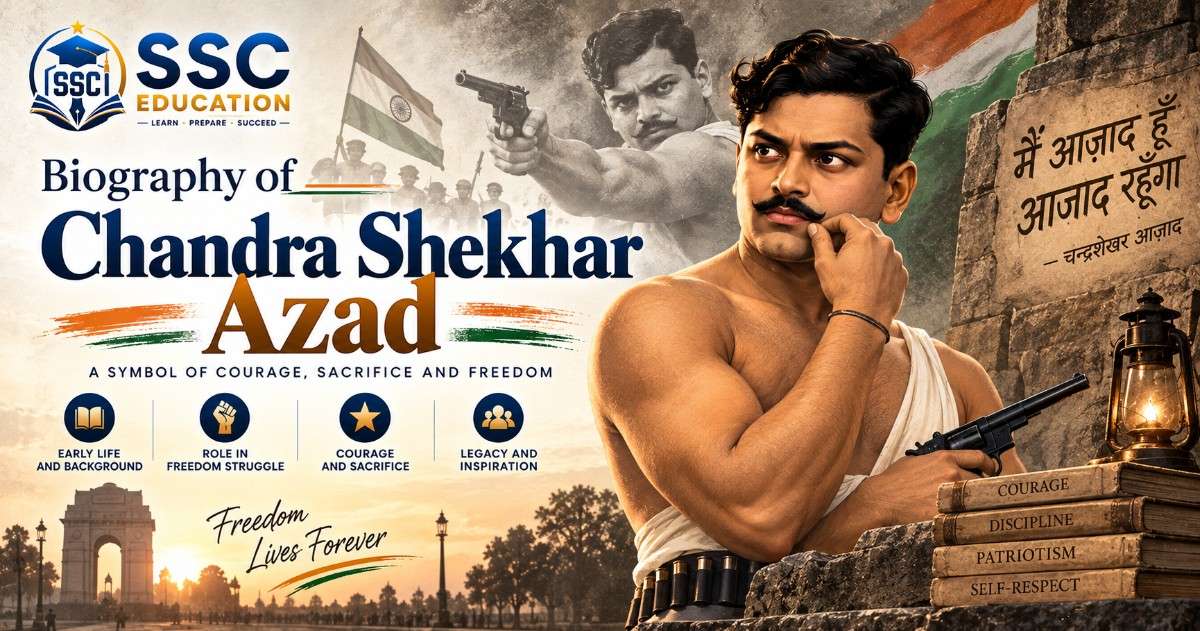
Biography of Chandra Shekhar Azad
Rahul Kumar
SSC Exam Expert & Content Editor
Table of Contents
- 1.Introduction
- 2.Quick Facts: Chandra Shekhar Azad
- 3.Early Life and Family
- 4.Varanasi and the Awakening
- 5.The Name "Azad": The Magistrate and the Fifteen Lashes
- 6.From Non-Cooperation to Revolution
- 7.The Kakori Train Action (9 August 1925)
- 8.Rebuilding the Movement: From HRA to HSRA
- 9.Azad's Role in the Saunders Killing (17 December 1928)
- 10.Hiding in Jhansi: Pandit Harishankar Brahmachari
- 11.The Viceroy's Train and the Philosophy of the Bomb
- 12.Efforts to Save Bhagat Singh
- 13.The Last Day: Alfred Park, Allahabad (27 February 1931)
- 14.Azad's Personality and Discipline
- 15.Azad's Ideas: From Nationalism to Socialism
- 16.Azad and Bhagat Singh: A Partnership
- 17.The Political Background: Why Young Indians Turned to Revolution
- 18.The Kakori Trial and Its Lessons
- 19.Azad and the Youth Today
- 20.Books and Sources on Chandra Shekhar Azad
- 21.Legacy and Memorials
- 22.The Revolutionary Movement: Key Names and Events (Quick Reference)
- 23.Lesser-Known Facts about Chandra Shekhar Azad
- 24.Timeline of Chandra Shekhar Azad's Life
- 25.Why Chandra Shekhar Azad Is Important for SSC and Other Competitive Exams
- 26.Related Reading
- 27.Conclusion
- 28.Azad's Contribution to the Freedom Struggle: A Summary
- 29.Important Terms and Names Linked with Azad
- 30.Frequently Asked Questions
Complete biography of Chandra Shekhar Azad: early life, the name Azad, Kakori, HSRA, Saunders killing, Jhansi hideout, last stand at Alfred Park, legacy, timeline and 24 FAQs for SSC exams.
Introduction
Chandra Shekhar Azad (23 July 1906 – 27 February 1931) was one of the most fearless revolutionaries of the Indian freedom struggle. Born Chandra Shekhar Tiwari in a poor family in a small village of central India, he became famous at the age of fifteen when, hauled before a magistrate for taking part in the Non-Cooperation Movement, he gave his name as Azad ("the free"), his father's name as Swatantrata ("independence") and his residence as Jail. From that day he was Chandra Shekhar Azad, and he vowed that the police would never take him alive.
Azad was the commander-in-chief of the Hindustan Socialist Republican Association, a comrade of Bhagat Singh, Sukhdev and Rajguru, a participant in the Kakori train action and the Saunders killing, and an expert organiser who evaded the police for nearly a decade. He died on 27 February 1931 in Alfred Park in Allahabad, after a shoot-out with the police in which he used his last bullet on himself rather than surrender. This biography covers his early life, his role in the revolutionary movement, the story of his last day, his ideas and legacy, and includes a revision guide and FAQs for SSC and other competitive examinations.
Quick Facts: Chandra Shekhar Azad
| Nationality | Indian |
|---|---|
| Best Known For | Revolutionary freedom fighter who vowed never to be taken alive by the British |
| Birth Name | Chandra Shekhar Tiwari (also written Chandrashekhar Sitaram Tiwari) |
| Born | 23 July 1906, Bhabra village, Alirajpur state (now in Madhya Pradesh) |
| Died | 27 February 1931, Alfred Park (now Chandra Shekhar Azad Park), Allahabad, aged 24 |
| Father | Sitaram Tiwari |
| Mother | Jagrani Devi |
| Ancestral Village | Badarka, Unnao district, Uttar Pradesh |
| Education | Studied Sanskrit at Kashi Vidyapeeth, Varanasi |
| Organisations | Hindustan Republican Association (HRA), Hindustan Socialist Republican Association (HSRA; commander-in-chief) |
| Major Events | Non-Cooperation (1921), Kakori action (1925), Saunders killing (1928) |
| Close Associates | Ram Prasad Bismil, Ashfaqulla Khan, Bhagat Singh, Sukhdev, Rajguru, Bhagwati Charan Vohra |
| Known For | The vow of never being captured alive; the name Azad (free) |
Early Life and Family
Chandra Shekhar was born on 23 July 1906 in Bhabra, a small village in the princely state of Alirajpur in what is now the Alirajpur district of Madhya Pradesh. His family came from the village of Badarka in the Unnao district of Uttar Pradesh, but had moved to the Bhil-dominated area of central India after a period of hardship. His father, Pandit Sitaram Tiwari, worked in a modest position in the estate of the local ruler, and his mother, Jagrani Devi, was a deeply religious woman who wished her son to become a scholar of Sanskrit. The family had very limited means, and Chandra Shekhar grew up in a poor household in a remote area.
The region in which he was raised had a large tribal population, and as a boy he mixed freely with local Bhil children. From them he learned to use the bow and arrow and to shoot accurately, skills that would prove useful later. He also learned to swim, to climb and to live in the outdoors. His mother's wish was that he should study Sanskrit at Varanasi, the ancient centre of learning, and, to fulfil it, he was sent to Kashi (Varanasi) as a teenager to study at the Sanskrit Pathshala.
Varanasi and the Awakening
Varanasi in the early 1920s was one of the centres of the national movement. The Kashi Vidyapeeth, a national university set up during the Non-Cooperation Movement, attracted students, and the town was filled with meetings, processions and pamphlets. The young Chandra Shekhar, still in his early teens, was drawn to the ideas of self-rule and national sacrifice that he heard on every side. He was also moved by the news of the Jallianwala Bagh massacre of 1919, which had shaken the whole country.
When Gandhi called for Non-Cooperation in 1920–21, young students left government schools and joined picket lines outside liquor shops and foreign cloth stores. Chandra Shekhar was among them. It was his first taste of politics, and he took to it with enthusiasm. The sight of thousands of ordinary Indians defying the authorities gave him a sense of purpose that he had not felt in the classroom.
The Name "Azad": The Magistrate and the Fifteen Lashes
In December 1921, at the age of fifteen, Chandra Shekhar was arrested in Varanasi for his part in the agitation and produced before a British magistrate, Mr. Khareghat, who had a reputation for severity. The magistrate asked him his name, and the boy replied: "Azad." Asked for his father's name, he said "Swatantrata" (independence). When the magistrate asked where he lived, he answered "Jail." The magistrate, angered by the young man's defiance, sentenced him to fifteen lashes.
According to the tradition, as the whip fell on his bare back, Chandra Shekhar did not cry out in pain; instead, with every stroke, he raised the slogan Bharat Mata ki Jai (Victory to Mother India). By the time the punishment ended, he had become a hero in the city. The crowds outside welcomed him with garlands, and the name Azad stuck. From that day he was known as Chandra Shekhar Azad, and he resolved that he would never again be caught by the police. He later described this as a promise that he would die free.
From Non-Cooperation to Revolution
In February 1922, a mob in Chauri Chaura in Uttar Pradesh burned a police station, killing twenty-two policemen. Gandhi, shocked by the violence, suddenly called off the Non-Cooperation Movement. The decision caused deep dismay among the young; many of them felt that the movement had been abandoned at its peak. Azad was among those who lost faith in purely non-violent methods. He came to believe that the country needed organised revolutionary action, and he began to look for people who shared his view.
In Varanasi he met Manmathnath Gupta and Pranavesh Chatterjee, who introduced him to Ram Prasad Bismil, the poet and revolutionary who was organising a new group in the United Provinces. Bismil, together with Sachindranath Sanyal and Jogesh Chandra Chatterjee, founded the Hindustan Republican Association (HRA) in 1924 with the goal of creating a federal republic of the United States of India through armed revolution. Azad joined the HRA and quickly became one of its most trusted members, known for his discipline, courage and skill with weapons.
The Kakori Train Action (9 August 1925)
The HRA needed money to buy weapons, and the revolutionaries decided to seize the government treasury being carried on a train. On 9 August 1925, a group of about ten members, including Ram Prasad Bismil, Ashfaqulla Khan, Rajendra Nath Lahiri, Roshan Singh and Chandra Shekhar Azad, stopped the Number 8 Down train near the village of Kakori, close to Lucknow, by pulling the emergency chain. They overpowered the guard, opened the safe and took away the cash, which amounted to a few thousand rupees. In the confusion, a passenger was accidentally shot dead, which turned the action into a murder case.
The British government responded with a large-scale crackdown, and within weeks, most of the HRA leadership had been arrested. Azad managed to evade the police and escaped. The Kakori trial lasted for more than a year. Four men — Ram Prasad Bismil, Ashfaqulla Khan, Rajendra Nath Lahiri and Roshan Singh — were sentenced to death and hanged in December 1927, and others were sentenced to long terms of imprisonment. The execution of these men was a serious blow to the revolutionary movement in northern India, but it also became a source of inspiration to a new generation.
Rebuilding the Movement: From HRA to HSRA
After Kakori, the HRA lay in ruins. Azad, who had escaped arrest, took on the task of rebuilding it. He travelled through Uttar Pradesh, Punjab, Rajasthan and Bihar, regrouping the survivors and recruiting new members. In this work he met the young revolutionaries of Punjab, such as Bhagat Singh, Sukhdev and Bhagwati Charan Vohra, who had been gathering ideas of socialism through their study circles in Lahore. The new generation had read the history of the Russian Revolution and believed that the revolutionary movement needed a clear social programme as well as a plan for armed action.
In September 1928, at a meeting held at Feroz Shah Kotla in Delhi, the revolutionaries agreed to reorganise the HRA as the Hindustan Socialist Republican Association (HSRA). Azad was elected commander-in-chief. Its purpose was defined not merely as the end of British rule, but as the establishment of a socialist republic in which the exploitation of man by man would be abolished. The organisation was divided into political and military wings, with Bhagat Singh as the chief thinker and organiser in Punjab and Azad as the head of the military side, responsible for arms, hideouts and discipline.
Azad's Role in the Saunders Killing (17 December 1928)
When Lala Lajpat Rai died from the injuries he received in the Simon Commission protest in Lahore, the HSRA decided to avenge his death. Azad, who was in overall charge, supported the plan and provided the organisational support. On 17 December 1928, Bhagat Singh and Rajguru shot the police officer John Saunders, whom they mistook for James Scott. Azad had positioned himself in the vicinity to cover their escape. When the Head Constable, Chanan Singh, ran after the fleeing men, Azad shot him dead to protect his comrades. He then led them to safety, and the group escaped Lahore through a well-planned route. Azad's careful planning in such operations earned him the respect of the younger men, who called him Panditji.
Hiding in Jhansi: Pandit Harishankar Brahmachari
Between his operations, Azad needed a safe place from which to work, and he found it in the Bundelkhand region around Jhansi. Near the town of Orchha, about fifteen kilometres from Jhansi, he used the forest along the Satar river as a training ground for the HSRA, where he taught recruits to use firearms. He built a small hut near a Hanuman temple on the river bank and lived there under the name of Pandit Harishankar Brahmachari, teaching children in the neighbourhood and working as an ordinary villager. He learned to drive a car at a motor garage in Jhansi, since he believed that a revolutionary should be able to operate every kind of machine. He was helped by local comrades, including Sadashiv Rao Malkapurkar and Vishwanath Vaishampayan, and he became a familiar figure in the neighbourhood. His disguise as a teacher was so complete that for a long time the police did not suspect him.
The Viceroy's Train and the Philosophy of the Bomb
In 1929 the HSRA was active on several fronts. After Bhagat Singh and Batukeshwar Dutt threw bombs in the Central Assembly and were arrested, the group's attention turned to the defence of its imprisoned comrades and to further action. On 23 December 1929, the HSRA tried to blow up the special train of the Viceroy, Lord Irwin, as it approached Delhi, but the bomb missed the Viceroy's carriage, and he escaped. Gandhi, in an article titled "The Cult of the Bomb", criticised the attempt, and Bhagwati Charan Vohra and Azad wrote a reply, the pamphlet The Philosophy of the Bomb, explaining the revolutionaries' thinking and arguing that the bomb was a response to repression.
In May 1930, Bhagwati Charan Vohra, one of the closest associates of Bhagat Singh and Azad, died in an accident while testing a bomb on the banks of the Ravi at Lahore, as he was preparing a plan to rescue Bhagat Singh and his comrades from jail. His death was a heavy loss to the group.
Efforts to Save Bhagat Singh
When Bhagat Singh, Sukhdev and Rajguru were sentenced to death on 7 October 1930, Azad tried all he could to save them. Several plans to rescue them from jail were considered but proved impractical after Vohra's death and the tight security. According to several accounts, Azad also went to Allahabad in early 1931 to persuade Jawaharlal Nehru and other leaders to press the government, through Gandhi, for the commutation of the sentences. Historians differ on the details of these meetings, but there is no doubt that he worked to the very end to save his friends, even though he knew that he himself was a hunted man.
The Last Day: Alfred Park, Allahabad (27 February 1931)
The events of the last day of Azad's life are among the most retold episodes in the history of the freedom movement, and they exist in several versions. What is agreed is this. On the morning of 27 February 1931, Azad was in Alfred Park, a public garden in Allahabad, where he had gone to meet a comrade. According to many accounts, the police had received information about his presence from an informer, and a large force led by senior officers, including the head of the CID, J. R. H. Nott-Bower, surrounded the park.
Azad, who was sitting with a comrade under a tree, realised that they had been surrounded. He first ordered his companion to escape, and then, standing alone behind the trunk of a tree, he fought off the police with his pistol. In the shoot-out that followed, he wounded several policemen and held the force at bay for a considerable time. When he was left with a single bullet, he kept his vow, turned the pistol on himself and died, aged only twenty-four, without being taken alive. He had, as the tradition puts it, remained Azad to the end.
The police, still afraid that the news would provoke unrest, cremated his body secretly at Rasulabad Ghat on the Ganga without informing his family or the public. When the townspeople of Allahabad learned what had happened, thousands gathered at the park. They collected the ashes and marked the tree where he had fallen; women of the city are said to have worshipped it as a place of sacrifice. The funeral procession that followed was one of the largest that Allahabad had seen, and the news brought mourning across the country. Azad died less than a month before the execution of Bhagat Singh, Sukhdev and Rajguru on 23 March 1931.
The couplet that is associated with him expresses the defiance of his last days: he would face the bullets of the enemy, he had been free and would remain free. Whether or not he composed it himself, it has become part of his legend.
Azad's Personality and Discipline
Comrades remembered Azad as a stern but affectionate leader. He kept a strict discipline within the HSRA, and imposed rules of conduct on its members: no drinking, no smoking, and a code of behaviour towards women that made him trusted in the homes where the revolutionaries took shelter. He himself lived as an austere brahmachari, remaining unmarried and possessing hardly anything beyond his pistol and a few clothes. He kept himself physically fit, was an accurate shot and could disguise himself as a sadhu, a labourer, a driver or a teacher.
Despite his stern manner, Azad had a sense of humour and was popular with the younger members of the group. He was also generous: when the group had money after an action, he kept only what was needed and sent the rest to comrades' families. His mother, Jagrani Devi, lived in poverty in Madhya Pradesh throughout these years, and it was some of his comrades, notably Sadashiv Malkapurkar, who later cared for her. In a movement of intellectuals, Azad was not a writer or theorist; his role was to give the movement practical leadership, discipline and courage, and in this he was irreplaceable. Comrades often said that it was Azad who held the party together.
Azad's Ideas: From Nationalism to Socialism
Azad's political views developed with the movement. In the HRA of 1924, the objective had been an independent federal republic achieved through armed struggle. Under the influence of Bhagat Singh and his colleagues, the HSRA of 1928 added a social objective: it stated that the revolution would not be complete unless the workers and peasants were freed from exploitation. Azad accepted this programme, although his own inclination was more practical than theoretical. He believed in secular nationalism and worked closely with Muslim comrades such as Ashfaqulla Khan; for him and his colleagues the unity of Hindus and Muslims in the struggle was not a matter of debate.
He also believed in organisation and in the importance of secrecy, funds and weapons. To raise resources, the revolutionaries carried out a number of robberies of government money and of wealthy individuals, which they justified as revolutionary necessity. Historians have debated the wisdom and morality of these methods, and the revolutionaries themselves often expressed regret at the loss of life. Azad's own attitude was that the fight was against a foreign government that used violence to maintain its rule, and that the defence of the nation justified the risks.
Azad and Bhagat Singh: A Partnership
The relationship between Azad and Bhagat Singh was one of the most productive partnerships in the revolutionary movement. Azad, older and more experienced in underground work, brought discipline and the network of hideouts and contacts built over years. Bhagat Singh, younger and better read, brought ideas, writing and a sense of how to use publicity. Together they redefined the movement. It is often said that Azad did not fully agree with Bhagat Singh's decision to court arrest at the Assembly in 1929, believing that the movement could not spare such a leader, but he respected his friend's decision. After Bhagat Singh's arrest, Azad carried on, trying to keep the organisation alive and to rescue his comrades. The two are usually remembered together, along with Sukhdev and Rajguru, as the four faces of the HSRA.
The Political Background: Why Young Indians Turned to Revolution
To understand Azad and his comrades, it is important to look at the political situation of the mid-1920s. The Non-Cooperation Movement of 1920–22 had raised enormous hopes and then ended suddenly. In the years that followed, the Congress was divided between those who wished to enter the legislatures and those who preferred constructive work, communal riots broke out in several cities, and the pace of the national movement slowed. Many young people, especially students and unemployed graduates, felt that peaceful methods had been tried and had not delivered results.
At the same time, new ideas were reaching India. The Russian Revolution of 1917 had shown that a small, disciplined organisation could overthrow an old order, and the writings of Marx, Lenin and others were being circulated in Indian cities. The Ghadar Party's example, and the memory of the Bengal revolutionaries of the early 1900s, provided models of sacrifice. In this environment, groups like the HRA and later the HSRA appeared, seeking to combine armed action with a programme of social change. Azad was the practical head of this movement in northern India and the link between its older and younger generations.
The Kakori Trial and Its Lessons
The Kakori Conspiracy Case, which began in 1926, became one of the best-known trials of the freedom struggle. About forty people were charged, and the trial lasted for many months in Lucknow. The accused, including Ram Prasad Bismil and Ashfaqulla Khan, were defended by lawyers such as Govind Ballabh Pant and Chandra Bhanu Gupta, and Motilal Nehru and other leaders took an interest in the case. Bismil, who was also a poet, wrote his autobiography in the condemned cell, and lines from his poems, such as Sarfaroshi ki tamanna, became the anthem of the revolutionaries.
The trial taught Azad several lessons. He saw how the loss of a single leader, or a careless mistake, could lead to the collapse of an entire organisation, and he decided that the HSRA should be smaller, more secret and better protected. He also saw that the government treated the accused with great severity, hanging four men for an action in which a single passenger had died, and this hardened his resolve. Above all, he saw the enormous public sympathy that the martyrs of Kakori received, which convinced him that sacrifice could awaken the country.
Azad and the Youth Today
For students and young people, Azad's example is instructive in several ways. First, he shows how firmly held principles can shape a whole life: the vow he made at fifteen guided everything he did afterwards. Second, he shows the value of discipline and self-reliance; he studied, trained and worked without the help of wealth or influence. Third, he shows that leadership need not be loud: he did not write books or make speeches, but he held together a group of people from different regions and backgrounds by trust and example. Finally, his life reminds us that the freedom enjoyed today was won by many kinds of effort — petitions, satyagrahas, imprisonments and, in the case of the revolutionaries, sacrifice — and that each of them deserves to be understood in its context.
Books and Sources on Chandra Shekhar Azad
Readers who wish to study Azad in more detail can turn to the memoirs of his associates. Manmathnath Gupta's They Lived Dangerously gives a first-hand account of the revolutionary movement and of Azad's role, and Vishwanath Vaishampayan, who lived and worked with him in Jhansi, wrote a well-known biography in Hindi. The writings of Shiv Verma and the histories of the revolutionary movement by scholars provide broader background. As with all figures of the period, the accounts differ in details, and it is useful to compare several sources; but on the main outline of his life — the name Azad, the HRA and HSRA, the Kakori and Saunders actions, and the last stand at Alfred Park — they agree.
Legacy and Memorials
- Chandra Shekhar Azad Park: Alfred Park in Allahabad (now Prayagraj), where he died, was renamed in his honour, and it contains a memorial statue and the tree associated with his last stand. The Allahabad Museum houses the pistol linked to him.
- Azad Nagar: His birthplace, Bhabra in Alirajpur district, was renamed Azad Nagar, and a memorial stands at his ancestral home.
- Postage stamp: The Government of India issued a commemorative stamp in his honour in 1988.
- Institutions: Universities, colleges, schools, parks and roads across India, especially in Uttar Pradesh and Madhya Pradesh, carry his name.
- Cinema and television: He has been portrayed in films such as Shaheed (1965), The Legend of Bhagat Singh (2002) and Rang De Basanti (2006), in which the character is played by Aamir Khan, and in the television series Chandrashekhar (2018).
- Popular culture: Songs, plays and stories about him are popular in Hindi-speaking regions, and his moustache-twirling image, standing with a pistol, is one of the most recognisable representations of a freedom fighter.
The Revolutionary Movement: Key Names and Events (Quick Reference)
Because Azad's life is linked with several events and organisations that are often asked about in examinations, a summary is useful.
- Hindustan Republican Association (HRA): Founded in 1924 by Sachindranath Sanyal, Ram Prasad Bismil and Jogesh Chandra Chatterjee.
- Kakori Conspiracy (9 August 1925): Train action near Lucknow; Bismil, Ashfaqulla Khan, Rajendra Lahiri and Roshan Singh were hanged in December 1927.
- Hindustan Socialist Republican Association (HSRA): Formed in September 1928 at Feroz Shah Kotla, Delhi; commander-in-chief Chandra Shekhar Azad.
- Saunders killing (17 December 1928): Lahore; Bhagat Singh, Rajguru and Azad.
- Assembly bomb (8 April 1929): Bhagat Singh and Batukeshwar Dutt.
- Lahore Conspiracy Case: Trial of Bhagat Singh and others; death sentences on 7 October 1930.
- Chittagong Armoury Raid (18 April 1930): Led by Surya Sen (Masterda) in Bengal.
- Death of Azad (27 February 1931): Alfred Park, Allahabad.
- Execution of Bhagat Singh, Sukhdev and Rajguru (23 March 1931): Lahore Jail.
Examiners frequently test which organisation carried out which action, and Azad's name connects the HRA, the Kakori action and the HSRA, making him a convenient link between the two phases of the revolutionary movement in northern India.
Lesser-Known Facts about Chandra Shekhar Azad
- He was only fifteen when he was first arrested and given fifteen lashes.
- He learned archery and shooting from Bhil children in his village in Alirajpur.
- He escaped arrest after the Kakori action and evaded the police for the remaining six years of his life.
- In Jhansi he lived as a teacher named Pandit Harishankar Brahmachari and learned to drive a car.
- He was the commander-in-chief of the HSRA, while Bhagat Singh was its chief ideologue in Punjab.
- He never married and lived by the code of a strict brahmachari.
- He was fond of horse riding, wrestling and swimming.
- He died at twenty-four, only a few weeks before the execution of Bhagat Singh, Sukhdev and Rajguru.
Timeline of Chandra Shekhar Azad's Life
| Year | Event |
|---|---|
| 1906 | Born at Bhabra, Alirajpur, on 23 July |
| 1919 | Jallianwala Bagh massacre |
| 1921 | Joined the Non-Cooperation Movement; arrested in December; took the name Azad |
| 1922 | Chauri Chaura; Non-Cooperation called off; turned towards revolutionary action |
| 1924 | Joined the Hindustan Republican Association |
| 1925 | Took part in the Kakori train action on 9 August |
| 1927 | Bismil, Ashfaqulla, Lahiri and Roshan Singh hanged in December |
| 1928 | HSRA formed in September with Azad as commander-in-chief; Saunders killed on 17 December |
| 1929 | Attempt on the Viceroy's train (23 December) |
| 1930 | Bhagwati Charan Vohra dies (May); death sentences on Bhagat Singh, Sukhdev and Rajguru (October) |
| 1931 | Died at Alfred Park, Allahabad, on 27 February |
Why Chandra Shekhar Azad Is Important for SSC and Other Competitive Exams
Azad is a regular subject in the modern history sections of SSC CGL, CHSL, MTS, GD Constable and Stenographer tests, as well as railway, banking and state-level examinations. The following points are the most useful.
- Original name: Chandra Shekhar Tiwari; born on 23 July 1906 at Bhabra (Alirajpur), Madhya Pradesh.
- Took the name Azad after being arrested in 1921 at the age of fifteen.
- Member of the HRA; took part in the Kakori action (1925); commander-in-chief of the HSRA (1928).
- Involved in the killing of Saunders in Lahore on 17 December 1928.
- Lived in Jhansi under the name Pandit Harishankar Brahmachari.
- Died on 27 February 1931 at Alfred Park, Allahabad (now Chandra Shekhar Azad Park).
- Associates: Ram Prasad Bismil, Ashfaqulla Khan, Bhagat Singh, Sukhdev, Rajguru.
A quick way to remember: Azad is linked to three places — Kakori (the train action), Lahore (Saunders) and Allahabad (his death) — and three organisational names: HRA, HSRA and the alias Harishankar Brahmachari.
Related Reading
Conclusion
Chandra Shekhar Azad's life was short, but it was defined by a single, clear resolve: to be free. From the boy who answered a magistrate with the word "Azad" to the man who kept his last bullet for himself, he stayed true to his vow. He was not a great writer or a theorist, but as a leader, organiser and comrade, he held the revolutionary movement of northern India together in its most difficult years. Whether or not one agrees with the methods of the revolutionaries, their courage, their commitment to secular and socialist ideals and their sacrifice remain an important part of India's history. For students, Azad's life offers a chain of memorable dates, names and places; for everyone, it stands as an example of the strength of a promise.
Azad's Contribution to the Freedom Struggle: A Summary
It is helpful to summarise what Azad contributed to the freedom movement, since his role was largely organisational and therefore easy to overlook. First, he was a bridge between two generations of revolutionaries: the older leaders of the HRA, such as Bismil and Sanyal, and the younger group around Bhagat Singh. When the Kakori arrests removed the older leaders, it was Azad who kept the network alive. Second, he was the chief of the military side of the HSRA, responsible for weapons, hideouts, funds and discipline, which enabled the more visible actions such as the Saunders operation and the Assembly bomb to take place. Third, he was a symbol of incorruptible resolve: his vow to remain free, and the manner in which he kept it, gave young Indians a powerful example. Finally, through his hiding places in Jhansi and other towns, he brought the revolutionary movement to small towns and villages beyond the big cities of Punjab and Bengal. These contributions may not be as widely known as slogans or speeches, but they were essential to the survival of the movement in its most dangerous years.
Important Terms and Names Linked with Azad
- Azad: The name he took in 1921, meaning free; the surname he used for the rest of his life.
- Panditji: The affectionate title used by his comrades.
- Bamtulbukhara: The nickname given to his pistol, kept as a memento in Allahabad.
- Harishankar Brahmachari: His alias in Jhansi.
- Feroz Shah Kotla: The place in Delhi where the HSRA was formed in 1928.
- Alfred Park: The Allahabad garden where he died, now named after him.
Keeping these terms together in one list makes it easy to answer one-line questions that ask for a name, place or alias.
Frequently Asked Questions
Who was Chandra Shekhar Azad?
Chandra Shekhar Azad (1906–1931) was an Indian revolutionary and freedom fighter, the commander-in-chief of the Hindustan Socialist Republican Association, who died in a shoot-out in Allahabad rather than be captured.
When and where was Chandra Shekhar Azad born?
He was born on 23 July 1906 in Bhabra village in the Alirajpur state, now in Madhya Pradesh.
What was Azad's original name?
His original name was Chandra Shekhar Tiwari, the son of Sitaram Tiwari and Jagrani Devi.
How did Chandra Shekhar get the name Azad?
In 1921, arrested at fifteen for joining the Non-Cooperation Movement, he told the magistrate that his name was Azad (free), his father's name was Swatantrata (independence) and his home was Jail; the name stayed with him.
How many lashes was Azad given as punishment?
He was sentenced to fifteen lashes and is said to have shouted Bharat Mata ki Jai with each stroke.
What is the Kakori train action?
On 9 August 1925, HRA revolutionaries including Bismil, Ashfaqulla Khan and Azad seized government money from a train near Kakori, close to Lucknow, to fund their activities.
What happened to the Kakori revolutionaries?
Ram Prasad Bismil, Ashfaqulla Khan, Rajendra Lahiri and Roshan Singh were hanged in December 1927; Azad escaped arrest.
What is the HSRA?
The Hindustan Socialist Republican Association was formed in September 1928 at Feroz Shah Kotla, Delhi, when the HRA was reorganised with socialism as its goal; Azad was its commander-in-chief.
What was Azad's role in the Saunders killing?
He supported the plan, covered the escape of Bhagat Singh and Rajguru and shot Head Constable Chanan Singh, who chased them.
Under what name did Azad live in Jhansi?
He lived as Pandit Harishankar Brahmachari, teaching children and training revolutionaries in the forest near Orchha on the Satar river.
Who helped Azad in Jhansi?
Comrades such as Sadashiv Rao Malkapurkar and Vishwanath Vaishampayan supported him in Jhansi.
When and where did Chandra Shekhar Azad die?
He died on 27 February 1931 at Alfred Park in Allahabad (Prayagraj) after a shoot-out with the police.
How did Azad die?
When he was left with one bullet in the shoot-out, he shot himself to keep his vow never to be captured alive.
What was Azad's age at death?
He was twenty-four when he died.
What is Alfred Park called today?
It is now called Chandra Shekhar Azad Park in Prayagraj.
Who were Azad's closest associates?
Ram Prasad Bismil, Ashfaqulla Khan, Bhagat Singh, Sukhdev, Rajguru and Bhagwati Charan Vohra were among his closest associates.
What was The Philosophy of the Bomb?
It was a pamphlet written in early 1930 by Bhagwati Charan Vohra and Azad in reply to Gandhi's article The Cult of the Bomb, explaining the revolutionaries' views.
Did Azad try to save Bhagat Singh?
Yes, he tried to arrange the rescue of Bhagat Singh and his comrades and, according to several accounts, sought the help of Congress leaders to press for commutation.
Was Azad married?
No, he never married and lived as a strict brahmachari.
Which stamp was issued in memory of Azad?
The Government of India issued a commemorative postage stamp in 1988.
Which films show Chandra Shekhar Azad?
He appears in films such as Shaheed (1965), The Legend of Bhagat Singh (2002) and Rang De Basanti (2006), and in the television series Chandrashekhar (2018).
Why was Azad disappointed with the Non-Cooperation Movement?
He, like many young people, felt the movement was called off too suddenly after the Chauri Chaura incident of 1922, and he turned to revolutionary methods.
What did the HSRA stand for in terms of ideology?
It stood for the end of British rule and for a socialist republic in which the exploitation of man by man would be abolished, with unity between Hindus and Muslims.
Which facts about Azad should I remember for SSC exams?
Remember his birth (23 July 1906, Bhabra), the name Azad (1921), the HRA and Kakori (1925), the HSRA (1928), the Saunders killing (1928) and his death at Alfred Park, Allahabad, on 27 February 1931.
Rahul Kumar
SSC Exam Expert & Content Editor
Rahul is a senior SSC exam strategist with 8+ years of experience helping aspirants crack CGL, CHSL and MTS exams. He writes in-depth notification breakdowns, exam pattern guides and preparation strategies.