
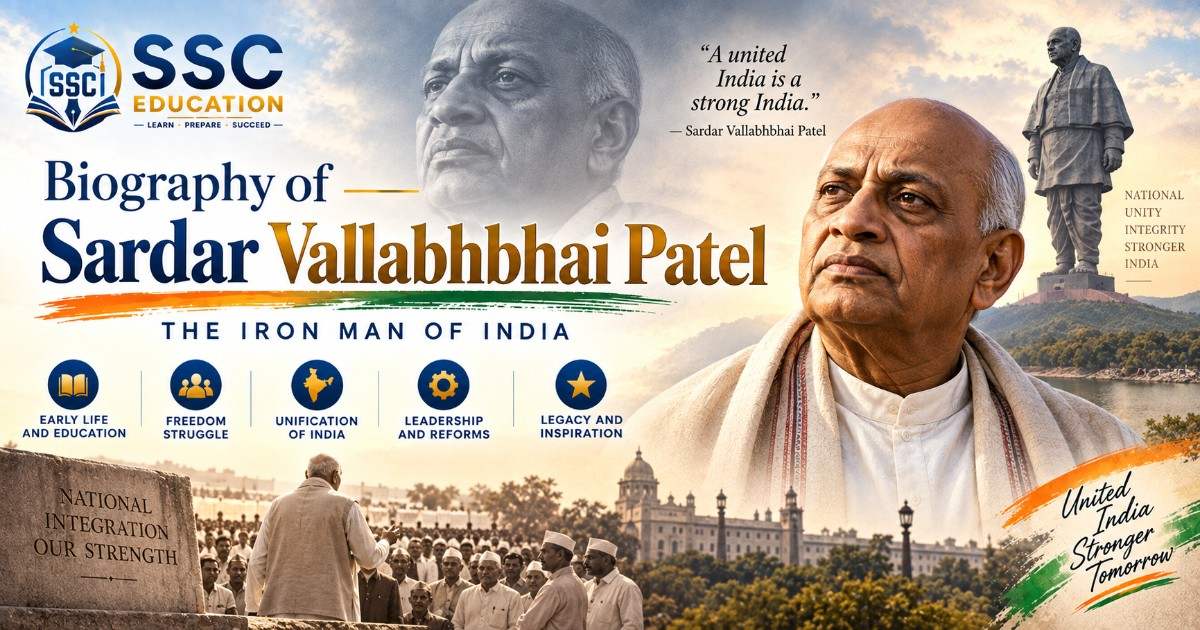
Biography of Sardar Vallabhbhai Patel
Rahul Kumar
SSC Exam Expert & Content Editor
Table of Contents
- 1.Introduction
- 2.Quick Facts: Sardar Vallabhbhai Patel
- 3.Early Life and Family
- 4.The Young Pleader
- 5.Studies in London and Return to India
- 6.Meeting Gandhi
- 7.The Kheda Satyagraha (1918)
- 8.Municipal Work, Nagpur and Borsad (1920s)
- 9.The Bardoli Satyagraha (1928) and the Title "Sardar"
- 10.Civil Disobedience, Karachi Congress and Prison
- 11.The Congress Organiser (1934–1939)
- 12.Quit India and Ahmednagar Fort (1942–1945)
- 13.Partition and the Cabinet Mission
- 14.Deputy Prime Minister and Home Minister
- 15.The Integration of the Princely States
- 16.Father of the All-India Services
- 17.Role in the Constituent Assembly
- 18.Somnath and the Amul Story
- 19.Gandhi's Assassination and the Last Years
- 20.Patel and Nehru: A Partnership of Opposites
- 21.Personality and Values
- 22.Legacy and Honours
- 23.Lesser-Known Facts about Sardar Patel
- 24.Timeline of Sardar Patel's Life
- 25.Why Sardar Vallabhbhai Patel Is Important for SSC and Other Competitive Exams
- 26.Related Reading
- 27.Conclusion
- 28.Frequently Asked Questions
Complete biography of Sardar Vallabhbhai Patel, the Iron Man of India: early life, Kheda and Bardoli satyagrahas, integration of princely states, All-India Services, Statue of Unity, timeline and 24 FAQs for SSC exams.
Introduction
Sardar Vallabhbhai Patel (31 October 1875 – 15 December 1950), remembered as the Iron Man of India, was a barrister, freedom fighter and statesman who did more than any other single person to turn a collection of colonial provinces and princely states into one nation. He was the first Deputy Prime Minister and Home Minister of independent India, the leader who persuaded or pressed about five hundred and sixty princely states to join the Indian Union, and the architect of the all-India civil services that he called the "steel frame" of the administration. His birthday, 31 October, is celebrated every year as Rashtriya Ekta Diwas (National Unity Day), and the world's tallest statue, the 182-metre Statue of Unity, honours him in Gujarat.
Patel's career had two halves. Before independence he was Gandhi's most effective organiser: the man who led the farmers of Kheda and Bardoli, raised funds for the Congress and built its election machinery. After independence he became the country's chief administrator, dealing with Partition, refugees, the princely states and the creation of a modern civil service in the space of three years. This biography follows his life from a Gujarati farming family to the Home Ministry, and it includes a detailed revision guide and FAQs for SSC and other competitive examinations.
Quick Facts: Sardar Vallabhbhai Patel
| Nationality | Indian |
|---|---|
| Best Known For | First Deputy Prime Minister and Home Minister of India; architect of the political integration of over 550 princely states |
| Full Name | Vallabhbhai Jhaverbhai Patel |
| Born | 31 October 1875, Nadiad, Bombay Presidency (now Gujarat) |
| Died | 15 December 1950, Bombay (now Mumbai), aged 75 |
| Title | Sardar (meaning chief or leader); Iron Man of India |
| Father | Jhaverbhai Patel, a farmer |
| Mother | Ladba (Ladben) Patel |
| Wife | Jhaverba (married 1893; died 1909) |
| Children | Maniben (born 1903) and Dahyabhai (born 1905) |
| Education | Studied law at the Middle Temple, London (1910–1913) |
| Major Movements | Kheda Satyagraha (1918), Bardoli Satyagraha (1928), Quit India (1942) |
| Congress President | Karachi session, 1931 |
| Offices | First Deputy Prime Minister and Home Minister of India (1947–1950) |
| Honour | Bharat Ratna (1991, posthumous) |
Early Life and Family
Vallabhbhai Patel was born on 31 October 1875 in Nadiad, in the Kheda district of present-day Gujarat, though he himself never knew the exact date and later used 31 October when he had to fill in a school form. His father, Jhaverbhai, was a farmer of the Leva Patel community who worked his own land and took part in the religious life of the village, while his mother, Ladba, was a pious and hard-working woman. The family was one of modest means: Vallabhbhai grew up working in the fields and learned the rhythms of farming life, and that experience gave him a permanent sympathy for peasants.
He was one of six children, and his elder brother, Vithalbhai, would also become a well-known public figure. As a boy Vallabhbhai was quiet, stubborn and unusually self-reliant. A story from his childhood, retold by his biographers, describes how he once had a painful boil on his body and, when the village barber hesitated to lance it with a hot iron rod, he took the rod himself and did it without flinching. It was a small event, but people who knew him later saw in it the same iron will that he showed in politics.
His schooling was uneven. He studied in Nadiad, Petlad and Borsad, sometimes walking long distances, and he did not pass his matriculation until the age of twenty-two, which led some of his relatives to assume that he was destined for an ordinary life. He had, however, made a private decision: he intended to become a lawyer, travel to England and earn enough money to improve his family's situation. In 1893, at the age of about seventeen, he was married to Jhaverba, and the couple had two children, Maniben and Dahyabhai.
The Young Pleader
After matriculation, Patel studied for the district pleader's examination, which he passed in 1900, and set up practice in Godhra before moving to Borsad and Anand. He was sharp, direct and fearless in court, and his skill at cross-examination soon made him one of the most successful lawyers of the region. A famous story from these years illustrates his self-control. In 1909, while he was cross-examining a witness in a difficult case, a court messenger handed him a telegram bringing the news that his wife, Jhaverba, who was being treated for cancer in Bombay, had died. He read the note, folded it into his pocket and continued the cross-examination to its end, and won the case. Only after the court rose did he tell others of the loss.
Patel was determined to go to England to study law, and he saved money for years. When his passage was finally arranged, however, the tickets and letters came in the name of his elder brother, whose initials were also V. J. Patel. Rather than create a family dispute, Vallabhbhai allowed Vithalbhai to go first, in 1905, and postponed his own dream by several years. Vithalbhai later became the first Indian President (Speaker) of the Central Legislative Assembly.
Studies in London and Return to India
In 1910, at the age of thirty-five, Vallabhbhai finally sailed for London, leaving his children with relatives. He joined the Middle Temple and completed the thirty-six-month course in thirty months, standing first in his class in the final examinations. Fellow students remembered a reserved, formally dressed man who avoided the social life of the city and devoted himself to books. He returned to India in 1913 and settled in Ahmedabad, where he soon became the leading criminal barrister of the city, with a large practice, a fashionable wardrobe and a reputation for being a strong bridge player.
At that stage he had little interest in politics and, by his own account, regarded Gandhi's ideas about non-violence and simple living with some scepticism. In 1917 he was elected as a member of the Ahmedabad Municipality and worked on sanitation and public works. Then a chance encounter began to change his life.
Meeting Gandhi
In October 1917, Patel attended the Gujarat Political Conference at Godhra, where he heard Gandhi speak. Their first conversation was brief, but Patel was impressed by the Mahatma's sincerity and by the practical way in which he addressed the problems of the villagers. He agreed to become the Secretary of the Gujarat Sabha, the political association that Gandhi had revived, and began to spend more time with him. In the following months he watched Gandhi work during an epidemic and a labour dispute in Ahmedabad and slowly came to believe that the Mahatma's method could actually work. It was in the Kheda satyagraha of 1918 that the transformation of the lawyer into a mass leader became complete.
The Kheda Satyagraha (1918)
In 1918 the crops in Kheda district failed because of heavy rain, and farmers were ruined. According to the revenue rules, if the harvest was below one-fourth of the normal yield, farmers were entitled to a suspension of the land tax. The government, however, insisted on collecting the full amount. Gandhi and Patel toured villages, explained the farmers' rights and urged them to refuse to pay until the government relented. Patel left his practice, gave up his luxuries and travelled from village to village, sleeping in farmers' homes and eating simple food.
The government responded by seizing cattle, property and even standing crops. Yet the farmers held firm, and volunteers helped them in hiding movable property and harvesting crops. After several months, the government agreed to suspend the collection of revenue for the poorer farmers for that year and later in the following year. It was a significant victory, and the experience transformed Patel. He gave up his legal practice, adopted khadi, and joined Gandhi's movement completely.
Municipal Work, Nagpur and Borsad (1920s)
During the 1920s Patel became a key figure of the Congress in Gujarat. He served as President of the Ahmedabad Municipal Corporation in the mid-1920s, improving drainage, water supply, schools and roads and gaining a reputation as an efficient administrator who insisted on honest accounts. During the Non-Cooperation Movement, he raised large sums for the Tilak Swaraj Fund, collecting more than a million rupees in Gujarat, and he threw away his European clothes, wearing khadi for the rest of his life.
In 1923, when the British administration in Nagpur banned the display of the Indian national flag in a procession, he led the Nagpur Flag Satyagraha. Thousands of volunteers from across India marched carrying the flag, and many were arrested; eventually the government gave way and released the prisoners. In 1924 he led another local satyagraha at Borsad against a special police tax imposed on villagers, and he secured its withdrawal. These campaigns made him one of the best-known Congress leaders outside Bombay and prepared him for the greatest test of his career.
The Bardoli Satyagraha (1928) and the Title "Sardar"
In 1928 the Bombay government increased the land revenue in the Bardoli taluka of Surat district by about thirty per cent, despite the fact that the region had suffered floods and famine. The peasants appealed for relief, and when officials rejected the plea, they turned to Patel. He organised the farmers in a structured manner: village committees, volunteer camps, a news bulletin and a fund to help those whose property was seized. The peasants of Bardoli resolved not to pay a single rupee of the enhanced tax until the government withdrew it.
The government tried to break the movement by confiscating land, seizing cattle and arresting workers. Patel toured the taluka, addressed meetings, and insisted that no violence should take place. The women of Bardoli played a prominent role in holding the campaign together. After nearly six months, and amid growing pressure from the public and the press, the government appointed an inquiry and eventually cancelled the increase and returned the confiscated land. It was a total victory, and it was in recognition of his leadership that the women of Bardoli gave him the title "Sardar", which means chief or leader. From that day he was known to India as Sardar Patel.
Civil Disobedience, Karachi Congress and Prison
When Gandhi began the Salt Satyagraha in 1930, Patel was arrested on 7 March, even before the march to Dandi began, and sentenced to imprisonment for making a speech in a village. After the Gandhi–Irwin Pact of 1931, he was released and elected President of the Indian National Congress at its Karachi session in March 1931. The session is remembered for its resolution on Fundamental Rights and Economic Policy, which promised civil liberties, the abolition of untouchability, a living wage and state ownership of key industries, and which became a direct source for the Fundamental Rights and Directive Principles of the Constitution twenty years later. The session also took place a few days after the execution of Bhagat Singh, Sukhdev and Rajguru, and Patel presided over it in an atmosphere of national anger and grief.
In the years that followed he was imprisoned repeatedly. In 1932 he and Gandhi shared cells in Yerwada jail in Pune, and it was in these months that they built a close relationship, in which Gandhi treated him like a younger brother and taught him Sanskrit, and Patel looked after the older man's needs. Patel later said that the time he spent with Gandhi in jail was among the happiest in his life.
The Congress Organiser (1934–1939)
Patel's great talent lay in organisation. When the Congress decided in 1934 to contest elections to the Central Legislative Assembly, and later in 1936–37 to the provincial assemblies, he chaired the Central Parliamentary Board, selected candidates, raised funds and handled the arrangements. The party won a majority in most provinces in 1937 and formed ministries in eight of them. Leaders such as Nehru, Rajendra Prasad and Bose provided the vision and the speeches; Patel provided the machinery, and many of his colleagues said that without him the Congress could not have functioned as a national party.
Quit India and Ahmednagar Fort (1942–1945)
When Gandhi launched the Quit India Movement in August 1942, Patel was one of its firmest supporters. On 7 August 1942, at Gowalia Tank in Bombay, he addressed a crowd of more than a hundred thousand people, and his speech was widely credited with convincing waverers that the moment for a final struggle had come. Two days later, on 9 August, he was arrested along with the entire Congress Working Committee and was held in the Ahmednagar Fort until 15 June 1945. During these years he spun cloth, read widely, gardened and played bridge with fellow prisoners, and he lost weight and suffered from ill health. By the time he was released, the war had ended, and the discussions on independence were about to begin.
Partition and the Cabinet Mission
Patel was among those who urged the Congress to accept the Cabinet Mission Plan of May 1946, hoping that a united India could be preserved with a weak Centre. When the plan collapsed and communal violence erupted in Calcutta, Noakhali, Bihar and Punjab, he concluded that a workable government could not be run in a country where a large part of the Muslim League opposed it. He reluctantly accepted the idea of partition as a way to save the rest of India from continuous conflict. His decision was among the most difficult of his life, and he shared responsibility for the outcome with Nehru, Gandhi and others.
In the Partition Council, which handled the division of the assets of British India, Patel represented India, and in the tragic weeks after 15 August 1947 he worked day and night to handle the refugee crisis, which involved over fifteen million people moving across the new borders. He set up committees in Delhi to manage relief, visited the camps and tried to prevent retaliatory violence. He addressed refugees in Amritsar and visited the shrine at Nizamuddin in Delhi to reassure Muslims that they would be protected. The scale of the disaster was beyond any government's ability, and the deaths of hundreds of thousands haunted him.
Deputy Prime Minister and Home Minister
On 15 August 1947, Patel became the first Deputy Prime Minister of India, and also held the portfolios of Home Affairs, States, and, until 1949, Information and Broadcasting. Nehru and Patel had worked together for thirty years and had different temperaments: Nehru was idealistic, internationalist and more inclined to theory, while Patel was practical, blunt and focused on administration. They quarrelled frequently over Kashmir, Hyderabad and policy toward Tibet and Pakistan, and Patel offered his resignation on several occasions. Yet both understood that the young nation needed them together, and Gandhi's last wish, expressed shortly before his death, was that they should work in harmony.
The Integration of the Princely States
Patel's greatest achievement was the integration of the princely states. When the British left, they declared that their treaty relationship (paramountcy) with the princes would lapse, leaving more than five hundred rulers technically free to join India, join Pakistan or, in theory, stay independent. The princely states covered about forty per cent of the land area of the subcontinent and included a fifth of its population. If even a handful had remained independent, the country might have broken into dozens of pieces.
As Minister for the States, Patel worked with V. P. Menon, the Secretary of the States Ministry, on a two-step plan. First, he asked the princes to sign an Instrument of Accession, handing over only three subjects — defence, external affairs and communications — to the Union. Second, once the rulers had signed, the states were gradually merged into provinces or unions of states. He used a mixture of personal persuasion, patriotic appeal and firm reminders that the people of the states wished to join India. He held meetings with princes, invited them to tea and lunch at his home and told them that he was asking for their cooperation as a friend, and that anarchy would harm them as well as India. In return the princes were promised privy purses (fixed annual payments) and the retention of their titles and personal properties. By 15 August 1947, almost all the states had signed; only Junagadh, Hyderabad and Jammu and Kashmir remained.
Junagadh
The Nawab of Junagadh, a small state in Kathiawar with a mostly Hindu population, acceded to Pakistan in September 1947 even though it had no land border with that country. The people protested and formed a provisional government, the Nawab fled to Karachi, and Indian troops entered the state. In a plebiscite in February 1948, almost the entire population voted to join India.
Hyderabad and Operation Polo
Hyderabad, the largest and richest princely state, was ruled by the Nizam, Mir Osman Ali Khan, who wanted independence. Negotiations and a standstill agreement in November 1947 failed to persuade him, while a militia known as the Razakars, led by Qasim Razvi, terrorised the countryside. On 13 September 1948, Patel ordered the Indian Army to march into Hyderabad in what was called Operation Polo. Within five days the Nizam's forces surrendered, and Hyderabad joined the Union. Patel also had to convince Nehru of the need for such action.
Kashmir
In Kashmir, the Maharaja hesitated until tribal raiders backed by Pakistan invaded in October 1947, after which he signed the Instrument of Accession. Patel was closely involved in the military response that secured Srinagar and the Kashmir Valley. He was sceptical of referring the matter to the United Nations and favoured a firm military solution, though the final policy was decided by the Cabinet under Nehru.
Other States
Many princes, such as those of Travancore, Bhopal and Jodhpur, wavered before accepting accession, and Patel used a mixture of diplomacy and pressure to bring them in. Through the following two years the states were merged into larger units such as Rajasthan, Madhya Bharat, PEPSU and Saurashtra, and Patel oversaw much of the process. The scale of what he accomplished is often compared to the unification of Germany by Bismarck, though it was done, for the most part, without war.
Father of the All-India Services
Patel also gave independent India its civil service. Many Congress leaders were suspicious of the Indian Civil Service, which they associated with the colonial government. Patel argued that a country as diverse and newly independent as India needed a trained, impartial, all-India administrative service that could function regardless of political changes. In the Constituent Assembly he defended the creation of the Indian Administrative Service (IAS) and the Indian Police Service (IPS) as successors to the ICS and Indian Police. He told the Assembly that without a good all-India service with the independence to speak its mind, there would be no united India. He called the service the "steel frame" of the administration, and he told civil servants that they should stay out of party politics. Each year the Sardar Vallabhbhai Patel National Police Academy in Hyderabad, where IPS officers are trained, honours this contribution, and many civil servants still consider him their patron saint.
Role in the Constituent Assembly
Patel was a leading member of the Constituent Assembly and chaired several important committees, including the Advisory Committee on Fundamental Rights, Minorities and Tribal and Excluded Areas, and the Provincial Constitution Committee. As chairman of the Advisory Committee, he steered the debates on minority rights and the rights of tribal groups. His approach was practical: he wanted a Constitution that would work, and he trusted in negotiation and compromise. He also played a part in the decision to abolish separate electorates for minorities, arguing that a united nation needed a shared political community.
Somnath and the Amul Story
In November 1947, when Patel visited Junagadh, he stood before the ruined temple at Somnath on the Gujarat coast and announced that it would be rebuilt as a national symbol. He pursued the plan with K. M. Munshi, and the temple was completed after his death and inaugurated in 1951 by President Rajendra Prasad.
Another lasting legacy concerns Gujarat's farmers. In the 1940s, Patel encouraged the farmers of Kheda to organise a cooperative to sell their milk directly, bypassing the private traders who exploited them. The result was the Kaira District Co-operative Milk Producers' Union, founded in 1946 with Tribhuvandas Patel, later led by Verghese Kurien, which grew into the Amul brand and the White Revolution. Amul's success is one of the great examples of the cooperative model in India.
Gandhi's Assassination and the Last Years
On 30 January 1948, Patel had a private meeting with Gandhi in the evening to discuss the tensions between himself and Nehru; he left just minutes before the Mahatma walked to the prayer meeting where he was shot dead by Nathuram Godse. Patel was the Home Minister and felt deeply that he had failed to protect Gandhi. Within two months he suffered a heart attack, and his health never fully recovered. The government banned the Rashtriya Swayamsevak Sangh on 4 February 1948, and the ban was lifted in July 1949 after the organisation agreed to certain conditions. After Gandhi's death, Patel publicly supported Nehru's leadership and told the nation that they must work together.
In his last two years he continued to work through illness, dealing with the East Pakistan refugee crisis of 1949, the Kashmir issue and the integration of the remaining states. He grew increasingly unwell in 1950, and in November his condition worsened. He went to Bombay for rest, and on 15 December 1950 he died of a massive heart attack at the age of seventy-five. The whole of the Indian government, including Nehru, Rajendra Prasad and Rajagopalachari, travelled to Bombay for the funeral, and a vast crowd of mourners followed the funeral procession.
Patel and Nehru: A Partnership of Opposites
No account of Patel is complete without his relationship with Jawaharlal Nehru. Both were disciples of Gandhi, both had spent years in prison and both were indispensable to the Congress. Nehru was seventeen years younger, a Cambridge-educated socialist with a global outlook and a talent for inspiring the young; Patel was a hard-headed organiser from rural Gujarat, sceptical of grand theories, with a talent for getting things done. They disagreed on issues such as Kashmir policy, the handling of Hyderabad, the approach to China and Tibet, and the choice of the Congress president in 1950, when Patel supported Purushottam Das Tandon against Nehru's preference, J. B. Kripalani.
Despite these differences, they worked together for thirty years and valued each other. Nehru paid warm tribute to Patel after his death, and Patel, for his part, publicly acknowledged Nehru as the leader of the country and described himself as a loyal soldier of the Congress. Their partnership is regarded by many historians as an important reason why India's early years, despite Partition, saw a stable government.
Personality and Values
Patel was known for his humour, frankness and lack of pretence. He spoke in plain Gujarati and Hindi, avoided ornamental language and had a dry wit that put visitors at ease. He was suspicious of long speeches and liked to end discussions with a decision. In private life he was frugal: he wore khadi, ate simple vegetarian food and often walked long distances. Despite his authority, he was not authoritarian; those who worked closely with him, such as V. P. Menon, described a leader who would listen to advice and change course if the argument was strong.
His convictions were equally direct. He believed in discipline, hard work and unity, and he disliked communalism and casteism. Speaking on the need for unity, he said that manpower without unity is not a strength unless it is harmonised and united properly, in which case it becomes a spiritual power. He believed that freedom without national integration would be hollow, and he used to say that the country's future depended on the honesty and commitment of its people rather than on speeches.
Legacy and Honours
- Statue of Unity: A 182-metre statue of Patel, the world's tallest, stands near the Sardar Sarovar Dam at Kevadia on the Narmada in Gujarat; it was inaugurated on 31 October 2018.
- Rashtriya Ekta Diwas: Since 2014, 31 October, his birthday, is observed as National Unity Day.
- Bharat Ratna: The nation conferred its highest civilian honour on him posthumously in 1991.
- Institutions: The Sardar Vallabhbhai Patel National Police Academy (Hyderabad), the Sardar Vallabhbhai Patel International Airport (Ahmedabad), Sardar Patel University (Gujarat) and the Sardar Sarovar Dam are among the institutions named in his honour.
- Civil services: The IAS and IPS remain the practical monuments of his belief in a strong, neutral administration.
- Amul: The cooperative dairy movement that he encouraged in Kheda became one of the largest in the world.
Patel is regularly compared with Otto von Bismarck for his role in unifying a fragmented territory, though Indians often add that his aim was not conquest but a voluntary union backed by popular will.
Lesser-Known Facts about Sardar Patel
- He passed his matriculation at the age of twenty-two, after which many people doubted that he would achieve much.
- He saved money for years to study law in England, but gave up his first chance to his elder brother, Vithalbhai.
- He completed the thirty-six-month barrister course in thirty months and stood first.
- He continued a cross-examination in court after receiving the news of his wife's death.
- He was the last person to talk privately to Gandhi before the assassination on 30 January 1948.
- He was a keen bridge player and played it in Ahmednagar Fort with fellow prisoners.
- He remained deeply attached to his farming roots and kept a rural simplicity throughout his career.
- He lived and died in relative poverty, and his daughter Maniben looked after him and his papers.
Timeline of Sardar Patel's Life
| Year | Event |
|---|---|
| 1875 | Born at Nadiad on 31 October |
| 1893 | Married Jhaverba |
| 1900 | Passed the pleader's examination; began practice |
| 1909 | Death of his wife |
| 1910–1913 | Studied at the Middle Temple, London |
| 1917 | Met Gandhi at Godhra; joined the Gujarat Sabha |
| 1918 | Led the Kheda Satyagraha |
| 1923 | Nagpur Flag Satyagraha |
| 1928 | Led the Bardoli Satyagraha; received the title Sardar |
| 1930 | Arrested during the Salt Satyagraha |
| 1931 | President of the Karachi Congress |
| 1942–1945 | Imprisoned at Ahmednagar Fort after Quit India |
| 1947 | First Deputy Prime Minister and Home Minister; integration of the states begins |
| 1948 | Operation Polo (September); Gandhi's assassination (30 January) |
| 1949 | Speech in the Constituent Assembly on the All-India Services |
| 1950 | Died at Bombay on 15 December |
| 1991 | Awarded the Bharat Ratna |
| 2018 | Statue of Unity inaugurated on 31 October |
Why Sardar Vallabhbhai Patel Is Important for SSC and Other Competitive Exams
Patel is one of the most frequently tested personalities in the General Awareness and Polity sections of SSC CGL, CHSL, MTS, GD Constable and Stenographer exams, as well as in railway, banking, state PSC and defence recruitment tests. The essential points are:
- Known as the Iron Man of India and the Bismarck of India; first Deputy Prime Minister and Home Minister.
- Born on 31 October 1875 (National Unity Day) and died on 15 December 1950.
- Received the title Sardar after the Bardoli Satyagraha of 1928.
- Led the Kheda Satyagraha (1918) and the Nagpur Flag Satyagraha (1923).
- Presided over the Karachi session of the Congress in 1931.
- Integrated the princely states with the help of V. P. Menon; conducted Operation Polo in Hyderabad (September 1948).
- Called the Father of the All-India Services (IAS and IPS), the “steel frame”.
- Awarded the Bharat Ratna in 1991; Statue of Unity (182 m) unveiled in 2018.
A neat memory aid is to link three places with three achievements: Bardoli (the title Sardar), Karachi (Congress presidency and the resolution on fundamental rights) and Hyderabad (Operation Polo and the integration of the states).
Related Reading
Conclusion
Sardar Patel's contribution can be measured on a map: the boundaries of the India we know today are, to a large extent, the result of his work. But a map does not capture the man who gave up a lucrative law practice for a village campaign, who read a telegram about his wife's death without pausing his work, who spent years in jail and who, in the last three years of his life, took on the task of building a state out of chaos. His style was blunt, his methods were practical and his goal was a united, orderly nation. For students, he is a source of dates and titles that recur again and again in exams; for everyone, he is a reminder that nation-building is done by patient administration as much as by heroic gestures.
Frequently Asked Questions
Who was Sardar Vallabhbhai Patel?
Sardar Vallabhbhai Patel (1875–1950) was an Indian freedom fighter, barrister and statesman who became the first Deputy Prime Minister and Home Minister of India and led the integration of the princely states.
Why is Vallabhbhai Patel called the Iron Man of India?
He is called the Iron Man of India for his firm determination in uniting more than five hundred princely states into the Indian Union.
When and where was Sardar Patel born?
He was born on 31 October 1875 in Nadiad, Gujarat, then part of the Bombay Presidency.
Why is 31 October celebrated as National Unity Day?
Rashtriya Ekta Diwas is celebrated on 31 October, Patel's birth anniversary, to honour his role in the unity and integrity of India.
How did Vallabhbhai Patel get the title Sardar?
The women of Bardoli gave him the title Sardar, meaning leader, after he led the successful Bardoli Satyagraha against a land revenue increase in 1928.
What was the Kheda Satyagraha?
It was a 1918 tax-resistance movement in Kheda, Gujarat, led by Gandhi and Patel, in which farmers refused to pay revenue after crop failure; the government eventually suspended collection for poorer farmers.
What was the Bardoli Satyagraha of 1928?
It was a campaign by the farmers of Bardoli in Surat district, led by Patel, against a thirty per cent increase in land revenue. It ended with the government withdrawing the increase.
Was Patel the President of the Indian National Congress?
Yes, he presided over the Karachi session of the Congress in 1931, which passed the resolution on Fundamental Rights and Economic Policy.
How many princely states did Patel integrate?
He led the integration of about 560 princely states with the help of V. P. Menon, using persuasion, treaties and, in Hyderabad and Junagadh, military action.
What was Operation Polo?
Operation Polo was the Indian military action of 13 to 17 September 1948 that ended the Nizam's rule in Hyderabad and integrated the state into the Indian Union.
What happened in Junagadh?
The Nawab of Junagadh acceded to Pakistan in 1947, but after protests and the entry of Indian troops, a plebiscite in February 1948 overwhelmingly favoured joining India.
Why is Patel called the Father of the All-India Services?
He championed the creation of the IAS and IPS in the Constituent Assembly and called the services the steel frame of the administration.
Who was V. P. Menon?
V. P. Menon was the Secretary of the States Ministry who worked closely with Patel on the accession and integration of the princely states.
What was Patel's role in the Constituent Assembly?
He chaired the Advisory Committee on Fundamental Rights, Minorities and Tribal and Excluded Areas and the Provincial Constitution Committee.
What is the Statue of Unity?
It is a 182-metre statue of Patel at Kevadia in Gujarat, near the Sardar Sarovar Dam, inaugurated on 31 October 2018 and recognised as the world's tallest statue.
When did Sardar Patel die?
He died on 15 December 1950 in Bombay after a heart attack, at the age of 75.
When was Sardar Patel awarded the Bharat Ratna?
He was awarded the Bharat Ratna posthumously in 1991.
What was Patel's role in the Quit India Movement?
He delivered a powerful speech at Gowalia Tank on 7 August 1942 and was arrested on 9 August, remaining in Ahmednagar Fort until June 1945.
Where did Patel study law?
He studied law at the Middle Temple in London from 1910 to 1913, finishing his course in thirty months and standing first.
Who was Patel's brother and why is he important?
Vithalbhai Patel, his elder brother, was a well-known lawyer and politician and the first Indian President of the Central Legislative Assembly.
What was Patel's relationship with Gandhi and Nehru?
He was one of Gandhi's closest followers and worked with Nehru for thirty years, though they differed on some policies such as Kashmir, Hyderabad and Tibet.
What was Patel's contribution to the Amul cooperative?
He encouraged the farmers of Kheda to form a milk cooperative in 1946, which became the Kaira District Cooperative Milk Producers' Union and later the Amul brand.
What role did Patel play in the restoration of Somnath?
In November 1947 he announced that the ruined temple would be rebuilt; it was completed after his death and inaugurated in 1951.
Which important dates related to Patel should I remember for SSC exams?
Remember 31 October 1875 (birth), 1918 (Kheda), 1928 (Bardoli and the title Sardar), 1931 (Karachi Congress), 1947 (Home Minister), September 1948 (Operation Polo), 15 December 1950 (death) and 1991 (Bharat Ratna).
Rahul Kumar
SSC Exam Expert & Content Editor
Rahul is a senior SSC exam strategist with 8+ years of experience helping aspirants crack CGL, CHSL and MTS exams. He writes in-depth notification breakdowns, exam pattern guides and preparation strategies.