
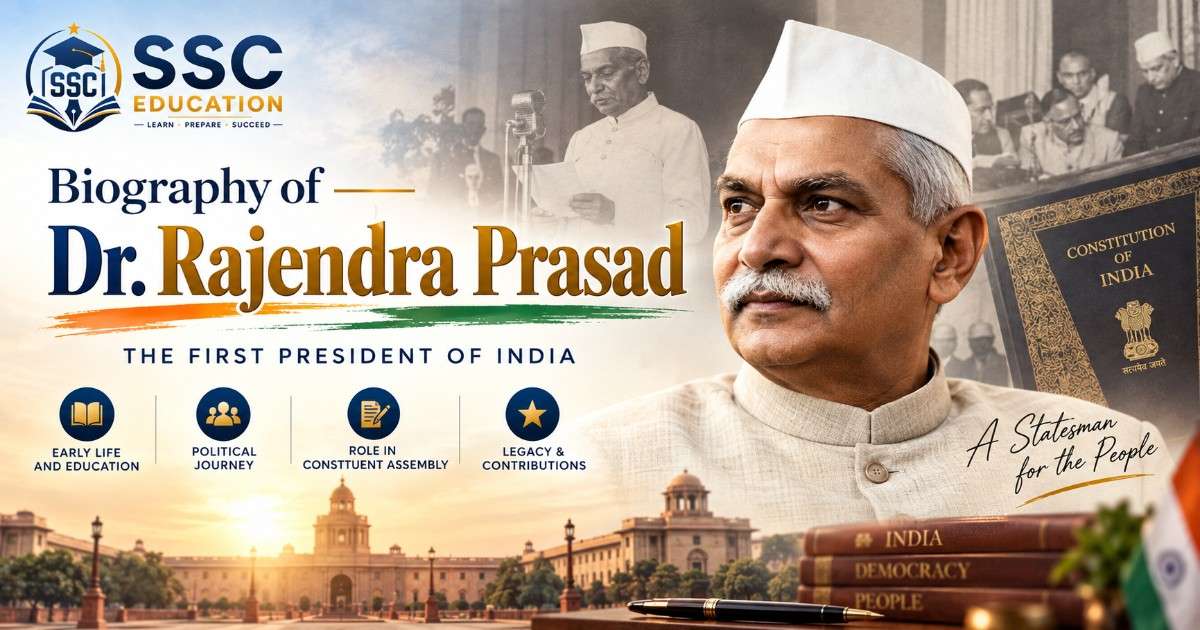
Biography of Dr. Rajendra Prasad
Rahul Kumar
SSC Exam Expert & Content Editor
Table of Contents
- 1.Introduction
- 2.Quick Facts: Dr. Rajendra Prasad
- 3.Early Life and Family
- 4.A Brilliant Student
- 5.Career as a Teacher and Lawyer
- 6.Meeting Gandhi and the Champaran Satyagraha (1917)
- 7.Non-Cooperation, Bihar Vidyapeeth and Journalism
- 8.Civil Disobedience and Repeated Imprisonment
- 9.Bihar Earthquake Relief (1934)
- 10.Three Times President of the Indian National Congress
- 11.Quit India Movement and Bankipore Jail
- 12.Interim Government and the Constituent Assembly
- 13.First President of India (1950–1962)
- 14.Retirement and Death
- 15.Books and Writings
- 16.Rajendra Prasad and the Hindi Language
- 17.Relationships with Gandhi, Patel and Nehru
- 18.Personality and Values
- 19.Legacy and Honours
- 20.Timeline of Rajendra Prasad's Life
- 21.His Ideas on Education and Society
- 22.Lesser-Known Facts about Rajendra Prasad
- 23.Why Dr. Rajendra Prasad Is Important for SSC and Other Competitive Exams
- 24.Rajendra Prasad's Contributions to the Republic at a Glance
- 25.Related Reading
- 26.Conclusion
- 27.Frequently Asked Questions
Complete biography of Dr. Rajendra Prasad, the first President of India: early life, education, Champaran Satyagraha, Constituent Assembly, presidency, books, awards, timeline and 24 FAQs for SSC exams.
Introduction
Dr. Rajendra Prasad (3 December 1884 – 28 February 1963) was a lawyer, freedom fighter, scholar and statesman who became the first President of the Republic of India. He is the only person in Indian history to have been elected President twice for a full term, and he presided over the very Assembly that wrote the Constitution under which he later took his oath of office. Few leaders can claim to have shaped an institution so completely — first as the man who chaired its making, and then as the man who occupied its highest chair.
What makes his story worth reading is not only the offices he held. Rajendra Prasad was a topper who gave up a glittering legal career because a Gujarati barrister in a dhoti asked him to. He was a scholar who preferred to be called "Rajen Babu", a President who lived in the grandest residence in the country but kept the habits of a Bihari village schoolmaster. This biography follows his life from the fields of Ziradei in Bihar to Rashtrapati Bhavan, and explains why questions about him appear so regularly in SSC, railway, banking and other competitive exams.
Quick Facts: Dr. Rajendra Prasad
| Nationality | Indian |
|---|---|
| Best Known For | First President of India (1950–1962); President of the Constituent Assembly |
| Full Name | Rajendra Prasad (affectionately called Rajen Babu and Deshratna) |
| Born | 3 December 1884, Ziradei, Siwan district, Bihar (then part of the Bengal Presidency) |
| Died | 28 February 1963, Patna, Bihar (aged 78) |
| Father | Mahadev Sahay, a scholar of Sanskrit and Persian |
| Mother | Kamleshwari Devi |
| Spouse | Rajvanshi Devi (married in 1896) |
| Education | Presidency College, Calcutta; M.A. in Economics; Master of Laws (gold medal); Doctorate in Law |
| Profession | Lawyer, professor, journalist, freedom fighter |
| Political Party | Indian National Congress (three-time President) |
| Major Offices | President of the Constituent Assembly (1946–1950); Union Minister for Food and Agriculture; First President of India (1950–1962) |
| Honour | Bharat Ratna (1962) |
| Famous Books | Satyagraha in Champaran, India Divided, Atmakatha |
Early Life and Family
Rajendra Prasad was born on 3 December 1884 in Ziradei, a village in the Siwan district of present-day Bihar. His father, Mahadev Sahay, was a respected scholar of Sanskrit and Persian who also took an interest in Ayurveda; his mother, Kamleshwari Devi, was a deeply religious woman who used to narrate stories from the Ramayana and the Mahabharata to her youngest son. He was the youngest child of the family, with an elder brother, Mahendra Prasad, and three elder sisters. The household was comfortable by village standards but not rich, and learning was valued above display.
The boy's education began in the traditional way. Before he was five he was placed under a maulvi who taught him Persian, and he then learned Hindi and basic arithmetic. This mixture — Persian and Sanskrit at home, Hindi in the village, English later in school — gave him an unusual comfort with several languages. Throughout his life he would write and speak fluently in Hindi, English, Urdu, Persian, Bengali and Sanskrit, and he later became one of the strongest voices in favour of Hindi as the language of the Union.
Like most boys of his time, Rajendra was married very young. In 1896, when he was only about twelve, he was married to Rajvanshi Devi. The marriage lasted for the rest of their lives and, by all accounts, it was a quiet and steady partnership. Rajvanshi Devi remained in the background of public life, but Rajendra Prasad often spoke of how much he depended on her patience while he was in jail or travelling for the movement. Their son, Mrityunjay Prasad, grew up in the shadow of his father's public life.
A Brilliant Student
Rajendra Prasad studied first at the Chhapra Zilla School and then for two years at T. K. Ghosh's Academy in Patna. His teachers quickly noticed that he was not merely diligent but exceptional. In the entrance examination of the University of Calcutta, which at that time covered the whole of eastern India including Bihar, he stood first, and the achievement was celebrated across his district because no student from that region had done so before. A monthly scholarship of thirty rupees followed, a very useful sum for a family that had many children to educate.
In 1902 he joined the Presidency College in Calcutta, one of the most demanding colleges in the country, where he first studied science before shifting to the arts. He passed the F.A. examination in 1904 and completed his B.A. with a first division, and in December 1907 he passed the M.A. in Economics, again in the first division. A famous anecdote from these years is still repeated in Bihar: one of his examiners is said to have written on his answer script that "the examinee is better than the examiner". Whether polished by retelling or not, the story captures how his brilliance was seen by those around him.
His student years in Calcutta also shaped his public life. In 1906 he was among the leading figures behind the Bihari Students' Conference, the first gathering of its kind in India, which brought together young Biharis and encouraged them to think about education and service to the region. Many of the leaders who later guided Bihar in politics and administration were part of that circle. In the same year he volunteered at the annual session of the Indian National Congress in Calcutta, which was his first direct contact with the organisation he would later lead three times.
Career as a Teacher and Lawyer
After his M.A., Rajendra Prasad chose to teach. He became a professor of English at the Langat Singh College in Muzaffarpur and later rose to become its principal, and in 1909 he also taught Economics at the Calcutta City College while studying law. Students remembered him as a patient teacher who explained rather than lectured and who refused to treat learning as a matter of memorising notes — a quality that later reflected in the way he thought about education for the whole country.
He completed the Master of Laws in 1915, winning a gold medal, and joined the Calcutta High Court, where his practice grew rapidly. In 1916, when the new High Court of Bihar and Orissa was established in Patna, he moved there and was soon counted among its most sought-after lawyers. He became a member of the Senate and Syndicate of Patna University and was known for his thorough preparation and his ability to reduce complicated disputes into clear arguments. Years later the University of Allahabad conferred on him the degree of Doctor of Law, and from then on the world addressed him as Dr. Rajendra Prasad.
By the age of thirty-two he was, in the ordinary sense, a success: a rising advocate with a growing income, a settled family and a respected name. It was precisely at this point that Mahatma Gandhi entered his life, and the story took a completely different course.
Meeting Gandhi and the Champaran Satyagraha (1917)
Rajendra Prasad first met Mahatma Gandhi at the Lucknow session of the Congress in December 1916. A few months later the two met again in Champaran, in the north of Bihar, where thousands of peasants were being forced to grow indigo on a part of their land under the tinkathia system, often on unfair terms set by European planters. When Gandhi arrived in April 1917 to investigate their complaints, he asked local lawyers, including Rajendra Prasad, to help him record the statements of farmers.
Rajendra Prasad came, expecting to give a few days of his time. What he saw changed him. Gandhi worked without servants, ate simple food, washed his own clothes and treated every farmer as an equal, and he insisted that the volunteers do the same. Rajendra Prasad, who had until then travelled with an assistant and lived in comfort, found himself dismissing his servants and doing his own chores. He would later write that Champaran taught him what real public service meant. Along with colleagues such as Brajkishore Prasad, Mazharul Haque, Anugrah Narayan Sinha and Shambhusharan Varma, he stayed in the district for months, collecting thousands of statements from peasants.
The inquiry led to the Champaran Agrarian Act of 1918, which ended the tinkathia system. Beyond the legal victory, Champaran taught India that non-violent mass action could win concrete results, and it made Rajendra Prasad one of Gandhi's most trusted lieutenants. He recorded the experience in his book Satyagraha in Champaran, published in 1922.
Non-Cooperation, Bihar Vidyapeeth and Journalism
When Gandhi launched the Non-Cooperation Movement in 1920, Rajendra Prasad took a decision that shocked his friends: he gave up his flourishing legal practice altogether. It meant giving up a large income and a secure future for a struggle whose outcome nobody could guarantee. He also encouraged students to leave government-controlled schools and colleges, and he himself withdrew his son from the university.
To give those students somewhere to go, he helped set up the Bihar Vidyapeeth in Patna, a national institution modelled on Gandhi's idea of an education that was rooted in Indian life and free from colonial control. He served as its chancellor. The campus, later known as the Sadaqat Ashram, became the headquarters of the Congress in Bihar and the place where he lived for much of his later life.
He was also a writer and editor. He supported the English weekly Searchlight and started the Hindi weekly Desh, using both to explain the aims of the national movement to readers in Bihar. His prose was straightforward and precise, and it reflected a lawyer's habit of stating facts before drawing conclusions.
Civil Disobedience and Repeated Imprisonment
Rajendra Prasad was not a leader who spoke from a distance. During the Civil Disobedience Movement of 1930, when Gandhi's Salt March at Dandi set the country in motion, he organised the salt satyagraha in Bihar, where volunteers prepared salt in defiance of the law at places such as Patna and Champaran. He was arrested and imprisoned, and this was only the beginning of a long series of jail terms. In all, the British government arrested him repeatedly between 1930 and 1945, and each release was followed by a return to work.
Prison did not slow him down; it changed the way he worked. He used the time to read, to write and to think about what independent India would need, and his friends remembered that he was never idle even inside the walls. Many of his books were planned or written in jail.
Bihar Earthquake Relief (1934)
On 15 January 1934 a devastating earthquake struck Bihar, destroying towns such as Muzaffarpur, Monghyr and Motihari and killing thousands of people. Rajendra Prasad was in jail when it happened. He was released on 17 January, and on the same day he set up the Bihar Central Relief Committee. Within weeks he had organised volunteers, collected donations from across the country and coordinated food, shelter and medical help. Accounts of the time record that the money raised by his committee exceeded the relief fund opened by the Viceroy, which shows how deeply people trusted him.
He repeated this service in 1935 when the Quetta earthquake struck. The British authorities did not permit him to enter Quetta, but he organised relief work from outside and chaired the Quetta Central Relief Committee. The experience gave him a reputation as a practical organiser whom people were willing to follow in a crisis, and it reinforced his belief that public service was the true test of a political worker.
Three Times President of the Indian National Congress
Rajendra Prasad's standing within the Congress led to his election as party president three times, in each case at a moment of difficulty.
- October 1934 (Bombay session): He presided over the Congress soon after the Civil Disobedience Movement, when the party was rebuilding its strength and preparing to contest provincial elections under the Government of India Act.
- 1939: After Subhas Chandra Bose resigned as president following differences with Gandhi and the Working Committee, Rajendra Prasad took over and steadied the organisation during a tense period on the eve of the Second World War.
- November 1947: After J. B. Kripalani resigned, he was again called on to lead the Congress in the first months after Independence, a time of Partition, migration and communal violence.
Each time he accepted the office reluctantly and left it as soon as possible. Those who worked with him described him as a conciliator rather than a dominating leader, and he was often the person to whom quarrelling colleagues turned when they wanted a fair hearing.
Quit India Movement and Bankipore Jail
In August 1942, after the Quit India resolution was passed in Bombay, the British government arrested nearly the whole Congress leadership within hours. Rajendra Prasad was arrested at the Sadaqat Ashram in Patna and lodged in the Bankipore Central Jail. He remained there for almost three years, until his release on 15 June 1945. During these years, his health suffered from asthma, which troubled him for the rest of his life.
Prison, however, gave him time to write. He worked on his autobiography, Atmakatha, and completed India Divided (1946), a well-argued study of the events and ideas that led towards the partition of the country. The book reflects both his legal mind and his pain at seeing the land divided; it is still a valuable primary source on how Congress leaders understood the Pakistan demand.
Interim Government and the Constituent Assembly
When the Interim Government was formed in 1946, Rajendra Prasad was made the Minister for Food and Agriculture, a portfolio that he continued to hold in the early months of independent India. Food shortage and the aftermath of the Bengal famine made this a serious responsibility, and he took up the task of increasing agricultural production and organising distribution.
Far more important was his role in the Constituent Assembly. The Assembly held its first meeting on 9 December 1946, with the veteran Sachchidananda Sinha as its temporary chairman. Two days later, on 11 December 1946, the members elected Rajendra Prasad as the permanent President of the Constituent Assembly, and he held the post until 24 January 1950.
His job was to keep a very diverse body working together: lawyers and teachers, princes and peasants' leaders, Hindus, Muslims, Sikhs, Christians, Parsis and members of the scheduled castes and tribes. The Drafting Committee headed by Dr. B. R. Ambedkar prepared the text, but it was Rajendra Prasad's fairness and patience in the chair that kept the debates orderly through nearly three years. The Constitution was adopted on 26 November 1949 and signed by the members on 24 January 1950, and it came into force on 26 January 1950.
In his concluding speech, he made a remark that is often quoted in classrooms: a constitution, however good, would only be as good as the people who ran it, and if those chosen to administer it were men of character and integrity, they could make even a defective constitution work well, while a bad set of people would spoil even the best.
First President of India (1950–1962)
On 26 January 1950, Rajendra Prasad took the oath as the first President of India in the Durbar Hall of the Government House, which was soon renamed Rashtrapati Bhavan. On the same day, the first Republic Day parade was held, with the President of Indonesia, Sukarno, as chief guest. There was a painful footnote to the day: Rajendra Prasad's elder sister, Bhagwati Devi, had died the night before. He performed the funeral rites and returned to attend the ceremonies, a moment that shows how completely he placed duty above personal grief.
He was elected President again in 1952 and 1957, after the first general elections, and completed his tenure on 13 May 1962 — about twelve years in office, the longest in the history of the Republic. No other President has served two full terms.
As President he tried to keep the office above party politics. He gave up his active role in the Congress on assuming the office, and he spent much of his time on state visits and public functions, travelling to countries such as Japan, Ceylon, the Soviet Union, Malaya and Indonesia between 1958 and 1960. He also opened the Mughal Gardens at Rashtrapati Bhavan to the public for a short period each year, a tradition that continues in the form of the annual Udyanotsav.
His years in office were not free of debate. He had differences with Prime Minister Jawaharlal Nehru on several matters, among them the Hindu Code Bill, which he felt required wider discussion, and the inauguration of the restored Somnath temple in 1951, which he attended despite Nehru's concerns about the President's role in a secular state. These disagreements were conducted with civility, and they are still studied in political science as early examples of how the office of President and the Prime Minister define the boundaries of their roles.
Throughout his term he lived simply. Even inside the vast residence, he kept the habits of a village home: he ate vegetarian food, wore plain khadi, spent time in the gardens and refused unnecessary display. He was a lifelong vegetarian who attended the World Vegetarian Congress in 1957, and he was known to spend a portion of his salary on charitable causes.
Retirement and Death
After stepping down in May 1962, Rajendra Prasad returned to Patna and lived at the Sadaqat Ashram, the campus of the Bihar Vidyapeeth, in a modest set of rooms. He had refused the comforts that a former President might have claimed. His wife, Rajvanshi Devi, died on 9 September 1962, a loss that further weakened his health. That same year, on the occasion of the Republic Day, the nation honoured him with the Bharat Ratna, its highest civilian award, recognising a lifetime of service.
Dr. Rajendra Prasad died on 28 February 1963 in Patna at the age of 78. His funeral was held on the banks of the Ganga, and the news brought a large part of Bihar and the country to a standstill. The house in which he spent his last days now forms part of the Rajendra Smriti Sangrahalaya in Patna, a museum that preserves his letters, books, photographs and personal belongings.
Books and Writings
Rajendra Prasad was an author of substance as well as a statesman, and his books remain useful to students of the freedom struggle. The best known are:
- Satyagraha in Champaran (1922) — his first-hand account of the indigo movement and Gandhi's first major experiment in India.
- India Divided (1946) — a study of the origins of the demand for Pakistan, written largely during imprisonment.
- Atmakatha (1946) — his autobiography in Hindi, composed in Bankipore Jail.
- Mahatma Gandhi and Bihar: Some Reminiscences (1949) — recollections of Gandhi's Bihar years.
- Bapu Ke Kadmon Mein (1954) — a warm memoir of his association with Gandhi.
- Since Independence (1960) — a collection of his thoughts on the early years of the Republic.
- Bharatiya Shiksha — his ideas on education for the nation.
Rajendra Prasad and the Hindi Language
He was an early and steady supporter of Hindi as the national language, and he was closely associated with the Hindi Sahitya Sammelan, which he served as president. In the Constituent Assembly he took part in the long debate that led to Hindi in the Devanagari script being adopted as the official language of the Union, with English continuing for a period. He believed that a common language would bring the country together, but he also insisted that no Indian language should be treated as inferior.
Relationships with Gandhi, Patel and Nehru
Rajendra Prasad is often described as a Gandhian in the fullest sense. He looked to Gandhi as a guide in both public and private life and kept himself close to the Mahatma's ideas of simplicity, non-violence and service. With Sardar Vallabhbhai Patel he shared a temperament: both were practical, both were lawyers who had left their practice for the movement, and both preferred organisation to speeches. His relations with Jawaharlal Nehru were cordial but different in style, since Nehru was modern and internationalist in outlook while Rajendra Prasad remained deeply rooted in Indian tradition. It is one of the strengths of the early Republic that such contrasting personalities worked together, argued in public and still maintained mutual respect.
Personality and Values
Those who worked with Rajendra Prasad recalled a gentle, patient man who rarely raised his voice. Colleagues nicknamed him Ajatashatru, the one without enemies, because even his political opponents spoke of him with respect. He was frugal in his habits, meticulous with accounts, unfailingly courteous to visitors of every background, and deeply religious without being dogmatic. He treated servants and clerks with the same politeness as ministers and ambassadors.
Two habits stood out. First, he never used office to reward family or friends; his son and relatives were expected to make their own way. Second, he was an insatiable reader and continued to study even in the busiest years, using the early morning hours for reading and writing.
Legacy and Honours
Rajendra Prasad's legacy is best measured in the institutions that carry his mark. He presided over the making of the Constitution, established the customs of the office of President and set a standard of personal simplicity that later Presidents have found hard to match. Across India, institutions have been named in his honour:
- Rajendra Smriti Sangrahalaya (museum), Patna
- Rajendra Agricultural University, Pusa, Bihar (now Dr. Rajendra Prasad Central Agricultural University)
- Rajendra College, Chhapra
- Rajendra Setu, the bridge over the Ganga at Mokama
- Rajendra Nagar, neighbourhoods in Patna and in Delhi
- Postage stamps, commemorative coins and a Films Division documentary, Babu Rajendra Prasad (1980)
His birth anniversary, 3 December, is observed in Bihar and across the country as a day of remembrance, and he continues to be presented in textbooks as a model of integrity, scholarship and quiet service.
Timeline of Rajendra Prasad's Life
| Year | Event |
|---|---|
| 1884 | Born at Ziradei, Bihar (3 December) |
| 1896 | Married Rajvanshi Devi |
| 1902 | Stood first in the Calcutta University entrance examination; joined Presidency College |
| 1906 | Helped organise the Bihari Students' Conference; first contact with the Congress |
| 1907 | Completed M.A. in Economics |
| 1911 | Became a member of the Indian National Congress |
| 1915 | Master of Laws with a gold medal |
| 1916 | Began practice at the Bihar and Orissa High Court, Patna; met Gandhi at Lucknow |
| 1917 | Joined the Champaran Satyagraha |
| 1920 | Gave up legal practice for the Non-Cooperation Movement; Bihar Vidyapeeth started soon after |
| 1930 | Took part in the Salt Satyagraha in Bihar |
| 1934 | Led earthquake relief in Bihar; elected Congress President |
| 1935 | Led Quetta earthquake relief |
| 1939 | Second term as Congress President |
| 1942–1945 | Imprisoned in Bankipore Jail after the Quit India Movement |
| 1946 | Minister for Food and Agriculture; elected President of the Constituent Assembly (11 December) |
| 1947 | Third term as Congress President (November) |
| 1950 | Became the first President of India (26 January) |
| 1952 and 1957 | Re-elected President |
| 1962 | Retired (13 May); awarded the Bharat Ratna |
| 1963 | Died at Patna (28 February) |
His Ideas on Education and Society
Because he had been a teacher, a student topper and the founder of a national university, Rajendra Prasad thought deeply about education. He believed that schools should build character as much as knowledge, and that a country freed from foreign rule would still remain dependent if its education continued to train clerks instead of thinkers and workers. In Bharatiya Shiksha and in many speeches he argued for an education that respected Indian languages, gave dignity to manual work and remained affordable for the poor.
His social outlook followed the same line. He supported the removal of untouchability, worked for village industries such as spinning and weaving, and encouraged the cooperative movement in agriculture. As Food and Agriculture Minister he stressed that no political freedom could be complete while farmers went hungry, and as President he often visited agricultural exhibitions and rural institutions. His concern for farmers came from Champaran, where he had seen the misery of peasants first-hand.
Lesser-Known Facts about Rajendra Prasad
- He is the only President of India to be elected to the office twice for full terms and the only one to have served for more than ten years.
- He was both the President of the Constituent Assembly and the first President of the Republic that the Assembly created.
- He was proficient in Hindi, English, Urdu, Persian, Bengali and Sanskrit, and wrote in several of them.
- He was a strict vegetarian for life and attended the World Vegetarian Congress in 1957.
- His sister died on the eve of the first Republic Day, yet he performed the last rites and attended the ceremonies the next morning.
- He was the person to whom the Congress turned three times when the party needed a steady president.
- On retirement he did not stay in Delhi but returned to the modest Sadaqat Ashram in Patna.
- Bihar's earthquake relief committee under him is remembered as one of the earliest large-scale civilian relief operations in modern India.
Why Dr. Rajendra Prasad Is Important for SSC and Other Competitive Exams
Questions on Rajendra Prasad appear in the General Awareness sections of SSC CGL, CHSL, MTS, GD Constable and Stenographer exams as well as in railway, banking and state-level examinations. They are usually direct and factual, so a candidate who has the key dates and titles ready can score easily. Examiners like to test the following points:
- He was the first President of India and the President of the Constituent Assembly (elected 11 December 1946).
- He is the only President elected for two full terms, serving from 26 January 1950 to 13 May 1962.
- He was elected President of the Indian National Congress three times (1934, 1939 and 1947).
- He participated in the Champaran Satyagraha (1917) with Gandhi.
- He founded the newspapers Searchlight (English) and Desh (Hindi) and started the Bihar Vidyapeeth.
- He wrote Satyagraha in Champaran, India Divided and Atmakatha.
- He was awarded the Bharat Ratna in 1962 and died on 28 February 1963.
- He led the relief work after the Bihar earthquake of 1934.
A useful revision trick is to remember him through the numbers 1884 (birth), 1917 (Champaran), 1946 (Constituent Assembly), 1950 (President), 1962 (Bharat Ratna) and 1963 (death). If you can attach an event to each year, most factual questions on him become easy to answer.
Rajendra Prasad's Contributions to the Republic at a Glance
Because his life covered so many roles, it helps to see his contributions grouped by the field in which they were made.
- Freedom movement: Champaran Satyagraha (1917), Non-Cooperation (1920), Salt Satyagraha in Bihar (1930), Quit India (1942) and years of imprisonment.
- Relief and service: Leader of the Bihar earthquake relief in 1934 and the Quetta relief in 1935, which showed how a political organisation could serve ordinary people.
- Education: Teacher at Muzaffarpur and Calcutta, founder of the Bihar Vidyapeeth, and advocate of a national education rooted in Indian languages and values.
- Journalism and literature: Editor and supporter of Searchlight and Desh, and author of several important books on Champaran, Partition and Gandhi.
- Party leadership: Three-time Congress President who guided the party at moments of crisis in 1934, 1939 and 1947.
- Constitution-making: President of the Constituent Assembly, responsible for conducting its proceedings from 1946 to 1950 in a fair, dignified and inclusive manner.
- Governance: First President of India, who defined the customs of the office and remained above party politics for twelve years.
Taken together, these roles explain why he is remembered as a bridge between the age of agitation and the age of institutions. Very few leaders of his generation moved so easily from the courtroom to the prison, from the relief camp to the Assembly hall and finally to Rashtrapati Bhavan.
Related Reading
Conclusion
Rajendra Prasad's life shows that great public service does not always come with loud rhetoric. He was a brilliant student who gave up a promising legal career, a scholar who spent years in jail, an organiser who could raise more relief than a government, and a President who tried to keep the highest office in the country modest and humane. For a student, his story is a reminder that ability and humility can go together. For an examinee, it is a compact and highly scoring chapter: a set of dates, offices and books that can be revised in an evening but explain, in miniature, how India moved from a movement to a Republic.
Frequently Asked Questions
Who was Dr. Rajendra Prasad?
Dr. Rajendra Prasad (1884–1963) was a lawyer, freedom fighter and statesman who served as the first President of India from 1950 to 1962. He also presided over the Constituent Assembly that framed the Constitution.
When and where was Rajendra Prasad born?
He was born on 3 December 1884 in the village of Ziradei in the Siwan district of Bihar.
Who was the first President of India?
Dr. Rajendra Prasad was the first President of India. He took the oath on 26 January 1950, the day the Constitution came into force.
How long was Rajendra Prasad the President of India?
He served for about twelve years, from 26 January 1950 to 13 May 1962. He was elected again in 1952 and 1957, which makes him the only President to complete two full terms.
What was Rajendra Prasad's role in the Constituent Assembly?
He was elected the permanent President of the Constituent Assembly on 11 December 1946 and guided its debates until 24 January 1950, while Dr. B. R. Ambedkar chaired the Drafting Committee.
Which movement connected Rajendra Prasad with Mahatma Gandhi?
The Champaran Satyagraha of 1917, in which he helped Gandhi collect the statements of indigo farmers, brought him into close association with Gandhi.
How many times was Rajendra Prasad the President of the Indian National Congress?
He was Congress President three times: in 1934, in 1939 after Subhas Chandra Bose resigned, and in 1947 after J. B. Kripalani resigned.
When was Rajendra Prasad awarded the Bharat Ratna?
He was awarded the Bharat Ratna, India's highest civilian honour, in 1962, the year in which he retired as President.
When and where did Rajendra Prasad die?
He died on 28 February 1963 in Patna, Bihar, at the age of 78, about nine months after leaving office.
Which books did Rajendra Prasad write?
His main books are Satyagraha in Champaran (1922), India Divided (1946), Atmakatha (1946), Mahatma Gandhi and Bihar: Some Reminiscences (1949), Bapu Ke Kadmon Mein (1954) and Since Independence (1960).
What was Rajendra Prasad's educational qualification?
He topped the Calcutta University entrance examination, studied at Presidency College, earned an M.A. in Economics, a Master of Laws with a gold medal and later a Doctorate in Law.
Why did Rajendra Prasad give up his legal practice?
He left his successful practice in 1920 to join Gandhi's Non-Cooperation Movement, believing that the freedom struggle needed full-time workers.
What was the Bihar Vidyapeeth?
The Bihar Vidyapeeth was a national educational institution founded in Patna in the early 1920s so that students who left government schools during Non-Cooperation could continue their studies. It later became the Sadaqat Ashram campus.
Which newspapers did Rajendra Prasad start or support?
He supported the English weekly Searchlight and started the Hindi weekly Desh to spread the message of the national movement in Bihar.
What did Rajendra Prasad do after the Bihar earthquake of 1934?
He was released from jail on 17 January 1934 and immediately formed the Bihar Central Relief Committee, which raised large funds and organised relief for the affected people.
Which ministry did Rajendra Prasad hold before becoming President?
He served as the Minister for Food and Agriculture in the Interim Government and continued in that portfolio after Independence for a short period.
Why was he called Ajatashatru?
Colleagues and even opponents used the word Ajatashatru, meaning one without enemies, for him because of his gentle nature and fairness.
Who was Rajendra Prasad's wife?
He was married to Rajvanshi Devi in 1896. She died on 9 September 1962, a few months before he died.
What was Rajendra Prasad's connection with the Somnath temple?
In May 1951 he inaugurated the restored Somnath temple in Gujarat, a decision on which he differed with Prime Minister Nehru about the President's role in a secular state.
Where can I visit places related to Rajendra Prasad?
You can visit the Rajendra Smriti Sangrahalaya and the Sadaqat Ashram in Patna, and his birthplace, Ziradei, in Siwan district of Bihar.
Who was the chief guest at the first Republic Day parade in 1950?
The President of Indonesia, Sukarno, was the chief guest at the first Republic Day celebration when Rajendra Prasad was President.
What important dates related to Rajendra Prasad should I remember for SSC exams?
Remember 1884 (birth), 1917 (Champaran), 11 December 1946 (Constituent Assembly), 26 January 1950 (President), 1962 (Bharat Ratna and retirement) and 28 February 1963 (death).
Why is Rajendra Prasad important in Indian history?
He connects the freedom movement with the Republic: he worked with Gandhi in Champaran, led the Congress three times, chaired the Constituent Assembly and became the first head of state of independent India.
Did Rajendra Prasad have differences with Jawaharlal Nehru?
Yes, on matters such as the Hindu Code Bill and the Somnath temple inauguration, but their differences were expressed with mutual respect and remain an important case study in the working of the Indian Constitution.
Rahul Kumar
SSC Exam Expert & Content Editor
Rahul is a senior SSC exam strategist with 8+ years of experience helping aspirants crack CGL, CHSL and MTS exams. He writes in-depth notification breakdowns, exam pattern guides and preparation strategies.