
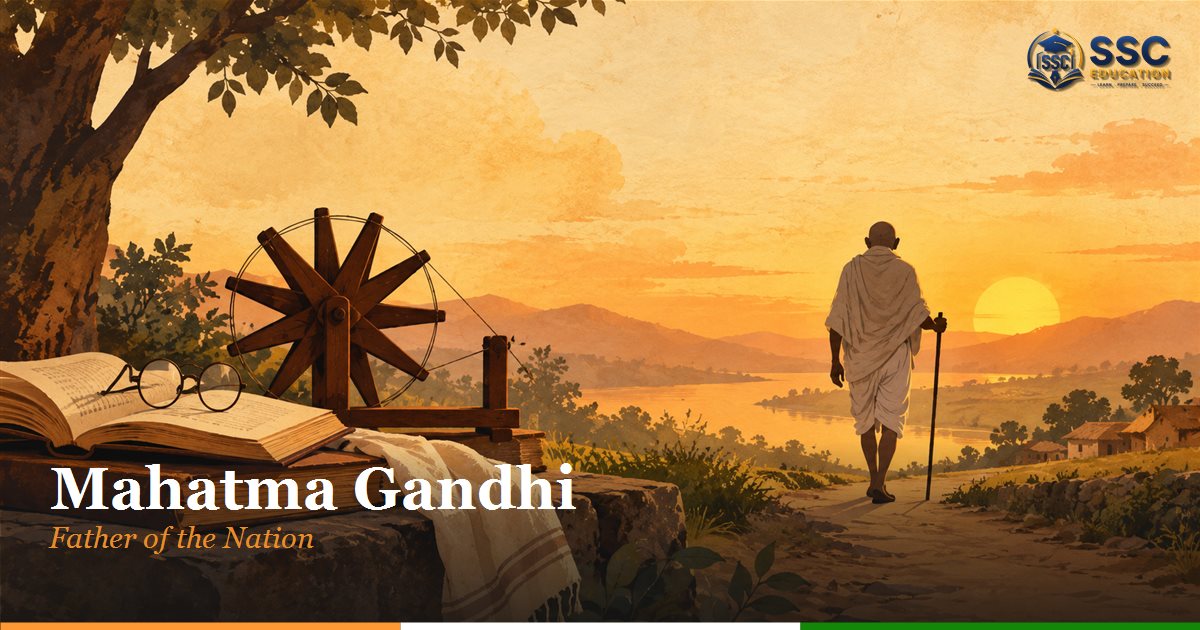
Biography of Mahatma Gandhi
Rahul Kumar
SSC Exam Expert & Content Editor
Table of Contents
- 1.Introduction
- 2.Quick Facts: Mahatma Gandhi
- 3.Early Life and Childhood
- 4.Education and Early Career
- 5.Gandhi in South Africa (1893–1914)
- 6.Return to India and Early Movements
- 7.Non-Cooperation Movement (1920–1922)
- 8.Civil Disobedience Movement and the Salt March (1930)
- 9.The Poona Pact and Social Reform
- 10.Quit India Movement (1942)
- 11.Partition of India and Independence
- 12.Assassination
- 13.Gandhi's Philosophy and Ideology
- 14.Gandhi's Vision for Education: Nai Talim
- 15.Personal Life
- 16.Books and Writings
- 17.Legacy and Influence
- 18.Awards, Honours and Recognition
- 19.Gandhi in Popular Culture
- 20.Why Mahatma Gandhi Still Matters Today
- 21.Timeline of Mahatma Gandhi's Life
- 22.Gandhi's Relationship with Other Leaders
- 23.Gandhi and Religion
- 24.Interesting Facts about Mahatma Gandhi
- 25.Famous Quotes by Mahatma Gandhi
- 26.Frequently Asked Questions (FAQs) about Mahatma Gandhi
- 27.Places to Visit: Gandhi Memorials and Museums
- 28.Related Reading
- 29.Conclusion
Mahatma Gandhi (1869–1948), the Father of the Nation, led India's freedom struggle through non-violence and Satyagraha. Read his full biography, freedom movements, philosophy, and legacy.
Introduction
Mahatma Gandhi (full name Mohandas Karamchand Gandhi) is one of the most famous names in world history. He is known as the "Father of the Nation" in India and lovingly called "Bapu" by millions of Indians. Gandhi led India's freedom struggle against British rule using a simple but powerful idea — non-violence (Ahimsa) and truth (Satyagraha). Without picking up a single weapon, he inspired an entire nation to fight for freedom, and his methods later inspired civil rights leaders across the world, including Martin Luther King Jr. and Nelson Mandela.
In this biography, we will cover Mahatma Gandhi's early life, education, his years in South Africa, his role in India's freedom movement, his philosophy of life, his personal life, his books, his assassination, and his lasting legacy — explained in simple and easy-to-understand language so that students, researchers, and curious readers can learn everything about him in one place.
Quick Facts: Mahatma Gandhi
| Nationality | Indian |
|---|---|
| Best Known For | Leader of the Indian independence movement, pioneer of nonviolent civil disobedience (satyagraha) |
| Full Name | Mohandas Karamchand Gandhi |
| Born | October 2, 1869, Porbandar, Gujarat, India |
| Died | January 30, 1948 (aged 78), New Delhi, India |
| Father | Karamchand Gandhi |
| Mother | Putlibai Gandhi |
| Wife | Kasturba Gandhi |
| Children | Harilal, Manilal, Ramdas, Devdas |
| Known As | Mahatma Gandhi, Bapu, Father of the Nation |
| Famous For | Leading India's freedom struggle through non-violence and Satyagraha |
| Famous Movements | Champaran Satyagraha, Non-Cooperation Movement, Civil Disobedience Movement (Salt March/Dandi March), Quit India Movement |
| Famous Books | The Story of My Experiments with Truth, Hind Swaraj |
Early Life and Childhood
Mahatma Gandhi was born on October 2, 1869, in the coastal town of Porbandar, in present-day Gujarat, India. His father, Karamchand Gandhi, worked as the Diwan (chief minister) of Porbandar state, and his mother, Putlibai, was a deeply religious woman who followed Vaishnavism and Jain traditions of non-violence and fasting. Gandhi later said that his mother's devotion and simple living had a huge influence on his own beliefs about truth and non-violence.
As a child, Gandhi was shy, average in studies, and not particularly outstanding in school. He was deeply affected by stories of truth and duty, especially the story of Shravana and the legend of Raja Harishchandra, a king who never lied even when he lost everything. This story left a permanent mark on young Gandhi's mind and shaped his lifelong commitment to truth.
In keeping with the custom of the time, Gandhi was married at the young age of 13 to Kasturba Makhanji (also called Kasturba Gandhi) in 1883. The couple would go on to spend over six decades together, and Kasturba became his closest companion in both his personal life and his political struggles.
Education and Early Career
After finishing his schooling in Rajkot, Gandhi's family wanted him to become a barrister (lawyer), so in 1888, at the age of 19, he sailed to England to study law at the Inner Temple in London. This was a bold decision for the time, as leaving India by sea was frowned upon by his community, and he even faced temporary social ostracism for it.
In London, Gandhi faced culture shock but slowly adapted, trying to dress and behave like an English gentleman before realising that simplicity suited him better. He became a vegetarian by choice (not just by upbringing), joined the London Vegetarian Society, and first encountered texts like the Bhagavad Gita and the Bible in English translation, which deeply influenced his spiritual thinking. He was called to the bar in 1891 and returned to India the same year, but his early legal career in Bombay and Rajkot did not go well, as he was too nervous to speak confidently in court.
Gandhi in South Africa (1893–1914)
In 1893, Gandhi accepted a one-year contract to work as a lawyer for an Indian firm in South Africa. This trip changed the course of his life. Soon after arriving, he experienced brutal racial discrimination: despite holding a valid first-class ticket, he was thrown off a train at Pietermaritzburg station because a white passenger objected to sharing the compartment with an Indian. This humiliating incident became a turning point that pushed Gandhi toward activism.
Over the next 21 years, Gandhi stayed in South Africa and became the leading voice for the rights of the Indian community there, who faced discriminatory laws, taxes, and restrictions. It was here that he developed his philosophy of Satyagraha (holding firmly to truth) as a method of non-violent resistance. Key milestones from this period include:
- Founding the Natal Indian Congress in 1894 to fight for Indian rights.
- Launching the newspaper Indian Opinion to spread his ideas.
- Establishing communal living experiments like the Phoenix Settlement and Tolstoy Farm, based on simplicity and self-sufficiency.
- Leading a large Satyagraha campaign against the unjust "Black Act," which required Indians to register and carry passes, and against a law that invalidated non-Christian marriages.
By the time he left South Africa in 1914, Gandhi had become a respected leader and a master of organised, non-violent civil resistance — skills he would soon bring home to India.
Return to India and Early Movements
Gandhi returned to India in January 1915. His mentor, the respected leader Gopal Krishna Gokhale, advised him to spend a year travelling across India to understand the country and its people before taking up any leadership role. Gandhi followed this advice sincerely, touring the country in third-class train compartments to see the real conditions of ordinary Indians.
His first major actions in India were local struggles for the poor and oppressed:
- Champaran Satyagraha (1917), Bihar: Gandhi's first Satyagraha movement in India, launched to help indigo farmers who were being forced by British planters to grow indigo under exploitative conditions. The movement succeeded and led to reforms.
- Kheda Satyagraha (1918), Gujarat: Gandhi supported farmers who could not pay land revenue due to crop failure, working alongside a young leader named Vallabhbhai Patel, who later became one of Gandhi's closest allies.
- Ahmedabad Mill Strike (1918): Gandhi mediated a dispute between mill workers and owners, even undertaking a fast to press for fair wages.
These early campaigns established Gandhi as a leader who could organise ordinary people and win concrete victories through peaceful means, setting the stage for his national leadership.
Non-Cooperation Movement (1920–1922)
The turning point that made Gandhi a national leader was the Jallianwala Bagh Massacre on April 13, 1919, in Amritsar, where British troops under General Dyer opened fire on a peaceful crowd, killing hundreds of unarmed men, women, and children. This tragedy, combined with anger over the repressive Rowlatt Act, convinced Gandhi that cooperation with British rule was no longer acceptable.
In 1920, Gandhi launched the Non-Cooperation Movement, urging Indians to boycott British goods, schools, courts, and titles, and to embrace Swadeshi (using Indian-made goods, especially hand-spun khadi cloth). The movement was combined with the Muslim-led Khilafat Movement, bringing Hindus and Muslims together in a united protest — a rare moment of communal unity in the freedom struggle. Millions of Indians participated, but Gandhi abruptly called off the movement in February 1922 after the Chauri Chaura incident, where a violent mob killed several policemen. Gandhi believed that a movement built on non-violence could not continue if it turned violent, even though this decision disappointed many of his followers. Gandhi was arrested and sentenced to six years in prison for sedition, but was released in 1924 on health grounds.
Civil Disobedience Movement and the Salt March (1930)
The most iconic event of Gandhi's life came in 1930. After the Indian National Congress declared "Purna Swaraj" (complete independence) as its goal at the Lahore session in December 1929, Gandhi decided to protest the British salt tax and monopoly, which affected every Indian, rich or poor.
On March 12, 1930, Gandhi, along with a group of followers, began the famous Salt March (Dandi March) — a 240-mile (about 385 km) walk from his Sabarmati Ashram in Ahmedabad to the coastal village of Dandi. The march took 24 days, and by the time Gandhi reached Dandi on April 6, 1930, and picked up a handful of salt from the seashore in defiance of British law, it had become a global media event and a powerful symbol of peaceful resistance. This launched the Civil Disobedience Movement across the country, with millions breaking the salt law and other unjust regulations.
Gandhi was arrested again, but the movement's success forced the British government to negotiate. This led to the Gandhi-Irwin Pact (1931), and Gandhi travelled to London to attend the Second Round Table Conference as the sole representative of the Congress — the only Round Table Conference he personally attended.
The Poona Pact and Social Reform
Gandhi was not only a political leader but also a social reformer. He worked throughout his life against the practice of untouchability, referring to the oppressed communities as "Harijans" (children of God) and starting the newspaper Harijan to spread awareness. In 1932, when the British government announced separate electorates for the "depressed classes" (the Communal Award), Gandhi went on a fast unto death in Yerwada Jail, believing separate electorates would divide Hindu society permanently. This led to the Poona Pact (1932) with Dr. B. R. Ambedkar, which replaced separate electorates with reserved seats within a joint electorate.
Quit India Movement (1942)
As World War II raged on, Gandhi felt that Britain had no moral right to rule India while denying it freedom. On August 8, 1942, the Congress passed the Quit India Resolution, and Gandhi gave his famous "Do or Die" speech, calling on every Indian to either win freedom or die trying. The British responded with mass arrests, and Gandhi himself was imprisoned at the Aga Khan Palace in Pune. It was during this imprisonment, in 1944, that his beloved wife Kasturba Gandhi passed away by his side. Gandhi was released in 1944 due to declining health, but the Quit India Movement had already shown the British that Indian patience had run out.
Partition of India and Independence
As independence approached in 1947, growing tension between Hindus and Muslims led to the tragic Partition of India, creating the separate nation of Pakistan. Gandhi was heartbroken by the communal violence that followed and spent this period not celebrating but working tirelessly for peace, travelling to riot-torn areas like Noakhali, Bihar, and Calcutta to stop the bloodshed, sometimes undertaking fasts to restore communal harmony. On August 15, 1947, when India finally became independent, Gandhi was in Calcutta, fasting for peace rather than joining the official celebrations in Delhi.
Assassination
On January 30, 1948, while walking to his evening prayer meeting at Birla House in New Delhi, Mahatma Gandhi was shot three times at close range by Nathuram Godse, a Hindu nationalist who was angered by Gandhi's efforts to protect Muslims and his perceived leniency toward Pakistan during Partition. Gandhi died instantly. His death sent shockwaves across the world, and his funeral procession was attended by millions. He was cremated on the banks of the Yamuna river, at a spot now known as Raj Ghat, which remains a place of pilgrimage and remembrance to this day.
Gandhi's Philosophy and Ideology
Gandhi's ideas were not just political strategies — they were a complete philosophy of life. Understanding these core ideas is essential to understanding Gandhi himself.
Satyagraha (Truth-Force)
Satyagraha, a term Gandhi coined himself, means "holding firmly to truth." It is a form of active, non-violent resistance to injustice, where the resister accepts suffering rather than inflicting it, in order to convert the opponent through moral force rather than defeat them through violence.
Ahimsa (Non-Violence)
Ahimsa, or non-violence, was central to everything Gandhi did. He believed non-violence was not a weapon of the weak but required far greater courage and discipline than violence. This principle guided his political movements and later became the foundation of civil rights struggles worldwide.
Swaraj and Sarvodaya
Swaraj meant not just political independence from British rule, but also self-rule at a personal level — self-discipline and self-reliance. Sarvodaya, meaning "welfare of all," was Gandhi's vision of a society where the progress of the weakest and poorest citizen mattered as much as anyone else's, an idea inspired partly by John Ruskin's book Unto This Last.
Swadeshi and the Charkha
Gandhi promoted Swadeshi — using goods made in India — as an economic weapon against British rule and as a path to self-sufficiency. The spinning wheel (charkha) became a symbol of this movement and of simple, honest labour, and it still appears at the centre of the Indian national flag used by the Congress during the freedom struggle.
Gandhi's Vision for Education: Nai Talim
Gandhi also had strong views on education. He proposed a model called "Nai Talim" (New Education), also known as Basic Education, which emphasised learning through handicrafts and productive work rather than rote memorisation of books. He believed education should develop the head, heart, and hands together, and that it should be connected to real, useful work so that children grew up to be self-reliant, dignified, and connected to the dignity of manual labour — a philosophy that still influences alternative education models in India today.
Personal Life
Gandhi married Kasturba Gandhi in 1883, and together they had four sons: Harilal, Manilal, Ramdas, and Devdas. Gandhi's personal life was marked by continuous experiments in simple living — he gave up Western clothing for a simple homespun dhoti, practiced vegetarianism, took vows of celibacy (brahmacharya) later in life, and frequently fasted, both for health reasons and as a political and spiritual tool. He lived in ashrams that he founded, such as the Sabarmati Ashram in Ahmedabad and the Sevagram Ashram in Wardha, where community living, manual labour, and prayer were part of daily life.
Books and Writings
Gandhi was also a prolific writer and journalist. His most famous work is his autobiography, "The Story of My Experiments with Truth", which candidly describes his personal and moral journey. Another important work is "Hind Swaraj" (1909), where he laid out his critical views on modern civilization and his vision for India's self-rule. He also edited several newspapers over his lifetime, including Indian Opinion (in South Africa), Young India, and Harijan, using them to spread his ideas on politics, religion, and social reform.
Legacy and Influence
Mahatma Gandhi's influence extends far beyond India's borders. His philosophy of non-violent resistance directly inspired:
- Martin Luther King Jr., who used Gandhian principles of non-violence during the American Civil Rights Movement.
- Nelson Mandela and the anti-apartheid movement in South Africa.
- Countless civil rights and independence movements across the world that used peaceful protest as a tool for change.
In India, Gandhi is officially honoured as the "Father of the Nation." His birthday, October 2, is celebrated as Gandhi Jayanti, a national holiday in India, and the United Nations has also declared October 2 as the International Day of Non-Violence in his honour. His face appears on Indian currency notes, and his memorials, statues, and ashrams remain important cultural and historical sites visited by people from around the world.
Awards, Honours and Recognition
Although Mahatma Gandhi was nominated for the Nobel Peace Prize five times (1937, 1938, 1939, 1947, and 1948), he never received it, and the Nobel Committee later publicly expressed regret over this omission after his assassination just before the 1948 prize was to be announced. Despite this, Gandhi remains one of the most universally respected figures in modern history, honoured through countless streets, institutions, statues, postage stamps, and commemorative days named after him across the globe.
Gandhi in Popular Culture
Mahatma Gandhi's life has been portrayed and referenced countless times in books, films, and popular media around the world. The most famous depiction is Richard Attenborough's 1982 film "Gandhi," starring Ben Kingsley in the title role, which won eight Academy Awards, including Best Picture and Best Actor, and introduced Gandhi's story to a whole new global audience. Gandhi's image, his round glasses, his walking stick, and his simple dhoti have become instantly recognisable symbols found on murals, postage stamps, coins, and currency notes across the world. His life continues to be studied in schools, universities, and leadership programmes as a case study in ethical leadership, conflict resolution, and non-violent political strategy.
Why Mahatma Gandhi Still Matters Today
Over seven decades after his death, Gandhi's ideas remain strikingly relevant. In a world often divided by conflict, his belief that ends can never justify unjust means continues to be studied by peace activists, diplomats, and students of political science. His emphasis on environmental simplicity, sustainable living, and "taking only what you need" is often cited by modern environmental movements. His insistence on communal harmony between religions remains an important lesson for pluralistic societies everywhere, including India. For students preparing for school essays, competitive exams, or general knowledge tests, Gandhi's life offers one of the richest case studies of how one individual's moral courage and disciplined strategy can change the destiny of an entire nation without a single shot being fired.
Timeline of Mahatma Gandhi's Life
| Year | Event |
|---|---|
| 1869 | Born on October 2 in Porbandar, Gujarat. |
| 1883 | Married Kasturba Makhanji at the age of 13. |
| 1888 | Sailed to London to study law at the Inner Temple. |
| 1891 | Called to the bar and returned to India. |
| 1893 | Moved to South Africa; thrown off a train at Pietermaritzburg. |
| 1894 | Founded the Natal Indian Congress. |
| 1906 | Began the first organised Satyagraha campaign in South Africa. |
| 1915 | Returned to India permanently. |
| 1917 | Led the Champaran Satyagraha in Bihar, his first movement in India. |
| 1918 | Led the Kheda Satyagraha and the Ahmedabad Mill Strike. |
| 1919 | Protested the Rowlatt Act; Jallianwala Bagh Massacre took place. |
| 1920–1922 | Led the Non-Cooperation Movement with the Khilafat Movement. |
| 1922 | Called off the movement after the Chauri Chaura incident; arrested and jailed. |
| 1930 | Led the Salt March (Dandi March) and started the Civil Disobedience Movement. |
| 1931 | Signed the Gandhi-Irwin Pact; attended the Second Round Table Conference in London. |
| 1932 | Fasted against separate electorates; signed the Poona Pact with Dr. B. R. Ambedkar. |
| 1942 | Launched the Quit India Movement with the "Do or Die" call; imprisoned at Aga Khan Palace. |
| 1944 | Kasturba Gandhi died in prison; Gandhi was released later that year. |
| 1947 | India gained independence on August 15, amid the Partition of India. |
| 1948 | Assassinated on January 30 in New Delhi by Nathuram Godse. |
Gandhi's Relationship with Other Leaders
Gandhi worked closely with, and sometimes disagreed with, several major leaders of the freedom movement. He mentored Jawaharlal Nehru, who became India's first Prime Minister, and relied heavily on the organisational skill of Vallabhbhai Patel, later known as the "Iron Man of India." His relationship with Dr. B. R. Ambedkar was more complex — the two leaders had genuine ideological differences over how to end caste discrimination, particularly around separate electorates, but they still worked together to arrive at the Poona Pact. Gandhi's ability to unite leaders with very different views under one national movement was one of his greatest political achievements.
Gandhi and Religion
Gandhi was a deeply religious man who drew from multiple faiths. Though born a Hindu, he studied the Bhagavad Gita, the Bible, and the Quran with equal respect, and often said, "God has no religion." He believed all major religions were different paths leading to the same truth, and he worked hard throughout his life to promote Hindu-Muslim unity, which is why the communal violence during Partition caused him so much personal grief.
Interesting Facts about Mahatma Gandhi
- Gandhi trained as a barrister in London but was too shy to argue his first case in an Indian courtroom.
- He walked roughly 18 km a day on average through his life — it is estimated he walked a distance equal to going around the earth almost twice.
- Gandhi never actually held any official government post or political office in independent India.
- He was arrested and imprisoned multiple times, both in South Africa and India, spending a total of many years behind bars.
- Time magazine named him "Man of the Year" in 1930 and later chose him as a runner-up for "Person of the Century" in 1999.
- Gandhi's image appears on every denomination of the Indian rupee currency note.
- Despite being a global icon of peace, Gandhi was assassinated by a fellow Indian just months after independence.
Famous Quotes by Mahatma Gandhi
- "Be the change that you wish to see in the world."
- "An eye for an eye only ends up making the whole world blind."
- "In a gentle way, you can shake the world."
- "The weak can never forgive. Forgiveness is the attribute of the strong."
- "Live as if you were to die tomorrow. Learn as if you were to live forever."
Frequently Asked Questions (FAQs) about Mahatma Gandhi
1. Who was Mahatma Gandhi?
Mahatma Gandhi was an Indian lawyer, political leader, and social reformer who led India's non-violent struggle for independence from British rule and became known globally as the "Father of the Nation."
2. When and where was Mahatma Gandhi born?
He was born on October 2, 1869, in Porbandar, in present-day Gujarat, India.
3. What is Mahatma Gandhi famous for?
He is famous for leading India's freedom movement through non-violent resistance, or Satyagraha, including movements like the Non-Cooperation Movement, the Salt March, and the Quit India Movement.
4. What is the full name of Mahatma Gandhi?
His full name was Mohandas Karamchand Gandhi.
5. Why is Gandhi called "Mahatma"?
The title "Mahatma," meaning "Great Soul," is widely believed to have been given to him by the Nobel laureate poet Rabindranath Tagore, in recognition of his moral and spiritual leadership.
6. What is the Salt March?
The Salt March, or Dandi March, was a 24-day, 240-mile walk led by Gandhi in 1930 from Sabarmati Ashram to the coastal village of Dandi, to protest the British salt tax through non-violent civil disobedience.
7. Who killed Mahatma Gandhi and why?
Gandhi was assassinated on January 30, 1948, by Nathuram Godse, a Hindu nationalist who blamed Gandhi for being too accommodating toward Muslims and Pakistan during the Partition of India.
8. What is Gandhi Jayanti?
Gandhi Jayanti is a national holiday in India celebrated on October 2, Gandhi's birthday. The United Nations also observes this date as the International Day of Non-Violence.
9. What were Gandhi's main principles?
His main principles were Satyagraha (truth-force), Ahimsa (non-violence), Swaraj (self-rule), Swadeshi (self-reliance), and Sarvodaya (welfare of all).
10. What books did Gandhi write?
His most famous books are his autobiography "The Story of My Experiments with Truth" and "Hind Swaraj."
11. Did Mahatma Gandhi win the Nobel Peace Prize?
No. Gandhi was nominated five times but never won the Nobel Peace Prize. The Nobel Committee later expressed regret over this.
12. How did Gandhi influence other world leaders?
Gandhi's philosophy of non-violence directly inspired leaders like Martin Luther King Jr. in the American Civil Rights Movement and Nelson Mandela in South Africa's anti-apartheid struggle.
13. Did Gandhi hold any political office in independent India?
No, Gandhi never held any formal political office, either before or after India's independence. He preferred to work as a moral and social leader rather than a government official.
14. What was the relationship between Gandhi and Dr. B. R. Ambedkar?
Gandhi and Ambedkar had significant disagreements over how to address caste discrimination, especially regarding separate electorates for the depressed classes, but they worked together to sign the Poona Pact of 1932.
15. Where is Mahatma Gandhi's samadhi (memorial) located?
His memorial, Raj Ghat, is located in New Delhi on the banks of the Yamuna river, at the spot where he was cremated.
Places to Visit: Gandhi Memorials and Museums
For readers and students who want to explore Gandhi's life firsthand, India has several important memorials and museums dedicated to him. Raj Ghat in New Delhi marks his cremation site and features a simple black marble platform with an eternal flame. The Sabarmati Ashram in Ahmedabad, where Gandhi lived and planned the Salt March, is now a museum showcasing his personal belongings, letters, and photographs. The Gandhi Smriti in New Delhi, located at Birla House where he spent his final days and was assassinated, preserves the room he lived in and the spot where he was shot. Other notable sites include the Kaba Gandhi No Delo in Rajkot, his childhood home, and the Mani Bhavan in Mumbai, from where he coordinated several important movements. These sites remain popular destinations for students, historians, and tourists from around the world who wish to connect with his legacy in person.
Related Reading
Conclusion
Mahatma Gandhi's life remains one of the most extraordinary stories of courage, conviction, and moral leadership in modern history. From a shy student in Porbandar to the man who led an entire nation to freedom without raising a weapon, Gandhi proved that truth and non-violence could be more powerful than any army. His teachings on Satyagraha, Ahimsa, and Sarvodaya continue to guide movements for justice and peace across the world, making him not just the Father of the Indian Nation, but a global symbol of moral courage whose relevance has only grown with time.
Rahul Kumar
SSC Exam Expert & Content Editor
Rahul is a senior SSC exam strategist with 8+ years of experience helping aspirants crack CGL, CHSL and MTS exams. He writes in-depth notification breakdowns, exam pattern guides and preparation strategies.