
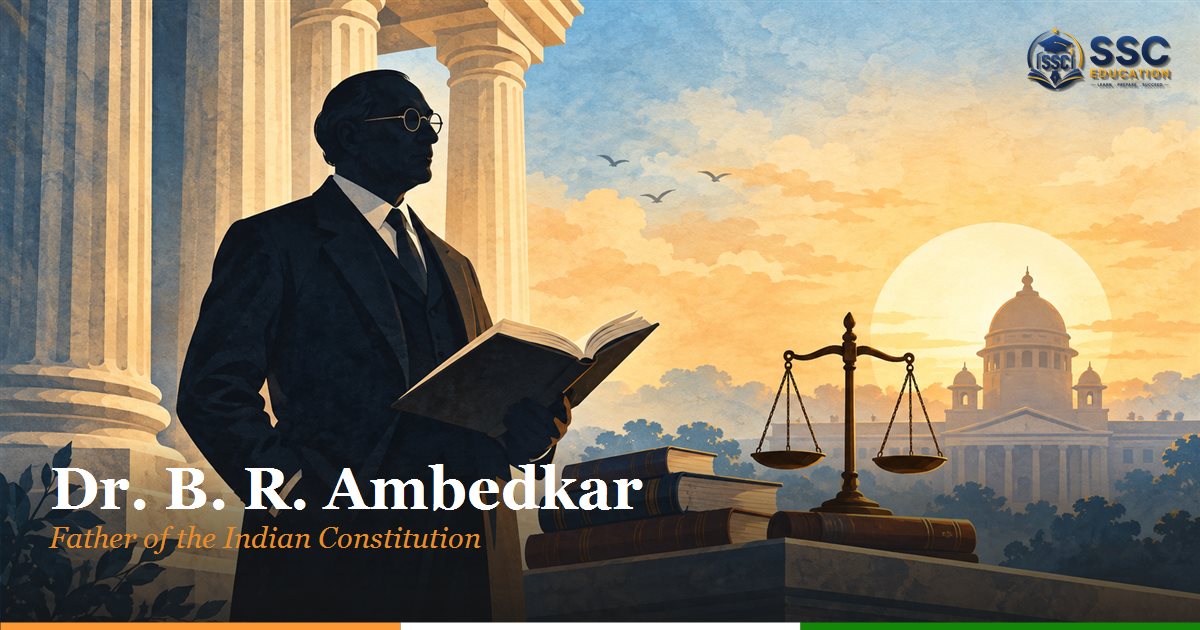
Biography of Dr. B. R. Ambedkar
Rahul Kumar
SSC Exam Expert & Content Editor
Table of Contents
- 1.Introduction
- 2.Quick Facts: Dr. B. R. Ambedkar
- 3.Early Life and Caste-Based Discrimination
- 4.Educational Journey: Breaking Barriers
- 5.Early Career and the Fight Against Untouchability
- 6.The Poona Pact and Political Representation
- 7.Father of the Indian Constitution
- 8.Ambedkar's Advocacy for Labour and Women's Rights
- 9.Ambedkar as an Economist
- 10.Conversion to Buddhism
- 11.The Independent Labour Party and Scheduled Castes Federation
- 12.Death
- 13.Educational Philosophy: "Educate, Agitate, Organize"
- 14.Personal Life
- 15.Books and Writings
- 16.Health Struggles and Final Years
- 17.Legacy and Influence
- 18.Ambedkar's Role in Drafting the Constitution: A Closer Look
- 19.Ambedkar in Popular Culture and Public Memory
- 20.Awards and Honours
- 21.Timeline of Dr. B. R. Ambedkar's Life
- 22.Ambedkar's Relationship with Other Leaders
- 23.Ambedkar's Views on Democracy and Nationalism
- 24.Interesting Facts about Dr. B. R. Ambedkar
- 25.Famous Quotes by Dr. B. R. Ambedkar
- 26.Global Recognition of Dr. Ambedkar
- 27.Why Dr. B. R. Ambedkar Still Matters Today
- 28.Frequently Asked Questions (FAQs) about Dr. B. R. Ambedkar
- 29.Related Reading
- 30.Conclusion
Dr. B. R. Ambedkar (1891-1956), Father of the Indian Constitution, led India's fight against caste discrimination. Read his full biography, education, and legacy.
Introduction
Dr. Bhimrao Ramji Ambedkar, popularly known as Dr. B. R. Ambedkar or affectionately as "Babasaheb," was an Indian jurist, economist, social reformer, and the chief architect of the Constitution of India. Born into a family from the socially oppressed Mahar caste, Ambedkar overcame extreme discrimination to become one of the most highly educated Indians of his time, and dedicated his life to fighting caste-based oppression, securing the rights of Dalits (the "untouchables"), and building a modern, egalitarian, constitutional India.
In this biography, we cover Dr. B. R. Ambedkar's early life and the discrimination he faced, his remarkable educational journey in India, America, and Britain, his role as India's first Law Minister and Chairman of the Constitution Drafting Committee, his social reform movements, his conversion to Buddhism, his death, and his enormous legacy — written in simple, easy-to-understand language along with commonly searched facts and frequently asked questions.
Quick Facts: Dr. B. R. Ambedkar
| Nationality | Indian |
|---|---|
| Best Known For | Chief architect of the Constitution of India and leader of the Dalit rights movement |
| Full Name | Bhimrao Ramji Ambedkar |
| Born | April 14, 1891, Mhow, Central Provinces (now Madhya Pradesh), India |
| Died | December 6, 1956 (aged 65), New Delhi, India |
| Father | Ramji Maloji Sakpal |
| Mother | Bhimabai Sakpal |
| Wives | Ramabai Ambedkar (first wife); Savita Ambedkar (second wife) |
| Known As | Babasaheb Ambedkar, Father of the Indian Constitution |
| Famous For | Chief architect of the Constitution of India, first Law Minister of India, Dalit rights leader, economist |
| Famous Books | Annihilation of Caste, The Problem of the Rupee, Who Were the Shudras?, The Buddha and His Dhamma |
| Highest Civilian Honour | Bharat Ratna (awarded posthumously in 1990) |
Early Life and Caste-Based Discrimination
Bhimrao Ramji Ambedkar was born on April 14, 1891, in the military town of Mhow, in present-day Madhya Pradesh. His father, Ramji Maloji Sakpal, was a Subedar (officer) in the British Indian Army, which gave young Bhimrao access to a basic school education that many children of his community were denied. However, belonging to the Mahar caste, which was classified as "untouchable" under the rigid caste hierarchy of the time, Ambedkar and his family faced severe social discrimination from a very young age.
In school, Ambedkar and other Dalit children were forced to sit separately from upper-caste students, were often denied access to drinking water from common sources, and faced humiliation from teachers and classmates alike. These painful early experiences of untouchability left a permanent mark on him and became the driving force behind his lifelong mission to abolish the caste system and secure equal rights for all Indians, regardless of birth.
Educational Journey: Breaking Barriers
Despite facing constant discrimination, Ambedkar excelled academically. In 1907, he passed his matriculation examination, becoming one of the first individuals from an "untouchable" community in India to do so, an achievement celebrated within his community. He went on to earn a degree from Elphinstone College in Bombay, becoming one of the first Dalits to attend the institution.
With financial support from the progressive ruler of Baroda State, Maharaja Sayajirao Gaekwad III, Ambedkar travelled to the United States in 1913 to study at Columbia University, where he earned an M.A. and later a Ph.D. in Economics. He then moved to England, where he studied at the London School of Economics and trained as a barrister at Gray's Inn, eventually earning a Doctor of Science (D.Sc.) degree in Economics from the University of London. This made him one of the most academically qualified Indians of his era, holding multiple advanced degrees from world-class institutions at a time when such achievements were exceedingly rare for anyone, let alone someone from a historically oppressed community.
Early Career and the Fight Against Untouchability
On returning to India, Ambedkar continued to face discrimination in his professional life despite his extraordinary qualifications, which only strengthened his resolve to fight the caste system. He began his activism in earnest in the 1920s, launching a Marathi fortnightly newspaper called "Mooknayak" (Leader of the Voiceless) in 1920 to give a voice to the concerns of the depressed classes.
One of his most symbolic acts of protest was the Mahad Satyagraha of 1927, where Ambedkar led thousands of Dalits to drink water from the public Chavadar Tank in Mahad, Maharashtra, asserting their right to access public water resources that had long been denied to them. Later that year, he also led a symbolic act of publicly burning the Manusmriti, an ancient legal text often cited to justify caste discrimination, to protest against the codification of caste-based inequality.
The Poona Pact and Political Representation
Ambedkar's political activism increasingly focused on securing constitutional and political safeguards for the depressed classes. In 1932, the British government's Communal Award proposed separate electorates for the "depressed classes," a move Ambedkar supported as a way to ensure independent political representation for Dalits. However, Mahatma Gandhi strongly opposed separate electorates, fearing they would permanently divide Hindu society, and undertook a fast unto death in Yerwada Jail in protest.
To resolve the crisis, Ambedkar and Gandhi negotiated the Poona Pact of 1932, under which separate electorates were replaced with reserved seats for depressed classes within a joint electorate. While Ambedkar had significant ideological differences with Gandhi over this issue, both leaders continued to interact throughout the freedom struggle, and Ambedkar later played an important role in the government led by the Congress after independence.
Father of the Indian Constitution
After India gained independence in 1947, Dr. Ambedkar was invited to serve as the nation's first Law Minister in Prime Minister Jawaharlal Nehru's cabinet. More significantly, he was appointed Chairman of the Drafting Committee of the Constituent Assembly, tasked with drafting the Constitution of independent India.
Over nearly three years, Ambedkar led the drafting process with exceptional legal skill, ensuring that the Constitution enshrined fundamental rights, the abolition of untouchability (Article 17), equality before law, and protections for religious and linguistic minorities. The Constitution of India was adopted by the Constituent Assembly on November 26, 1949, and came into effect on January 26, 1950. For his monumental contribution, Dr. Ambedkar is widely and rightfully honoured as the "Father of the Indian Constitution." November 26 is now celebrated annually in India as Samvidhan Divas (Constitution Day) in his honour.
Ambedkar's Advocacy for Labour and Women's Rights
Beyond caste reform, Dr. Ambedkar was a strong advocate for labour rights and gender equality, both of which were considered progressive and even radical for his time. As Labour Member of the Viceroy's Executive Council during the early 1940s, he introduced significant labour welfare reforms, including reduced working hours for industrial workers, the establishment of employment exchanges, and provisions for maternity benefits and paid leave. After independence, as Law Minister, he drafted the Hindu Code Bill, an ambitious and controversial attempt to reform Hindu personal law to grant women greater rights in matters of marriage, divorce, inheritance, and property. Although the original comprehensive bill faced strong political opposition and was not passed in full during his tenure, leading to his resignation from the cabinet in 1951, many of its core provisions were later enacted in separate legislation, and it remains a landmark moment in the history of Indian women's rights.
Ambedkar as an Economist
Beyond his legal and social reform work, Dr. Ambedkar was also a highly trained economist whose ideas influenced India's financial institutions. His doctoral research on "The Problem of the Rupee" examined India's currency and monetary policy under British rule, and his recommendations significantly influenced the establishment of the Reserve Bank of India (RBI), India's central bank, founded in 1935. He also advocated for state-led industrialisation, land reforms, and labour rights during his tenure as a member of the Governor-General's Executive Council.
Conversion to Buddhism
After decades of struggling against caste discrimination within Hindu society, Ambedkar grew increasingly convinced that true social equality required a complete break from a caste-based religious framework. On October 14, 1956, in a historic mass ceremony in Nagpur, Ambedkar converted to Buddhism along with several hundred thousand of his followers, in an event now referred to as the Dhamma Chakra Pravartan Din. He famously stated that although he was born a Hindu, he would not die as one, choosing Buddhism for its emphasis on equality, rationality, and compassion. This mass conversion movement remains one of the largest religious conversion events in modern history and continues to shape Dalit Buddhist identity in India today.
The Independent Labour Party and Scheduled Castes Federation
In addition to his social reform activities, Dr. Ambedkar was also a committed politician who founded multiple political organisations to represent the interests of India's marginalised communities. In 1936, he founded the Independent Labour Party, which contested and won several seats in the Bombay Legislative Assembly elections of 1937, campaigning on a platform that combined labour rights with anti-caste politics. Later, in 1942, he founded the All India Scheduled Castes Federation, which aimed to unite Dalit communities across India into a single political voice advocating for constitutional safeguards and representation. Although these parties had limited electoral success compared to the dominant Indian National Congress, they were instrumental in keeping the political demands of Dalit communities visible on the national stage during the crucial years leading up to independence, and they laid important groundwork for later Dalit political movements in India.
Death
Dr. B. R. Ambedkar passed away on December 6, 1956, in New Delhi, just weeks after completing his influential final book, "The Buddha and His Dhamma." His death was mourned across the nation, and December 6 is observed every year in India as Mahaparinirvan Din, with millions of followers visiting his memorial, Chaitya Bhoomi, in Mumbai to pay their respects.
Educational Philosophy: "Educate, Agitate, Organize"
Dr. Ambedkar believed that education was the single most powerful tool for social transformation and personal liberation, famously summarising his approach to social change with the slogan "Educate, Agitate, Organize." He urged Dalit communities to prioritise the education of their children above all else, believing that knowledge and self-respect, combined with organised collective action, were the only lasting solutions to centuries of oppression. He personally worked to establish schools, hostels, and colleges for underprivileged students, including founding the People's Education Society in 1945, which went on to establish several colleges in Maharashtra that continue to operate today. This emphasis on education as a path to dignity and empowerment remains one of the most widely cited and applied aspects of his philosophy in contemporary social work and public policy in India.
Personal Life
Dr. Ambedkar married Ramabai Ambedkar in 1906; she supported him steadfastly through years of hardship and study abroad, and passed away in 1935. In 1948, he married Dr. Savita Ambedkar (originally named Sharda Kabir), a physician who cared for him during his declining health in his later years. Despite his personal struggles, including chronic health issues developed over decades of overwork and stress, Ambedkar remained intellectually active throughout his life, reading and writing extensively until his final days.
Books and Writings
Dr. Ambedkar was an extraordinarily prolific scholar and writer. His major works include:
- Annihilation of Caste (1936): One of his most influential works, a scathing critique of the Hindu caste system, originally written as a speech he was barred from delivering.
- The Problem of the Rupee (1923): His doctoral thesis on Indian currency and monetary policy, which influenced the creation of the Reserve Bank of India.
- Who Were the Shudras?: A historical study examining the origins of caste-based social stratification in India.
- The Buddha and His Dhamma: His final major work, published posthumously, presenting his interpretation of Buddhist philosophy.
Health Struggles and Final Years
Despite his towering intellectual achievements, Dr. Ambedkar's later years were marked by serious health struggles, including diabetes, poor eyesight, and chronic pain, worsened by decades of relentless work, study, and political activism, often under conditions of great personal stress and social hostility. Friends and colleagues noted that he continued to work at an extraordinary pace even as his health declined, driven by an urgent sense that there was still enormous work left to secure justice for India's marginalised communities. His second wife, Dr. Savita Ambedkar, herself a trained physician, played a crucial role in caring for him during this period, allowing him to complete some of his most important later writings, including his final major work on Buddhism, despite his failing health.
Legacy and Influence
Dr. B. R. Ambedkar's legacy is foundational to modern India's constitutional and democratic identity. As the chief architect of the Constitution, his vision of equality, justice, and fundamental rights for all citizens, regardless of caste, religion, or gender, remains the bedrock of Indian democracy. He is celebrated as an icon of social justice, and his birthday, April 14, is observed as Ambedkar Jayanti, a major public holiday in India marked by processions, tributes, and public events, particularly among Dalit and Buddhist communities. His statues, depicting him holding the Constitution of India, are found in public spaces across the country, symbolising his enduring association with justice and equality.
Ambedkar's Role in Drafting the Constitution: A Closer Look
The task Ambedkar undertook as Chairman of the Drafting Committee was immense: creating a legal framework for a vast, diverse, newly independent nation with hundreds of languages, religions, and social groups, while healing the wounds of Partition and centuries of social inequality. He and his committee studied constitutions from around the world, including those of the United States, Britain, Ireland, and Canada, borrowing and adapting ideas suited to Indian conditions while innovating extensively on social justice provisions unique to India's needs. Key contributions credited to Ambedkar include Article 14 (equality before law), Article 17 (abolition of untouchability), Article 15 (prohibition of discrimination), and the provisions establishing reservations in education and government employment for Scheduled Castes and Scheduled Tribes. His closing speech to the Constituent Assembly on November 25, 1949, warning against the dangers of hero-worship in politics and stressing the need for both political and social democracy, remains one of the most quoted speeches in Indian constitutional history.
Ambedkar in Popular Culture and Public Memory
Dr. Ambedkar occupies a unique place in Indian public memory, with his image, often depicted in a blue suit holding a copy of the Constitution, appearing in public squares, government offices, and educational institutions across the country. His birthday is marked by large public gatherings, especially in Maharashtra and other states with significant Dalit populations. Numerous films, documentaries, and academic works have documented his life, and his writings continue to be widely studied in law schools, political science departments, and social justice movements, both in India and internationally, as a foundational text for understanding caste, democracy, and constitutional rights.
Awards and Honours
Dr. B. R. Ambedkar was posthumously awarded India's highest civilian honour, the Bharat Ratna, in 1990, in recognition of his monumental contributions to the nation. Numerous universities, institutions, airports, and public buildings across India have been named in his honour, including Dr. Babasaheb Ambedkar Marathwada University and Dr. B. R. Ambedkar National Institute of Technology. In global surveys and polls, he is frequently ranked among the greatest and most influential Indians in history.
Timeline of Dr. B. R. Ambedkar's Life
| Year | Event |
|---|---|
| 1891 | Born on April 14 in Mhow, Central Provinces. |
| 1907 | Passed matriculation examination. |
| 1913 | Travelled to the United States to study at Columbia University. |
| 1916–1917 | Earned M.A. and Ph.D. in Economics from Columbia University. |
| 1920–1923 | Studied at the London School of Economics and trained as a barrister at Gray's Inn. |
| 1920 | Launched the newspaper "Mooknayak." |
| 1927 | Led the Mahad Satyagraha and publicly burned the Manusmriti. |
| 1932 | Negotiated the Poona Pact with Mahatma Gandhi. |
| 1935 | His economic ideas influenced the founding of the Reserve Bank of India. |
| 1947 | Appointed independent India's first Law Minister. |
| 1947–1949 | Chaired the Drafting Committee of the Constituent Assembly. |
| 1949 | Constitution of India adopted on November 26. |
| 1950 | Constitution of India came into effect on January 26. |
| 1956 | Converted to Buddhism in Nagpur on October 14. |
| 1956 | Died on December 6 in New Delhi. |
| 1990 | Posthumously awarded the Bharat Ratna. |
Ambedkar's Relationship with Other Leaders
Ambedkar's relationship with Mahatma Gandhi was famously complex, marked by genuine mutual respect alongside sharp ideological disagreements over how best to address caste discrimination, most notably during the negotiations that led to the Poona Pact of 1932. His working relationship with Jawaharlal Nehru, as a fellow member of the first independent Indian cabinet, was more collaborative, with Nehru inviting Ambedkar to lead the crucial task of drafting the Constitution despite their different political backgrounds. Ambedkar also worked alongside other Constituent Assembly members, including Sardar Vallabhbhai Patel and Rajendra Prasad, to build consensus on India's foundational legal framework during a politically turbulent period.
Ambedkar's Views on Democracy and Nationalism
Dr. Ambedkar held a distinctive and nuanced view of Indian nationalism, arguing that political democracy alone was insufficient unless it was accompanied by social and economic democracy as well. In his final address to the Constituent Assembly, he warned that India was entering a "life of contradictions," with political equality guaranteed by the Constitution existing alongside deep social and economic inequality rooted in caste. He cautioned against what he called the danger of "hero-worship" in Indian politics, urging citizens to hold even their most respected leaders accountable rather than surrendering their liberties to any individual, however great. This emphasis on constitutional morality, active citizenship, and the ongoing struggle to close the gap between legal equality and lived social reality remains one of his most frequently cited and studied contributions to Indian political thought.
Interesting Facts about Dr. B. R. Ambedkar
- Ambedkar held doctorates from both Columbia University in the United States and the London School of Economics in the United Kingdom.
- He is credited as one of the key influences behind the establishment of the Reserve Bank of India.
- Despite drafting India's Constitution, Ambedkar lost his own seat in the 1952 general elections.
- He was the first Indian to pursue a doctorate in Economics abroad.
- His 1956 conversion to Buddhism, along with hundreds of thousands of followers, is considered one of the largest mass religious conversions of the 20th century.
- A 2012 poll conducted by a national television channel ranked him "The Greatest Indian" in history, ahead of even Mahatma Gandhi and Jawaharlal Nehru.
Famous Quotes by Dr. B. R. Ambedkar
- "I measure the progress of a community by the degree of progress which women have achieved."
- "Cultivation of mind should be the ultimate aim of human existence."
- "Life should be great rather than long."
- "Educate, Agitate, Organize."
- "Constitutional morality is not a natural sentiment. It has to be cultivated."
Global Recognition of Dr. Ambedkar
In recent decades, Dr. Ambedkar's contributions have gained increasing recognition beyond India's borders. Columbia University, his alma mater, has honoured him as one of its most distinguished graduates, and his portrait hangs alongside other notable alumni on campus. The United Nations Educational, Scientific and Cultural Organization (UNESCO) has recognised his contributions to human rights and social justice, and his writings on caste and democracy are studied in universities worldwide as important contributions to political philosophy and human rights literature. Scholars increasingly compare his intellectual contributions on questions of equality and social justice to those of other major 20th-century civil rights figures internationally, reflecting the growing global appreciation of his work well beyond the context of Indian politics alone.
Why Dr. B. R. Ambedkar Still Matters Today
Dr. Ambedkar's life and work remain deeply relevant to India's ongoing efforts toward social justice and equality. The constitutional protections he authored, including fundamental rights, reservations for historically disadvantaged communities, and the abolition of untouchability, continue to shape public policy and legal debate in India today. For students of law, civics, and social justice, Ambedkar's journey from facing extreme discrimination to becoming the principal author of the world's longest written constitution offers one of the most powerful case studies of individual perseverance transforming an entire nation's legal and moral framework.
Frequently Asked Questions (FAQs) about Dr. B. R. Ambedkar
1. Who was Dr. B. R. Ambedkar?
Dr. B. R. Ambedkar was an Indian jurist, economist, and social reformer who served as independent India's first Law Minister and chaired the committee that drafted the Constitution of India.
2. When and where was Dr. B. R. Ambedkar born?
He was born on April 14, 1891, in Mhow, in present-day Madhya Pradesh, India.
3. Why is Ambedkar called the "Father of the Indian Constitution"?
He is given this title because he chaired the Drafting Committee of the Constituent Assembly and played the leading role in shaping the Constitution of India, which was adopted in 1949.
4. What is Ambedkar Jayanti?
Ambedkar Jayanti is a public holiday in India celebrated on April 14, Dr. Ambedkar's birthday, marked by tributes and events, especially among Dalit and Buddhist communities.
5. Why did Dr. Ambedkar convert to Buddhism?
He converted to Buddhism in 1956, along with hundreds of thousands of followers, because he believed Buddhism offered equality and rationality that Hindu society's caste system denied to communities like his own.
6. What was the Poona Pact?
The Poona Pact of 1932 was an agreement between Dr. Ambedkar and Mahatma Gandhi that replaced separate electorates for depressed classes with reserved seats within a joint electorate.
7. What books did Dr. Ambedkar write?
His major works include "Annihilation of Caste," "The Problem of the Rupee," "Who Were the Shudras?," and "The Buddha and His Dhamma."
8. What role did Ambedkar play in founding the Reserve Bank of India?
His doctoral research and recommendations on Indian currency and monetary policy significantly influenced the structure and establishment of the Reserve Bank of India in 1935.
9. Did Dr. Ambedkar receive the Bharat Ratna?
Yes, he was posthumously awarded India's highest civilian honour, the Bharat Ratna, in 1990.
10. How did Dr. B. R. Ambedkar die?
He died on December 6, 1956, in New Delhi, shortly after completing his final book on Buddhism.
11. What is Mahaparinirvan Din?
Mahaparinirvan Din is observed annually on December 6 to commemorate Dr. Ambedkar's death anniversary, with followers visiting his memorial, Chaitya Bhoomi, in Mumbai.
12. Where did Dr. Ambedkar study abroad?
He studied at Columbia University in the United States and the London School of Economics in the United Kingdom, earning multiple advanced degrees.
13. What was the Hindu Code Bill?
The Hindu Code Bill was a set of reforms to Hindu personal law drafted by Ambedkar as Law Minister, aiming to give women greater rights in marriage, divorce, and inheritance; opposition to the full bill led to his resignation from the cabinet in 1951.
14. What was Dr. Ambedkar's role in creating the Reserve Bank of India?
His doctoral thesis, "The Problem of the Rupee," provided key recommendations on currency management that influenced the structure of the Reserve Bank of India when it was established in 1935.
15. What is Chaitya Bhoomi?
Chaitya Bhoomi in Mumbai is the memorial site where Dr. Ambedkar was cremated, and it remains a major pilgrimage site visited by millions of his followers every year, especially on December 6.
Related Reading
Conclusion
Dr. B. R. Ambedkar's life is a remarkable story of triumph over adversity. Born into a community that faced systemic exclusion, he rose to become one of the most educated men of his era and the principal architect of the Constitution that governs the world's largest democracy. His relentless fight against caste discrimination, his contributions to Indian economic policy, and his vision of a just, equal society continue to shape India's laws, institutions, and social movements to this day, cementing his place as one of the most important figures in modern Indian history.
Rahul Kumar
SSC Exam Expert & Content Editor
Rahul is a senior SSC exam strategist with 8+ years of experience helping aspirants crack CGL, CHSL and MTS exams. He writes in-depth notification breakdowns, exam pattern guides and preparation strategies.