
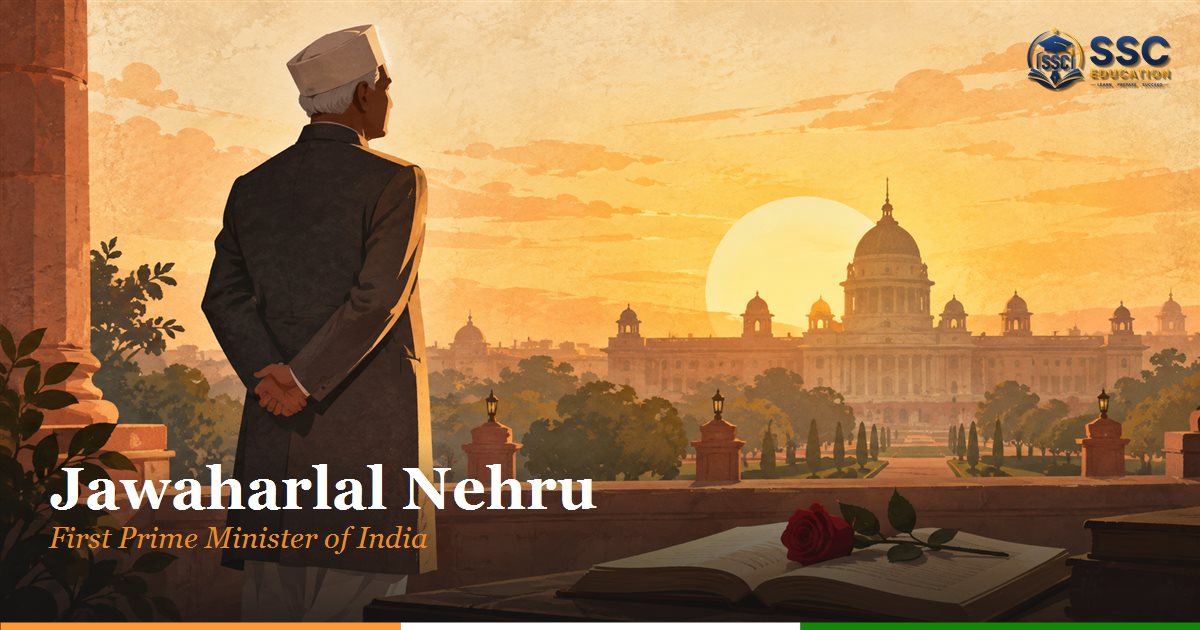
Biography of Jawaharlal Nehru
Rahul Kumar
SSC Exam Expert & Content Editor
Table of Contents
- 1.Introduction
- 2.Quick Facts: Jawaharlal Nehru
- 3.Early Life and Family Background
- 4.Education in England
- 5.Entry into the Freedom Struggle
- 6.Rise as a National Leader
- 7.India's First Prime Minister
- 8.Building Modern India: Nehru's Policies and Vision
- 9.Nehru and the Kashmir Issue
- 10.Foreign Policy and the Non-Aligned Movement
- 11.Nehru's Cabinet and Key Associates
- 12.Nehru's Approach to Secularism and Democracy
- 13.Personal Life
- 14.Books and Writings
- 15.Challenges of Nation-Building After Partition
- 16.Death and National Mourning
- 17.Legacy and Influence
- 18.Awards and Honours
- 19.Places and Institutions Named After Nehru
- 20.Nehru in Popular Culture
- 21.Timeline of Jawaharlal Nehru's Life
- 22.Nehru's Contribution to India's Space and Atomic Energy Programmes
- 23.Nehru's Relationship with Other Leaders
- 24.Interesting Facts about Jawaharlal Nehru
- 25.Famous Quotes by Jawaharlal Nehru
- 26.Nehru's Economic Vision in Detail
- 27.Nehru's Final Years and Declining Health
- 28.Why Jawaharlal Nehru Still Matters Today
- 29.Frequently Asked Questions (FAQs) about Jawaharlal Nehru
- 30.Related Reading
- 31.Conclusion
Jawaharlal Nehru (1889-1964) was independent India's first and longest-serving Prime Minister. Read his full biography, freedom struggle journey, policies, and legacy.
Introduction
Jawaharlal Nehru was independent India's first Prime Minister and one of the most influential architects of modern India. Fondly called "Chacha Nehru" (Uncle Nehru) by children, and widely known as "Pandit Nehru" for his scholarly nature, he led India for 17 continuous years, from 1947 until his death in 1964, shaping the country's democracy, foreign policy, and economic direction during its most formative years.
In this biography, we cover Jawaharlal Nehru's early life, education in England, his role in India's freedom struggle alongside Mahatma Gandhi, his years as Prime Minister, his vision for modern India, his personal life, his famous books, his death, and his enduring legacy — written in simple, easy-to-understand language, along with commonly searched facts and frequently asked questions.
Quick Facts: Jawaharlal Nehru
| Nationality | Indian |
|---|---|
| Best Known For | First Prime Minister of India (1947–1964) |
| Full Name | Jawaharlal Nehru |
| Born | November 14, 1889, Allahabad, India |
| Died | May 27, 1964 (aged 74), New Delhi, India |
| Father | Motilal Nehru |
| Mother | Swarup Rani Nehru |
| Wife | Kamala Nehru |
| Daughter | Indira Gandhi (later Prime Minister of India) |
| Known As | Pandit Nehru, Chacha Nehru |
| Famous For | First Prime Minister of India (1947–1964), architect of modern India's democracy and economy |
| Famous Books | The Discovery of India, Glimpses of World History, Toward Freedom (autobiography) |
| Celebrated As | His birthday, November 14, is celebrated as Children's Day in India |
Early Life and Family Background
Jawaharlal Nehru was born on November 14, 1889, in Allahabad (now Prayagraj), into a wealthy and influential Kashmiri Pandit family. His father, Motilal Nehru, was a highly successful lawyer and a prominent leader of the Indian National Congress, while his mother, Swarup Rani, came from a well-respected family in Lahore. Growing up in the grand family residence, Anand Bhawan, Jawaharlal enjoyed a privileged and comfortable childhood, with private tutors providing his early education at home.
This upbringing exposed young Nehru early on to both Western liberal ideas and Indian nationalist politics, since his father's home was frequently visited by leading Congress politicians. This blend of influences would shape Nehru's unique worldview — a deep commitment to Indian independence combined with a strong belief in science, secularism, and modern democratic institutions.
Education in England
At the age of 15, Nehru was sent to England for his education. He studied at the prestigious Harrow School, and later went on to Trinity College, Cambridge, where he earned a degree in Natural Sciences. Following this, he trained as a barrister at the Inner Temple in London, qualifying in 1912. His years in England exposed him to Fabian socialism, liberal political thought, and European culture, all of which left a lasting influence on his political and economic thinking.
Nehru returned to India in 1912 and initially practised law, following in his father's footsteps, but he soon found himself drawn more strongly toward the growing nationalist movement rather than legal practice.
Entry into the Freedom Struggle
Nehru's political awakening intensified after he met Mahatma Gandhi in 1916, and especially after witnessing Gandhi's Champaran Satyagraha in 1917 and the horror of the Jallianwala Bagh Massacre in 1919. Deeply moved by the suffering of ordinary Indians under British rule, Nehru dedicated himself fully to the freedom movement, gradually becoming one of Gandhi's closest political allies and eventually the natural choice to lead the next generation of Congress leadership.
He participated actively in the Non-Cooperation Movement (1920–22) and was imprisoned multiple times by the British for his political activities. Over the course of the freedom struggle, Nehru spent nearly nine years in various prisons, using much of that time for reading and writing, which resulted in some of his most famous literary works.
Rise as a National Leader
Nehru's rise within the Congress party was rapid. He became President of the Indian National Congress for the first time in 1929 at the historic Lahore Session, where the Congress famously declared "Purna Swaraj" (complete independence) as its goal, with the Indian tricolour hoisted on the banks of the Ravi river at midnight on December 31, 1929. He would go on to serve as Congress President several more times over the following decades, becoming one of the most recognisable faces of the independence movement alongside Gandhi, Sardar Patel, and Subhas Chandra Bose.
During his prison years, particularly during his time at Ahmednagar Fort jail in the early 1940s, Nehru wrote some of his most acclaimed books, reflecting deeply on India's history, culture, and place in the world.
India's First Prime Minister
When India finally achieved independence at midnight on August 14–15, 1947, Jawaharlal Nehru delivered his historic "Tryst with Destiny" speech to the Constituent Assembly, one of the most celebrated speeches in modern history, declaring: "At the stroke of the midnight hour, when the world sleeps, India will awake to life and freedom." He was sworn in as independent India's first Prime Minister and would go on to hold the office continuously for the next 17 years, until his death in 1964 — making him India's longest-serving Prime Minister.
Building Modern India: Nehru's Policies and Vision
As Prime Minister, Nehru faced the enormous challenge of building a stable, unified, and modern nation out of a newly independent, deeply diverse, and partition-scarred country. His key contributions include:
- Parliamentary Democracy: Nehru firmly established India's democratic institutions and parliamentary traditions, ensuring free and fair elections and a strong commitment to secularism and civil liberties.
- Five-Year Plans: He set up the Planning Commission in 1950 and launched India's First Five-Year Plan in 1951, adopting a mixed economy model that combined public sector planning with private enterprise.
- Industrialisation: Nehru championed heavy industry and modern infrastructure, establishing major public sector steel plants at Bhilai, Durgapur, and Rourkela, along with dams and power projects, which he called the "temples of modern India."
- Scientific and Educational Institutions: He was instrumental in founding premier institutions such as the Indian Institutes of Technology (IITs), the All India Institute of Medical Sciences (AIIMS), and various atomic energy and space research bodies, reflecting his deep belief in science and technology as tools for national progress.
- States Reorganisation: His government passed the States Reorganisation Act of 1956, redrawing India's internal state boundaries largely along linguistic lines.
- Integration of Princely States: Working closely with Sardar Vallabhbhai Patel, Nehru's government oversaw the integration of hundreds of former princely states into the Indian Union.
Nehru and the Kashmir Issue
One of the most complex and long-running challenges of Nehru's tenure was the dispute over the princely state of Jammu and Kashmir. Following an invasion by tribal militias backed by Pakistan in October 1947, the Maharaja of Kashmir, Hari Singh, signed the Instrument of Accession joining Kashmir to India, after which Indian troops were deployed to repel the invaders. Nehru, himself of Kashmiri ancestry, took a personal interest in the region and took the matter to the United Nations, resulting in a ceasefire and a UN-monitored Line of Control that, in a modified form, continues to this day. Nehru's decision to approach the United Nations and his subsequent handling of the Kashmir question remain among the most debated aspects of his foreign policy legacy, with historians continuing to study the long-term consequences of these early decisions.
Foreign Policy and the Non-Aligned Movement
Nehru was one of the principal architects of India's independent foreign policy during the Cold War era. Rather than aligning with either the United States-led Western bloc or the Soviet-led Eastern bloc, Nehru championed a policy of non-alignment, becoming a founding leader of the Non-Aligned Movement alongside leaders like Josip Broz Tito of Yugoslavia, Gamal Abdel Nasser of Egypt, and Sukarno of Indonesia. This policy was formally shaped at the historic Bandung Conference of 1955.
With China, Nehru initially pursued friendly relations under the slogan "Hindi-Chini Bhai Bhai" (Indians and Chinese are brothers) and signed the Panchsheel Agreement (1954), based on five principles of peaceful coexistence. However, relations deteriorated sharply, culminating in the Sino-Indian War of 1962, a military and diplomatic setback that deeply affected Nehru personally and is widely regarded as one of the most difficult periods of his tenure.
Nehru's Cabinet and Key Associates
Nehru's government during the crucial early years of independence included several towering figures of the freedom movement. Sardar Vallabhbhai Patel served as Deputy Prime Minister and Home Minister, overseeing the historic integration of over 560 princely states into the Indian Union. Dr. B. R. Ambedkar served as India's first Law Minister and chaired the Drafting Committee of the Constituent Assembly, working alongside Nehru to give shape to the Indian Constitution. Maulana Abul Kalam Azad served as India's first Education Minister, helping establish many of the premier educational institutions Nehru envisioned. This talented cabinet of leaders, despite occasional ideological differences with Nehru, worked together to lay the institutional foundations of the new republic during its most fragile early years.
Nehru's Approach to Secularism and Democracy
One of Nehru's most significant and lasting contributions was his uncompromising commitment to a secular state, where citizens of all religions would be treated equally under the law, regardless of India's Hindu-majority population and the trauma of Partition along religious lines. He believed strongly that democracy, scientific temper, and secularism were essential pillars for a diverse country like India to remain united and progressive. This commitment to pluralism and constitutional democracy, backed by regular free elections even in a poor, newly independent country, was considered a remarkable achievement at a time when many newly decolonised nations were falling into authoritarian rule.
Personal Life
Nehru married Kamala Nehru in 1916. The couple had one daughter, Indira Gandhi, who would later go on to become India's third Prime Minister, continuing a remarkable political legacy now often referred to as the Nehru-Gandhi family (notably, this family is not related by blood to Mahatma Gandhi; the shared surname "Gandhi" comes from Indira's husband, Feroze Gandhy/Gandhi). Kamala Nehru suffered from prolonged illness and passed away in 1936. Nehru himself never remarried and devoted himself to his political work and to raising his daughter, to whom he wrote a famous series of letters later published as "Letters from a Father to His Daughter" and "Glimpses of World History."
Nehru was known for his elegant sense of style, notably popularising the "Nehru jacket," a closed-neck coat that remains a recognisable fashion style in India to this day. He was also famously fond of children, which led to his birthday being celebrated nationally as Children's Day.
Books and Writings
Nehru was a gifted writer, and much of his most significant literary work was produced during his long years in British prisons. His major works include:
- The Discovery of India (1946): Written during his imprisonment at Ahmednagar Fort, this book explores India's long history, culture, and civilisation, and remains one of his most celebrated works.
- Glimpses of World History: A sweeping account of world history, originally written as a series of letters to his young daughter, Indira, from prison.
- Toward Freedom: Nehru's autobiography, describing his political journey and the freedom struggle.
- Letters from a Father to His Daughter: A collection of accessible, simple letters written to introduce Indira to science and nature.
Challenges of Nation-Building After Partition
Nehru assumed office at an extraordinarily difficult moment in Indian history. The Partition of India in 1947 had triggered one of the largest and most violent mass migrations in human history, with millions of refugees crossing new borders and widespread communal violence between Hindus, Muslims, and Sikhs. Alongside dealing with this humanitarian crisis, Nehru's government had to draft a new Constitution, hold the country's first general elections, integrate hundreds of princely states with differing loyalties, and build a modern economy almost from scratch, all while maintaining India's fragile unity as one of the most diverse nations on earth, home to hundreds of languages, religions, and cultures. Historians widely regard Nehru's success in holding India together as a functioning democracy during this period as one of the most remarkable political achievements of the twentieth century.
Death and National Mourning
Jawaharlal Nehru died of a heart attack on May 27, 1964, in New Delhi, while still serving as Prime Minister, having never fully recovered from the political and personal toll of the 1962 war with China. His death led to nationwide mourning, and he was cremated on the banks of the Yamuna river at a site now known as Shanti Van. He was succeeded as Prime Minister by Lal Bahadur Shastri.
Legacy and Influence
Jawaharlal Nehru's legacy is central to the story of modern India. He is widely credited as the chief architect of India's parliamentary democracy, its planned economic development model, its network of scientific and technical institutions, and its independent, non-aligned foreign policy stance during the Cold War. His vision of a secular, democratic, and scientifically progressive India continues to shape the country's institutions and public discourse even today.
His birthday, November 14, is celebrated across India as Children's Day, reflecting his deep affection for children and his belief that they represented the future of the nation. His family, including his daughter Indira Gandhi and grandson Rajiv Gandhi, both went on to serve as Prime Ministers of India, making the Nehru-Gandhi family one of the most prominent political dynasties in the country's history.
Awards and Honours
Jawaharlal Nehru was posthumously and formally recognised for his contributions to India's development. Numerous institutions, universities, stadiums, and public infrastructure projects across India are named in his honour, including Jawaharlal Nehru University (JNU) in New Delhi and the Jawaharlal Nehru Port in Mumbai. His life and work remain a major area of study within Indian political history and civics education.
Places and Institutions Named After Nehru
Reflecting his enormous influence on modern India, countless institutions, places, and public projects carry Jawaharlal Nehru's name. These include Jawaharlal Nehru University (JNU) in New Delhi, one of India's leading centres for higher education and research; the Jawaharlal Nehru Port Trust near Mumbai, one of India's busiest container ports; the Pandit Jawaharlal Nehru Stadium in New Delhi, host to major international sporting events including the Asian Games; and numerous medical colleges, technical institutes, roads, and public libraries across the country. The sheer number of institutions named after him reflects the scale of his contribution to shaping independent India's public life.
Nehru in Popular Culture
Jawaharlal Nehru remains a widely referenced figure in Indian popular culture, documentaries, and historical dramas about the independence movement. His "Tryst with Destiny" speech is frequently quoted and replayed on Independence Day and in classrooms across India as one of the finest examples of political oratory in modern history. Numerous biographies, television series, and academic works continue to study his life, his correspondence with world leaders, and his role in shaping the early Republic of India, making him one of the most documented political figures in the country's modern history.
Timeline of Jawaharlal Nehru's Life
| Year | Event |
|---|---|
| 1889 | Born on November 14 in Allahabad. |
| 1905–1912 | Educated at Harrow School and Trinity College, Cambridge; trained as a barrister in London. |
| 1912 | Returned to India and began legal practice. |
| 1916 | Married Kamala Nehru; met Mahatma Gandhi. |
| 1917 | Deeply influenced by Gandhi's Champaran Satyagraha. |
| 1920–22 | Actively participated in the Non-Cooperation Movement. |
| 1929 | Elected Congress President at the historic Lahore Session; "Purna Swaraj" declared. |
| 1930s–40s | Repeatedly imprisoned by the British; wrote major books in prison, including The Discovery of India. |
| 1942 | Participated in the Quit India Movement; imprisoned until 1945. |
| 1947 | Became India's first Prime Minister on August 15; delivered the "Tryst with Destiny" speech. |
| 1950 | Established the Planning Commission of India. |
| 1954 | Signed the Panchsheel Agreement with China. |
| 1955 | Played a leading role at the Bandung Conference, shaping the Non-Aligned Movement. |
| 1956 | States Reorganisation Act passed, redrawing state boundaries on linguistic lines. |
| 1962 | Sino-Indian War with China, a major setback for his government. |
| 1964 | Died on May 27 in New Delhi while still serving as Prime Minister. |
Nehru's Contribution to India's Space and Atomic Energy Programmes
Nehru held a deep, almost personal belief that science and technology were essential to lifting India out of poverty and backwardness. He formed a close working relationship with scientists such as Dr. Homi J. Bhabha, whom he supported in establishing the Tata Institute of Fundamental Research and later the Atomic Energy Commission of India, laying the groundwork for India's nuclear energy programme. Nehru also backed the early efforts that would eventually lead to the founding of the Indian National Committee for Space Research, the forerunner of the Indian Space Research Organisation (ISRO). This strong state support for scientific research during Nehru's tenure is widely credited with giving India an early and crucial head start in advanced scientific fields compared to many other newly independent nations of the era.
Nehru's Relationship with Other Leaders
Nehru shared a close and respectful bond with Mahatma Gandhi, who saw him as a natural successor and once said Nehru, not any other leader, should lead India after independence. His working relationship with Sardar Vallabhbhai Patel, India's first Deputy Prime Minister and Home Minister, was crucial to the peaceful integration of princely states, even though the two leaders often held differing views on economic and administrative policy. Nehru also mentored his daughter Indira Gandhi closely, preparing her, through both example and extensive correspondence, for a life of public service that would eventually lead her to the same office he held.
Interesting Facts about Jawaharlal Nehru
- Nehru spent a combined total of about nine years in prison during the freedom struggle, across multiple sentences.
- He always wore a fresh rose in his buttonhole, which became one of his most recognisable personal trademarks.
- His birthday is celebrated as Children's Day in India because of his well-known affection for children.
- The "Nehru jacket," a closed-collar coat he frequently wore, became internationally fashionable and remains popular in India.
- Despite being from a wealthy aristocratic family, Nehru embraced socialist economic ideas influenced by his time in Europe.
- He served as India's Prime Minister for over 16 continuous years, the longest tenure of any Indian Prime Minister to date.
Famous Quotes by Jawaharlal Nehru
- "At the stroke of the midnight hour, when the world sleeps, India will awake to life and freedom."
- "Freedom and power bring responsibility."
- "The policy of being too clever, of using dubious means to achieve one's ends, is bound to fail in the long run."
- "A moment comes, which comes but rarely in history, when we step out from the old to the new."
- "Democracy is good. I say this because other systems are worse."
Nehru's Economic Vision in Detail
Nehru's economic philosophy was shaped by his years in Europe, where he had observed both the successes of industrial planning in the Soviet Union and the social welfare policies of Fabian socialists in Britain. He believed that a newly independent, largely agrarian country like India could not simply rely on free markets to industrialise quickly enough, and that the state needed to play a central, active role in building heavy industry, infrastructure, and social services. This led to India's distinctive "mixed economy" model, combining a large public sector in core industries such as steel, coal, and power, alongside a private sector for consumer goods and smaller enterprises. While later economists have debated the efficiency of this approach, it undeniably gave India its early industrial base, including major public sector undertakings that still operate today, such as Bhilai Steel Plant, Hindustan Aeronautics Limited, and Bharat Heavy Electricals Limited (BHEL).
Nehru's Final Years and Declining Health
The last two years of Nehru's life were marked by declining health, worsened significantly by the political and emotional toll of India's defeat in the 1962 Sino-Indian War. Colleagues and biographers noted that Nehru, previously known for his energy and optimism, appeared visibly aged and weary in his final months in office. Despite this, he continued to attend to the duties of the Prime Minister's office until his death from a heart attack on May 27, 1964. His passing marked the end of an era in Indian politics and raised urgent questions about political succession, which were resolved through the selection of Lal Bahadur Shastri as the next Prime Minister.
Why Jawaharlal Nehru Still Matters Today
Jawaharlal Nehru's decisions in the first two decades after independence continue to shape India in the present day. The democratic institutions he nurtured, the scientific and technical education system he built, and the foreign policy tradition of strategic independence he established remain foundational to how India functions as a nation. For students of history, civics, and political science, Nehru's life offers a detailed case study in nation-building — the challenges of uniting a vast, diverse, newly independent country, and the long-term consequences, both positive and difficult, of the choices made by its earliest leaders.
Frequently Asked Questions (FAQs) about Jawaharlal Nehru
1. Who was Jawaharlal Nehru?
Jawaharlal Nehru was a leading figure in India's independence movement and became independent India's first Prime Minister, serving from 1947 until his death in 1964.
2. When and where was Jawaharlal Nehru born?
He was born on November 14, 1889, in Allahabad (now Prayagraj), India.
3. Why is Nehru's birthday celebrated as Children's Day?
Nehru was known for his deep affection for children, so after his death, his birthday, November 14, was designated as Children's Day in India in his honour.
4. Was Jawaharlal Nehru related to Mahatma Gandhi?
No. Despite sharing political ties and mutual respect, Jawaharlal Nehru was not related by blood to Mahatma Gandhi. The Nehru-Gandhi political family's surname comes from Indira Gandhi's husband, Feroze Gandhy.
5. What is Nehru famous for?
He is famous for being independent India's first Prime Minister and for shaping the country's parliamentary democracy, economic planning, scientific institutions, and non-aligned foreign policy.
6. What books did Jawaharlal Nehru write?
His major books include "The Discovery of India," "Glimpses of World History," and his autobiography, "Toward Freedom."
7. What was Nehru's role in the Non-Aligned Movement?
Nehru was one of the founding leaders of the Non-Aligned Movement, promoting a foreign policy of independence from both Cold War power blocs, formalised at the 1955 Bandung Conference.
8. How did Jawaharlal Nehru die?
He died of a heart attack on May 27, 1964, in New Delhi, while still serving as Prime Minister of India.
9. Who succeeded Nehru as Prime Minister?
Lal Bahadur Shastri succeeded Jawaharlal Nehru as Prime Minister of India after his death in 1964.
10. How long did Nehru serve as Prime Minister?
He served as Prime Minister for nearly 17 years, from August 15, 1947, until his death on May 27, 1964, making him India's longest-serving Prime Minister.
11. What was the Sino-Indian War of 1962?
It was a border war between India and China in 1962 that resulted in a difficult setback for India and deeply affected Nehru during the final years of his life.
12. Who was Nehru's daughter?
His daughter was Indira Gandhi, who later became the third Prime Minister of India.
13. What was Nehru's role in drafting the Indian Constitution?
While Dr. B. R. Ambedkar chaired the Drafting Committee, Nehru, as Prime Minister and a senior Constituent Assembly member, played a key role in shaping the Constitution's democratic, secular, and socialist framework, including moving the historic "Objectives Resolution" that laid out independent India's founding principles.
14. What is the "Nehru jacket"?
The Nehru jacket is a hip-length, closed-neck coat that Jawaharlal Nehru frequently wore, which became a recognisable fashion style named after him, both in India and internationally.
15. How many times was Nehru imprisoned by the British?
Nehru was imprisoned multiple times during the freedom struggle, spending a combined total of approximately nine years in various British jails between 1921 and 1945.
Related Reading
Conclusion
Jawaharlal Nehru's life bridges India's colonial past and its democratic present. From an England-educated barrister to a freedom fighter who spent years in British prisons, and finally to the nation's first and longest-serving Prime Minister, Nehru's vision shaped nearly every major institution of modern India — its democracy, its economy, its science and education system, and its place in world affairs. His legacy, debated and studied to this day, remains inseparable from the story of India's journey as an independent nation.
Rahul Kumar
SSC Exam Expert & Content Editor
Rahul is a senior SSC exam strategist with 8+ years of experience helping aspirants crack CGL, CHSL and MTS exams. He writes in-depth notification breakdowns, exam pattern guides and preparation strategies.