SSC Statement and Conclusion Questions with Answers and Tricks
Rahul Kumar
SSC Exam Expert & Content Editor
Table of Contents
- 1.How Statement and Conclusion Questions Work
- 2.Rules and Shortcut Tricks
- 3.Set 1: Single Conclusion Questions (Q1–Q7)
- 4.Set 2: Two Conclusion Questions (Q8–Q14)
- 5.Set 3: If-Then and Mixed Questions (Q15–Q21)
- 6.Common Mistakes in Statement and Conclusion
- 7.How to Practice These 21 Questions
- 8.Related Topics to Study Next
- 9.Frequently Asked Questions
Practice 21 SSC statement and conclusion questions with answers and explanations. Covers logical inference, two-conclusion questions and if-then reasoning for CGL, CHSL, MTS and GD.
Statement and conclusion questions test whether you can decide what logically follows from the given facts. They are common in SSC CGL, CHSL and MTS reasoning papers. The golden rule is to accept only the information given in the statement and ignore your general knowledge. This practice paper gives you 21 questions with answers and short explanations.
How Statement and Conclusion Questions Work
You are given one or two statements and one or two conclusions. You have to decide whether each conclusion definitely follows from the statements.
- A conclusion follows only if it is always true when the statements are true.
- If a conclusion may be true or may be false, it does not follow.
- Treat the statements as true even if they are not true in real life.
Rules and Shortcut Tricks
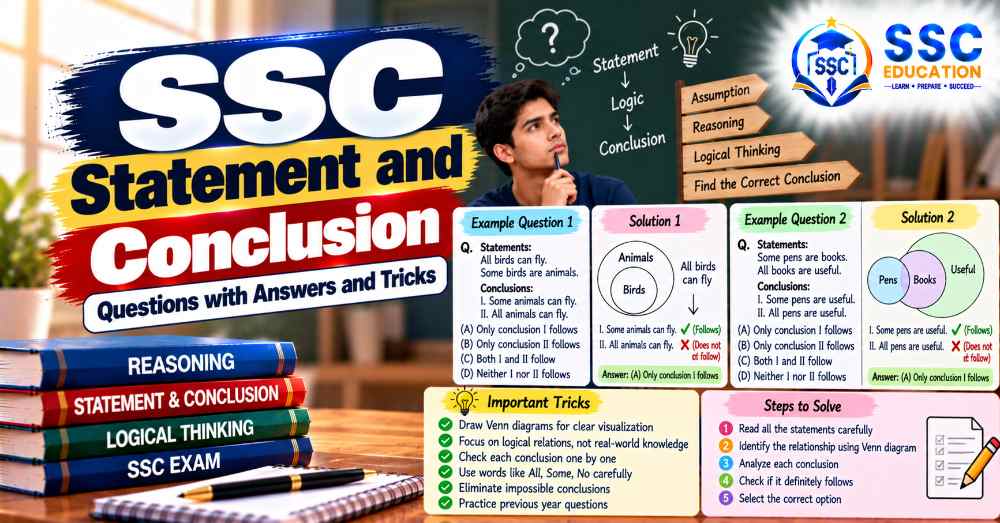
- All A are B gives "Some B are A" but not "All B are A".
- Some A are B gives "Some B are A" but not "All A are B".
- No A is B gives "No B is A" and nothing about A and B being related in other ways.
- If P then Q: if P is true, Q is true. If Q is false, P is false. But if Q is true, P may or may not be true.
- Only A can do X means everyone who does X is A.
- Two "some" statements together never give a definite conclusion.
- Use small Venn diagrams to check the conclusions.
Set 1: Single Conclusion Questions (Q1–Q7)
Q1. Statement: All doctors are graduates. Rita is a doctor. Conclusion: Rita is a graduate.
Answer: Follows
Solution: Rita belongs to the doctors, who are all graduates.
Q2. Statement: Some teachers are poets. All poets are artists. Conclusion: Some teachers are artists.
Answer: Follows
Solution: Those teachers who are poets are also artists.
Q3. Statement: No fish is a bird. A penguin is a bird. Conclusion: A penguin is not a fish.
Answer: Follows
Solution: Birds and fish do not overlap.
Q4. Statement: Ravi is taller than Shyam. Shyam is taller than Mohan. Conclusion: Mohan is the shortest of the three.
Answer: Follows
Solution: The order is Ravi, Shyam, Mohan.
Q5. Statement: All who study pass the exam. Meena passed. Conclusion: Meena studied.
Answer: Does not follow
Trick: Meena may have passed for other reasons.
Q6. Statement: Some pens are blue. Conclusion: All pens are blue.
Answer: Does not follow
Solution: "Some" does not mean "all".
Q7. Statement: Only graduates can apply. Kiran applied. Conclusion: Kiran is a graduate.
Answer: Follows
Solution: Every applicant must be a graduate.
Set 2: Two Conclusion Questions (Q8–Q14)
Q8. Statement: All roses are flowers. All flowers are plants. I: All roses are plants. II: All plants are roses.
Answer: Only I follows
Solution: Roses are inside flowers, which are inside plants. II is the reverse and is not true.
Q9. Statement: Some cats are dogs. All dogs are animals. I: Some cats are animals. II: All animals are dogs.
Answer: Only I follows
Solution: The cats that are dogs are animals. II is not given.
Q10. Statement: No pen is a pencil. Some pencils are erasers. I: Some erasers are pencils. II: No eraser is a pen.
Answer: Only I follows
Solution: I is the reverse of "some pencils are erasers". Nothing is given about erasers and pens.
Q11. Statement: All cars are vehicles. Some vehicles are red. I: Some cars are red. II: Some vehicles are cars.
Answer: Only II follows
Solution: II is the reverse of "all cars are vehicles". The red vehicles may not be cars.
Q12. Statement: Some books are pages. Some pages are pictures. I: Some books are pictures. II: Some pictures are pages.
Answer: Only II follows
Trick: II is the reverse of the second statement. Two "some" statements give nothing about books and pictures.
Q13. Statement: All boys are tall. No tall person is weak. I: No boy is weak. II: Some weak persons are tall.
Answer: Only I follows
Solution: Boys are inside tall persons, who are not weak. II contradicts the second statement.
Q14. Statement: All A are B. No B is C. I: No A is C. II: Some C are A.
Answer: Only I follows
Solution: A is inside B, and B has no C. II contradicts it.
Set 3: If-Then and Mixed Questions (Q15–Q21)
Q15. Statement: If it rains, the match is cancelled. The match was not cancelled. Conclusion: It did not rain.
Answer: Follows
Trick: If the effect is false, the cause must be false.
Q16. Statement: If it rains, the match is cancelled. The match was cancelled. Conclusion: It rained.
Answer: Does not follow
Solution: The match could be cancelled for another reason.
Q17. Statement: Either A or B will win, not both. A did not win. Conclusion: B won.
Answer: Follows
Solution: One of them must win and A did not.
Q18. Statement: All members of the club are adults. Some adults are teachers. Conclusion: Some members are teachers.
Answer: Does not follow
Solution: The teachers who are adults may not be members.
Q19. Statement: A is the sister of B. B is the brother of C. Conclusion: A is the sister of C.
Answer: Follows
Solution: A, B and C are siblings, so A is a sister of C.
Q20. Statement: Only some students passed. Conclusion: Some students did not pass.
Answer: Follows
Solution: "Only some" means not all.
Q21. Statement: Every employee gets a bonus. Sita does not get a bonus. Conclusion: Sita is not an employee.
Answer: Follows
Solution: If she were an employee, she would have got a bonus.
Common Mistakes in Statement and Conclusion
- Using general knowledge instead of the given statements.
- Treating "some" as "all" or the reverse of "all" as true.
- Accepting a conclusion that is only possibly true.
- Mixing up the two forms of if-then statements.
- Not checking each conclusion separately.
- Ignoring words like only, some, no and all.
How to Practice These 21 Questions
- Learn the conversion rules for all, some and no.
- Draw a small Venn diagram for each question.
- Solve each set in 7 minutes.
- Check every conclusion separately.
Related Topics to Study Next
Frequently Asked Questions
What is a statement and conclusion question?
It is a question in which you decide whether a conclusion follows logically from the given statements.
When does a conclusion follow?
A conclusion follows when it must be true if the statements are true.
Can I use my general knowledge?
No. Use only the given statements, even if they are not true in real life.
What does "All A are B" imply?
It implies "Some B are A" but not "All B are A".
What does "Some A are B" imply?
It implies "Some B are A" but not "All A are B".
What is the difference between "only" and "all"?
"Only A can do X" means everyone who does X is A. "All A can do X" means A can do X but others may also do it.
How do I handle two statements with "some"?
Two "some" statements together give no definite conclusion about the first and last group.
What is the if-then rule?
If P then Q means that when P is true, Q is true. When Q is false, P is false.
What are the options in a two-conclusion question?
Usually: only I follows, only II follows, both follow, or neither follows.
How is this different from syllogism?
Syllogism uses all, some and no statements. Statement and conclusion also includes inference, if-then and comparison questions.
How many such questions come in SSC exams?
One or two questions per shift in the reasoning section.
How should I prepare for these questions?
Learn the rules, practise Venn diagrams and solve previous year questions.
Rahul Kumar
SSC Exam Expert & Content Editor
Rahul is a senior SSC exam strategist with 8+ years of experience helping aspirants crack CGL, CHSL and MTS exams. He writes in-depth notification breakdowns, exam pattern guides and preparation strategies.