SSC Solar System and Physical Geography Questions with Answers
Rahul Kumar
SSC Exam Expert & Content Editor
Table of Contents
- 1.Key Facts About the Solar System
- 2.Quick Fact Table
- 3.Eclipses, Tides and Layers of the Earth
- 4.Set 1: Planets and the Sun (Q1–Q7)
- 5.Set 2: The Earth and the Moon (Q8–Q14)
- 6.Set 3: Atmosphere and the Earth's Interior (Q15–Q21)
- 7.Planets: Extra Facts to Remember
- 8.Common Mistakes in Solar System
- 9.How to Practice These 21 Questions
- 10.Related Topics to Study Next
- 11.Frequently Asked Questions
Practice 21 SSC solar system and physical geography questions with answers on planets, the earth, moon, atmosphere, eclipses and seasons with fact tables for CGL, CHSL, MTS and GD.
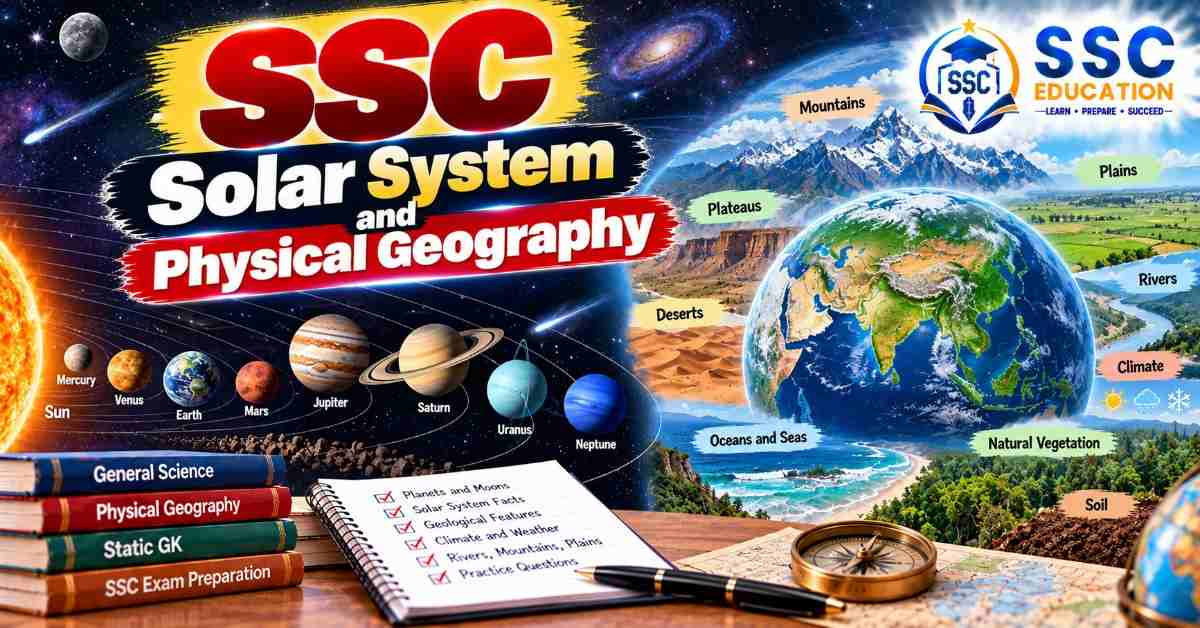
Solar system and physical geography questions are easy marks in SSC General Awareness. They ask about planets, the earth's movements, the moon, eclipses, seasons and the layers of the atmosphere. This practice paper gives you fact tables and 21 questions with answers and short explanations.
Key Facts About the Solar System
- The solar system has eight planets that revolve around the sun.
- The order from the sun is: Mercury, Venus, Earth, Mars, Jupiter, Saturn, Uranus and Neptune.
- The earth rotates on its axis in about 24 hours (day and night) and revolves around the sun in about 365 and a quarter days (a year).
- Seasons are caused by the tilt of the earth's axis (23.5 degrees) and its revolution.
Quick Fact Table
| Topic | Fact |
|---|---|
| Largest planet | Jupiter |
| Smallest planet | Mercury |
| Hottest planet | Venus |
| Red planet | Mars |
| Planet with prominent rings | Saturn |
| Closest planet to the sun | Mercury |
| Time taken by sunlight to reach the earth | About 8 minutes 20 seconds |
| Natural satellite of the earth | Moon |
| Layer of the atmosphere with ozone | Stratosphere |
| Layer where weather occurs | Troposphere |
| Main gas in the atmosphere | Nitrogen (78%) |
| Oxygen in the atmosphere | About 21% |
| Instrument to measure earthquakes | Seismograph |
| Scale to measure earthquake magnitude | Richter scale |
| Hot desert wind of the Sahara | Harmattan and Sirocco regional winds |
Eclipses, Tides and Layers of the Earth
| Topic | Fact |
|---|---|
| Solar eclipse | The moon comes between the sun and the earth (new moon day) |
| Lunar eclipse | The earth comes between the sun and the moon (full moon day) |
| Tides | Caused mainly by the gravitational pull of the moon and the sun |
| Layers of the earth | Crust, mantle and core (outer core is liquid and inner core is solid) |
| Thinnest layer | Crust |
| Layers of the atmosphere | Troposphere, stratosphere, mesosphere, thermosphere and exosphere |
| Summer solstice (northern hemisphere) | 21 June, the longest day |
| Winter solstice (northern hemisphere) | 22 December, the shortest day |
| Equinox | 21 March and 23 September, day and night are equal |
A good way to remember the planets in order is the sentence: My Very Educated Mother Just Served Us Noodles. The first letters give Mercury, Venus, Earth, Mars, Jupiter, Saturn, Uranus and Neptune. Revise the table of firsts and the order of the planets in the last week before the exam.
Set 1: Planets and the Sun (Q1–Q7)
Q1. Which is the largest planet in the solar system?
Answer: Jupiter
Solution: It is a gas giant.
Q2. Which is the smallest planet?
Answer: Mercury
Solution: It is also the closest to the sun.
Q3. Which is the hottest planet?
Answer: Venus
Solution: Because of its thick atmosphere of carbon dioxide.
Q4. Which planet is called the red planet?
Answer: Mars
Solution: Because of iron oxide on its surface.
Q5. Which planet has prominent rings?
Answer: Saturn
Solution: The rings are made of ice and rock.
Q6. How long does sunlight take to reach the earth?
Answer: About 8 minutes 20 seconds
Solution: Light travels about 300,000 km per second.
Q7. How many planets are there in the solar system?
Answer: Eight
Solution: Pluto is a dwarf planet.
Set 2: The Earth and the Moon (Q8–Q14)
Q8. How long does the earth take to rotate on its axis?
Answer: About 24 hours
Solution: This causes day and night.
Q9. How long does the earth take to revolve around the sun?
Answer: About 365 and a quarter days
Solution: This causes the year and the leap year.
Q10. What causes the seasons on the earth?
Answer: The tilt of the earth's axis and its revolution
Solution: The tilt is 23.5 degrees.
Q11. What is the natural satellite of the earth?
Answer: The Moon
Solution: It has no atmosphere.
Q12. When does a solar eclipse occur?
Answer: When the moon comes between the sun and the earth
Solution: It occurs on a new moon day.
Q13. When does a lunar eclipse occur?
Answer: When the earth comes between the sun and the moon
Solution: It occurs on a full moon day.
Q14. What mainly causes the tides in the oceans?
Answer: The gravitational pull of the moon and the sun
Solution: The moon has the greater effect.
Set 3: Atmosphere and the Earth's Interior (Q15–Q21)
Q15. Which layer of the atmosphere contains the ozone layer?
Answer: Stratosphere
Solution: It protects us from ultraviolet rays.
Q16. In which layer of the atmosphere does weather occur?
Answer: Troposphere
Solution: It is the lowest layer.
Q17. Which is the most abundant gas in the atmosphere?
Answer: Nitrogen
Solution: It forms about 78% of the air.
Q18. Which instrument records earthquakes?
Answer: Seismograph
Solution: Magnitude is measured on the Richter scale.
Q19. Which is the thinnest layer of the earth?
Answer: Crust
Solution: It is the outermost layer.
Q20. Which layer of the earth is liquid?
Answer: The outer core
Solution: The inner core is solid.
Q21. On which date is the longest day in the northern hemisphere?
Answer: 21 June
Solution: This is the summer solstice.
Planets: Extra Facts to Remember
| Planet | Fact |
|---|---|
| Mercury | Smallest planet and closest to the Sun |
| Venus | Hottest planet; rotates in the opposite direction |
| Earth | Only planet known to have life |
| Mars | Red planet with the tallest volcano, Olympus Mons |
| Jupiter | Largest planet of the solar system |
| Saturn | Known for its rings |
| Uranus | Rotates on its side |
| Neptune | Farthest planet from the Sun |
Light takes about 8 minutes and 20 seconds to reach the earth from the Sun, and about 1.3 seconds from the Moon. Pluto was reclassified as a dwarf planet in 2006.
Common Mistakes in Solar System
- Confusing the smallest and the closest planets (both are Mercury).
- Mixing up solar and lunar eclipses.
- Confusing rotation with revolution.
- Forgetting the sequence of the atmospheric layers.
- Mixing the hottest planet (Venus) with the closest to the sun (Mercury).
- Learning facts without the order of the planets.
How to Practice These 21 Questions
- Learn the planet order with the memory sentence.
- Revise the fact tables.
- Solve one set daily.
- Revise mistakes weekly.
Related Topics to Study Next
- SSC Science Questions
- SSC Static GK Questions
- 1000 Important SSC GK Questions
- SSC Current Affairs Questions
Frequently Asked Questions
How many planets are there?
Eight.
Which is the largest planet?
Jupiter.
Which is the hottest planet?
Venus.
Why do we have seasons?
Because of the tilt of the earth's axis and its revolution around the sun.
What is a solar eclipse?
When the moon comes between the sun and the earth.
What is a lunar eclipse?
When the earth comes between the sun and the moon.
Which layer has the ozone layer?
The stratosphere.
Which gas is the most abundant in air?
Nitrogen.
What is the difference between rotation and revolution?
Rotation is the spinning of the earth on its axis and revolution is its movement around the sun.
What is the Richter scale?
A scale to measure the magnitude of earthquakes.
How many solar system questions come in SSC exams?
One or two questions in General Awareness.
How should I prepare this topic for SSC exams?
Learn the tables, use the memory sentence and practise questions.
Rahul Kumar
SSC Exam Expert & Content Editor
Rahul is a senior SSC exam strategist with 8+ years of experience helping aspirants crack CGL, CHSL and MTS exams. He writes in-depth notification breakdowns, exam pattern guides and preparation strategies.