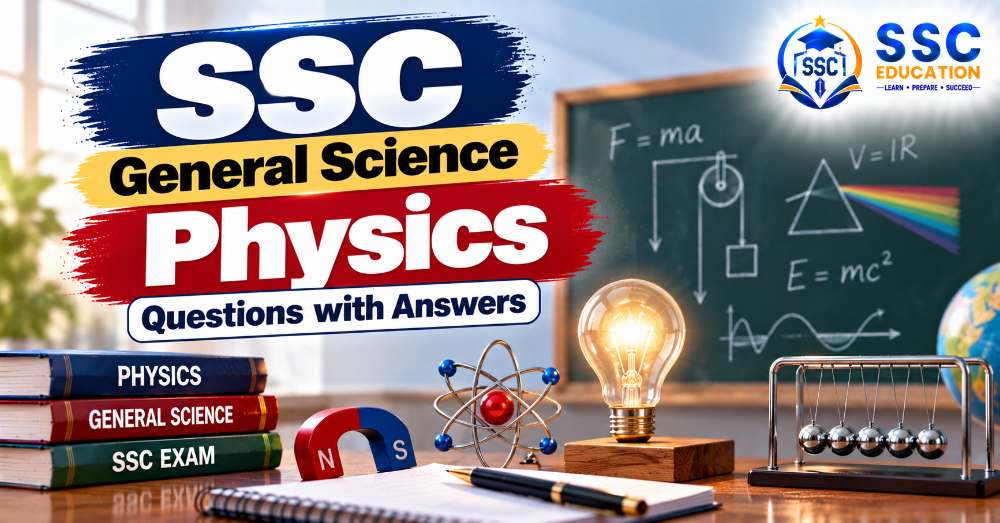
SSC General Science Physics Questions with Answers
Rahul Kumar
SSC Exam Expert & Content Editor
Table of Contents
- 1.Key Concepts to Remember
- 2.Quick Fact Table
- 3.Important Laws, Instruments and Applications
- 4.Set 1: Motion, Force and Energy (Q1–Q7)
- 5.Set 2: Light, Sound and Heat (Q8–Q14)
- 6.Set 3: Electricity and Magnetism (Q15–Q21)
- 7.Common Physics Phenomena in Daily Life
- 8.Common Mistakes in Physics
- 9.How to Practice These 21 Questions
- 10.Related Topics to Study Next
- 11.Frequently Asked Questions
Practice 21 SSC physics questions with answers on units, motion, force, light, sound, heat and electricity, with a formula table and short explanations for CGL, CHSL, MTS and GD.
Physics is a scoring part of SSC General Science. Most questions are direct and ask for units, laws, instruments and everyday applications. This practice paper gives you a fact table, a short formula sheet and 21 questions with answers and one-line explanations, so you can revise quickly before the exam.
Key Concepts to Remember
- Speed = distance / time, and velocity is speed in a given direction. Acceleration = change in velocity / time.
- Newton's first law is the law of inertia, the second law gives F = ma, and the third law says every action has an equal and opposite reaction.
- Work = force x displacement, and power = work / time. Kinetic energy = 1/2 mv squared.
- Light travels at about 3 x 10^8 m/s in vacuum, and sound needs a medium and travels at about 343 m/s in air.
Quick Fact Table
| Quantity | SI unit |
|---|---|
| Force | Newton (N) |
| Work and energy | Joule (J) |
| Power | Watt (W) |
| Pressure | Pascal (Pa) |
| Frequency | Hertz (Hz) |
| Electric current | Ampere (A) |
| Electric charge | Coulomb (C) |
| Resistance | Ohm |
| Potential difference | Volt (V) |
| Temperature | Kelvin (K) |
| Luminous intensity | Candela (cd) |
| Magnetic field strength | Tesla (T) |
| Loudness of sound | Decibel (dB) |
| Power of a lens | Dioptre (D) |
Important Laws, Instruments and Applications
| Topic | Fact |
|---|---|
| Ohm's law | V = IR |
| Archimedes' principle | Explains floating and sinking of bodies |
| Pascal's law | Used in the hydraulic lift and hydraulic brakes |
| Bernoulli's principle | Explains the lift of an aeroplane wing |
| Concave mirror | Used by dentists, in torches and in shaving mirrors |
| Convex mirror | Used as a rear-view mirror in vehicles |
| Total internal reflection | Used in optical fibres and causes the shining of diamonds |
| Myopia | Corrected by a concave lens |
| Hypermetropia | Corrected by a convex lens |
| Ammeter and voltmeter | Connected in series and in parallel respectively |
| Fuse | Protects a circuit from overloading and is connected in series |
| Transformer | Changes AC voltage and works on electromagnetic induction |
Physics questions in SSC are mostly factual, so a short chart of units and laws gives you the best return on your time. Revise the table every day, and practise the numerical questions in two steps: write the formula first, then put in the values. Always check the units before you mark the final answer, because a wrong unit is the most common reason for a lost mark in this topic.
Set 1: Motion, Force and Energy (Q1–Q7)
Q1. What is the SI unit of force?
Answer: Newton
Solution: One newton is the force that gives 1 kg an acceleration of 1 m/s squared.
Q2. Which law of motion is also called the law of inertia?
Answer: Newton's first law
Solution: A body stays at rest or in uniform motion unless a force acts on it.
Q3. What is the SI unit of work?
Answer: Joule
Solution: Work = force x displacement.
Q4. What is the SI unit of power?
Answer: Watt
Solution: One watt equals one joule per second.
Q5. A body of mass 5 kg is moving with an acceleration of 4 m/s squared. What is the force on it?
Answer: 20 N
Solution: F = ma = 5 x 4 = 20 N.
Q6. The kinetic energy of a body depends on which two quantities?
Answer: Mass and speed
Solution: KE = 1/2 mv squared.
Q7. Which quantity is conserved in a collision when no external force acts?
Answer: Momentum
Solution: Momentum = mass x velocity.
Set 2: Light, Sound and Heat (Q8–Q14)
Q8. Which mirror is used as a rear-view mirror in vehicles?
Answer: Convex mirror
Solution: It gives a wider field of view.
Q9. Which phenomenon is used in optical fibres?
Answer: Total internal reflection
Solution: Light stays inside the fibre.
Q10. Which lens is used to correct myopia (short sight)?
Answer: Concave lens
Solution: It diverges the rays before they enter the eye.
Q11. What is the unit of the loudness of sound?
Answer: Decibel
Solution: Symbol dB.
Q12. Sound cannot travel through which of these?
Answer: Vacuum
Solution: Sound needs a material medium.
Q13. What is the SI unit of temperature?
Answer: Kelvin
Solution: 0 degree Celsius = 273 K.
Q14. What is the speed of light in vacuum approximately?
Answer: 3 x 10^8 m/s
Solution: It is the highest speed in nature.
Set 3: Electricity and Magnetism (Q15–Q21)
Q15. What is the SI unit of electric current?
Answer: Ampere
Solution: It is a base unit.
Q16. What is the SI unit of resistance?
Answer: Ohm
Solution: Ohm's law gives R = V / I.
Q17. A current of 2 A flows through a resistance of 5 ohm. What is the potential difference?
Answer: 10 V
Solution: V = IR = 2 x 5 = 10 V.
Q18. How is an ammeter connected in a circuit?
Answer: In series
Solution: It has a very low resistance.
Q19. Which device is used to change the voltage of an AC supply?
Answer: Transformer
Solution: It works on electromagnetic induction.
Q20. What is the function of a fuse?
Answer: It protects the circuit from overloading
Solution: It melts when the current is too high.
Q21. Who discovered electromagnetic induction?
Answer: Michael Faraday
Solution: He discovered it in 1831.
Common Physics Phenomena in Daily Life
Many SSC questions ask for the reason behind a daily-life event. A rainbow is formed by the dispersion of sunlight in raindrops. The sky looks blue because of the scattering of light. A pencil looks bent in water because of refraction. A mirage is caused by total internal reflection. An echo is the reflection of sound, and it needs a minimum distance of about 17 metres. A spinning ice skater spins faster by pulling in her arms, which is conservation of angular momentum.
Keep these in a short list and revise them with the formula sheet. Questions usually give four close options, so knowing the exact reason matters.
Common Mistakes in Physics
- Confusing the unit of work (joule) with the unit of power (watt).
- Mixing up concave and convex mirrors and lenses.
- Writing the wrong connection (series or parallel) for meters.
- Forgetting to convert grams to kilograms in numericals.
- Mixing speed with velocity and distance with displacement.
- Not memorising the SI base units.
How to Practice These 21 Questions
- Learn the unit table and the laws table.
- Write each formula on a card.
- Solve one set every day.
- Revise the wrong answers each week.
Related Topics to Study Next
- SSC Science Questions
- 1000 Important SSC GK Questions
- 200 Indian History and Polity Questions
- SSC CGL Tier 1 Mini Mock
Frequently Asked Questions
What is the SI unit of force?
Newton.
What is the SI unit of power?
Watt.
Which law of motion is the law of inertia?
Newton's first law.
What is the formula for Ohm's law?
V = IR.
Which lens corrects short sight?
A concave lens.
Which mirror is used as a rear-view mirror?
A convex mirror.
What is the speed of light in vacuum?
About 3 x 10^8 m/s.
Which principle is used in a hydraulic lift?
Pascal's law.
Can sound travel in a vacuum?
No, it needs a medium.
How many physics questions come in SSC exams?
Usually two to five in General Science.
Which physics topics are most important for SSC?
Units, laws of motion, light, sound, heat and electricity.
How should I prepare physics for SSC exams?
Learn the tables, practise numericals and revise daily.
Rahul Kumar
SSC Exam Expert & Content Editor
Rahul is a senior SSC exam strategist with 8+ years of experience helping aspirants crack CGL, CHSL and MTS exams. He writes in-depth notification breakdowns, exam pattern guides and preparation strategies.