SSC Para Jumbles Questions with Answers and Tricks
Rahul Kumar
SSC Exam Expert & Content Editor
Table of Contents
- 1.What Is a Para Jumble?
- 2.Tricks to Solve Para Jumbles Quickly
- 3.Set 1: Story and Sequence Questions (Q1–Q5)
- 4.Set 2: Description and Process Questions (Q6–Q10)
- 5.Set 3: Exam-Level Questions (Q11–Q15)
- 6.Common Mistakes in Para Jumbles
- 7.How to Practice These 15 Questions
- 8.Related Topics to Study Next
- 9.Frequently Asked Questions
Practice 15 SSC para jumbles questions with answers and explanations. Learn tricks to find the opening sentence, mandatory pairs and the logical order for CGL, CHSL, MTS and CPO English.
Para jumbles (sentence rearrangement) questions give four jumbled sentences, and you have to arrange them in a logical order. They appear in SSC CGL, CPO and CHSL English papers. The questions need a clear method: find the opening sentence, link the pairs and check the closing sentence. This practice paper gives you 15 questions with answers and short explanations.
What Is a Para Jumble?
A para jumble is a paragraph whose sentences are mixed up. When you arrange them correctly, they form a smooth and logical paragraph with a clear beginning, middle and end.
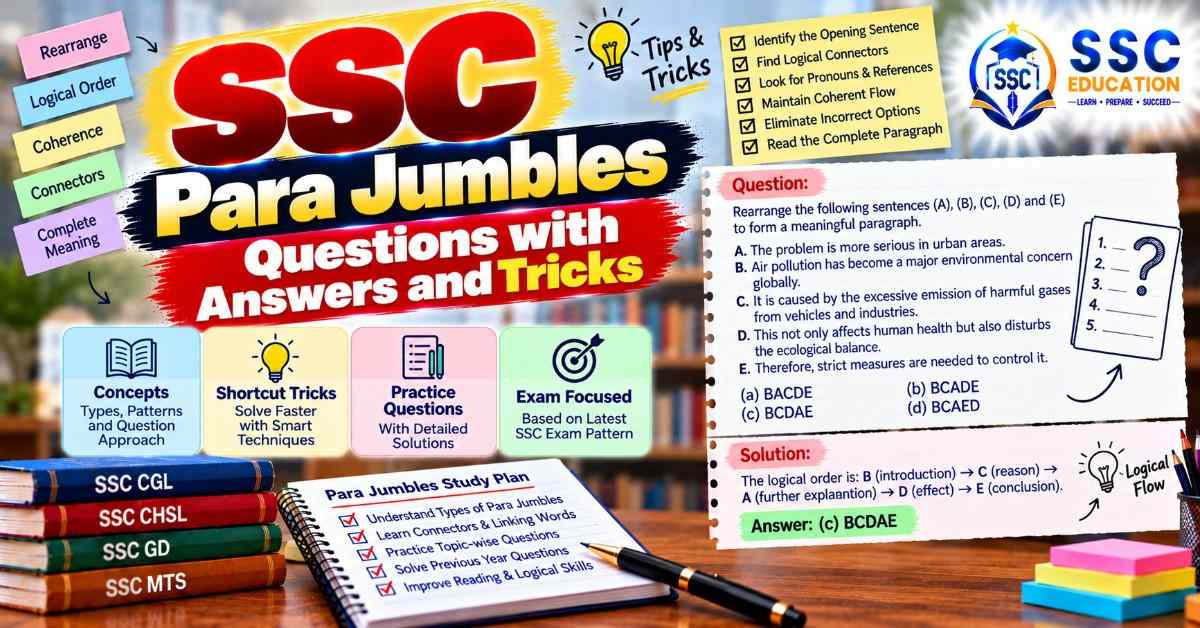
Tricks to Solve Para Jumbles Quickly
- Find the opening sentence: it introduces the topic or the person and usually does not have a pronoun like he, she, it or they without an earlier noun.
- Find the mandatory pairs: two sentences that must be together, such as a question and its answer, or a noun and a pronoun that refers to it.
- Look at the connectors: however, therefore, hence, also, but and then show the order.
- Follow the time order in a story: past events come before the later ones.
- Find the closing sentence: it often gives the result or the conclusion.
- Use elimination: check the first sentence in the options and remove the wrong ones.
Set 1: Story and Sequence Questions (Q1–Q5)
Q1. Rearrange the sentences into a meaningful paragraph. P: He worked hard day and night. Q: Rahul wanted to become a doctor. R: Finally, he cleared the entrance exam. S: So he started preparing for the exam.
Answer: QSPR
Solution: Q introduces Rahul and his wish, S shows the action, P shows the effort and R gives the result.
Q2. Rearrange the sentences into a meaningful paragraph. P: The farmers were very happy. Q: It rained heavily last night. R: The fields turned green. S: The long dry spell finally ended.
Answer: QSRP
Solution: The rain ends the dry spell, the fields turn green and the farmers become happy.
Q3. Rearrange the sentences into a meaningful paragraph. P: Because of heavy traffic he reached the station late. Q: Raju was going to Delhi for an interview. R: As a result, he missed the morning train. S: He had to take a bus instead.
Answer: QPRS
Solution: Q introduces Raju, P gives the reason, R gives the result and S the solution.
Q4. Rearrange the sentences into a meaningful paragraph. P: Yoga improves concentration. Q: Yoga is an ancient Indian practice. R: It also keeps the body fit and flexible. S: Millions of people practise it every day.
Answer: QSPR
Solution: Q introduces yoga, S tells its popularity, and P and R give the benefits.
Q5. Rearrange the sentences into a meaningful paragraph. P: The thief ran away. Q: The police arrived soon after. R: A thief entered the house at midnight. S: The owner woke up and shouted.
Answer: RSPQ
Solution: The order of events is: entry, owner wakes, thief runs and police arrive.
Set 2: Description and Process Questions (Q6–Q10)
Q6. Rearrange the sentences into a meaningful paragraph. P: Water is essential for life. Q: Hence we must not waste it. R: But fresh water is limited on the earth. S: Every living being needs it.
Answer: PSRQ
Solution: P introduces water, S gives the reason, R gives the problem and Q gives the conclusion.
Q7. Rearrange the sentences into a meaningful paragraph. P: The match began at 4 pm. Q: Both teams were ready by afternoon. R: India won by five wickets. S: The crowd cheered loudly throughout.
Answer: QPSR
Solution: Preparation, start, crowd reaction and result.
Q8. Rearrange the sentences into a meaningful paragraph. P: The bus stopped suddenly. Q: The passengers were thrown forward. R: The driver had applied the brake. S: A child had run in front of the bus.
Answer: SRPQ
Solution: The child runs, the driver brakes, the bus stops and the passengers are thrown forward.
Q9. Rearrange the sentences into a meaningful paragraph. P: He studied the question paper carefully. Q: Aman entered the examination hall. R: Then he began to write the answers. S: He took his seat and read the instructions.
Answer: QSPR
Solution: Q introduces Aman, then he sits, reads and writes.
Q10. Rearrange the sentences into a meaningful paragraph. P: A healthy diet includes fruits and vegetables. Q: Regular exercise is equally important. R: Good health depends on many habits. S: Sleep should also be sufficient.
Answer: RPQS
Solution: R is the general opening, then diet, exercise and sleep.
Set 3: Exam-Level Questions (Q11–Q15)
Q11. Rearrange the sentences into a meaningful paragraph. P: The library was silent. Q: Students were reading quietly. R: Suddenly, a mobile phone rang. S: Everyone turned to look.
Answer: PQRS
Solution: Setting, activity, sudden event and reaction.
Q12. Rearrange the sentences into a meaningful paragraph. P: Gandhiji returned to India in 1915. Q: He had spent twenty years in South Africa. R: There he fought against racial discrimination. S: His ideas of non-violence took shape there.
Answer: PQRS
Solution: P names the person, Q gives background, R and S explain with "there".
Q13. Rearrange the sentences into a meaningful paragraph. P: The company launched a new phone. Q: It sold out within hours. R: The phone had an excellent camera. S: Customers were lining up outside the stores.
Answer: PRSQ
Solution: Launch, feature, crowds and then the result.
Q14. Rearrange the sentences into a meaningful paragraph. P: Reading improves vocabulary. Q: Reading is a habit worth developing. R: Newspapers are a good start for beginners. S: Soon you will enjoy books too.
Answer: QPRS
Solution: Q is the general opening, P gives a benefit, R gives a tip and S the outcome.
Q15. Rearrange the sentences into a meaningful paragraph. P: The rain stopped. Q: The sun came out. R: A rainbow appeared in the sky. S: Children rushed outside to see it.
Answer: PQRS
Solution: Natural time order of events.
Common Mistakes in Para Jumbles
- Starting with a sentence that has a pronoun without an earlier noun.
- Ignoring connectors such as however, hence and also.
- Not checking pairs of sentences that must be together.
- Arranging only by guessing the options.
- Not reading the final paragraph after arranging.
- Spending too much time on one jumble.
How to Practice These 15 Questions
- Find the opening sentence first.
- Mark the pairs and connectors.
- Read the final order once to check the flow.
- Practise 5 jumbles every day.
Related Topics to Study Next
- SSC English Practice Set
- Reading Comprehension Practice Set
- Cloze Test Questions
- Error Detection Questions
Frequently Asked Questions
What is a para jumble?
It is a set of mixed sentences that you must arrange in a logical order to form a paragraph.
How do I find the opening sentence?
Look for the sentence that introduces the topic and has no pronoun or connector referring to an earlier sentence.
What are mandatory pairs?
They are two sentences that must come together, such as a noun and a pronoun that refers to it.
What do connectors tell us?
Words like however, hence, also and but show the link between sentences and help in ordering.
How do I find the closing sentence?
It often gives the result, the conclusion or the final outcome.
How many para jumble questions come in SSC exams?
One to three questions per paper in CGL and CPO English.
What is the best way to practise para jumbles?
Read short passages, break them into sentences and rearrange them without looking.
Can I use the options to solve a para jumble?
Yes. Check the first sentence of the options and eliminate the wrong ones.
Is there any negative marking?
Yes, as in other English questions. Attempt only when the order is clear.
How can I improve my speed in para jumbles?
Practise with a timer of 1 minute per question.
Does reading help in para jumbles?
Yes. Regular reading improves your sense of logical flow.
How should I prepare para jumbles for SSC exams?
Learn the tricks, practise daily and solve previous year questions.
Rahul Kumar
SSC Exam Expert & Content Editor
Rahul is a senior SSC exam strategist with 8+ years of experience helping aspirants crack CGL, CHSL and MTS exams. He writes in-depth notification breakdowns, exam pattern guides and preparation strategies.