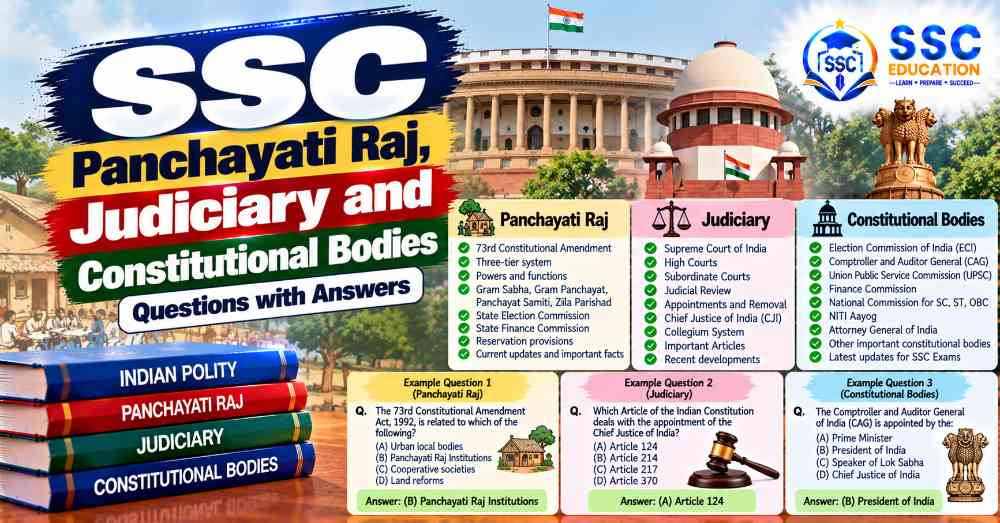
SSC Panchayati Raj, Judiciary and Constitutional Bodies Questions with Answers
Rahul Kumar
SSC Exam Expert & Content Editor
Table of Contents
- 1.Key Facts About Local Government and Courts
- 2.Quick Fact Table
- 3.Important Constitutional Bodies and Their Functions
- 4.Set 1: Panchayati Raj (Q1–Q7)
- 5.Set 2: The Judiciary (Q8–Q14)
- 6.Set 3: Constitutional Bodies (Q15–Q21)
- 7.Common Mistakes in Panchayati Raj and Judiciary
- 8.How to Practice These 21 Questions
- 9.Related Topics to Study Next
- 10.Frequently Asked Questions
Practice 21 SSC polity questions on Panchayati Raj, the Supreme Court, High Courts and constitutional bodies such as CAG, Election Commission and UPSC with answers and fact tables.
Panchayati Raj, the judiciary and the constitutional bodies carry regular questions in SSC General Awareness. The questions ask about amendments, article numbers, qualifications, tenure and the functions of the Supreme Court, the High Courts and bodies such as the Election Commission and the CAG. This practice paper gives you fact tables and 21 questions with answers and short explanations.
Key Facts About Local Government and Courts
- The 73rd Constitutional Amendment (1992) gave constitutional status to Panchayati Raj (Part IX, Articles 243 to 243O).
- The 74th Amendment (1992) gave constitutional status to urban local bodies (Part IX-A).
- The Balwant Rai Mehta Committee (1957) recommended the three-tier system, and Rajasthan was the first state to start it (Nagaur, 2 October 1959).
- The Supreme Court is the highest court, and the High Court is the highest court in a state.
Quick Fact Table
| Topic | Fact |
|---|---|
| Three tiers of Panchayati Raj | Gram Panchayat, Panchayat Samiti and Zila Parishad |
| Supreme Court established | 28 January 1950 |
| Strength of the Supreme Court | 34 judges including the Chief Justice (after 2019) |
| Retirement age of a Supreme Court judge | 65 years |
| Retirement age of a High Court judge | 62 years |
| Article for writs in the Supreme Court | Article 32 |
| Article for writs in the High Courts | Article 226 |
| Comptroller and Auditor General | Article 148 |
| Election Commission | Article 324 |
| Union Public Service Commission | Article 315 |
| Finance Commission | Article 280 |
| Attorney General of India | Article 76 |
| Governor of a state | Article 153 |
| Appointment of Supreme Court judges | By the President, in consultation with the collegium |
| PIL (Public Interest Litigation) | A case filed for the public interest, often under Article 32 or 226 |
Important Constitutional Bodies and Their Functions
| Body | Function |
|---|---|
| Election Commission | Conducts elections to Parliament, state legislatures and the offices of the President and Vice-President |
| CAG | Audits the accounts of the Union and the states |
| UPSC | Conducts exams for the All India Services and Central Services |
| Finance Commission | Recommends the distribution of taxes between the Union and the states (every five years) |
| Attorney General | Chief legal adviser of the Government of India |
| National Commission for Scheduled Castes | Protects the interests of SCs |
| Lok Adalat | Settles disputes through compromise outside regular courts |
| Judicial review | Power of courts to examine the constitutionality of laws |
Remember the pattern of articles: 76 for the Attorney General, 148 for the CAG, 280 for the Finance Commission, 315 for the UPSC and 324 for the Election Commission. A simple method is to write them in a small table and revise it every week. Also remember that the 73rd Amendment added the Eleventh Schedule (29 subjects for panchayats) and the 74th added the Twelfth Schedule (18 subjects for municipalities).
Set 1: Panchayati Raj (Q1–Q7)
Q1. Which amendment gave constitutional status to Panchayati Raj?
Answer: The 73rd Amendment (1992)
Solution: It added Part IX to the Constitution.
Q2. Which committee recommended the three-tier Panchayati Raj system?
Answer: Balwant Rai Mehta Committee (1957)
Solution: It submitted its report in 1957.
Q3. Which state first introduced Panchayati Raj?
Answer: Rajasthan
Solution: It started at Nagaur on 2 October 1959.
Q4. What are the three tiers of Panchayati Raj?
Answer: Gram Panchayat, Panchayat Samiti and Zila Parishad
Solution: They are at the village, block and district levels.
Q5. Which amendment is related to urban local bodies (municipalities)?
Answer: The 74th Amendment (1992)
Solution: It added Part IX-A.
Q6. Which schedule lists the subjects of the Panchayats?
Answer: The Eleventh Schedule
Solution: It has 29 subjects.
Q7. What is the term of a Panchayat?
Answer: Five years
Solution: Elections are held within six months of dissolution.
Set 2: The Judiciary (Q8–Q14)
Q8. When was the Supreme Court established?
Answer: 28 January 1950
Solution: It is the highest court in India.
Q9. What is the retirement age of a Supreme Court judge?
Answer: 65 years
Solution: For High Court judges it is 62 years.
Q10. Under which article can a person approach the Supreme Court for fundamental rights?
Answer: Article 32
Solution: Dr. Ambedkar called it the heart and soul of the Constitution.
Q11. Under which article can the High Courts issue writs?
Answer: Article 226
Solution: Their power is wider than that of the Supreme Court.
Q12. How many judges are there in the Supreme Court at present (including the Chief Justice)?
Answer: 34
Solution: The number was raised in 2019.
Q13. What does PIL stand for?
Answer: Public Interest Litigation
Solution: It allows any person to approach the court in public interest.
Q14. What is judicial review?
Answer: The power of courts to examine the constitutionality of laws
Solution: It is a basic feature of the Constitution.
Set 3: Constitutional Bodies (Q15–Q21)
Q15. Which article provides for the Election Commission?
Answer: Article 324
Solution: It conducts the elections.
Q16. Which article provides for the Comptroller and Auditor General?
Answer: Article 148
Solution: He audits government accounts.
Q17. Which article provides for the Union Public Service Commission?
Answer: Article 315
Solution: It conducts civil services exams.
Q18. Which article provides for the Finance Commission?
Answer: Article 280
Solution: It is appointed every five years.
Q19. Which article provides for the Attorney General of India?
Answer: Article 76
Solution: He is the chief legal adviser.
Q20. Who appoints the Governor of a state?
Answer: The President
Solution: Article 153 provides for a Governor in each state.
Q21. Which body conducts the Civil Services Examination?
Answer: UPSC
Solution: It is the central recruiting agency.
Common Mistakes in Panchayati Raj and Judiciary
- Mixing the 73rd and 74th Amendments.
- Confusing Article 32 and Article 226.
- Mixing the article numbers of the CAG, UPSC and the Election Commission.
- Forgetting the retirement ages of judges.
- Confusing the first state of Panchayati Raj with the first state to hold elections.
- Not noting the number of Supreme Court judges.
How to Practice These 21 Questions
- Learn the fact table and the article numbers.
- Write the amendments in a chart.
- Solve one set daily.
- Revise mistakes weekly.
Related Topics to Study Next
- Fundamental Rights Practice Test
- 200 Indian History and Polity Questions
- SSC CGL Tier 1 Mini Mock
- SSC Static GK Questions
Frequently Asked Questions
Which amendment is related to Panchayati Raj?
The 73rd Amendment.
Which is the first state to introduce Panchayati Raj?
Rajasthan.
Under which article does the Supreme Court issue writs?
Article 32.
Under which article do the High Courts issue writs?
Article 226.
Which article deals with the Election Commission?
Article 324.
Which article deals with the CAG?
Article 148.
What is the retirement age of a Supreme Court judge?
65 years.
What is the three-tier Panchayati Raj system?
Gram Panchayat, Panchayat Samiti and Zila Parishad.
What is a PIL?
Public Interest Litigation.
How many such questions come in SSC exams?
One to three polity questions per paper.
Who appoints the judges of the Supreme Court?
The President, in consultation with the collegium.
How should I prepare this topic for SSC exams?
Learn the tables and article numbers and practise questions.
Rahul Kumar
SSC Exam Expert & Content Editor
Rahul is a senior SSC exam strategist with 8+ years of experience helping aspirants crack CGL, CHSL and MTS exams. He writes in-depth notification breakdowns, exam pattern guides and preparation strategies.