SSC Governors-General and Viceroys of India Questions with Answers
Rahul Kumar
SSC Exam Expert & Content Editor
Table of Contents
- 1.Key Facts About the Office
- 2.Quick Fact Table
- 3.Important Acts and Events with the Viceroy
- 4.Set 1: First and Last Holders (Q1–Q7)
- 5.Set 2: Reforms and Policies (Q8–Q14)
- 6.Set 3: Later Viceroys and Events (Q15–Q21)
- 7.Timeline of Key Reforms by Viceroys
- 8.Common Mistakes in Governors-General and Viceroys
- 9.How to Practice These 21 Questions
- 10.Related Topics to Study Next
- 11.Frequently Asked Questions
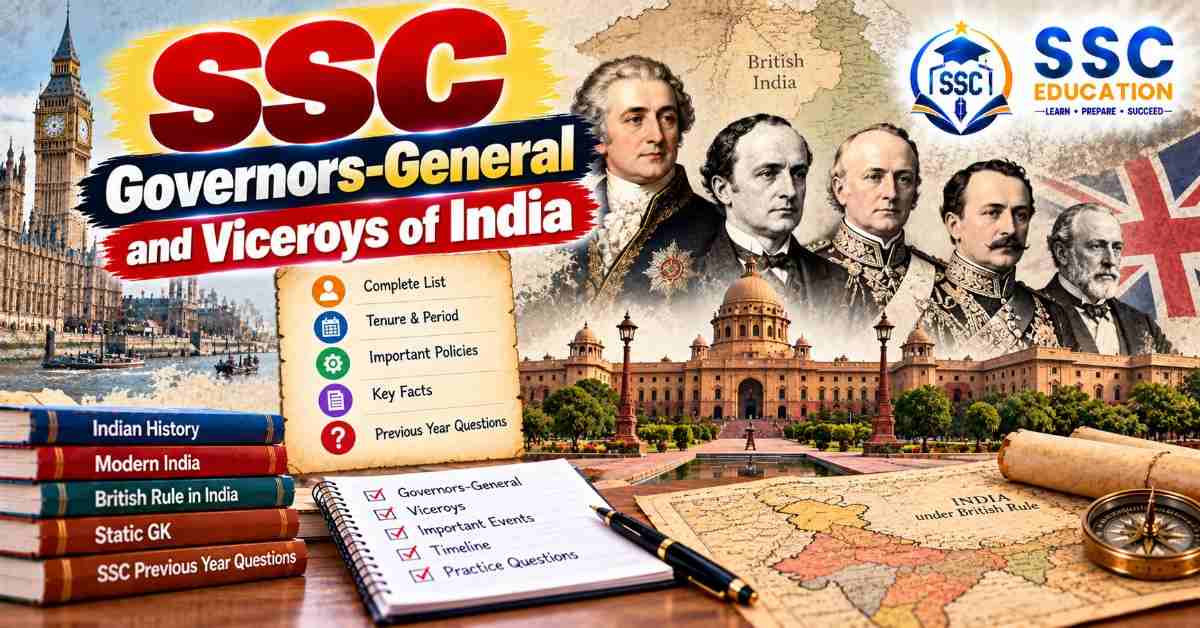
Practice 21 SSC questions on Governors-General and Viceroys of India with answers: first and last holders, reforms, acts and events with a fact table for CGL, CHSL, MTS and GD.
Governors-General and Viceroys of India is a high-scoring area of modern history in SSC exams. Questions ask who was the first or the last holder of the post, who introduced a reform and during whose period an event happened. This practice paper gives you a fact table and 21 questions with answers and short explanations.
Key Facts About the Office
- The first Governor-General of Bengal was Warren Hastings (1773).
- The first Governor-General of India was Lord William Bentinck (1833, by the Charter Act of 1833).
- The title Viceroy began in 1858 after the Revolt of 1857, with Lord Canning as the first Viceroy.
- The last Viceroy was Lord Mountbatten (1947), and the last Governor-General of independent India was C. Rajagopalachari.
Quick Fact Table
| Name | Known for |
|---|---|
| Warren Hastings | First Governor-General of Bengal; Regulating Act 1773 |
| Lord Cornwallis | Permanent Settlement of Bengal (1793) |
| Lord Wellesley | Subsidiary Alliance system |
| Lord William Bentinck | Abolished sati (1829); first Governor-General of India |
| Lord Dalhousie | Doctrine of Lapse; first railway (1853); postal reforms |
| Lord Canning | First Viceroy of India (1858) |
| Lord Lytton | Vernacular Press Act (1878) |
| Lord Ripon | Local self-government; the Ilbert Bill |
| Lord Dufferin | Indian National Congress founded in 1885 |
| Lord Curzon | Partition of Bengal (1905) |
| Lord Minto II | Morley-Minto Reforms (1909) |
| Lord Hardinge II | Capital shifted from Calcutta to Delhi (1911) |
| Lord Chelmsford | Montagu-Chelmsford Reforms (1919); Jallianwala Bagh |
| Lord Irwin | Gandhi-Irwin Pact (1931) |
| Lord Mountbatten | Last Viceroy; Partition and independence (1947) |
Important Acts and Events with the Viceroy
| Act or event | Viceroy or Governor-General |
|---|---|
| Charter Act 1833 | Lord William Bentinck |
| Revolt of 1857 | Lord Canning |
| Indian Councils Act 1861 | Lord Canning |
| Ilbert Bill controversy (1883) | Lord Ripon |
| Indian Universities Act (1904) | Lord Curzon |
| Rowlatt Act (1919) | Lord Chelmsford |
| August Offer (1940) | Lord Linlithgow |
| Cripps Mission (1942) | Lord Linlithgow |
| Cabinet Mission (1946) | Lord Wavell |
| Mountbatten Plan (3 June 1947) | Lord Mountbatten |
Make a timeline from 1773 to 1947 and write one famous event next to each ruler. For example, link Cornwallis with Permanent Settlement, Dalhousie with railways and the Doctrine of Lapse, Curzon with the Partition of Bengal, Hardinge with the capital shift to Delhi and Mountbatten with independence and partition. Revise the table once a week and solve 10 questions daily in the last month.
Set 1: First and Last Holders (Q1–Q7)
Q1. Who was the first Governor-General of Bengal?
Answer: Warren Hastings
Solution: He served from 1773.
Q2. Who was the first Governor-General of India?
Answer: Lord William Bentinck
Solution: As per the Charter Act of 1833.
Q3. Who was the first Viceroy of India?
Answer: Lord Canning
Solution: After the Revolt of 1857.
Q4. Who was the last Viceroy of India?
Answer: Lord Mountbatten
Solution: He was also the first Governor-General of independent India.
Q5. Who was the last Governor-General of independent India?
Answer: C. Rajagopalachari
Solution: He served until 1950.
Q6. Who introduced the Permanent Settlement in Bengal?
Answer: Lord Cornwallis
Solution: It was introduced in 1793.
Q7. Who introduced the Subsidiary Alliance system?
Answer: Lord Wellesley
Solution: Many Indian states accepted it.
Set 2: Reforms and Policies (Q8–Q14)
Q8. Who abolished the practice of sati?
Answer: Lord William Bentinck
Solution: The regulation was passed in 1829.
Q9. Who introduced the Doctrine of Lapse?
Answer: Lord Dalhousie
Solution: It led to the annexation of states such as Satara and Jhansi.
Q10. Under which Governor-General was the first railway line opened in India (1853)?
Answer: Lord Dalhousie
Solution: It ran from Bombay to Thane.
Q11. Who passed the Vernacular Press Act in 1878?
Answer: Lord Lytton
Solution: It restricted the Indian language press.
Q12. Who is known as the father of local self-government in India?
Answer: Lord Ripon
Solution: He introduced local bodies in 1882.
Q13. Under which Viceroy was the Indian National Congress founded in 1885?
Answer: Lord Dufferin
Solution: A. O. Hume founded it.
Q14. Who was the Viceroy at the time of the Partition of Bengal in 1905?
Answer: Lord Curzon
Solution: The partition was cancelled in 1911.
Set 3: Later Viceroys and Events (Q15–Q21)
Q15. Under which Viceroy were the Morley-Minto Reforms introduced in 1909?
Answer: Lord Minto II
Solution: They introduced separate electorates.
Q16. Under which Viceroy was the capital shifted to Delhi in 1911?
Answer: Lord Hardinge II
Solution: The announcement was made at the Delhi Durbar.
Q17. Who was the Viceroy at the time of the Jallianwala Bagh massacre (1919)?
Answer: Lord Chelmsford
Solution: The Rowlatt Act was passed in the same period.
Q18. Which Viceroy signed the Gandhi-Irwin Pact in 1931?
Answer: Lord Irwin
Solution: It followed the Civil Disobedience Movement.
Q19. Who was the Viceroy at the time of the August Offer in 1940?
Answer: Lord Linlithgow
Solution: It was a British proposal during World War II.
Q20. Who was the Viceroy during the Cabinet Mission of 1946?
Answer: Lord Wavell
Solution: It proposed a federal structure.
Q21. Which Viceroy announced the plan for the partition of India on 3 June 1947?
Answer: Lord Mountbatten
Solution: It is known as the Mountbatten Plan.
Timeline of Key Reforms by Viceroys
| Viceroy or Governor-General | Important event |
|---|---|
| Lord William Bentinck | Abolished sati in 1829 |
| Lord Dalhousie | Doctrine of Lapse, first railway (1853), first telegraph |
| Lord Canning | Last Governor-General and first Viceroy (1858) |
| Lord Ripon | Local self-government, repeal of the Vernacular Press Act |
| Lord Curzon | Partition of Bengal in 1905 |
| Lord Hardinge II | Shifted the capital from Calcutta to Delhi in 1911 |
| Lord Irwin | Gandhi-Irwin Pact in 1931 |
| Lord Mountbatten | Last Viceroy and first Governor-General of free India |
| C. Rajagopalachari | Last Governor-General of India |
A simple way to remember the list is to link each name with one big event and the year of that event.
Common Mistakes in Governors-General and Viceroys
- Confusing the first Governor-General of Bengal with the first Governor-General of India.
- Mixing up Lord Dalhousie and Lord Curzon.
- Forgetting that Canning was both the last Governor-General and the first Viceroy.
- Confusing the Montagu-Chelmsford and Morley-Minto reforms.
- Not linking the Viceroy to the event.
- Learning only the names without the dates.
How to Practice These 21 Questions
- Learn the table in order of time.
- Link each name with one famous act.
- Solve one set daily.
- Revise mistakes weekly.
Related Topics to Study Next
- 200 Indian History and Polity Questions
- SSC CGL Tier 1 Mini Mock
- SSC Static GK Questions
- 1000 Important SSC GK Questions
Frequently Asked Questions
Who was the first Viceroy of India?
Lord Canning.
Who was the last Viceroy of India?
Lord Mountbatten.
Who was the first Governor-General of India?
Lord William Bentinck.
Who started the Doctrine of Lapse?
Lord Dalhousie.
Who was the Viceroy during the Partition of Bengal?
Lord Curzon.
Who abolished sati?
Lord William Bentinck in 1829.
Which Viceroy shifted the capital to Delhi?
Lord Hardinge II in 1911.
What was the Permanent Settlement?
A land revenue system introduced by Lord Cornwallis in 1793.
Who was the last Governor-General of independent India?
C. Rajagopalachari.
How many Viceroy questions come in SSC exams?
One or two questions in General Awareness.
Which Viceroy was in office during the Revolt of 1857?
Lord Canning (as Governor-General).
How should I prepare this topic for SSC exams?
Learn the table, link each name with an event and practise questions.
Rahul Kumar
SSC Exam Expert & Content Editor
Rahul is a senior SSC exam strategist with 8+ years of experience helping aspirants crack CGL, CHSL and MTS exams. He writes in-depth notification breakdowns, exam pattern guides and preparation strategies.