SSC Environment and Ecology Questions with Answers
Rahul Kumar
SSC Exam Expert & Content Editor
Table of Contents
- 1.Key Concepts to Remember
- 2.Quick Fact Table
- 3.National Parks, Pollution and Climate: Facts to Revise
- 4.Set 1: Ecosystem and Pollution (Q1–Q7)
- 5.Set 2: National Parks and Conservation (Q8–Q14)
- 6.Set 3: Conventions and Days (Q15–Q21)
- 7.Types of Pollution and Energy Sources
- 8.Common Mistakes in Environment and Ecology
- 9.How to Practice These 21 Questions
- 10.Related Topics to Study Next
- 11.Frequently Asked Questions
Practice 21 SSC environment and ecology questions with answers on ecosystems, pollution, climate change, national parks and conventions, with fact tables for CGL, CHSL, MTS and GD.
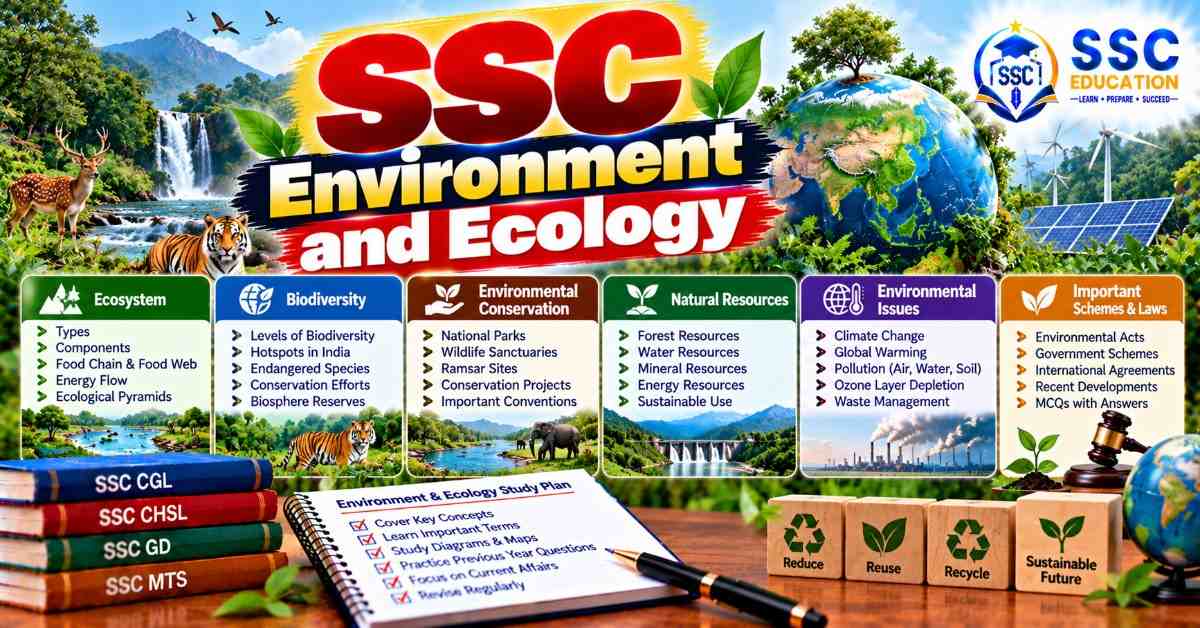
Environment and ecology is a growing topic in SSC General Awareness. The questions cover ecosystems, pollution, global warming, national parks, biosphere reserves and international conventions. This practice paper gives you fact tables and 21 questions with answers and short explanations.
Key Concepts to Remember
- An ecosystem is a community of living things interacting with their non-living environment. A food chain begins with a producer such as a green plant.
- The ozone layer in the stratosphere protects us from harmful ultraviolet rays, and it is damaged by chlorofluorocarbons (CFCs).
- The main greenhouse gases are carbon dioxide, methane, nitrous oxide and water vapour.
- Biodiversity hotspots are regions rich in species that are under threat. India has four: the Himalayas, the Western Ghats, Indo-Burma and Sundaland (Nicobar Islands).
Quick Fact Table
| Topic | Fact |
|---|---|
| World Environment Day | 5 June |
| Earth Day | 22 April |
| World Wildlife Day | 3 March |
| World Water Day | 22 March |
| Ozone Day | 16 September |
| Montreal Protocol (1987) | Protects the ozone layer by phasing out CFCs |
| Kyoto Protocol (1997) | Reduces greenhouse gas emissions |
| Paris Agreement (2015) | Keeps global warming well below 2 degrees Celsius |
| Ramsar Convention | Protects wetlands (Chilika and Keoladeo were the first Indian sites) |
| Project Tiger | Launched in 1973 |
| Project Elephant | Launched in 1992 |
| Wildlife Protection Act | 1972 |
| Environment Protection Act | 1986 |
| Biggest tiger reserve by area | Nagarjunsagar-Srisailam |
| First national park of India | Jim Corbett National Park (1936) |
National Parks, Pollution and Climate: Facts to Revise
| Topic | Fact |
|---|---|
| Kaziranga National Park (Assam) | One-horned rhinoceros |
| Gir National Park (Gujarat) | Asiatic lion |
| Sundarbans (West Bengal) | Royal Bengal tiger and mangrove forests |
| Periyar (Kerala) | Elephants and tigers |
| Keoladeo (Rajasthan) | Birds, a Ramsar site |
| Acid rain is caused by | Sulphur dioxide and oxides of nitrogen |
| Smog is caused by | Smoke and fog, mainly from vehicles and industry |
| Eutrophication | Excess nutrients in water, causing algae growth |
| Biological oxygen demand (BOD) | Measure of water pollution |
| Major source of air pollution in cities | Vehicles and industries |
Questions on this topic are often linked to current events, so read the news about climate summits and wildlife along with this table. Remember that the cleanest fuel among the common ones is hydrogen and natural gas, that carbon monoxide is a poisonous gas produced by incomplete burning, and that the unit used for the loudness of noise pollution is the decibel. These small facts are asked again and again.
Set 1: Ecosystem and Pollution (Q1–Q7)
Q1. Which gas is the major cause of global warming?
Answer: Carbon dioxide
Solution: It traps heat in the atmosphere.
Q2. Which gas damages the ozone layer?
Answer: Chlorofluorocarbons (CFCs)
Solution: They release chlorine in the stratosphere.
Q3. Which gases cause acid rain?
Answer: Sulphur dioxide and oxides of nitrogen
Solution: They mix with rain water.
Q4. What does BOD measure?
Answer: Water pollution
Solution: It is the oxygen needed by microbes to break down waste.
Q5. What is the start of any food chain?
Answer: A producer (green plant)
Solution: Plants make food by photosynthesis.
Q6. Which poisonous gas is formed by incomplete burning of fuel?
Answer: Carbon monoxide
Solution: It is colourless and odourless.
Q7. In which layer of the atmosphere is the ozone layer found?
Answer: Stratosphere
Solution: It absorbs UV rays.
Set 2: National Parks and Conservation (Q8–Q14)
Q8. In which state is Kaziranga National Park?
Answer: Assam
Solution: It is famous for the one-horned rhinoceros.
Q9. Which national park is the home of the Asiatic lion?
Answer: Gir National Park
Solution: It is in Gujarat.
Q10. Which is the first national park of India?
Answer: Jim Corbett National Park
Solution: It was established in 1936.
Q11. In which year was Project Tiger launched?
Answer: 1973
Solution: It started in the Corbett reserve.
Q12. In which year was the Wildlife Protection Act passed?
Answer: 1972
Solution: It protects wild animals and plants.
Q13. Which is the largest mangrove forest in the world?
Answer: The Sundarbans
Solution: It is shared by India and Bangladesh.
Q14. Which animal is the national animal of India?
Answer: Tiger
Solution: The national bird is the peacock.
Set 3: Conventions and Days (Q15–Q21)
Q15. On which date is World Environment Day celebrated?
Answer: 5 June
Solution: The first one was held in 1974.
Q16. Which agreement protects the ozone layer?
Answer: Montreal Protocol
Solution: It was signed in 1987.
Q17. Which convention is related to wetlands?
Answer: Ramsar Convention
Solution: It was signed in 1971.
Q18. In which year was the Environment Protection Act passed in India?
Answer: 1986
Solution: It followed the Bhopal gas tragedy.
Q19. What is the date of Earth Day?
Answer: 22 April
Solution: It is celebrated worldwide.
Q20. Which agreement of 2015 aims to limit global warming?
Answer: Paris Agreement
Solution: It aims for well below 2 degrees Celsius.
Q21. Which protocol aims to reduce greenhouse gas emissions?
Answer: Kyoto Protocol
Solution: It was adopted in 1997.
Types of Pollution and Energy Sources
| Type | Main cause or fact |
|---|---|
| Air pollution | Vehicle smoke, factories and burning of waste |
| Water pollution | Sewage, industrial waste and pesticides |
| Noise pollution | Traffic, loudspeakers and machines |
| Soil pollution | Plastic, chemicals and excess fertilisers |
| Renewable energy | Solar, wind, hydro and biomass |
| Non-renewable energy | Coal, petroleum and natural gas |
| Bhadla Solar Park | Rajasthan, one of the largest solar parks in the world |
| Gas used in biogas | Methane |
| Ganga Action Plan | Started in 1985 |
| Namami Gange | Started in 2014 |
The topic also asks about the 3Rs: reduce, reuse and recycle. Remember the difference between biodegradable waste, which microbes can break down, and non-biodegradable waste such as plastic and glass.
Common Mistakes in Environment and Ecology
- Mixing the dates of World Environment Day, Earth Day and Ozone Day.
- Confusing the Montreal Protocol (ozone) with the Kyoto Protocol (climate).
- Forgetting the states of important national parks.
- Mixing the greenhouse gases with ozone-depleting gases.
- Not revising the years of Project Tiger and the Acts.
- Ignoring the current affairs linked to environment.
How to Practice These 21 Questions
- Learn the days and conventions table.
- Match each national park with its state and animal.
- Solve one set daily.
- Revise the wrong answers weekly.
Related Topics to Study Next
- SSC Science Questions
- SSC Current Affairs Questions
- 1000 Important SSC GK Questions
- SSC CGL Tier 1 Mini Mock
Frequently Asked Questions
When is World Environment Day celebrated?
On 5 June.
Which protocol protects the ozone layer?
The Montreal Protocol.
Which gas is the main cause of global warming?
Carbon dioxide.
Which is the first national park of India?
Jim Corbett National Park.
In which state is Kaziranga National Park?
Assam.
In which year was Project Tiger launched?
1973.
Which Act was passed in 1986?
The Environment Protection Act.
Which convention is related to wetlands?
The Ramsar Convention.
Which gases cause acid rain?
Sulphur dioxide and oxides of nitrogen.
How many environment questions come in SSC exams?
Usually one to three in General Awareness.
Which topics are most important?
National parks, days, conventions and pollution.
How should I prepare this topic for SSC exams?
Learn the tables, follow current affairs and practise questions.
Rahul Kumar
SSC Exam Expert & Content Editor
Rahul is a senior SSC exam strategist with 8+ years of experience helping aspirants crack CGL, CHSL and MTS exams. He writes in-depth notification breakdowns, exam pattern guides and preparation strategies.