SSC Dice Reasoning Questions with Answers and Tricks
Rahul Kumar
SSC Exam Expert & Content Editor
Table of Contents
- 1.How a Dice Works in Reasoning Questions
- 2.Rules and Shortcut Tricks
- 3.Set 1: Standard Dice Questions (Q1–Q7)
- 4.Set 2: Two-Position Problems (Q8–Q14)
- 5.Set 3: Exam-Level Questions (Q15–Q21)
- 6.Common Mistakes in Dice Questions
- 7.How to Practice These 21 Questions
- 8.Related Topics to Study Next
- 9.Frequently Asked Questions
Practice 21 SSC dice reasoning questions with answers and tricks. Covers standard dice, opposite faces, two-position problems and counting rules for CGL, CHSL, MTS and GD reasoning.
Dice questions are a popular topic in the SSC reasoning section. You are asked to find the number opposite a given face, using one, two or three positions of the same dice. There is only one idea to learn, and with a little practice each question takes about 20 seconds. This practice paper gives you 21 dice questions with answers and short solutions, written in text so that you can solve them without figures.
How a Dice Works in Reasoning Questions
A dice is a cube with six faces. Every face has exactly one opposite face and four adjacent faces.
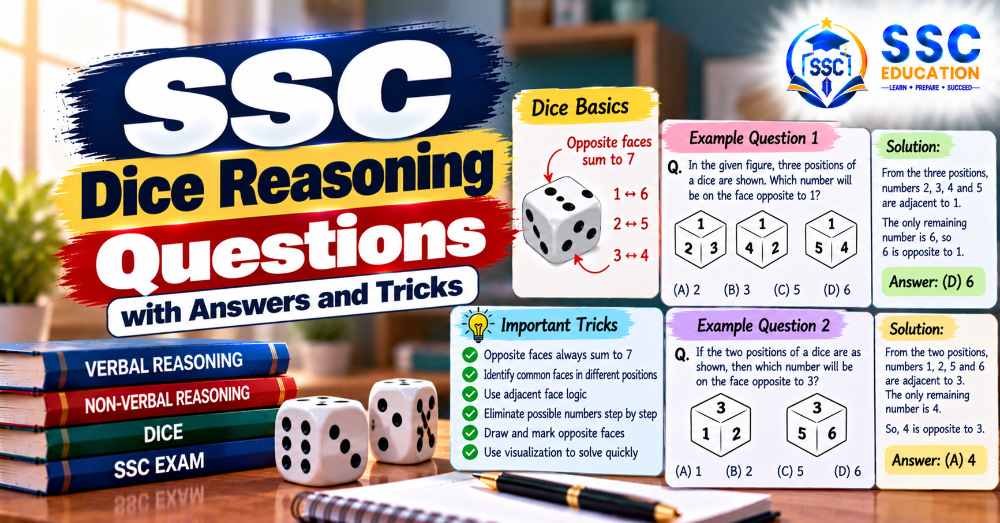
- In a standard dice, the opposite faces add up to 7: 1 is opposite 6, 2 is opposite 5 and 3 is opposite 4.
- A face can never be adjacent to its own opposite face.
- Three faces meet at every corner, and these three faces are always adjacent to each other.
Rules and Shortcut Tricks
- Two positions with one common face: the faces next to the common face move in a circle (clockwise or anticlockwise). Compare the order to find the opposite faces.
- Two positions with two common faces: the two different faces are opposite to each other.
- Three positions: find the opposite of one face with the two-position rule and repeat.
- Whenever two faces are shown together in any position, they are adjacent, so they cannot be opposite.
- Quick check: the three visible faces at a corner can never include an opposite pair.
- For two dice thrown together, the number of ways to get a sum s is the number of pairs (a, b) with a + b = s.
Set 1: Standard Dice Questions (Q1–Q7)
Q1. On a standard dice, which number is opposite 1?
Answer: 6
Solution: Opposite faces add up to 7.
Q2. On a standard dice, which number is opposite 4?
Answer: 3
Solution: 7 - 4 = 3.
Q3. On a standard dice, the top face shows 3. What is on the bottom face?
Answer: 4
Solution: 7 - 3 = 4.
Q4. On a standard dice, which number can never be adjacent to 4?
Answer: 3
Solution: 3 is the opposite face of 4.
Q5. The top faces of three standard dice are 2, 4 and 6. Find the sum of the bottom faces.
Answer: 9
Solution: The bottom faces are 5, 3 and 1.
Q6. What is the sum of all six faces of a standard dice?
Answer: 21
Solution: 1 + 2 + 3 + 4 + 5 + 6 = 21.
Q7. Which numbers can be adjacent to 6 on a standard dice?
Answer: 2, 3, 4 and 5
Solution: Only 1 is opposite 6.
Set 2: Two-Position Problems (Q8–Q14)
Q8. A dice is shown in two positions: (1, 2, 3) and (1, 3, 5). Which number is opposite 2?
Answer: 5
Trick: Two faces (1 and 3) are common and the different faces 2 and 5 are opposite.
Q9. A dice is shown in two positions: (2, 4, 6) and (2, 4, 5). Which number is opposite 6?
Answer: 5
Solution: Common faces 2 and 4, so 6 and 5 are opposite.
Q10. A dice is shown in two positions: (3, 4, 5) and (3, 5, 6). Which number is opposite 4?
Answer: 6
Solution: Common faces 3 and 5, so 4 and 6 are opposite.
Q11. A dice has two positions: (A, B, C) and (A, C, D). Which letter is opposite B?
Answer: D
Solution: Common faces A and C, so B and D are opposite.
Q12. A dice has two positions: (P, Q, R) and (P, R, S). Which letter is opposite Q?
Answer: S
Solution: The different faces Q and S are opposite.
Q13. A dice has two positions: (1, 2, 4) and (4, 2, 6). Which number is opposite 1?
Answer: 6
Solution: Common faces 2 and 4, so 1 and 6 are opposite.
Q14. On a dice, the opposite pairs are (1, 4), (2, 5) and (3, 6). Which number is opposite 5?
Answer: 2
Solution: It is given in the pairs.
Set 3: Exam-Level Questions (Q15–Q21)
Q15. On a dice with opposite pairs (1, 6), (2, 4) and (3, 5), the top face is 2. What is on the bottom face?
Answer: 4
Solution: 2 and 4 are opposite.
Q16. Two standard dice are thrown. In how many ways can the sum of the top faces be 9?
Answer: 4 ways
Solution: The pairs are (3, 6), (4, 5), (5, 4) and (6, 3).
Q17. Two standard dice are thrown. In how many ways can the sum be 7?
Answer: 6 ways
Solution: The pairs are (1, 6), (2, 5), (3, 4), (4, 3), (5, 2) and (6, 1).
Q18. On a standard dice, the top face is 3. Which numbers appear on the four side faces?
Answer: 1, 2, 5 and 6
Solution: The top (3) and the bottom (4) are excluded.
Q19. A standard dice has 1 on the top and 2 at the front. What is on the bottom and at the back?
Answer: Bottom = 6 and back = 5
Solution: Bottom is opposite 1 and the back is opposite 2.
Q20. What is the maximum sum of the three faces that meet at one corner of a standard dice?
Answer: 15
Trick: The faces 4, 5 and 6 are pairwise adjacent.
Q21. What is the minimum sum of the three faces that meet at one corner of a standard dice?
Answer: 6
Solution: The faces 1, 2 and 3 are pairwise adjacent.
Common Mistakes in Dice Questions
- Assuming that all dice follow the "sum 7" rule (some questions give a different pairing).
- Taking two faces seen together as opposite faces.
- Not noticing the common faces in two positions.
- Ignoring the rotation direction in single common-face problems.
- Making counting errors in "number of ways" questions.
- Not drawing a quick net of the dice.
How to Practice These 21 Questions
- Learn the three rules and apply them to each question.
- Draw a small net or cube while solving.
- Solve each set in 7 minutes.
- Revise the rules before every mock test.
Related Topics to Study Next
Frequently Asked Questions
What is a standard dice?
A standard dice is a cube in which opposite faces add up to 7. The pairs are 1-6, 2-5 and 3-4.
How do I find the opposite face in two positions?
If two faces are common in both positions, the two different faces are opposite to each other.
Can opposite faces be seen together?
No. Two faces seen together at the same time are adjacent, never opposite.
How many faces meet at a corner of a dice?
Three faces meet at each corner, and all three are adjacent to each other.
What is the sum of all faces of a dice?
1 + 2 + 3 + 4 + 5 + 6 = 21 for a standard dice.
How many dice questions come in SSC exams?
Usually one question per shift comes from dice or cube topics in the reasoning section.
Is dice a non-verbal reasoning topic?
Yes. In exams it is usually given with figures, but the rules are the same as in the text questions here.
What if the dice is not a standard dice?
Use only the positions shown in the question to find the opposite faces.
How do I count the ways to get a sum on two dice?
List all pairs (a, b) from 1 to 6 with a + b equal to the sum.
What is the maximum sum of three visible faces?
15, when the faces 4, 5 and 6 meet at a corner of a standard dice.
How can I solve dice questions faster?
Learn the two common-face rule and practise 20 questions daily for a week.
How should I prepare dice questions for SSC exams?
Learn the rules, practise with figures from mock tests and revise previous year questions.
Rahul Kumar
SSC Exam Expert & Content Editor
Rahul is a senior SSC exam strategist with 8+ years of experience helping aspirants crack CGL, CHSL and MTS exams. He writes in-depth notification breakdowns, exam pattern guides and preparation strategies.