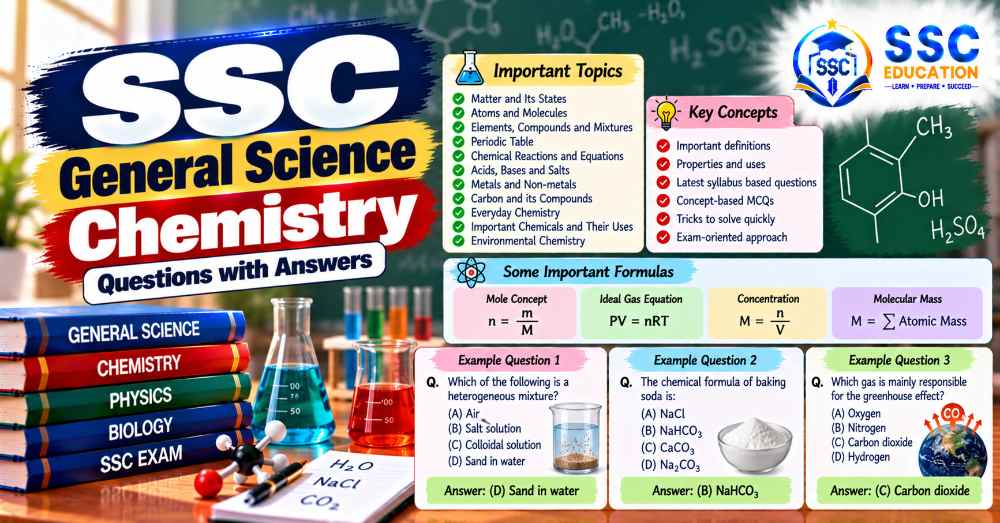
SSC General Science Chemistry Questions with Answers
Rahul Kumar
SSC Exam Expert & Content Editor
Table of Contents
- 1.Key Concepts to Remember
- 2.Common Chemical Names
- 3.Acids, Bases and Elements in Daily Life
- 4.Set 1: Elements and Atoms (Q1–Q7)
- 5.Set 2: Acids, Bases and Salts (Q8–Q14)
- 6.Set 3: Metals, Gases and Carbon Compounds (Q15–Q21)
- 7.Periodic Table and Gases: Facts to Revise
- 8.Physical and Chemical Changes
- 9.Common Mistakes in Chemistry
- 10.How to Practice These 21 Questions
- 11.Related Topics to Study Next
- 12.Frequently Asked Questions
Practice 21 SSC chemistry questions with answers on elements, acids and bases, metals, carbon compounds and daily-life chemicals, with fact tables for CGL, CHSL, MTS and GD.
Chemistry in SSC General Science is mostly about common elements, acids, bases, metals, gases and the chemical names of everyday substances. The questions are short and factual. This practice paper gives you fact tables and 21 questions with answers and short explanations to revise fast.
Key Concepts to Remember
- An acid turns blue litmus red, a base turns red litmus blue, and a neutral substance has a pH of 7.
- The pH scale runs from 0 to 14. Below 7 is acidic and above 7 is basic.
- Atomic number is the number of protons, and mass number is the number of protons plus neutrons.
- Metals are good conductors, while non-metals are generally poor conductors (graphite is an exception).
Common Chemical Names
| Common name | Chemical name / formula |
|---|---|
| Common salt | Sodium chloride (NaCl) |
| Baking soda | Sodium bicarbonate (NaHCO3) |
| Washing soda | Sodium carbonate (Na2CO3) |
| Bleaching powder | Calcium oxychloride (CaOCl2) |
| Quick lime | Calcium oxide (CaO) |
| Slaked lime | Calcium hydroxide (Ca(OH)2) |
| Limestone / chalk | Calcium carbonate (CaCO3) |
| Plaster of Paris | Calcium sulphate hemihydrate |
| Gypsum | Calcium sulphate dihydrate |
| Vinegar | Acetic acid |
| Laughing gas | Nitrous oxide (N2O) |
| Dry ice | Solid carbon dioxide |
| Marsh gas | Methane (CH4) |
| Caustic soda | Sodium hydroxide (NaOH) |
| Blue vitriol | Copper sulphate |
Acids, Bases and Elements in Daily Life
| Item | Acid or element present |
|---|---|
| Lemon and orange | Citric acid |
| Vinegar | Acetic acid |
| Curd and sour milk | Lactic acid |
| Tamarind | Tartaric acid |
| Apple | Malic acid |
| Ant sting and nettle | Formic acid |
| Stomach juice | Hydrochloric acid |
| Tea | Tannic acid |
| Tomato | Oxalic acid |
| Water | Hydrogen and oxygen |
| Lightest element | Hydrogen |
| Most abundant gas in air | Nitrogen (about 78 percent) |
Chemistry questions in SSC repeat the same names again and again, so one good table is enough to score well. Revise the common names, the acids in food and the properties of the main gases. In addition, remember that the only liquid metal at room temperature is mercury, the hardest natural substance is diamond, and the most reactive metals are potassium and sodium, which are stored in kerosene.
Set 1: Elements and Atoms (Q1–Q7)
Q1. What is the atomic number of carbon?
Answer: 6
Solution: Carbon has six protons.
Q2. Which is the lightest element?
Answer: Hydrogen
Solution: Its atomic number is 1.
Q3. Which gas is the most abundant in the atmosphere?
Answer: Nitrogen
Solution: About 78 percent of air.
Q4. Which metal is liquid at room temperature?
Answer: Mercury
Solution: Its symbol is Hg.
Q5. What is the chemical symbol of gold?
Answer: Au
Solution: From the Latin word aurum.
Q6. What is the chemical symbol of sodium?
Answer: Na
Solution: From the Latin word natrium.
Q7. Which is the hardest natural substance?
Answer: Diamond
Solution: It is a form of carbon.
Set 2: Acids, Bases and Salts (Q8–Q14)
Q8. What is the pH of a neutral solution?
Answer: 7
Solution: Pure water is neutral.
Q9. Which acid is present in lemon?
Answer: Citric acid
Solution: It gives the sour taste.
Q10. Which acid is present in curd?
Answer: Lactic acid
Solution: It forms during fermentation of milk.
Q11. What is the chemical name of baking soda?
Answer: Sodium bicarbonate
Solution: Formula NaHCO3.
Q12. What is the chemical formula of common salt?
Answer: NaCl
Solution: Sodium chloride.
Q13. Which acid is present in the stomach?
Answer: Hydrochloric acid
Solution: It helps digestion.
Q14. What happens to blue litmus paper in an acid?
Answer: It turns red
Solution: Bases turn red litmus blue.
Set 3: Metals, Gases and Carbon Compounds (Q15–Q21)
Q15. Which gas is called laughing gas?
Answer: Nitrous oxide
Solution: Formula N2O.
Q16. Which gas is used in fire extinguishers?
Answer: Carbon dioxide
Solution: It does not support burning.
Q17. What is the main component of natural gas?
Answer: Methane
Solution: Formula CH4.
Q18. Which metals are stored in kerosene?
Answer: Sodium and potassium
Solution: They react strongly with water and air.
Q19. Which allotrope of carbon conducts electricity?
Answer: Graphite
Solution: It has free electrons.
Q20. What is dry ice?
Answer: Solid carbon dioxide
Solution: It changes directly from solid to gas.
Q21. What is the chemical formula of water?
Answer: H2O
Solution: Two atoms of hydrogen and one of oxygen.
Periodic Table and Gases: Facts to Revise
| Topic | Fact |
|---|---|
| Number of known elements | 118 |
| Most abundant element in the earth's crust | Oxygen |
| Most abundant metal in the earth's crust | Aluminium |
| Most abundant gas in the atmosphere | Nitrogen |
| Lightest gas | Hydrogen |
| Gas that supports burning | Oxygen |
| Gas used in balloons for safety | Helium |
| Noble gases | Helium, neon, argon, krypton, xenon and radon |
| Father of the periodic table | Dmitri Mendeleev |
| Gas used to ripen fruits | Ethylene |
| Gas used in cooking gas (LPG) | Butane and propane |
| Metal used in thermometers | Mercury |
The modern periodic table arranges elements by atomic number in 18 groups and 7 periods. Elements in the same group have similar properties. Remember that the properties of the noble gases are inertness and a full outer shell, which is why they hardly react with other elements.
Physical and Chemical Changes
A physical change does not make a new substance, for example melting of ice or boiling of water. A chemical change makes a new substance and cannot be easily reversed, for example rusting of iron, burning of paper and curdling of milk. Rusting needs both oxygen and moisture, and it can be prevented by painting, galvanisation (coating with zinc) or oiling. SSC often asks for an example of each type, so keep two or three examples ready for both.
Common Mistakes in Chemistry
- Mixing the common names of baking soda and washing soda.
- Confusing quick lime and slaked lime.
- Forgetting the acids found in daily food items.
- Writing a wrong symbol from the Latin name (Na, K, Au, Ag, Fe).
- Mixing atomic number with mass number.
- Thinking that all non-metals are poor conductors.
How to Practice These 21 Questions
- Learn the chemical names and symbols table.
- Make a chart of acids found in food.
- Solve one set daily.
- Revise the wrong answers weekly.
Related Topics to Study Next
- SSC Science Questions
- 1000 Important SSC GK Questions
- 200 Indian History and Polity Questions
- SSC CGL Tier 1 Mini Mock
Frequently Asked Questions
What is the chemical name of baking soda?
Sodium bicarbonate.
What is the chemical name of washing soda?
Sodium carbonate.
What is the pH of a neutral solution?
7.
Which acid is present in lemon?
Citric acid.
Which acid is present in curd?
Lactic acid.
Which metal is liquid at room temperature?
Mercury.
Which gas is known as laughing gas?
Nitrous oxide.
What is the symbol of sodium?
Na.
Which is the hardest natural substance?
Diamond.
How many chemistry questions come in SSC exams?
Usually two to four in General Science.
Which chemistry topics are most important for SSC?
Chemical names, acids and bases, metals and gases.
How should I prepare chemistry for SSC exams?
Learn the tables, revise symbols and practise questions daily.
Rahul Kumar
SSC Exam Expert & Content Editor
Rahul is a senior SSC exam strategist with 8+ years of experience helping aspirants crack CGL, CHSL and MTS exams. He writes in-depth notification breakdowns, exam pattern guides and preparation strategies.