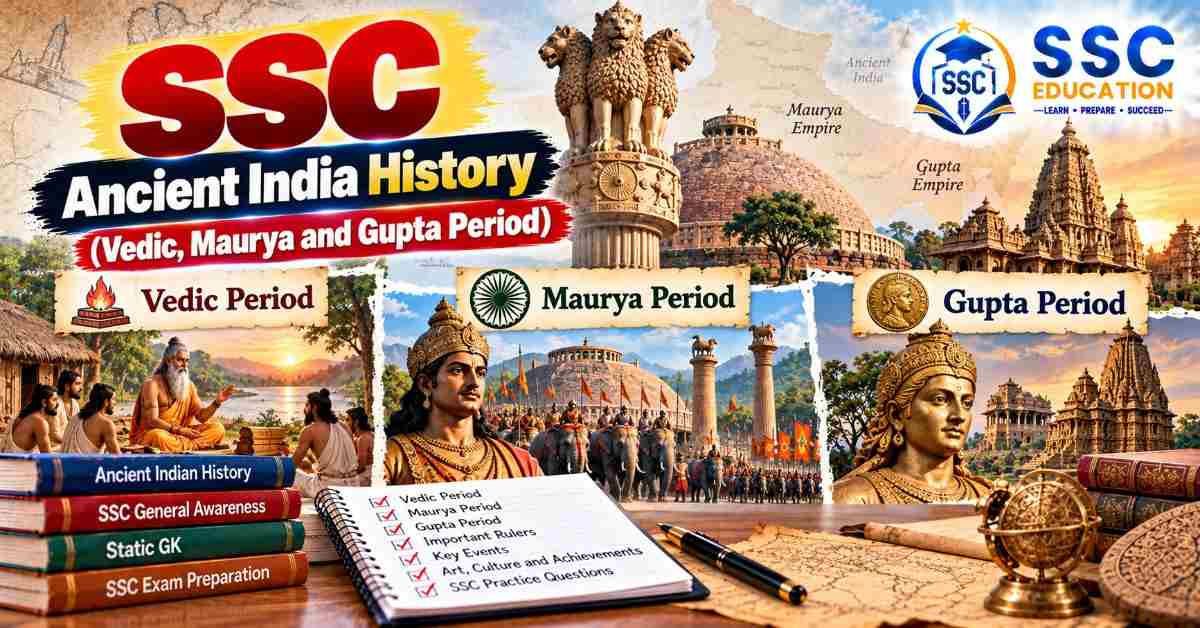
SSC Ancient India History Questions with Answers (Vedic, Maurya and Gupta Period)
Rahul Kumar
SSC Exam Expert & Content Editor
Table of Contents
- 1.Key Facts About Ancient India
- 2.Quick Fact Table
- 3.Important Ancient Texts and Their Authors
- 4.Set 1: Early India and the Maurya Empire (Q1–Q7)
- 5.Set 2: Gupta and Post-Gupta Period (Q8–Q14)
- 6.Set 3: Religion and the South (Q15–Q21)
- 7.Dynasties and Rulers: Quick Table
- 8.Sources of Ancient Indian History
- 9.Common Mistakes in Ancient India
- 10.How to Practice These 21 Questions
- 11.Related Topics to Study Next
- 12.Frequently Asked Questions
Practice 21 SSC ancient India history questions with answers on the Vedic age, Mahajanapadas, Maurya, Gupta, Harsha and South Indian dynasties with fact tables for CGL, CHSL, MTS and GD.
Ancient Indian history is a regular part of SSC General Awareness. Questions come from the Vedic period, the Mahajanapadas, the Maurya and Gupta empires, Harsha and the South Indian dynasties. The questions are factual, so tables of rulers, dates and works are the best way to prepare. This practice paper gives you fact tables and 21 questions with answers and short explanations.
Key Facts About Ancient India
- The Indus Valley Civilisation (about 2500 BC) had planned cities such as Harappa and Mohenjo-daro.
- The Vedic age is known from the four Vedas, and the Rigveda is the oldest.
- The 16 Mahajanapadas existed in the 6th century BC, and Magadha became the most powerful.
- Gautama Buddha and Mahavira lived in the same period.
Quick Fact Table
| Topic | Fact |
|---|---|
| Founder of the Maurya Empire | Chandragupta Maurya (about 321 BC), helped by Chanakya (Kautilya) |
| Kalinga War | 261 BC, after which Ashoka adopted Buddhism |
| Language and script of Ashoka's edicts | Prakrit in the Brahmi script |
| Greek ambassador at the Mauryan court | Megasthenes (wrote Indica) |
| Founder of the Gupta Empire | Sri Gupta; Chandragupta I raised its power |
| Napoleon of India | Samudragupta |
| Nine Gems (Navaratnas) in the court of | Chandragupta II Vikramaditya |
| Chinese traveller during Chandragupta II | Fa-Hien |
| Chinese traveller during Harsha | Hiuen Tsang |
| Founder of Nalanda University (traditional) | Kumaragupta I |
| Alexander invaded India | 326 BC (battle with Porus on the river Jhelum) |
| Fourth Buddhist Council ruler | Kanishka (Kushan) |
| Builder of Brihadeeswara Temple, Thanjavur | Rajaraja Chola I |
| 24th Tirthankara | Mahavira |
| Birthplace of Buddha | Lumbini |
Important Ancient Texts and Their Authors
| Text | Detail |
|---|---|
| Arthashastra | Kautilya; a book on politics and economy |
| Indica | Megasthenes; the account of the Mauryan India |
| Rajatarangini | Kalhana; the history of Kashmir |
| Abhijnanashakuntalam | Kalidasa; the famous Sanskrit play |
| Mudrarakshasa | Vishakhadatta; a play about Chanakya |
| Buddhacharita | Ashvaghosha; the life of Buddha |
| Harshacharita | Banabhatta; the biography of Harsha |
| Mahabhashya | Patanjali; a commentary on Panini |
| Ashtadhyayi | Panini; the Sanskrit grammar |
Link each ruler with a famous work, a traveller and a famous city. For example, Ashoka with the Kalinga War and the Sarnath pillar, Chandragupta II with Fa-Hien and the Nine Gems, and Harsha with Hiuen Tsang and Kannauj. This association makes the facts easier to recall in the exam.
Set 1: Early India and the Maurya Empire (Q1–Q7)
Q1. Which is the oldest Veda?
Answer: Rigveda
Solution: It has 1,028 hymns.
Q2. Who founded the Maurya Empire?
Answer: Chandragupta Maurya
Solution: He was guided by Chanakya.
Q3. Which war changed the heart of Ashoka?
Answer: Kalinga War (261 BC)
Solution: He then adopted Buddhism.
Q4. In which script were the edicts of Ashoka written (mostly)?
Answer: Brahmi
Solution: The language was Prakrit.
Q5. Who wrote the Indica?
Answer: Megasthenes
Solution: He was a Greek ambassador.
Q6. Who wrote the Arthashastra?
Answer: Kautilya (Chanakya)
Solution: It is a book on statecraft.
Q7. Where was Gautama Buddha born?
Answer: Lumbini
Solution: It is in present-day Nepal.
Set 2: Gupta and Post-Gupta Period (Q8–Q14)
Q8. Who is called the Napoleon of India?
Answer: Samudragupta
Solution: He conquered many kingdoms.
Q9. Which Gupta ruler is also known as Vikramaditya?
Answer: Chandragupta II
Solution: The Nine Gems were in his court.
Q10. Which Chinese traveller visited India during the Gupta period?
Answer: Fa-Hien
Solution: He visited during Chandragupta II.
Q11. Which Chinese traveller visited India during the time of Harsha?
Answer: Hiuen Tsang
Solution: He studied at Nalanda.
Q12. Who wrote the Harshacharita?
Answer: Banabhatta
Solution: It is a biography of Harsha.
Q13. Who wrote Abhijnanashakuntalam?
Answer: Kalidasa
Solution: It is a famous Sanskrit play.
Q14. Which king invaded India in 326 BC?
Answer: Alexander
Solution: He fought Porus on the Jhelum.
Set 3: Religion and the South (Q15–Q21)
Q15. Who was the 24th Tirthankara of the Jains?
Answer: Mahavira
Solution: He was born in Vaishali.
Q16. Which ruler organised the Fourth Buddhist Council?
Answer: Kanishka
Solution: It was held in Kashmir.
Q17. Who built the Brihadeeswara Temple at Thanjavur?
Answer: Rajaraja Chola I
Solution: It is a UNESCO World Heritage Site.
Q18. Which Mahajanapada became the most powerful?
Answer: Magadha
Solution: It was the base of the Maurya Empire.
Q19. Which text is the commentary of Patanjali?
Answer: Mahabhashya
Solution: It is a commentary on Panini.
Q20. Who composed the Sanskrit grammar Ashtadhyayi?
Answer: Panini
Solution: It is a famous work on grammar.
Q21. Which dynasty ruled before the Mauryas in Magadha?
Answer: Nanda dynasty
Solution: Chandragupta overthrew the last Nanda king.
Dynasties and Rulers: Quick Table
| Dynasty or ruler | Key fact |
|---|---|
| Chandragupta Maurya | Founded the Mauryan Empire in 321 BCE |
| Ashoka | Fought the Kalinga War (261 BCE) and adopted Buddhism |
| Kanishka | Kushana ruler; held the Fourth Buddhist Council |
| Chandragupta I | Founder of the Gupta Empire |
| Samudragupta | Called the Napoleon of India |
| Chandragupta II | Vikramaditya; Chinese traveller Fa-Hien visited |
| Harshavardhana | Ruled from Kannauj; Hiuen Tsang visited |
| Pulakeshin II | Chalukya king who defeated Harsha |
| Kalidasa | Court poet of the Guptas |
| Aryabhata | Gupta-age mathematician and astronomer |
Remember that the Mauryan capital was Pataliputra, that Ashoka's inscriptions are in the Brahmi script, and that the Gupta age is called the Golden Age of ancient India. These facts are asked again and again.
Sources of Ancient Indian History
The sources are of two types, literary and archaeological. Literary sources include the Vedas, the Puranas, the epics and the Buddhist and Jain books. Archaeological sources include coins, inscriptions and monuments. The oldest Veda is the Rigveda, and the Indus Valley Civilisation is dated to about 2500 BCE for its mature phase. Harappa and Mohenjo-daro are its best-known cities.
Common Mistakes in Ancient India
- Mixing up the travellers: Fa-Hien, Hiuen Tsang and Megasthenes.
- Confusing the Gupta rulers (Samudragupta and Chandragupta II).
- Forgetting the year of the Kalinga War and of Alexander's invasion.
- Mixing the texts and their authors.
- Confusing the Buddhist councils and their rulers.
- Reading history without a timeline.
How to Practice These 21 Questions
- Learn the fact table and the author table.
- Make a timeline of ancient India.
- Solve one set daily.
- Revise mistakes weekly.
Related Topics to Study Next
- 200 Indian History and Polity Questions
- SSC CGL Tier 1 Mini Mock
- SSC Static GK Questions
- 1000 Important SSC GK Questions
Frequently Asked Questions
Who founded the Maurya Empire?
Chandragupta Maurya.
Who was the Napoleon of India?
Samudragupta.
Which is the oldest Veda?
The Rigveda.
Which Chinese traveller visited India during Harsha's time?
Hiuen Tsang.
Who wrote the Arthashastra?
Kautilya, also called Chanakya.
What was the effect of the Kalinga War on Ashoka?
He gave up war and adopted Buddhism.
Who built the Brihadeeswara Temple?
Rajaraja Chola I.
Who was the Greek ambassador to the Mauryan court?
Megasthenes.
Where was Buddha born?
Lumbini.
How many ancient history questions come in SSC exams?
One or two in General Awareness.
Which script did Ashoka use in his edicts?
Mostly Brahmi.
How should I prepare ancient history for SSC exams?
Learn the tables, make a timeline and practise questions.
Rahul Kumar
SSC Exam Expert & Content Editor
Rahul is a senior SSC exam strategist with 8+ years of experience helping aspirants crack CGL, CHSL and MTS exams. He writes in-depth notification breakdowns, exam pattern guides and preparation strategies.