
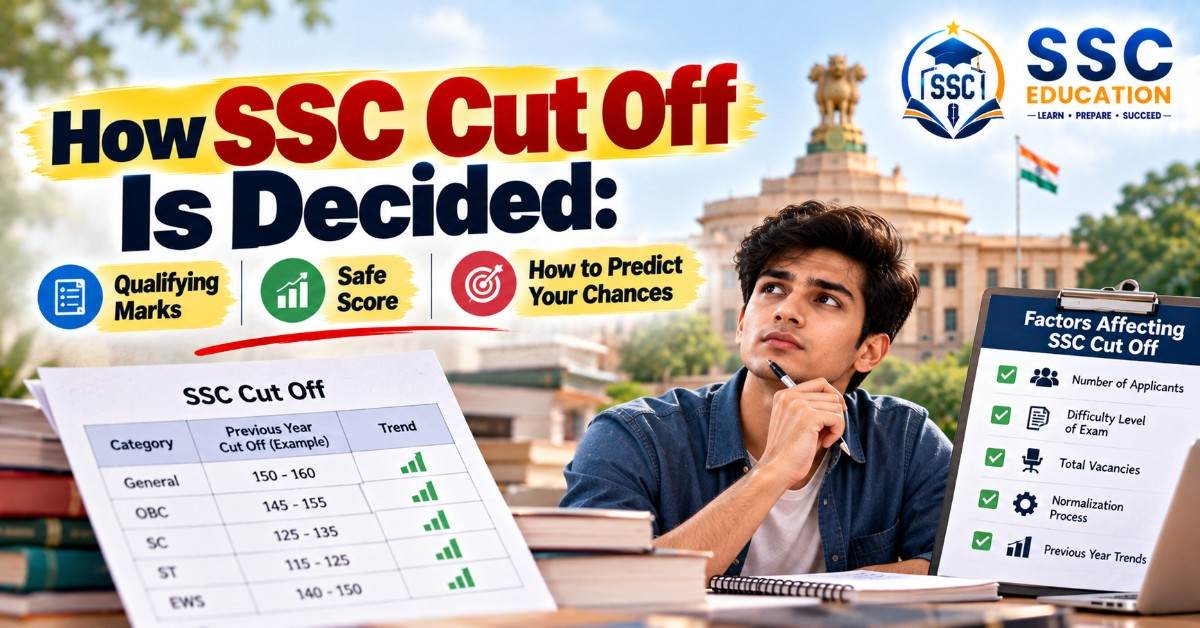
How SSC Cut Off Is Decided: Qualifying Marks, Safe Score and How to Predict Your Chances
Rahul Kumar
SSC Exam Expert & Content Editor
Table of Contents
- 1.Qualifying Marks vs Cut Off
- 2.Factors That Decide the SSC Cut Off
- 3.Normalisation and Its Role
- 4.How to Estimate Your Safe Score
- 5.How the Cut Off Differs for Different Exams
- 6.Common Mistakes Students Make
- 7.What to Do While Waiting for the Cut Off
- 8.Category-Wise Cut Off: Why Numbers Differ
- 9.A Safe-Score Method You Can Use From Day One
- 10.Cut Off vs Your Own Performance: How to Use the Numbers
- 11.Things That Do Not Change the Cut Off
- 12.Why You Should Never Prepare for the "Minimum" Score Only
- 13.Free Practice Papers to Prepare for This Topic
- 14.Frequently Asked Questions (FAQs)
Understand how the SSC cut off is decided: qualifying marks, factors that change the cut off, category-wise difference, normalisation and how to estimate a safe score for CGL, CHSL, MTS and GD.
Every aspirant asks the same question after the exam: "What will be the cut off?" The SSC cut off is not a fixed number. It changes from exam to exam and from year to year depending on a few clear factors. This guide explains how the cut off is decided, the difference between qualifying marks and the actual cut off and how you can estimate a safe score for your exam.
Qualifying Marks vs Cut Off
- Qualifying marks: the minimum marks that a candidate must score in a paper to be considered. For many SSC exams, the minimum qualifying percentage is 30% for Unreserved, 25% for OBC and EWS and 20% for all other categories.
- Cut off: the actual marks of the last candidate who is selected for the next stage. It is usually much higher than the qualifying marks.
- Qualifying marks are fixed in the notification. The cut off is known only when the result is declared.
Factors That Decide the SSC Cut Off
| Factor | How it affects the cut off |
|---|---|
| Number of vacancies | More vacancies usually mean a lower cut off, and fewer vacancies mean a higher cut off. |
| Difficulty level of the paper | A tough paper lowers the average score and the cut off. An easy paper raises it. |
| Number of candidates | More applicants and a strong competition raise the cut off. |
| Category | The cut off for Unreserved is higher than for reserved categories. |
| Normalisation | Marks of shifts are adjusted, which can change the final score. |
| Post and preference | For the final selection, popular posts need a higher score than other posts. |
Normalisation and Its Role
When an exam is held in many shifts, SSC applies normalisation to adjust the marks and keep the competition fair. You should focus on your accuracy and attempts, not on guessing the effect of normalisation.
How to Estimate Your Safe Score
- Check the previous 3 years cut off for your exam and category from official result notices.
- Take the highest of those cut offs as a reference and add a margin of 10 to 15 marks for safety.
- Take full-length mock tests in the same pattern and see whether you consistently cross this safe score.
- Work on accuracy, because negative marking reduces your score quickly.
- Aim to improve the weakest section first because it gives the fastest gain.
How the Cut Off Differs for Different Exams
- SSC CGL and CHSL Tier 1: the cut off is for qualifying for Tier 2 and is decided category-wise and region-wise.
- SSC MTS and GD: the cut off is category-wise and for GD it is state or force-wise and gender-wise too.
- SSC CPO: the cut off is decided for each paper and category.
- Final cut off: it depends on the post-wise vacancy and the final marks after all stages.
Common Mistakes Students Make
- Comparing their score only with the last year cut off and ignoring this year's difficulty.
- Believing in unofficial cut off predictions shared on social media.
- Not counting the negative marking while estimating the score.
- Stopping the preparation until the result is out, instead of preparing for the next stage.
What to Do While Waiting for the Cut Off
- Prepare for the next stage (Tier 2, skill test, PET or document verification).
- Compare your answers with the official answer key and calculate your probable score.
- Keep your documents ready for verification.
- Continue your practice in case you need to attempt the next exam.
Category-Wise Cut Off: Why Numbers Differ
SSC prepares merit lists separately for each category, such as Unreserved, OBC, EWS, SC and ST, because the number of vacancies and the reservation rules are different for each category. Within a category, there can also be separate cut offs for different posts, regions or forces, depending on the exam. For example, in a recruitment for uniformed forces, the cut off can be decided state-wise and gender-wise, while in a clerical exam, it is decided category-wise for the whole country. This is why you cannot compare your marks with the cut off of a different category or a different exam. Always compare with the cut off of your own category and the exam you have applied for.
- A higher number of vacancies in a category generally lowers its cut off.
- A category with many applicants for few vacancies has a higher cut off.
- Cut offs may also differ for candidates with disabilities or ex-servicemen as per the rules.
A Safe-Score Method You Can Use From Day One
- Collect the cut off marks of the last three years for your category and the same stage.
- Calculate the average and the highest of those cut offs.
- Add 10 to 15 marks to the highest cut off as a safety buffer.
- Convert the target into the number of questions: for example, if the target is 160 out of 200, you need about 80 correct answers with few mistakes.
- Take mock tests of the same pattern and check whether you cross your safe score consistently in at least 8 out of 10 mocks.
A consistent score above your safe target is a better sign of readiness than a single high score in one mock test.
Cut Off vs Your Own Performance: How to Use the Numbers
Many candidates become worried when they see a high cut off in the previous year and lose confidence. Instead of getting disturbed, use the cut off as a benchmark to plan your preparation. If the cut off was 150 and your mock average is 120, you know that you have to improve by 30 marks, which is about 15 more correct questions. Break this gap into section-wise targets: for example, 5 more in maths, 4 in reasoning, 3 in English and 3 in GA. A clear target removes stress and gives your preparation a direction.
Things That Do Not Change the Cut Off
- Rumours and unofficial predictions on social media.
- The number of students in your coaching or study group.
- The marks that your friends expect in the exam.
- Your personal feeling about the difficulty of the paper; only the overall performance of all candidates matters.
Why You Should Never Prepare for the "Minimum" Score Only
Some candidates make a plan to score just above the previous year cut off, but this is risky because the cut off can rise in a year with an easier paper or fewer vacancies. A better plan is to prepare for a score that is well above the highest recent cut off, so that you can handle changes in difficulty and still qualify. Also remember that the final selection depends on the rank in the merit list, and the better your marks, the better your choice of post and department.
Free Practice Papers to Prepare for This Topic
Reading is only half of the preparation. Put what you have learnt into practice with these free topic-wise practice papers on SSC Education. Each paper has questions with answers and solutions, so you can check your level and improve step by step.
- SSC CGL Tier 1 Mini Mock: 25 High-Weightage History & Polity Questions
- SSC Reasoning Practice Set with Answers (Top 100 Questions)
- 100 SSC Percentage Questions with Shortcut Tricks
- SSC English Practice Set with Answers (2026)
- SSC Static GK Questions Practice Set with Answers
- SSC Time and Work Questions with Solutions and Tricks
- SSC Data Interpretation Questions with Solutions
- SSC Coding-Decoding Questions with Answers and Tricks
You can also browse all SSC practice papers and solve the previous year question papers for exam-level practice.
Frequently Asked Questions (FAQs)
1. What is the SSC cut off?
The cut off is the minimum score needed to qualify for the next stage of an SSC exam. It is decided after the exam depending on several factors.
2. What are the SSC qualifying marks?
For many exams, the minimum qualifying marks are 30% for Unreserved, 25% for OBC and EWS and 20% for other categories. Check the notification for your exam.
3. Who decides the SSC cut off?
The Staff Selection Commission decides the cut off after the exam based on vacancies, performance and category.
4. Does normalisation affect the SSC cut off?
Yes. Normalisation adjusts the marks of different shifts, which can slightly change the final scores.
5. Is the SSC cut off the same for all categories?
No. The cut off is different for each category, such as Unreserved, OBC, EWS, SC and ST.
6. How much should I score to be safe in SSC CGL Tier 1?
Check the previous year cut offs for your category and aim for 10 to 15 marks above the highest recent cut off.
7. Is the SSC cut off higher for popular posts?
The final selection for popular posts needs higher marks, because many candidates choose them.
8. Can the SSC cut off be lower than last year?
Yes. If the paper is tough or the number of vacancies is large, the cut off can be lower.
9. Where can I find the previous year SSC cut off?
You can find it in the official result and cut off notices on ssc.gov.in.
10. How can I improve my score before the next exam?
Take regular mock tests, analyse your mistakes, improve accuracy and revise your weak topics.
Rahul Kumar
SSC Exam Expert & Content Editor
Rahul is a senior SSC exam strategist with 8+ years of experience helping aspirants crack CGL, CHSL and MTS exams. He writes in-depth notification breakdowns, exam pattern guides and preparation strategies.