
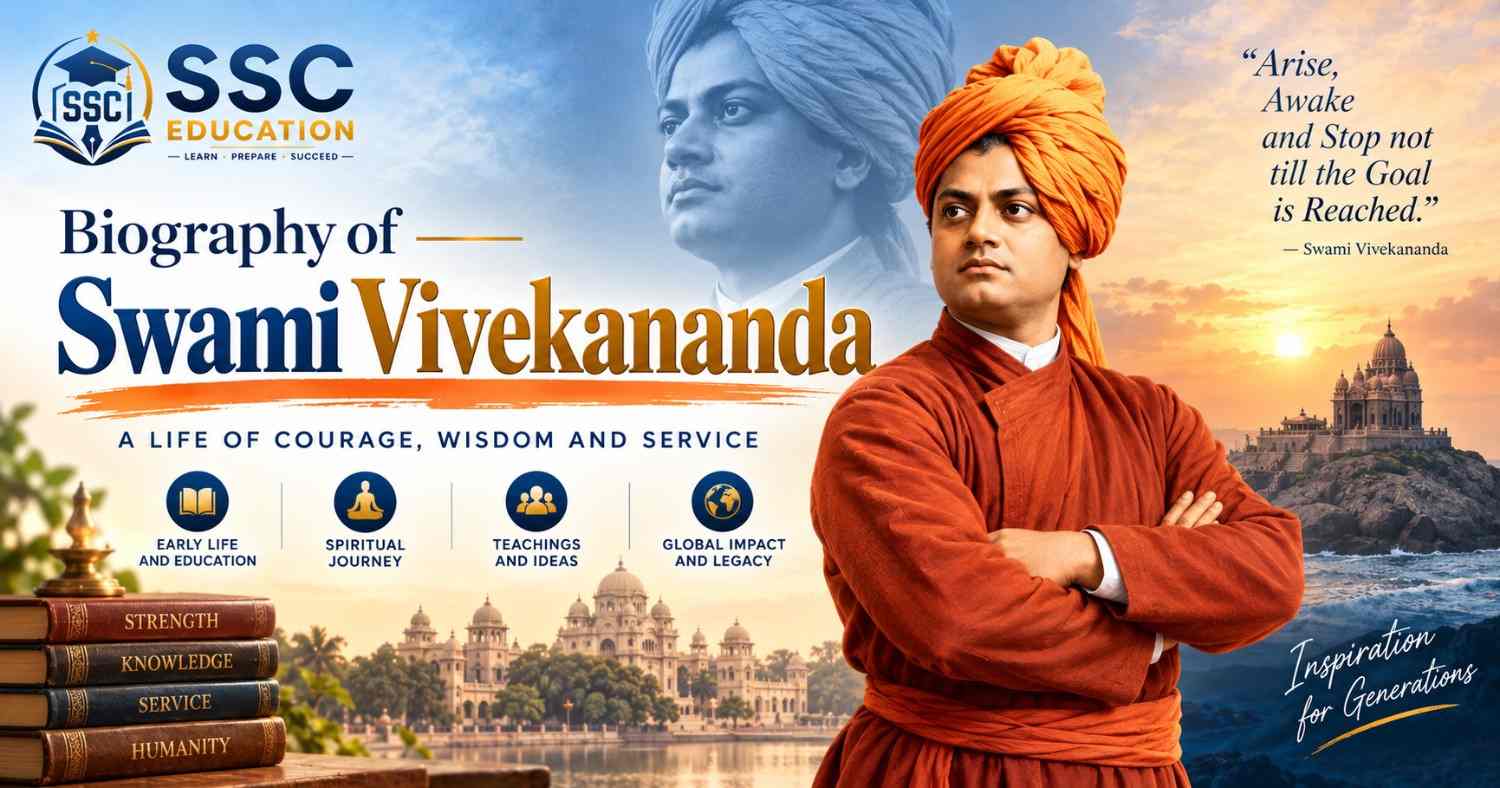
Biography of Swami Vivekananda
Rahul Kumar
SSC Exam Expert & Content Editor
Table of Contents
- 1.Introduction
- 2.Quick Facts: Swami Vivekananda
- 3.Early Life and Family
- 4.Education
- 5.Meeting Sri Ramakrishna
- 6.Becoming a Monk: The Baranagar Math
- 7.The Wandering Years (1888–1893)
- 8.Meditation at Kanyakumari (December 1892)
- 9.The Chicago Address (11 September 1893)
- 10.Years in the West (1893–1897)
- 11.Return to India and the Ramakrishna Mission (1897)
- 12.Second Visit to the West and the Final Years (1899–1902)
- 13.Death
- 14.His Teachings and Philosophy
- 15.Books and Writings
- 16.Sister Nivedita and Other Disciples
- 17.Why Vivekananda Still Matters Today
- 18.Influence on the Freedom Movement
- 19.Famous Quotes of Swami Vivekananda
- 20.Legacy and Honours
- 21.Lesser-Known Facts about Swami Vivekananda
- 22.Timeline of Swami Vivekananda's Life
- 23.Why Swami Vivekananda Is Important for SSC and Other Competitive Exams
- 24.Related Reading
- 25.Conclusion
- 26.Frequently Asked Questions
Complete biography of Swami Vivekananda: early life as Narendranath Datta, meeting Sri Ramakrishna, the 1893 Chicago address, Ramakrishna Mission, teachings, timeline and 24 FAQs for SSC exams.
Introduction
Swami Vivekananda (12 January 1863 – 4 July 1902) was a monk, philosopher and teacher who introduced Indian thought to the modern world and, at the same time, taught Indians to believe in themselves again. Born Narendranath Datta in a Calcutta household, he spent his short life of thirty-nine years travelling on foot across India, addressing crowds in America and Europe, founding the Ramakrishna Mission and writing books that are still read in dozens of languages. His birthday, 12 January, is celebrated every year as National Youth Day in India.
Vivekananda was neither a scholar sitting in a library nor a preacher repeating old texts. He was a restless questioner who asked his teachers hard questions, tested every idea against experience, and then insisted that religion must be measured by what it does for people. His famous call — "Arise, awake, and stop not till the goal is reached" — has become a motto for students, and his life is a regular topic in SSC, railway, banking and state-level examinations. This biography covers his early life, education, spiritual search, the Chicago address, the founding of the Ramakrishna Mission, his teachings and legacy, along with an exam-oriented revision guide and detailed FAQs.
Quick Facts: Swami Vivekananda
| Nationality | Indian |
|---|---|
| Best Known For | Hindu monk who introduced Vedanta and Yoga to the West; founder of the Ramakrishna Mission |
| Birth Name | Narendranath Datta (nicknamed Naren and Bile) |
| Born | 12 January 1863, Calcutta (now Kolkata), Bengal Presidency |
| Died | 4 July 1902, Belur Math, near Calcutta (aged 39) |
| Father | Vishwanath Datta, an attorney at the Calcutta High Court |
| Mother | Bhubaneswari Devi |
| Guru | Sri Ramakrishna Paramahamsa |
| Education | Metropolitan Institution, Presidency College and Scottish Church College; B.A. from the University of Calcutta (1884) |
| Founder of | Ramakrishna Mission (1 May 1897) and Belur Math |
| Best-Known Event | Address at the Parliament of the World's Religions, Chicago, 11 September 1893 |
| Famous Books | Raja Yoga, Karma Yoga, Bhakti Yoga, Jnana Yoga, Lectures from Colombo to Almora |
| Remembered On | National Youth Day, 12 January |
Early Life and Family
Narendranath Datta was born on 12 January 1863 at Simla Pally in north Calcutta, on the day of Makar Sankranti. His father, Vishwanath Datta, was a successful attorney of the Calcutta High Court, known for his generosity, worldly wisdom and broad-minded outlook. His mother, Bhubaneswari Devi, was a devout woman who knew long passages of the Ramayana and the Mahabharata by heart and who taught her son stories, prayers and a sense of quiet dignity. The family was one of nine children. His paternal grandfather, Durgacharan Datta, was a scholar of Sanskrit and Persian who had left home to become a monk at the age of twenty-five, a fact that later made the family think about whether Narendra would follow the same path.
As a child Naren was boisterous, curious and hard to control. His mother once remarked that she had prayed to Lord Shiva for a son and Shiva had sent one of his own spirited companions. He loved music, wrestling, horse riding, swimming and games, and he had an unusual memory: he could recite whole pages after reading them once. Alongside these energetic pursuits there was a strong inward side. From childhood he liked to sit in meditation before images of Shiva, Rama and Sita, and he sometimes fell into such deep concentration that the people around him thought he had lost consciousness.
The Datta household was a meeting place for musicians, lawyers and scholars, and the children grew up in an atmosphere of debate. Naren watched his father discuss religion, politics and law with guests of every faith, and he learned early that questions were welcome. Vishwanath Datta's habit of asking him to defend his opinions with reasons rather than emotion left a permanent mark on his thinking.
Education
In 1871, at the age of eight, Narendra was admitted to the Metropolitan Institution founded by Ishwar Chandra Vidyasagar. Later he joined the Presidency College in Calcutta, and in 1879 he passed the entrance examination in the first division — among the very few students who managed to do so that year. He then moved to the Scottish Church College, where he studied Western logic, European history and philosophy. He graduated with a B.A. from the University of Calcutta in 1884, after passing the Fine Arts examination earlier, in 1881.
His reading was remarkably wide. He studied David Hume, Immanuel Kant, Hegel, Spinoza, Schopenhauer, Auguste Comte, John Stuart Mill and Charles Darwin, and he corresponded with the English thinker Herbert Spencer, whose book on education he translated into Bengali. His principal at the Scottish Church College, William Hastie, wrote that he had travelled far and wide but had never come across a young man of Narendra's talents, not even in German universities. Alongside academic subjects, he trained in Indian classical music and sang so beautifully that he was later asked to sing devotional songs at religious gatherings.
Narendra's intellectual honesty, however, produced doubts. The more he read, the more he wondered whether God could be proved or experienced. He joined the Brahmo Samaj, then led by Keshab Chandra Sen, because it reasoned about religion without rituals, and he was for a time a member of the Sadharan Brahmo Samaj. He also took part in the Band of Hope, a movement that discouraged drinking and smoking among the young. Yet none of these groups answered the question that troubled him most: had anyone actually seen God?
Meeting Sri Ramakrishna
The answer came in the form of a temple priest at Dakshineswar, on the banks of the Ganga. In November 1881, Narendra met Sri Ramakrishna Paramahamsa for the first time. He asked him the question he had put to many religious leaders: "Have you seen God?" Ramakrishna replied without hesitation that he had, and that he saw God as clearly as he saw Narendra, only in a much more intense sense. Narendra had never heard such a direct answer from anyone, and it left him puzzled, moved and unconvinced in equal measure.
The relationship developed slowly. Narendra resisted Ramakrishna's worship of Kali, doubted the value of idols, and did not accept the non-dual philosophy of Advaita Vedanta at first. Ramakrishna never argued with him; he simply answered every doubt with patience and asked him to come back. In 1884, Narendra's father died suddenly, leaving the family in debt. In those dark months, while relatives filed lawsuits and he searched for work in vain, Narendra found in Ramakrishna the only steady support in his life. Encouraged by his teacher, he visited the Kali temple and prayed — not for wealth but for knowledge and devotion.
When Ramakrishna developed throat cancer in 1885, Narendra and a small band of young disciples nursed him at Cossipore, near Calcutta. It was in these months that the young man experienced nirvikalpa samadhi, the highest state of meditation in the tradition, and that Ramakrishna gave the disciples ochre robes, making them the nucleus of a new monastic order. Ramakrishna passed away on 16 August 1886, and Narendra, then only twenty-three, was left as the leader of his brother-monks.
Becoming a Monk: The Baranagar Math
After Ramakrishna's death, his young followers had nowhere to live. Several lay supporters had helped them during the master's illness, but now the support faded. In 1886 the disciples moved into a dilapidated house at Baranagar, in north Calcutta, which became the first monastery of the Ramakrishna order. They raised money for rent through madhukari, the traditional practice of collecting alms from door to door, and they lived on the simplest food while spending their days in meditation, study and singing.
On Christmas Eve in 1886, at a village called Antpur, Narendra and eight of his brother-disciples took formal monastic vows in front of a sacred fire. It was a quiet and deeply emotional evening, and the young monks reportedly talked late into the night about Jesus, whose life they felt was very close to the ideals of renunciation they had just accepted. Around this time Narendra also compiled a devotional song anthology called Sangeet Kalpataru with Vaishnav Charan Basak, published in 1887.
The Wandering Years (1888–1893)
By 1888 Narendra felt that he could no longer stay in one place. He set out as a parivrajaka, a wandering monk with no fixed address, carrying only a water pot, a staff and two books: the Bhagavad Gita and The Imitation of Christ. For nearly five years he crossed India, mostly on foot and sometimes by train when people offered him tickets. He visited Varanasi, Ayodhya, Agra, Vrindavan, Rishikesh, Alwar, Jaipur, Ahmedabad, Junagadh, Porbandar, Bombay, Pune, Belgaum, Bangalore, Cochin, Trivandrum and Madras, and in between he stayed with kings, ministers and scholars as well as with poor villagers.
These journeys were the real education of his life. He discussed philosophy with maharajas and Sanskrit pandits, ate with people of every caste and religion, and saw at first hand the hunger, illiteracy and hopelessness that colonial rule had produced. The suffering of the masses, he wrote later, broke his heart, and he concluded that a religion which could not feed the hungry was not worth the name. This conviction became the core of the philosophy he later called Daridra Narayana seva — service to the poor as service to God.
In 1892, on a train in Maharashtra, he met the nationalist leader Bal Gangadhar Tilak, who invited him to stay at his home in Pune. In Rajasthan he became a friend of Maharaja Ajit Singh of Khetri, who admired his intelligence and suggested the name Vivekananda, meaning "the bliss of discerning wisdom". The Maharaja also became one of his most generous patrons. Until then, the young monk had used several names, including Sachchidananda and Vividishananda.
Meditation at Kanyakumari (December 1892)
At the southernmost tip of India, at Kanyakumari, Vivekananda came to a turning point. In the last week of December 1892, he swam across the sea to a large rock offshore and spent three days meditating on the past, present and future of India. He later described how he thought of his country as a great body whose people had been robbed of dignity and hope, and he resolved to devote his life to raising them.
From this meditation came a decision to travel to the West. He believed that India needed material knowledge and organisation from the world, and that the world in return needed India's spiritual insights. Disciples in Madras, led by the young teacher Alasinga Perumal, collected funds for his voyage, and the Maharaja of Khetri provided further support. Today the rock, known as the Vivekananda Rock Memorial (opened in 1970), draws lakhs of visitors every year.
The Chicago Address (11 September 1893)
Vivekananda left Bombay on 31 May 1893, travelling by way of Japan, China and Canada. Aboard the ship from Yokohama to Vancouver he met the industrialist Jamsetji Tata, who was on his way to America to study industry. The conversation about India's need for scientific education is often said to have inspired Tata's later plan for a research institute in Bangalore, the Indian Institute of Science, though Vivekananda himself declined to lead it.
He reached Chicago in July, only to discover that he had arrived too early and lacked credentials for the Parliament of the World's Religions, which was part of the World's Columbian Exposition. His funds were low and the city was expensive. A chance meeting on a train led him to Professor John Henry Wright of Harvard University, who was so impressed that he arranged for him to be invited as a delegate. Wright is remembered for saying that asking Vivekananda for credentials was like asking the sun to state its right to shine.
On 11 September 1893, at the Art Institute of Chicago, the young monk in an orange robe rose to speak before an audience of about seven thousand. He began simply: "Sisters and Brothers of America." What followed was a two-minute standing ovation before he had spoken another sentence. He went on to speak about the tolerance and universal acceptance that Hinduism stood for, quoting a verse that compares different religions to streams that flow by different paths and all mingle in the same sea, and a line from the Bhagavad Gita saying that whoever comes to the Lord through whatever form, He reaches them.
American newspapers called him an "orator by divine right" and "the greatest figure in the Parliament of Religions". The Harvard philosopher William James described him as a wonder of oratorical power. In the days that followed he spoke several more times, including a paper on Hinduism and a closing address on 27 September, in which he argued that the Parliament had proved that holiness, purity and charity were not the exclusive possession of any church, and that every religion should aid others rather than destroy them.
Years in the West (1893–1897)
The Chicago address made Vivekananda famous overnight, and for nearly two years he lectured across the eastern and central United States in cities such as Chicago, Detroit, Boston and New York. He met scholars, scientists and artists, and he found admirers in people like Josephine MacLeod, Sara Bull and the physicist Lord Kelvin. Harvard and Columbia even offered him professorships in Eastern philosophy, which he declined because they were incompatible with his monastic life. In 1894 he founded the Vedanta Society of New York, the first of several centres in the West.
The intense pace of lecturing strained his health, and in 1895 he withdrew to give a small group of students private classes at Thousand Island Park in New York state. In the same year he visited England, where he met the Irish teacher Margaret Elizabeth Noble, who was to become his devoted disciple, Sister Nivedita. He also met the Oxford Indologist Max Muller and the German scholar Paul Deussen. His book Raja Yoga, an interpretation of Patanjali's Yoga Sutras, appeared in 1896 and made a deep impression in Western intellectual circles.
Throughout these years he kept writing home about India. He asked his Indian friends to start schools, to help the poor, to organise relief for those suffering from famine, and to build a strong young generation. On 16 December 1896 he left England for India, having spent about three and a half years in the West.
Return to India and the Ramakrishna Mission (1897)
Vivekananda landed at Colombo on 15 January 1897 and was greeted like a national hero. As his train travelled north through Pamban, Rameswaram, Madurai, Kumbakonam and Madras to Calcutta, crowds gathered at every station, and in some places people are said to have sat on the tracks to make the train stop so that they could hear him. His speeches on this journey were later collected in the book Lectures from Colombo to Almora, one of the most stirring works of Indian nationalism. He told his countrymen to give up the belief that they were weak, to serve the poor, and to make education and self-respect the basis of national life.
On 1 May 1897 he founded the Ramakrishna Mission in Calcutta. Its aims combined spiritual practice and social service: education, medical care, famine relief and disaster relief were to be carried out as worship. The motto of the Mission, Atmano mokshartham jagat hitaya cha, means "for one's own liberation and for the welfare of the world". Even in its first year the Mission began famine relief in the Murshidabad district under his brother-monk Swami Akhandananda, and it later ran relief operations after floods, plague and earthquakes.
Over the next two years he established the monastery at Belur Math on the western bank of the Hooghly river, which became the headquarters of the Mission, and the Advaita Ashrama at Mayavati in the Himalayas. He started two journals: Prabuddha Bharata in English and Udbodhan in Bengali, so that the ideas of the movement could reach readers directly. In January 1898, the Irish disciple Margaret Noble arrived in India; he gave her the name Nivedita ("the dedicated") and encouraged her to start a school for girls in Calcutta.
Second Visit to the West and the Final Years (1899–1902)
In June 1899, despite failing health, Vivekananda left for a second visit to the West with Swami Turiyananda and Sister Nivedita. He established Vedanta Societies in San Francisco and New York, opened a retreat, the Shanti Ashrama, in California, and attended the Congress of the History of Religions in Paris in 1900. He also travelled to Brittany, Vienna, Istanbul, Athens and Egypt before returning to India on 9 December 1900.
The last two years of his life were spent mainly at Belur Math, where he supervised the young monastery, gave lessons to monks, received visitors and looked after the animals in the compound. He suffered from asthma, diabetes and chronic sleeplessness, and he was too ill to attend the Congress of Religions in Japan in 1901. He made pilgrimages to Bodh Gaya and Varanasi and continued to talk about his plan for a Vedic college and about the education of women.
Death
On 4 July 1902, Swami Vivekananda spent his last day much like any other. He meditated for about three hours in the morning, taught a class on Sanskrit grammar and the Shukla Yajur Veda, and discussed the plan of the Vedic college with his disciples. In the evening, at about seven o'clock, he retired to his room and asked not to be disturbed. At about 9.20 p.m., while meditating, he passed away. He was only thirty-nine. The physicians spoke of the rupture of a blood vessel in the brain; his disciples believed that he had attained mahasamadhi. He had often said he would not live to be forty, and the prediction proved true. He was cremated on the bank of the Ganga at Belur, opposite the spot where his teacher Ramakrishna had been cremated sixteen years earlier.
His Teachings and Philosophy
Vivekananda's philosophy can be summed up in a few ideas that he repeated throughout his life.
- Divinity of the soul: "Each soul is potentially divine. The goal is to manifest this divinity within by controlling nature, external and internal." Every person, regardless of caste, religion or gender, carries this potential.
- The four yogas: Karma Yoga (the path of selfless action), Bhakti Yoga (devotion), Jnana Yoga (knowledge) and Raja Yoga (meditation) are different roads to the same goal, suited to different temperaments.
- Service as worship: He taught that service to the poor and suffering is the most direct worship of God, expressed in the phrase shiva jnane jiva seva.
- Harmony of religions: He believed that all religions are different paths to the truth and that no faith has a monopoly on it.
- Education for character: He said that education is the manifestation of the perfection already in man, and that a good education must build character, strength of mind and self-reliance.
- Strength and fearlessness: He repeatedly urged young people to be strong in body and mind, and to give up fear, superstition and self-pity.
- Uplift of women and the masses: He argued that a nation could not rise if half of its population remained uneducated and if the poor were neglected.
His philosophy is sometimes called Practical Vedanta, because it took the non-dual philosophy of the Upanishads out of the monastery and applied it to social problems. For him, nationalism and spirituality were not separate: India's spiritual heritage was to be the foundation of her national revival.
Books and Writings
- Raja Yoga (1896) — lectures delivered in New York, with a commentary on Patanjali's Yoga Sutras.
- Karma Yoga — a guide to selfless action, based on his New York lectures of 1895–96.
- Bhakti Yoga — a discussion of the path of devotion.
- Jnana Yoga — talks on knowledge and Advaita Vedanta.
- Lectures from Colombo to Almora (1897) — his speeches during the triumphant tour of India.
- My Master — a tribute to Sri Ramakrishna.
- Songs and poems — including the Bengali prayer "Khandana Bhava-Bandhana" and the poem "To the Fourth of July".
Sister Nivedita and Other Disciples
Vivekananda's circle of followers extended across the world. In India, his brother-monks such as Swami Brahmananda, Swami Saradananda, Swami Turiyananda and Swami Akhandananda helped him build the Mission. In the West, disciples such as Josephine MacLeod, Sara Bull and Sister Christine supported his work with money and friendship. Above all stood Sister Nivedita, who left her home in Ireland to work for the education of girls in Calcutta, wrote several books on India and later became an active supporter of the freedom movement.
Why Vivekananda Still Matters Today
More than a century after his death, Vivekananda's message reads as if it were addressed to the present generation. He spoke about the power of a focused mind at a time when distractions were fewer, but his advice on concentration, discipline and habits is even more relevant to students who study with a phone in their pocket. He told the young to build strong bodies, saying that they would understand the Gita better through football than through reading it, and he urged them to develop a fearless mind and a compassionate heart together.
His views on education anticipate many modern debates. He wanted schools that taught practical skills alongside literature and science, that encouraged questions instead of memorisation, and that respected women as equals. He argued that a nation's strength lay in the character of its ordinary citizens and that any leader who neglected the poor was building on sand. His ideas on interfaith harmony are also highly relevant in a plural society: he did not ask people to give up their own faith, but to understand that other paths could be equally sincere.
For those preparing for competitive examinations, there is a further lesson. Vivekananda's ability to absorb huge amounts of reading came from concentration and regular practice, not from tricks. His advice to take one idea and make it your life is a fair summary of how successful aspirants prepare: they choose a goal, stay with it and refuse to be distracted.
Influence on the Freedom Movement
Vivekananda never joined a political party, and he did not direct any campaign against the British government, yet few figures did more to prepare the ground for the freedom movement. He gave a generation of Indians something that political speeches could not: self-respect. In a time when colonial education taught Indians that their religion and culture were backward, a monk who spoke with confidence before Western audiences made the idea of Indian inferiority seem absurd.
The young revolutionaries and leaders who followed him openly acknowledged the debt. Subhas Chandra Bose read his works as a schoolboy and later called him the spiritual father of the modern nationalist movement. Mahatma Gandhi visited Belur Math and spoke of how deeply his love for the country had increased after reading Vivekananda. Bal Gangadhar Tilak, who had met him on a train in 1892, wrote in tribute after his death, and Sri Aurobindo, Jawaharlal Nehru and Rabindranath Tagore all found inspiration in him. The French writer Romain Rolland wrote a biography of Vivekananda in 1930 that introduced him to a new generation of readers in Europe.
Famous Quotes of Swami Vivekananda
- "Arise, awake, and stop not till the goal is reached."
- "Strength is life; weakness is death."
- "All the power is within you; you can do anything and everything."
- "Take up one idea. Make that one idea your life; think of it, dream of it, live on that idea."
- "Education is the manifestation of the perfection already in man."
- "They alone live who live for others; the rest are more dead than alive."
These lines are often used in essays, speeches and school assemblies, but their meaning is deeper than slogans: each one comes back to the belief that people are capable of far more than they think.
Legacy and Honours
The institutions that Vivekananda started have grown into one of the largest spiritual and service organisations in the world. The Ramakrishna Math and Ramakrishna Mission today run schools, colleges, hospitals, dispensaries, orphanages, rural development projects and relief operations across India and abroad, and Vedanta centres in many countries carry forward his teaching.
- National Youth Day: The Government of India declared his birthday, 12 January, National Youth Day in 1984, and it has been observed since 1985.
- Vivekananda Rock Memorial: The memorial at Kanyakumari, opened in 1970, marks the rock where he meditated in 1892.
- Belur Math: The monastery near Kolkata remains the headquarters of the Ramakrishna Mission and a major pilgrimage centre.
- Public memorials: Stamps, coins, universities, bridges and airports across the country carry his name, including Swami Vivekananda Airport at Raipur.
- Literature: His Complete Works, published in several volumes, are among the most widely read Indian spiritual texts.
Lesser-Known Facts about Swami Vivekananda
- He translated Herbert Spencer's book on education into Bengali as a student.
- He was known for a photographic memory and speed reading and was called a shrutidhara, one who remembers what he hears.
- Before becoming a monk, he trained in Indian classical music and later wrote and sang devotional songs.
- As a wandering monk he carried only the Bhagavad Gita and a copy of The Imitation of Christ.
- He declined offers of professorships at Harvard and Columbia in the United States.
- He founded twelve Vedanta centres in the West, of which the largest is in Hollywood, California.
- He is said to have predicted that he would not live to be forty, and he died at thirty-nine.
- Jamsetji Tata's idea of a great science institute is often linked to his conversation with Vivekananda in 1893.
Timeline of Swami Vivekananda's Life
| Year | Event |
|---|---|
| 1863 | Born in Calcutta on 12 January |
| 1871 | Joined the Metropolitan Institution |
| 1879 | Passed the entrance examination in the first division; joined Presidency College |
| 1881 | First met Sri Ramakrishna at Dakshineswar |
| 1884 | Graduated from the University of Calcutta; his father died |
| 1886 | Ramakrishna died (16 August); Baranagar Math founded; monastic vows at Antpur |
| 1888 | Began his wanderings across India |
| 1892 | Met Tilak in Maharashtra; meditated at Kanyakumari (December) |
| 1893 | Left Bombay on 31 May; addressed the Parliament of Religions on 11 September |
| 1894 | Founded the Vedanta Society of New York |
| 1896 | Raja Yoga published; returned towards India in December |
| 1897 | Reached Colombo on 15 January; founded the Ramakrishna Mission on 1 May |
| 1898–99 | Belur Math established; Prabuddha Bharata and Udbodhan revived and begun |
| 1899–1900 | Second journey to the West; Paris Congress of 1900 |
| 1902 | Died at Belur Math on 4 July |
Why Swami Vivekananda Is Important for SSC and Other Competitive Exams
Vivekananda is a regular subject in General Awareness, Indian History and Static GK sections of SSC CGL, CHSL, MTS, GD Constable and Stenographer exams, and also in railway and state-level tests. The questions are typically factual and can be answered by remembering a few names, dates and titles.
- Birth name: Narendranath Datta; birth date: 12 January 1863 (National Youth Day).
- Guru: Sri Ramakrishna Paramahamsa.
- The famous address at the Parliament of the World's Religions, Chicago: 11 September 1893.
- Founded the Ramakrishna Mission on 1 May 1897 and the Belur Math.
- The name Vivekananda was suggested by Raja Ajit Singh of Khetri.
- Journals: Prabuddha Bharata (English) and Udbodhan (Bengali).
- His famous disciple: Sister Nivedita (Margaret Noble).
- Died on 4 July 1902 at Belur Math at the age of 39.
- Books: Raja Yoga, Karma Yoga, Bhakti Yoga, Jnana Yoga.
A practical way to revise is to remember three anchors: 1863 (birth), 1893 (Chicago) and 1902 (death), and to link the other events — the 1897 Mission, the Kanyakumari rock and the Khetri Maharaja — around them.
Related Reading
Conclusion
Vivekananda's life was short, but the ideas he left behind have proved remarkably durable. In thirty-nine years he moved from a doubting student to a monk, from a monk to a world figure and from a world figure to the founder of an institution that continues to serve millions. What made him different from many public speakers was that he insisted on action: religion, for him, had to feed the hungry, teach the ignorant and strengthen the weak. For students and competitive-exam aspirants, his life offers both a compact set of facts to memorise and a larger lesson: that self-belief, discipline and service, taken together, can accomplish more than talent alone.
Frequently Asked Questions
Who was Swami Vivekananda?
Swami Vivekananda (1863–1902) was an Indian monk, philosopher and disciple of Sri Ramakrishna who introduced Vedanta and yoga to the West and founded the Ramakrishna Mission.
What was Swami Vivekananda's real name?
His birth name was Narendranath Datta, known in the family as Naren. He took the name Vivekananda after becoming a monk, a name suggested by Raja Ajit Singh of Khetri.
When and where was Swami Vivekananda born?
He was born on 12 January 1863 in Calcutta (now Kolkata), in the Bengal Presidency.
Why is 12 January celebrated as National Youth Day?
The Government of India declared his birth anniversary, 12 January, as National Youth Day in 1984, and it has been observed since 1985, because his ideas continue to inspire young people.
Who was the guru of Swami Vivekananda?
His guru was Sri Ramakrishna Paramahamsa, a priest at the Dakshineswar Kali temple, whom he first met in 1881.
What was Swami Vivekananda's famous speech at Chicago?
On 11 September 1893, at the Parliament of the World's Religions in Chicago, he began his address with the words "Sisters and Brothers of America" and received a two-minute standing ovation for his message of religious tolerance.
When did Swami Vivekananda found the Ramakrishna Mission?
He founded the Ramakrishna Mission on 1 May 1897 in Calcutta, combining spiritual practice with social service such as education, medical care and relief work.
Where is Belur Math located?
Belur Math is located on the western bank of the Hooghly river near Kolkata in West Bengal. It is the headquarters of the Ramakrishna Math and Mission.
What is the Vivekananda Rock Memorial?
It is a memorial at Kanyakumari, Tamil Nadu, built on the rock where Vivekananda meditated for three days in December 1892. It was opened to the public in 1970.
Which books did Swami Vivekananda write?
His best-known works are Raja Yoga, Karma Yoga, Bhakti Yoga, Jnana Yoga, Lectures from Colombo to Almora and My Master.
Who was Sister Nivedita?
Sister Nivedita, born Margaret Elizabeth Noble in Ireland, was a disciple of Vivekananda who moved to India in 1898 and worked for girls' education and the nationalist cause.
When did Swami Vivekananda die and how old was he?
He died on 4 July 1902 at Belur Math at the age of 39, while meditating in his room.
What is the meaning of the name Vivekananda?
The name Vivekananda means the bliss of discerning wisdom, formed from viveka (discrimination) and ananda (bliss).
What were the four yogas taught by Vivekananda?
He taught Karma Yoga (selfless action), Bhakti Yoga (devotion), Jnana Yoga (knowledge) and Raja Yoga (meditation) as four paths to the same spiritual goal.
What was Vivekananda's famous slogan for youth?
His best-known call is "Arise, awake, and stop not till the goal is reached", inspired by a verse of the Katha Upanishad.
What was the Vedanta Society of New York?
It was a centre for teaching Vedanta founded by Vivekananda in 1894, the first of many Vedanta centres in the West.
Which journals did Vivekananda start?
He started Prabuddha Bharata in English and Udbodhan in Bengali to spread the message of the Ramakrishna movement.
Did Swami Vivekananda meet Jamsetji Tata?
Yes. They met on a ship journey in 1893, and their conversation about science and industry is often connected with Tata's later plan for the Indian Institute of Science.
Where did Vivekananda meditate before going to the West?
He meditated on a rock off the coast of Kanyakumari in the last week of December 1892, and decided there to travel abroad for the good of India.
Which Western thinkers did Vivekananda meet?
He met or impressed William James, Max Muller, Paul Deussen, Lord Kelvin, Josiah Royce and many others during his visits to the United States and Europe.
How did Swami Vivekananda influence the freedom movement?
He revived Indian self-confidence and inspired leaders such as Subhas Chandra Bose, Tilak, Gandhi and Sri Aurobindo, even though he stayed away from party politics.
What is the motto of the Ramakrishna Mission?
The motto is Atmano mokshartham jagat hitaya cha, meaning for one's own liberation and for the welfare of the world.
Which important dates of Vivekananda should I remember for SSC exams?
Remember 12 January 1863 (birth), 11 September 1893 (Chicago address), 1 May 1897 (Ramakrishna Mission founded) and 4 July 1902 (death).
Why is Swami Vivekananda important for competitive exams?
He appears in History, Static GK and Current Affairs sections of SSC, railway and banking exams, and questions are usually based on his birth date, guru, the Chicago speech, the Ramakrishna Mission and his books.
Rahul Kumar
SSC Exam Expert & Content Editor
Rahul is a senior SSC exam strategist with 8+ years of experience helping aspirants crack CGL, CHSL and MTS exams. He writes in-depth notification breakdowns, exam pattern guides and preparation strategies.