
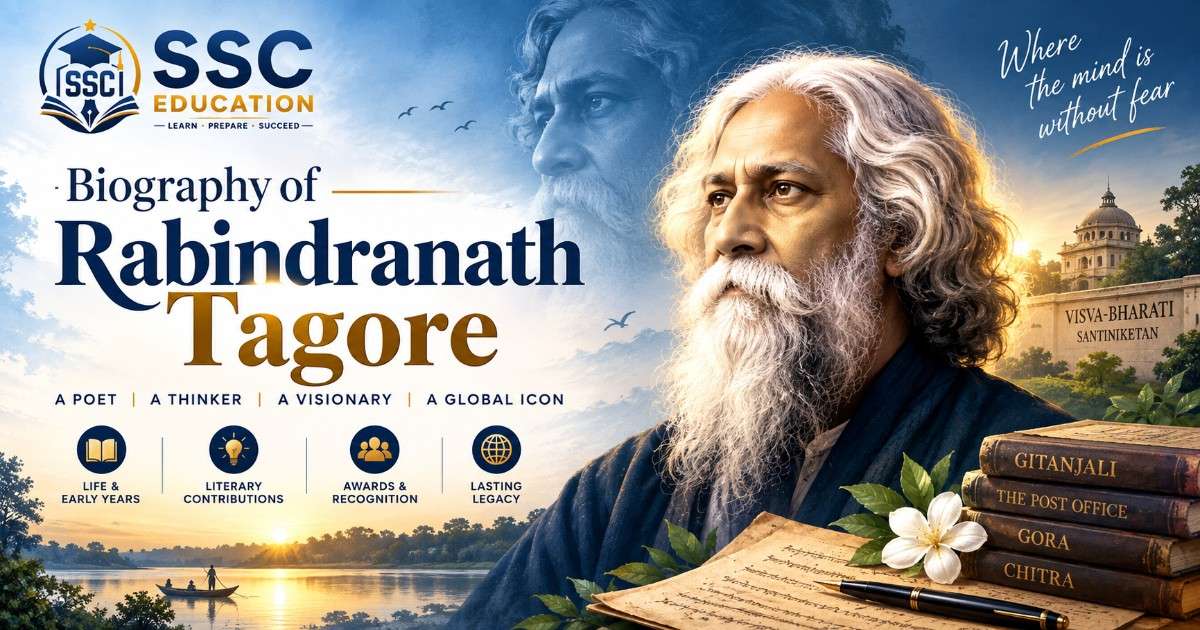
Biography of Rabindranath Tagore
Rahul Kumar
SSC Exam Expert & Content Editor
Table of Contents
- 1.Introduction
- 2.Quick Facts: Rabindranath Tagore
- 3.Early Life and the Tagore Family
- 4.Education: A School Without Walls
- 5.A Poet at Sixteen: Bhanusimha
- 6.Marriage and Family Life
- 7.Shelaidaha and the Sadhana Years (1890–1901)
- 8.The Short Story and the Novel
- 9.Swadeshi and the Partition of Bengal (1905)
- 10.Santiniketan: A School in Nature (1901)
- 11.Gitanjali and the Nobel Prize (1913)
- 12.The Knighthood and Its Renunciation (1919)
- 13.Visva-Bharati and Sriniketan (1921)
- 14.The National Anthems
- 15.Rabindra Sangeet: A Musical Revolution
- 16.Plays and Dance-Dramas
- 17.Painting: A New Career at Sixty
- 18.Travels and Meetings with World Thinkers
- 19.Tagore and Gandhi: Respect and Disagreement
- 20.Tagore's Ideas: Humanism, Nationalism and Education
- 21.Later Years and Death
- 22.Legacy and Honours
- 23.Major Works of Rabindranath Tagore at a Glance
- 24.Lesser-Known Facts about Rabindranath Tagore
- 25.Timeline of Rabindranath Tagore's Life
- 26.Why Rabindranath Tagore Is Important for SSC and Other Competitive Exams
- 27.Related Reading
- 28.Conclusion
- 29.Frequently Asked Questions
Complete biography of Rabindranath Tagore: early life, Gitanjali, Nobel Prize 1913, Santiniketan and Visva-Bharati, national anthems, Rabindra Sangeet, ideas, timeline and 24 FAQs for SSC exams.
Introduction
Rabindranath Tagore (7 May 1861 – 7 August 1941), called Gurudev and Kabiguru ("the great poet"), was a Bengali poet, novelist, playwright, composer, painter, educator and thinker who changed the course of Indian literature and music. In 1913 he became the first Indian, and the first non-European, to win the Nobel Prize in Literature, for Gitanjali. He wrote the words and music of the national anthem of India, Jana Gana Mana, and of Bangladesh, Amar Shonar Bangla, and his poetry inspired the anthem of Sri Lanka; no other writer is associated with the national songs of three countries.
Tagore's achievement, however, cannot be summed up in a list of firsts. He wrote about two thousand songs that are still sung in Bengal every day, founded a school at Santiniketan that grew into the Visva-Bharati University, gave the short story a place in Bengali literature, painted in the last decade of his life and argued for a form of nationalism that was open to the world. This biography follows his life from a great Calcutta household to Nobel recognition, covers his major works, his ideas on education and nationalism, his relationships with Gandhi and Einstein and his legacy, and includes a revision guide and detailed FAQs for SSC and other competitive examinations.
Quick Facts: Rabindranath Tagore
| Nationality | Indian |
|---|---|
| Best Known For | Poet, author, composer and educator; wrote the national anthems of India and Bangladesh; first non-European Nobel laureate in Literature (1913) |
| Born | 7 May 1861, Jorasanko Thakur Bari, Calcutta (now Kolkata), Bengal Presidency |
| Died | 7 August 1941, Jorasanko, Calcutta (aged 80) |
| Father | Debendranath Tagore, a leader of the Brahmo Samaj |
| Mother | Sarada Devi |
| Wife | Mrinalini Devi (married 1883; died 1902) |
| Titles | Gurudev, Kabiguru, Bishwakabi |
| Nobel Prize | Literature, 1913, for Gitanjali; the first non-European laureate |
| Institutions | Santiniketan (1901), Visva-Bharati University (1921), Sriniketan (1921) |
| National Anthems | Jana Gana Mana (India), Amar Shonar Bangla (Bangladesh) |
| Famous Works | Gitanjali, Gora, Ghare Baire, Chokher Bali, Kabuliwala, Stray Birds |
| Songs | About 2,230 compositions, known as Rabindra Sangeet |
| Birth Anniversary | Rabindra Jayanti (Pochishe Baisakh) |
Early Life and the Tagore Family
Rabindranath Tagore was born on 7 May 1861 in the family mansion at Jorasanko in north Calcutta, the youngest of the thirteen surviving children of Debendranath Tagore and Sarada Devi. The family, whose name was an anglicised form of Thakur, was one of the wealthiest and most cultured in Bengal, and its home was a centre of a literary, musical and reformist movement now often called the Bengal Renaissance. Debendranath, known as Maharshi ("the great sage"), was a deeply spiritual man who led the Adi Brahmo Samaj, a reform movement that rejected idol worship and emphasised the worship of one formless God, drawing on the Upanishads.
Rabindranath's brothers and sisters formed a remarkable circle. Dwijendranath was a philosopher and poet; Satyendranath was the first Indian to enter the Indian Civil Service; Jyotirindranath was a musician, playwright and composer who taught his younger brother about music and theatre; and Swarnakumari Devi was a novelist and editor. The house was filled with music, plays, journals and visitors, and the young Rabindranath grew up in an atmosphere in which literature and the arts were everyday matters. His sister-in-law, Kadambari Devi, who was close to him in age, was his companion and an early inspiration, and her death by suicide in 1884 was a lasting sorrow that is often reflected in his writings.
His mother, Sarada Devi, died in 1875 when he was fourteen. As a child he was looked after by the servants and, as he later described in his memoir Jibansmriti (Reminiscences), he lived a rather solitary life in a large house, watching the world from the windows, a childhood that made him a keen observer of nature and people. His early years shaped his imagination and his sense of longing, themes that appear throughout his work.
Education: A School Without Walls
Tagore disliked formal schooling intensely. He attended several schools in Calcutta, including the Oriental Seminary and the Normal School, but he found the teaching mechanical and the discipline oppressive, and he left them, one after another. Much of his education took place at home, where tutors taught him Bengali, Sanskrit, English, mathematics, science, music, drawing and gymnastics, and where he read widely. His experience gave him a lifelong conviction that education should be joyful, creative and in harmony with nature.
In 1873, at the age of eleven, he travelled with his father for several months, first visiting Santiniketan near Bolpur, where the Maharshi had a house, and then travelling to Amritsar and to the Himalayan hill station of Dalhousie. The journey opened his eyes to the open landscape, to the Sikh Golden Temple and to his father's disciplined spiritual life, and it left a memory of Santiniketan that would shape his later work.
In 1878, when he was seventeen, his father sent him to England to prepare for a career at the bar. He was briefly enrolled at a public school in Brighton, in East Sussex, and later studied English literature for a short time at University College London, but he did not take a degree and returned to India in 1880. In England, he learned about Western music and literature, listened to English, Scottish and Irish folk songs, and read Shakespeare closely, and these influences were later blended with Indian musical traditions in his own compositions.
A Poet at Sixteen: Bhanusimha
Tagore began writing poetry at the age of about eight, and by the time he was sixteen, in 1877, he had published poems in a periodical under the pseudonym Bhanusimha (the Sun-Lion). Written in the style of medieval Vaishnava devotional verses in an old literary dialect, they were so convincing that some scholars took them for the works of a lost seventeenth-century poet. In the same year, he wrote his first short story, Bhikharini (The Beggar Woman), often regarded as the beginning of the Bengali short story. His early poetry collections included Kabi-Kahini (1878), Sandhya Sangit (1882), which contained the famous poem Nirjharer Swapnabhanga (The Awakening of the Waterfall), and Prabhat Sangit (1883). His first original dramatic work, Valmiki Pratibha (1881), a musical drama, was performed at the family home, with the young poet himself playing the role of Valmiki.
Marriage and Family Life
In December 1883, Rabindranath married Bhabatarini, who was given the name Mrinalini Devi after marriage, a girl from a Jessore family who was still a child. They had five children, of whom two died young; the elder son, Rathindranath, later became a scientist and administrator, and the daughters included Madhurilata and Renuka. The family faced a series of personal tragedies at the turn of the century: Mrinalini died in 1902, Renuka in 1903 and his younger son Shamindranath in 1907, and his father, Debendranath, died in 1905. These losses affected him deeply, and many of the poems of this period, including those of Gitanjali, reflect a search for consolation and meaning.
Shelaidaha and the Sadhana Years (1890–1901)
In 1890 Tagore's father put him in charge of the family's estates in East Bengal (now in Bangladesh), at Shelaidaha, Patisar and Shahzadpur. For about a decade, he lived on a houseboat on the Padma river and on the estates, in the midst of villages, farmers and rivers, and he came to know rural Bengal as few writers of his class had. He listened to the songs of boatmen and to the stories of villagers, watched the seasons change on the river and learned about the poverty and endurance of the peasants he was responsible for. He also began initiatives to improve the villagers' condition, including schools, dispensaries and cooperative credit.
These were among the most productive years of his creative life. Between 1891 and 1895 he edited the magazine Sadhana, in which many of his stories, essays and poems appeared, and this stretch is called the Sadhana period. He wrote more than half of the eighty-four stories in his collection Galpaguchchha during this time, including Kabuliwala (1892), the moving story of a fruit-seller from Kabul and his friendship with a small Bengali girl, and Kshudita Pashan (The Hungry Stones, 1895), a haunting tale of a palace with a supernatural presence. His poetry of the period, collected in volumes such as Manasi (1890) and Sonar Tari (The Golden Boat, 1894), brought new depth to Bengali verse, combining rich imagery with reflections on time, love and nature.
The Short Story and the Novel
Tagore is regarded as the creator of the modern Bengali short story. His stories deal with ordinary people — a postmaster in a village, a wife who is treated as a burden, a boy who is denied schooling — and they show sympathy for women, children and the poor, along with irony about social customs. In the novel, he wrote works of great psychological subtlety. Chokher Bali (1902–03) portrays a young widow who challenges social norms, Gora (1907–10), his longest novel, explores questions of religion, nationalism and identity through the story of a young man who discovers that he is not the Hindu he believed himself to be, and Ghare Baire (The Home and the World, 1916) is a critique of aggressive nationalism seen through a triangle of love and politics. Later novels include Jogajog (1929) and Shesher Kabita (1929), a lyrical novel full of poems.
Swadeshi and the Partition of Bengal (1905)
In 1905, the British Viceroy Lord Curzon announced the partition of Bengal, and the province erupted in protest. Tagore took a leading part in the early phase of the Swadeshi movement. He composed patriotic songs, including Amar Sonar Bangla (My Golden Bengal), which would later become the national anthem of Bangladesh, and he organised a Rakhi Bandhan ceremony on 16 October 1905, the day on which the partition came into force, in which Hindus and Muslims tied rakhis on one another's wrists as a sign of unity.
Soon, however, he became uneasy with the direction of the movement. He objected to its increasing use of coercion, to the pressure on poor Muslim traders to boycott foreign goods and to the growth of a narrow and aggressive religious nationalism. He withdrew from active politics and warned that a movement built on hatred would harm the country. His novel Ghare Baire and his lectures on nationalism, delivered in Japan and the United States in 1916–17, developed these ideas, arguing that the worship of the nation as an idol could lead to conflict and that India's mission was to teach the world unity in diversity.
Santiniketan: A School in Nature (1901)
In December 1901 Tagore founded an experimental school at Santiniketan, on the land his father had bought near Bolpur in Birbhum district of West Bengal, with only five students. His aim was to create an alternative to the colonial system of schooling that he had found so oppressive as a boy. Classes were held under trees, the relationship between teachers and students was affectionate and informal, and the curriculum combined literature, music, art and crafts with the study of nature. He wrote textbooks himself and invited scholars and artists to teach.
The early years were hard. He financed the school largely from his own pocket, and he had to sell his wife's jewels and even the copyright of his books to meet the costs. Yet the school grew, and it became a meeting place for artists such as Nandalal Bose, musicians, scholars and visitors from abroad. It expressed Tagore's belief that education should encourage curiosity, creativity and a sense of connection with the world, rather than merely prepare students for examinations. "Proper teaching," he is reported to have said, "does not explain things; proper teaching stokes curiosity."
Gitanjali and the Nobel Prize (1913)
In 1910 Tagore published Gitanjali ("Song Offerings"), a collection of devotional poems in Bengali. In 1912, on a voyage to England, he began translating some of the poems into English prose. In London, he showed the manuscript to the painter William Rothenstein, who introduced him to the Irish poet W. B. Yeats and other writers. Yeats was deeply moved and wrote the introduction to the English Gitanjali, published by the India Society of London in November 1912. Ezra Pound and other literary figures also praised it. Among the best-known poems in the collection is the one that begins "Where the mind is without fear and the head is held high", which expresses a vision of a free and enlightened nation.
In November 1913, the Swedish Academy announced that the Nobel Prize in Literature would go to Rabindranath Tagore, for his "profoundly sensitive, fresh and beautiful verse" and for having made his poetic thought, expressed in his own English words, part of the literature of the West. He was the first Indian, and the first non-European, to receive the prize. Tagore did not go to Stockholm to receive it in person; the prize was accepted on his behalf by the British ambassador, and he later used the prize money to support Santiniketan. The award brought India's literature to world attention and became a source of enormous pride to an India then under colonial rule.
The Knighthood and Its Renunciation (1919)
In 1915, the British government conferred a knighthood on Tagore, and he became Sir Rabindranath Tagore. On 13 April 1919, British troops under General Dyer fired on an unarmed crowd at Jallianwala Bagh in Amritsar, killing hundreds. The severity of the punishments imposed afterwards, including martial law, shocked the country, and Tagore, when he found that no one else would speak out, wrote to the Viceroy, Lord Chelmsford, on 30 May 1919 renouncing his knighthood. He said that the time had come when "badges of honour make our shame glaring in their incongruous context of humiliation", and that he wished to stand, shorn of all special distinctions, by the side of those countrymen who were suffering. The act made him one of the moral leaders of the national movement.
Visva-Bharati and Sriniketan (1921)
After the Nobel Prize, Tagore expanded his vision for Santiniketan. In December 1921 he established Visva-Bharati, a university whose name means "the communion of the world with India", where scholars from India and abroad could study together in a spirit of exchange. Its motto, taken from the Upanishads, is Yatra visvam bhavatyekanidam ("where the world makes a home in a single nest"). It included the Kala Bhavana (art), Sangit Bhavana (music), a centre for Chinese and Tibetan studies and later many other departments, and it welcomed scholars such as C. F. Andrews, Sylvain Levi and Vincenzo Formichi. After independence, Visva-Bharati was made a central university in 1951, with the Prime Minister of India as its Chancellor.
In 1921, with the English agricultural economist Leonard Elmhirst, Tagore also established the Institute of Rural Reconstruction at Surul near Santiniketan, later renamed Sriniketan ("the abode of welfare"). The institute worked with nearby villages on agriculture, cottage industries, health, cooperative societies and education, and it applied Tagore's belief that the development of the country had to begin in its villages. In 2023, Santiniketan was inscribed as a UNESCO World Heritage Site, recognising the cultural landscape that he created.
The National Anthems
Tagore's songs became the anthems of nations. The following are the best known.
- Jana Gana Mana (India): The first stanza of his Bengali hymn Bharoto Bhagyo Bidhata, written in Sanskritised Bengali. It was first sung at the Calcutta session of the Indian National Congress in December 1911, and was adopted as India's national anthem by the Constituent Assembly on 24 January 1950. Its playing time is about 52 seconds.
- Amar Shonar Bangla (Bangladesh): Written during the Swadeshi movement in 1905, it was adopted as the national anthem of Bangladesh in 1971.
- Sri Lanka: The national anthem of Sri Lanka, written and composed by Ananda Samarakoon, a student of Tagore at Santiniketan, is generally regarded as having been inspired by his work.
Rabindra Sangeet: A Musical Revolution
Tagore composed about 2,230 songs, collectively called Rabindra Sangeet, in which the words and music are inseparable. He drew on Hindustani classical music, Bengali folk forms such as baul and kirtan, Carnatic music and Western melodies, and blended them into a distinct style. His songs cover devotion (puja), love (prem), nature (prakriti), patriotism (swadesh), life's rituals (anushthanik) and the seasons. Among the best known are Ekla Chalo Re ("Walk alone"), Amra Sabai Raja and Tumi Kemon Kore Gaan Koro He Guni. Rabindra Sangeet is performed at weddings, festivals, protests and everyday gatherings across Bengal and Bangladesh, and it is a key element of Bengali cultural identity.
Plays and Dance-Dramas
Tagore wrote about forty plays and musical dramas. Visarjan (Sacrifice, 1890) is often considered his finest drama, a powerful examination of violence and religion. Dak Ghar (The Post Office, 1912) tells of a sick child, Amal, who longs for a world beyond his window. Raktakarabi (Red Oleanders, 1926) is a symbolic play about a tyrannical ruler and the force of love. In his later years he created a series of dance-dramas, Chitrangada, Chandalika (1938) and Shyama (1939), known together as Rabindra Nritya Natya, which gave a new place to dance in Bengali culture. Chandalika, based on a Buddhist legend, is about a young woman of low caste, and reflects his opposition to untouchability.
Painting: A New Career at Sixty
Tagore started painting when he was in his sixties. It began with doodles and corrections in his manuscripts, in which he found shapes and faces emerging, and it developed into a large body of work: more than two thousand paintings, in ink, watercolour and other media, which he created in the last fifteen years of his life. He had no formal training, and his style was independent of Indian traditions and of European academic art, with dark, expressive faces, dreamlike landscapes and abstract patterns. His paintings were exhibited in Paris in 1930 and later in London, Berlin and New York, and they are regarded today as an important part of modern Indian art.
Travels and Meetings with World Thinkers
Tagore visited more than thirty countries on five continents, as a lecturer, a poet and an ambassador of Indian culture. He lectured in the United States and Britain in 1912–13, in Japan and the United States in 1916–17, and in South America in 1924, where he stayed in Buenos Aires as a guest of the writer Victoria Ocampo. In 1927 he toured Southeast Asia, visiting Malaya, Java, Bali and Siam, and in 1930 he travelled through Europe, the Soviet Union and the United States. In 1932 he visited Iran at the invitation of Reza Shah Pahlavi and Iraq, and he made his last foreign visit to Sri Lanka in 1933.
He met many of the leading minds of the time, including W. B. Yeats, Ezra Pound, Romain Rolland, Robert Frost, Thomas Mann, George Bernard Shaw, H. G. Wells and Henri Bergson. A famous conversation took place in 1930 with Albert Einstein, in which the physicist and the poet discussed the nature of reality and beauty; a note on it was later published as an appendix to Tagore's book The Religion of Man (1931). Einstein said that the world can be seen either as depending on humanity or as existing independent of it, and Tagore argued that the truth lay in the relationship between the human mind and the universe.
Tagore and Gandhi: Respect and Disagreement
The relationship between Tagore and Mahatma Gandhi was one of deep mutual respect combined with sharp differences of opinion. Gandhi called Tagore Gurudev, and Tagore is credited with popularising the title Mahatma for Gandhi. They admired each other's moral courage. In 1915, when Gandhi returned from South Africa, he and his followers stayed at Santiniketan for some weeks, and Tagore's school was among the first places to observe the practice of self-reliance that Gandhi advocated.
Yet they argued in public on several issues. Tagore was uneasy about the non-cooperation movement, which he feared would create an atmosphere of hostility to the West and to learning; he wrote that India should not turn away from what was best in world culture. He also disagreed with Gandhi's emphasis on the spinning wheel as a national programme, and, most memorably, with Gandhi's remark after the Bihar earthquake of 1934 that the disaster was a divine punishment for the sin of untouchability. Tagore rebuked this view in public, saying that it was unscientific and that such explanations would encourage superstition. Despite these exchanges, they remained friends until the end, and Gandhi visited Tagore at Santiniketan after Tagore's death to pay his respects. In the last year of his life, Tagore appealed to Gandhi to look after Visva-Bharati.
Tagore's Ideas: Humanism, Nationalism and Education
- Universal humanism: Tagore believed that all people are part of a single human family and that civilisations grow by exchange with each other. He spoke of the "Religion of Man" as a faith based on love of humanity.
- Criticism of narrow nationalism: Alongside his love for India, he warned that when nationalism becomes aggressive and exclusive, it becomes a danger. His lectures on Nationalism (1917) were critical of the way in which the nation-state could dominate individuals and of Japan's militarism and the West's imperialism.
- Anti-colonial views: Though critical of certain nationalist methods, he denounced British rule, its economic exploitation of India and its repression, and he supported the goal of freedom.
- Education: He believed that education should be joyful, based on the mother tongue, close to nature and connected with life, and that it should develop the imagination as well as the intellect.
- Rural reconstruction: He argued that the country's real strength lay in its villages and that they should be helped to become self-reliant through cooperation.
- Opposition to caste and untouchability: He wrote and spoke against caste discrimination and untouchability, wrote plays and poems about people excluded from society, and supported the campaign to open the Guruvayur temple in Kerala to all castes.
- Women's dignity: His stories and novels show great sympathy for women's lives, and his family and school encouraged women's education and public participation.
- Nature and science: In his later years he took a growing interest in science, wrote a book on it for general readers, Visva-Parichay (1937), and often used images from nature and the physical world in his poetry.
Later Years and Death
In his last decade Tagore was still highly active, though his health was declining. He wrote new forms of poetry, including prose poems in collections such as Punashcha (1932), and experimented with dance-dramas, painting and essays. He also spoke against fascism and Nazism during the 1930s and expressed anguish at the outbreak of the Second World War. In 1937 he fell seriously ill and lost consciousness for a period, and in 1940 he suffered another serious illness from which he never fully recovered. His last years were marked by pain, yet many critics regard the poems of this period as among his finest.
On 30 July 1941, the day before a planned operation, he dictated his last poem, in which he spoke of being "lost in the middle of my birthday" and of having given away all that he had. He died on 7 August 1941, at the age of eighty, in the upper room of the Jorasanko house in which he had been born. The date, called Baishe Srabon in the Bengali calendar, is observed every year with songs and recitations, and the news of his death led to mourning across the country, even in the middle of the war.
Legacy and Honours
- Rabindra Jayanti: His birth anniversary, 25 Baisakh (Pochishe Baisakh) in the Bengali calendar, generally falling on 8 or 9 May, is celebrated with songs, dance, plays and recitations, especially in West Bengal, Bangladesh and at Santiniketan.
- Visva-Bharati: A central university since 1951, and Santiniketan, a UNESCO World Heritage Site since 2023.
- Rabindra Bharati University: A university in Kolkata, established in 1962 on the centenary of his birth, at the Jorasanko house.
- Anthems: The national anthems of India and Bangladesh, and the influence on Sri Lanka's anthem.
- Literature and translations: His works have been translated into many languages, and anthologies such as The Essential Tagore (2011), published by Harvard University Press and Visva-Bharati for the 150th anniversary, have brought them to new readers.
- Films: Satyajit Ray made Charulata (1964, based on the novella Nastanirh) and Ghare Baire (1984), and Tagore's stories, such as Kabuliwala, have been adapted several times.
- Honours: Nobel Prize in Literature (1913); knighthood (1915, renounced in 1919); many honorary degrees, including one from Oxford University in 1940.
Beyond such marks of honour, his influence continues in the way Bengalis sing, write and think, and in the growth of ideas about creative education that are reflected in India's National Education Policy and in schools around the world.
Major Works of Rabindranath Tagore at a Glance
- Poetry: Sandhya Sangit (1882), Manasi (1890), Sonar Tari (1894), Naivedya (1901), Kheya (1906), Gitanjali (1910), Balaka (1916), Punashcha (1932), Shesh Saptak (1935) and Patraput (1936).
- Novels: Nastanirh (1901), Chokher Bali (1902–03), Noukadubi (1906), Gora (1910), Ghare Baire (1916), Chaturanga (1916), Jogajog (1929), Shesher Kabita (1929) and Char Adhyay (1934).
- Short stories: Galpaguchchha (three volumes, eighty-four stories), including Kabuliwala, Kshudita Pashan, Postmaster, Atithi and Streer Patra.
- Plays: Valmiki Pratibha (1881), Visarjan (1890), Dak Ghar (1912), Raktakarabi (1926), Chandalika (1938) and Shyama (1939).
- Prose and essays: Jibansmriti (Reminiscences), Sadhana (1913), Nationalism (1917), Creative Unity (1922), The Religion of Man (1931), Visva-Parichay (1937) and travel letters such as Europe Jatrir Patra, Java Jatrir Patra and Russiar Chithi.
- English works: Gitanjali (1912), The Crescent Moon (1913), Fruit-Gathering (1916) and Stray Birds (1916).
Lesser-Known Facts about Rabindranath Tagore
- He attended school for only a short time and was largely educated at home.
- He wrote poems in the style of medieval poets under the name Bhanusimha at sixteen and fooled scholars.
- He is the only person to have composed the national anthems of two countries: India and Bangladesh.
- He composed around 2,230 songs and started painting at sixty.
- He returned his knighthood after the Jallianwala Bagh massacre in 1919.
- He did not travel to Stockholm to receive the Nobel Prize in 1913.
- He founded Santiniketan with only five students in 1901.
- He visited more than thirty countries and met Einstein, Yeats, Romain Rolland and Bernard Shaw.
- He wrote his last poem a week before his death, on 30 July 1941.
- He played a role in the introduction of the title Mahatma for Gandhi.
Timeline of Rabindranath Tagore's Life
| Year | Event |
|---|---|
| 1861 | Born at Jorasanko, Calcutta, on 7 May |
| 1875 | Death of his mother, Sarada Devi |
| 1877 | Published poems as Bhanusimha; first short story Bhikharini |
| 1878–1880 | Studied in England |
| 1883 | Married Mrinalini Devi |
| 1890 | Began managing the family estates at Shelaidaha |
| 1891–95 | Sadhana period; edited Sadhana |
| 1901 | Founded the school at Santiniketan |
| 1905 | Swadeshi movement; Rakhi Bandhan; wrote Amar Sonar Bangla |
| 1910 | Gitanjali (Bengali) and Gora published |
| 1911 | Jana Gana Mana first sung at the Calcutta Congress |
| 1912 | English Gitanjali published in London |
| 1913 | Nobel Prize in Literature |
| 1915 | Knighted |
| 1919 | Renounced the knighthood after Jallianwala Bagh (30 May) |
| 1921 | Founded Visva-Bharati and Sriniketan |
| 1930 | Exhibited paintings in Paris; met Einstein |
| 1941 | Died at Jorasanko on 7 August |
Why Rabindranath Tagore Is Important for SSC and Other Competitive Exams
Tagore features regularly in the literature, awards, history and art and culture sections of SSC CGL, CHSL, MTS, GD Constable and Stenographer exams and in railway, banking and state-level tests. The facts asked most often are these:
- First Indian and first non-European to win the Nobel Prize in Literature (1913), for Gitanjali.
- Composed the national anthem of India, Jana Gana Mana (adopted on 24 January 1950), and of Bangladesh, Amar Shonar Bangla.
- Founded Santiniketan (1901) and Visva-Bharati (1921) in Birbhum, West Bengal; also Sriniketan.
- Renounced his knighthood (1915) in 1919 after the Jallianwala Bagh massacre.
- Known as Gurudev and Kabiguru; born 7 May 1861, died 7 August 1941.
- Works: Gora, Ghare Baire, Chokher Bali, Kabuliwala; songs called Rabindra Sangeet.
- Gave the title Mahatma to Gandhi (popular tradition), and Gandhi called him Gurudev.
A simple way to remember is 1913 (Nobel), 1915 (knighthood), 1919 (renounced) and 1921 (Visva-Bharati), a four-date chain that answers most factual questions on him.
Related Reading
Conclusion
Rabindranath Tagore lived at the meeting point of many worlds — village and city, tradition and modernity, India and the West — and refused to give up any of them. His poems taught readers to see the divine in everyday life, his stories gave a voice to the ignored and his songs gave a country its anthem and a language its music. His school, in a grove of sal trees, proposed a different idea of what education might be, and his stand on nationalism, expressed at a time when the world was moving towards war, has become more relevant as the years have passed. For students, he offers a set of clear dates, titles and achievements; for readers everywhere, he remains a companion who speaks of freedom, beauty and human unity.
Frequently Asked Questions
Who was Rabindranath Tagore?
Rabindranath Tagore (1861–1941) was a Bengali poet, novelist, playwright, composer, painter and educator, and the first Indian to win the Nobel Prize in Literature.
When and where was Rabindranath Tagore born?
He was born on 7 May 1861 at the Jorasanko Thakur Bari in Calcutta (Kolkata), in the Bengal Presidency.
Who were the parents of Rabindranath Tagore?
His father was Debendranath Tagore, a leader of the Brahmo Samaj, and his mother was Sarada Devi.
When did Tagore win the Nobel Prize and for which work?
He won the Nobel Prize in Literature in 1913 for his English collection Gitanjali (Song Offerings).
Was Tagore the first Asian to win the Nobel Prize?
He was the first non-European and the first Indian to win the Nobel Prize in Literature; he was also the first Asian to win a Nobel Prize.
Which national anthems were written by Tagore?
He wrote Jana Gana Mana, India's national anthem, and Amar Shonar Bangla, the national anthem of Bangladesh; Sri Lanka's anthem was inspired by his work.
When was Jana Gana Mana adopted as the national anthem?
It was first sung at the Calcutta session of the Congress in 1911 and adopted as India's national anthem on 24 January 1950.
What is Gitanjali?
Gitanjali is a collection of devotional poems, published in Bengali in 1910 and in English in 1912, with an introduction by W. B. Yeats.
Why did Tagore return his knighthood?
He renounced the knighthood conferred in 1915 through a letter to Lord Chelmsford on 30 May 1919, in protest against the Jallianwala Bagh massacre and its aftermath.
What is Santiniketan?
Santiniketan is the place in Birbhum, West Bengal, where Tagore founded a school in 1901, which grew into the Visva-Bharati University.
When was Visva-Bharati founded?
Tagore established Visva-Bharati in 1921; it became a central university in 1951.
What is Sriniketan?
Sriniketan is the Institute of Rural Reconstruction, founded by Tagore and Leonard Elmhirst in 1921 near Santiniketan to work on village development.
What is Rabindra Sangeet?
Rabindra Sangeet is the collection of about 2,230 songs composed by Tagore, blending Indian classical, folk and Western music with his poetry.
What are Tagore's famous novels?
His best-known novels include Gora, Ghare Baire (The Home and the World), Chokher Bali, Noukadubi, Jogajog and Shesher Kabita.
What is Kabuliwala?
Kabuliwala is one of Tagore's best-known short stories (1892), about the friendship between an Afghan fruit-seller and a little Bengali girl.
Which titles are associated with Tagore?
He is known as Gurudev, Kabiguru and Bishwakabi (the world poet).
What was Tagore's relationship with Mahatma Gandhi?
They respected each other and called each other by honorific titles (Gurudev and Mahatma), but disagreed on issues such as non-cooperation and the spinning wheel.
Did Tagore meet Albert Einstein?
Yes. In 1930 they held a well-known conversation on the nature of reality, a note of which was included in Tagore's book The Religion of Man.
When did Tagore start painting?
He began painting in his sixties and produced about two thousand works, which were exhibited in Paris and other cities from 1930.
What was Tagore's view on nationalism?
He supported freedom from colonial rule but warned against narrow and aggressive nationalism, arguing for unity among peoples and a universal humanism.
When and where did Tagore die?
He died on 7 August 1941 at the age of eighty, in the Jorasanko house in Calcutta where he was born.
When is Rabindra Jayanti celebrated?
Rabindra Jayanti is celebrated on 25 Baisakh (Pochishe Baisakh) of the Bengali calendar, usually 8 or 9 May, in memory of his birth.
Who was Tagore's wife?
He married Mrinalini Devi in 1883; she died in 1902.
Which important dates related to Tagore should I remember for SSC exams?
Remember 1861 (birth), 1901 (Santiniketan), 1913 (Nobel Prize), 1915 (knighthood), 1919 (knighthood renounced), 1921 (Visva-Bharati) and 1941 (death).
Rahul Kumar
SSC Exam Expert & Content Editor
Rahul is a senior SSC exam strategist with 8+ years of experience helping aspirants crack CGL, CHSL and MTS exams. He writes in-depth notification breakdowns, exam pattern guides and preparation strategies.