
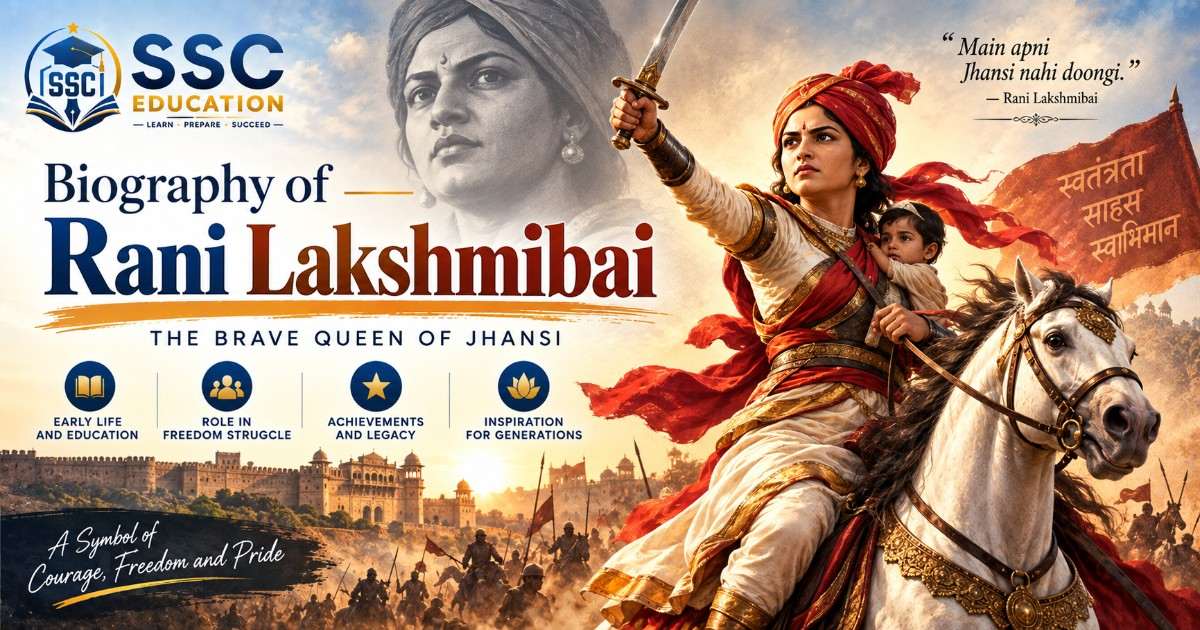
Biography of Rani Lakshmibai
Rahul Kumar
SSC Exam Expert & Content Editor
Table of Contents
- 1.Introduction
- 2.Quick Facts: Rani Lakshmibai
- 3.Early Life and Childhood
- 4.Marriage and Life as the Queen of Jhansi
- 5.The Adoption and the Death of Gangadhar Rao
- 6.The Doctrine of Lapse and the Annexation of Jhansi
- 7.The Background of 1857
- 8.The Revolt Reaches Jhansi (June 1857)
- 9.The Rani Takes Charge of Jhansi
- 10.Sir Hugh Rose Marches on Jhansi
- 11.The Siege of Jhansi (22 March–4 April 1858)
- 12.Kalpi and the Battle for Central India
- 13.The Last Battle and Death of the Rani (June 1858)
- 14.What Happened After: Damodar Rao and the Rebel Leaders
- 15.History versus Legend: What We Know and What We Do Not
- 16.Different Narratives: Caste, Region and Memory
- 17.Personality and Qualities
- 18.The Rani in Literature and the Arts
- 19.Rani Lakshmibai and the Indian National Army
- 20.Memorials and Institutions
- 21.Revolt of 1857: Leaders and Centres (Quick Reference)
- 22.Causes of the Revolt of 1857 in Brief
- 23.Lesser-Known Facts about Rani Lakshmibai
- 24.Timeline of Rani Lakshmibai's Life
- 25.Why Rani Lakshmibai Is Important for SSC and Other Competitive Exams
- 26.Related Reading
- 27.Conclusion
- 28.Frequently Asked Questions
Complete biography of Rani Lakshmibai of Jhansi: early life, Doctrine of Lapse, Revolt of 1857, siege of Jhansi, death near Gwalior, history vs legend, timeline and 24 FAQs for SSC exams.
Introduction
Rani Lakshmibai of Jhansi (traditionally born 19 November 1828; died 18 June 1858) is one of the most celebrated figures of the Revolt of 1857, remembered across India as the queen who fought the British Army in defence of her kingdom and died in battle on the plains of Gwalior at the age of about thirty. She rose from being a young widow, fighting for the right of her adopted son to inherit his father's throne, to being a leader of the rebellion in Central India, and even her opponents admitted her courage. The British general who defeated her, Sir Hugh Rose, called her the best and bravest of the rebels.
The Rani has been the subject of poems, novels, films and folk songs for more than a century and a half. Her story carries elements of legend, and historians have argued about some details, such as her exact date of birth and her role in the events at Jhansi in June 1857. This biography separates what is well documented from what is traditional, explains why the British annexed Jhansi, follows the siege and the final campaign in detail, and includes a revision guide and FAQs for SSC and other competitive examinations.
Quick Facts: Rani Lakshmibai
| Nationality | Indian |
|---|---|
| Best Known For | Queen of Jhansi and leading figure of the Revolt of 1857 |
| Birth Name | Manikarnika Tambe (nicknamed Manu) |
| Born | Traditionally 19 November 1828 in Varanasi (historians debate the year, between about 1827 and 1835) |
| Died | 18 June 1858 (some accounts say 17 June), near Kotah-ki-Serai, Gwalior |
| Father | Moropant Tambe, a courtier of the Peshwa family |
| Mother | Bhagirathibai (died when Manikarnika was a young child) |
| Husband | Raja Gangadhar Rao Newalkar of Jhansi (married 1842) |
| Son | A baby son born in 1851 who died in infancy; adopted son Damodar Rao (born Anand Rao) |
| Known As | Rani of Jhansi; the Warrior Queen; Jhansi ki Rani |
| Central Event | Siege of Jhansi (22 March–4 April 1858) and the Revolt of 1857 |
| Opponent | Major General Sir Hugh Rose |
| Allies | Tatya Tope, Rao Sahib and the Nawab of Banda |
Early Life and Childhood
The girl who became Rani Lakshmibai was born as Manikarnika, and her family called her Manu. According to the traditional account she was born in Varanasi on 19 November 1828, although scholars have suggested different years for her birth, from 1827 to 1835, because no official record survives. Her father, Moropant Tambe, belonged to a Marathi Brahmin family and worked at the court of Peshwa Baji Rao II, who had been living in exile at Bithoor near Kanpur under a British pension. Her mother, Bhagirathibai, died when Manu was only about four years old.
After her mother's death Moropant took his daughter to Bithoor, where he was employed at the Peshwa's court. According to popular tradition, which historians treat cautiously, the girl grew up alongside the children of the Peshwa's household, including Nana Sahib, who were later important figures in the Revolt. The Peshwa's courtiers are said to have given her the nickname Chhabili, meaning playful or full of spirit, for her lively temperament.
Unlike most girls of her time, Manu was not confined to the women's quarters. She received an education that included reading and writing, and, according to the tales told about her, she learned horse riding, swordsmanship and shooting alongside the boys of the household. Whether or not every detail of the legend is accurate, the picture of a bold and physically capable young woman is consistent with the way in which she behaved during the crisis of 1857.
Marriage and Life as the Queen of Jhansi
In 1842, at a young age, Manikarnika was married to Raja Gangadhar Rao Newalkar of Jhansi, a Maratha state in Bundelkhand. After the wedding she took the name Lakshmibai in honour of the goddess Lakshmi, following a tradition of the time. Jhansi was not a large state, but it occupied a strategic position in central India, and it had been a tributary of the Peshwas before falling under British influence in the early nineteenth century. The British had installed Gangadhar Rao as ruler in 1843 after a period of uncertainty.
Gangadhar Rao is described in most accounts as a cultured and generous ruler who loved theatre, music and religious festivals. He repaired the fort and encouraged the arts, though the state's finances were modest. Lakshmibai, for her part, is said to have taken an active interest in the administration, performing religious ceremonies, holding a court for women and, in the Marathi custom, receiving visitors during the festival of Haldi-Kumkum. She also continued her physical training and kept horses in her stable.
In 1851 the couple had a son, but the child died when he was only a few months old. The loss was a heavy blow to the family, and it set in motion the events that led to the end of Jhansi's independence.
The Adoption and the Death of Gangadhar Rao
After the death of the baby, Gangadhar Rao's health began to fail. By the autumn of 1853 he was seriously ill, and he realised that he needed an heir. According to Hindu custom, a ruler without a natural son could adopt one, and on 20 or 21 November 1853, in the presence of the British political agent, he adopted a five-year-old boy, Anand Rao, a relative, who was renamed Damodar Rao. Gangadhar Rao also wrote a letter to the British officials, asking them to recognise the boy as his successor and to treat his widow, Lakshmibai, as regent during the child's minority. He died on 21 November 1853, only a day or so after the adoption.
The Doctrine of Lapse and the Annexation of Jhansi
The British East India Company, under Governor-General Lord Dalhousie, followed a policy known as the Doctrine of Lapse. According to this policy, if the ruler of a dependent state died without a natural male heir, the state would "lapse" to the Company, and an adopted heir would not be recognised. Dalhousie had already used the doctrine to annex Satara in 1848, Sambalpur in 1849 and Nagpur in 1854, and Jhansi fell into the same pattern. In 1854 the Company refused to accept Damodar Rao as the heir, declared that Jhansi had lapsed and annexed the state, arguing that the late Raja was a subordinate ruler whose adoption required the consent of the paramount power.
Lakshmibai did not accept the decision quietly. She hired the services of an Australian lawyer, John Lang, who prepared a petition arguing that the adoption was valid under Hindu law and that Jhansi's treaty rights had been ignored, and she sent it to the Governor-General and, through him, to authorities in London. The appeal was rejected. She was offered a pension of five thousand rupees a month and was allowed to continue living in Jhansi, but she was required to move out of the fort into the Rani Mahal, the palace in the town, and the state's revenues and administration passed to British officials. The Company also demanded that she repay a debt of thirty-six thousand rupees that the late Raja had reportedly owed, which she argued should have been treated as a state liability.
It was in this context that the Rani is said to have declared, in a sentence made famous by popular writing, that she would not give up her Jhansi. Modern historians note that this specific line was popularised by later literature, notably a novel of 1946, and cannot be verified as her own words. But it captures the spirit of her stand: she kept up a dignified, legal and persistent effort to recover the rights of her adopted son, while living quietly in the palace and performing her religious and charitable duties.
The Background of 1857
By 1857, discontent with the Company's rule had reached a critical point across northern and central India. The annexation of states by the Doctrine of Lapse, heavy land revenue, the displacement of local rulers and landlords, and fears about interference with religion had all created resentment. In the army, Indian soldiers (sepoys) were angered by the introduction of the new Enfield rifle, whose cartridges were rumoured to be greased with cow and pig fat. On 10 May 1857, sepoys at Meerut rose in revolt, marched to Delhi and proclaimed the aged Mughal emperor, Bahadur Shah Zafar, as their leader. Within weeks, revolts had spread to Kanpur, Lucknow, Bareilly and many other places.
The Revolt Reaches Jhansi (June 1857)
The news of Meerut and Delhi spread to Jhansi, where a small British garrison and a few European families lived. The Rani, in an effort to protect herself, wrote to the British Commissioner to say that she was loyal to the government and that she had raised a force of guards to maintain order. She also asked for permission to raise more troops for her own safety. In early June 1857, the sepoys of the 12th Bengal Native Infantry stationed at Jhansi rose in revolt. On 5 June they seized the Star Fort, where the ammunition was stored, and on 8 June nearly all the British officers and their families, about sixty people, surrendered on the promise of safety and were killed at a garden known as Jokhan Bagh.
The role of the Rani in the massacre has been debated ever since. Some British accounts held her responsible, claiming that she instigated the sepoys, whereas Indian sources emphasise that she had offered protection to the Europeans and was helpless against the mutineers. Historians who have studied the evidence conclude that the picture is unclear: there is no proof that she ordered the killings, but there are indications that she was under strong pressure from the rebels, who demanded money and threatened the palace. On 11 June the rebels demanded a large ransom, which she negotiated down to a smaller amount. After the mutineers left for Delhi, Jhansi was without a government.
The Rani Takes Charge of Jhansi
With the British gone and the city in disorder, the leading citizens and the remaining troops turned to the Rani and asked her to take control. Lakshmibai accepted and issued a proclamation which, in essence, stated that the people belonged to God, the country to the emperor, and that the authority in Jhansi was that of Lakshmibai. For the next eight months she governed Jhansi in the name of her adopted son. She collected revenue, repaired the fort, cast cannon, distributed money among the soldiers, arranged supplies and preserved order. She even wrote to the British authorities, insisting that she had acted only to protect the city and that she was willing to give up the administration on the arrival of British officials, though her letters were not answered.
In the same months she had to defend Jhansi against neighbouring rulers who sought to exploit the situation. In August and September 1857 the forces of Orchha and Datia, two states allied with the British, attacked Jhansi, hoping to divide its territory. The Rani rallied her troops and repelled the attack. According to popular tradition, she also recruited and trained women for the defence of the fort — though whether this amounted to an organised women's regiment is doubtful — and among them stood Jhalkari Bai, a woman from a lower-caste community who is remembered in local tradition as a brave warrior and confidante.
Sir Hugh Rose Marches on Jhansi
By early 1858, the British had recaptured Delhi and Lucknow and turned to the reconquest of Central India. The task was given to Major General Sir Hugh Rose, who led the Central India Field Force of about three thousand men, and who reached Jhansi in the third week of March. Rose regarded Jhansi as a stronghold because it held a formidable fort built on a rocky hill, with high granite walls, and because the Rani was known to be preparing for a long defence. Inside the city, the Rani had gathered a garrison that was reported to number several thousand, along with cannon and stocks of food.
The Siege of Jhansi (22 March–4 April 1858)
The siege began on 22 March 1858, when Rose's guns opened fire on the city walls. The Rani's artillery replied with skill, and the defenders repaired the breaches in the walls at night, sometimes with the help of women and townspeople who carried stone and ammunition. Local tradition names some of the great guns of the fort and remembers that the artillery of Jhansi, commanded by experienced gunners, caused the British serious trouble in the first days.
Relief was on its way. Tatya Tope, the best-known commander of the rebellion, marched from Kalpi with an army of around twenty thousand men to break the siege. On 1 April 1858 Rose turned part of his force to meet him at the river Betwa and defeated the relief army decisively, with heavy losses to the rebels and light losses to the British. It was a critical setback for Jhansi. On 3 April the British breached the southern wall and forced their way into the city, and the fighting moved from street to street and from house to house. The Rani led a counterattack with a force that included Afghan troops, but the defenders were pushed back into the fort. Thousands of defenders and townspeople died in the fighting, and the city was sacked. The Rani's father, Moropant Tambe, who was captured trying to flee, was later hanged.
The Rani realised that further resistance was pointless. In the early hours of 4 April 1858, with her young son and a small group of faithful followers, she left the fort. The manner of her escape is one of the most romanticised episodes in Indian history: in the popular version, she jumped on horseback from the wall of the fort with her child tied to her back, and legend names the horse Badal. Historians point out that accounts of the exact route differ, but they agree that she left Jhansi during the night with about three hundred riders and travelled roughly a hundred miles to Kalpi.
Kalpi and the Battle for Central India
At Kalpi, the Rani joined Tatya Tope, Rao Sahib (Nana Sahib's nephew) and the Nawab of Banda. By late April a force of about ten thousand had been assembled, and the leaders debated strategy. The Rani argued for taking the offensive and for preserving the strength of the army, but the command was given to Tatya Tope, and the rebels' plans were not coordinated. In May, Hugh Rose advanced on Kalpi, and on 22 May 1858 he defeated the rebel army in a fierce battle. The leaders fled, and Kalpi fell.
The Rani, Tatya Tope and Rao Sahib were now at a low point. They made a bold decision: to march on Gwalior, where Maharaja Jayajirao Scindia, a loyal ally of the British, held a great fort and a strong army. The plan depended on the support of the Gwalior Contingent, a force of soldiers in Scindia's service, many of whom sympathised with the rebels. When the rebels approached on 31 May, the Maharaja's troops changed sides or melted away, and Scindia fled to Agra. The rebels occupied Gwalior, with its treasury and arsenal, and on 3 June Rao Sahib was proclaimed Peshwa at a ceremony. The Rani declined to join in the celebrations, for she believed that the British would attack soon and that the time was needed for defence.
The Last Battle and Death of the Rani (June 1858)
Hugh Rose reached Gwalior in mid-June with fresh troops and moved quickly. On 17 June 1858 fighting broke out in the hilly ground between Kotah-ki-Serai and the city, where the Rani commanded a body of cavalry. The 8th Hussars charged her bodyguard, and in the fighting she was killed, most likely on 17 or 18 June. The precise circumstances of her death are unclear: contemporary British accounts differ, and Indian tradition has produced its own versions, but all sources agree that she died fighting and refused to be taken prisoner. Her followers are said to have carried her body to a nearby spot and cremated it to prevent it from falling into British hands. The site is now marked in Gwalior by a memorial.
Her death demoralised the rebels, and Rose captured Gwalior on 19 June, ending the main phase of the rebellion in Central India. In his report Rose wrote that she was remarkable for her beauty, cleverness and perseverance, and for her generosity to those beneath her, and that these qualities, combined with her rank, made her the most dangerous of all the rebel leaders; he also called her the best and bravest of the rebels. Coming from an opponent, the tribute helped to establish her reputation.
What Happened After: Damodar Rao and the Rebel Leaders
Her adopted son, Damodar Rao, survived and lived under difficult conditions. The British seized the funds that had been kept in trust for him and gave him a modest pension, which he tried unsuccessfully to increase, and he grew up in Indore, where his family lived for generations in comparatively humble circumstances. Tatya Tope continued a guerrilla campaign for many months before being betrayed, captured and hanged in April 1859. Rao Sahib was captured and executed in 1862, while the fate of Nana Sahib remains unknown.
History versus Legend: What We Know and What We Do Not
Rani Lakshmibai's story is unusual in that it exists in two forms: a documented history and a large body of tradition. Students and readers should understand which is which, as it is often the source of confusion.
- Her birth year: The traditional date of 19 November 1828 is widely used in India, but no birth record exists, and historians suggest dates between 1827 and 1835. This is why some books give her age at death as twenty-two or twenty-three, and others as about thirty.
- Her role in the Jhansi massacre: The killing of the British families in June 1857 is well documented, but whether the Rani ordered or approved it is disputed. The evidence is inconclusive, and modern historians treat her involvement as unproven.
- The women's regiment: The idea that she led an organised women's army is popular, but contemporary evidence for it is thin. Some women probably helped in the defence of the fort, and later tradition gave the idea its shape.
- Famous words: The declaration often attributed to her about not giving up Jhansi appears to have been popularised by later literature and cannot be confirmed as her spoken words.
- The escape from the fort: The story of the leap on horseback is a powerful image, but different accounts describe the route and manner differently.
- Portraits: No portrait made during her lifetime is known to survive; the images we see are later imaginings.
None of these uncertainties reduces the central fact of her story: as a young widow she fought the British over the rights of her adopted son, led her people through a siege, and died in battle. If anything, understanding the gaps in the record makes the achievement seem more human and more impressive.
Different Narratives: Caste, Region and Memory
The memory of the Rani has also been shaped by different communities in different ways. In Maharashtra and Bundelkhand, she is a regional heroine; in national history books, she stands for courage and resistance; in some Dalit communities, however, the emphasis has been placed on figures such as Jhalkari Bai, a woman from the Kori community who is remembered as a brave fighter and, in some versions, as a look-alike who helped the Rani to escape. Historians point out that these traditions developed largely in the twentieth century and that the documentary record about Jhalkari Bai is limited. The result is that separate commemorations exist for the two women, and each community remembers a different aspect of 1857. Recognising these different voices helps to build a more complete picture of the rebellion, in which many people of different backgrounds took part.
Personality and Qualities
All the descriptions of the Rani, whether Indian or British, agree on certain qualities. She was intelligent and determined, capable of long-term planning, and personally brave. She was skilled in horse riding and, according to tradition, in weapons. She was a good organiser of resources: in the months of her rule she collected taxes, repaired the fort's defences, cast guns and maintained discipline. She treated her soldiers with generosity, as Rose himself noted. In personal life she was religious, performing daily worship and charity, and in a period when women were largely restricted to domestic roles, she took on tasks of government and war with remarkable confidence.
She also showed political realism. Before the rebellion, she chose the legal route and hired a lawyer; when the mutiny began, she tried first to protect herself by professing loyalty; and once the British showed that they would not restore her rights, she chose to fight. Many historians see in this progression not a sudden change but a careful assessment of the choices before her.
The Rani in Literature and the Arts
- Poetry: The best-known tribute is the Hindi poem Jhansi Ki Rani by Subhadra Kumari Chauhan, first published in 1930, which describes the Rani as the brave woman of Jhansi who fought like a man. Generations of schoolchildren have memorised it.
- Novels: Vrindavan Lal Verma's Hindi novel Jhansi Ki Rani Lakshmibai (1946) set the standard portrait for the nationalist reading of her life; Mahasweta Devi's Bengali book Jhansir Rani (1956) drew on oral traditions and research.
- Early writing: Rabindranath Tagore wrote an essay on the Rani of Jhansi when he was still a teenager in 1877.
- Cinema and television: Sohrab Modi's Jhansi Ki Rani (1953) was India's first Technicolor film, and the story was told again in television serials and in the film Manikarnika: The Queen of Jhansi (2019).
- Statues and stamps: Statues of the Rani on horseback, often with the child on her back, stand in Jhansi, Gwalior and many other cities; the Government of India issued a postage stamp in 1957 on the centenary of the Revolt.
Rani Lakshmibai and the Indian National Army
The Rani's name was invoked again during the Second World War. In 1943, Subhas Chandra Bose, the head of the Azad Hind government in Southeast Asia, formed a women's unit of the Indian National Army and named it the Rani of Jhansi Regiment. It was commanded by Captain Lakshmi Swaminathan (later known as Lakshmi Sahgal), and its recruits, drawn from Indian families in Malaya, Singapore and Burma, trained in Singapore. The regiment took part in the Burma campaign in 1944–45, mainly in supporting roles, and it stands as a lasting tribute to the way the Rani's memory inspired later generations.
Memorials and Institutions
- The Jhansi Fort in Uttar Pradesh, with its Rani Mahal, remains a major tourist site and a protected monument.
- The Samadhi of the Rani at Phool Bagh in Gwalior marks the place associated with her death and cremation.
- The Rani Lakshmi Bai Central Agricultural University at Jhansi is named after her.
- The Rani Jhansi Marine National Park in the Andaman Islands also bears her name.
- Colleges, roads, parks and women's institutions across the country carry her name, and many schools celebrate her birth anniversary on 19 November.
Revolt of 1857: Leaders and Centres (Quick Reference)
Because the Rani of Jhansi is usually asked about together with other leaders of 1857, it helps to keep the main centres and leaders in mind.
- Delhi: Bahadur Shah Zafar (nominal leader), General Bakht Khan
- Kanpur: Nana Sahib, Tatya Tope, Azimullah Khan
- Lucknow: Begum Hazrat Mahal, Birjis Qadr
- Jhansi and Central India: Rani Lakshmibai, Tatya Tope, Rao Sahib
- Bihar (Jagdishpur): Kunwar Singh
- Faizabad: Maulvi Ahmadullah Shah
- Bareilly: Khan Bahadur Khan
- Allahabad and Varanasi: Maulvi Liaquat Ali
The British commanders who put down the revolt included Sir Colin Campbell, Sir Hugh Rose, General Havelock, John Nicholson and Sir James Outram. The rebellion began at Meerut on 10 May 1857, and its main phase was over by mid-1858; the Government of India Act of 1858 ended the rule of the East India Company and transferred power to the British Crown.
Causes of the Revolt of 1857 in Brief
Historians point to a combination of causes. Politically, the annexation policy, especially the Doctrine of Lapse, had angered rulers such as the Rani of Jhansi, the Nawab of Awadh and Nana Sahib, whose pension was stopped. Economically, heavy land revenue, the decline of traditional crafts and the loss of privileges by landlords caused widespread hardship. Socially and religiously, Indians feared that reforms such as the abolition of sati and the promotion of widow remarriage, together with the activities of missionaries, were part of a design to change their faiths. Militarily, Indian soldiers were paid less than their British counterparts, faced discrimination and were required to serve overseas, and the introduction of the greased cartridges of the Enfield rifle was the immediate trigger. Together these factors turned a mutiny of soldiers into a wider rebellion that involved rulers, peasants and townspeople.
Lesser-Known Facts about Rani Lakshmibai
- She lost her mother at an early age and grew up in the household of the exiled Peshwa at Bithoor.
- She employed an Australian lawyer, John Lang, to argue her case against the annexation of Jhansi.
- She was offered a pension of five thousand rupees a month by the British but refused to accept that the annexation was legal.
- Her father, Moropant Tambe, was captured and hanged by the British after the fall of Jhansi.
- Sohrab Modi's 1953 film about her was India's first colour film shot in Technicolor.
- The British commander Hugh Rose praised her as the best and bravest of the rebels.
- The women's unit of the Indian National Army was named after her.
- Her adopted son, Damodar Rao, survived and lived on a small pension in Indore.
Timeline of Rani Lakshmibai's Life
| Year | Event |
|---|---|
| c. 1828 | Born as Manikarnika at Varanasi (traditional date 19 November 1828) |
| 1842 | Married Raja Gangadhar Rao of Jhansi; became Lakshmibai |
| 1851 | Birth and death of her infant son |
| 1853 | Adoption of Damodar Rao; death of Gangadhar Rao (21 November) |
| 1854 | Jhansi annexed under the Doctrine of Lapse; moved to the Rani Mahal |
| 10 May 1857 | Revolt begins at Meerut |
| June 1857 | Revolt at Jhansi; Rani assumes control of the city |
| 22 March–4 April 1858 | British siege of Jhansi; Rani escapes to Kalpi |
| 22 May 1858 | Defeat at Kalpi |
| 1–3 June 1858 | Rebels take Gwalior |
| 17–18 June 1858 | Killed in battle near Gwalior |
| 19 June 1858 | British recapture Gwalior |
Why Rani Lakshmibai Is Important for SSC and Other Competitive Exams
Rani Lakshmibai is one of the most frequently asked personalities in questions on the Revolt of 1857 in SSC CGL, CHSL, MTS, GD Constable, Stenographer and railway examinations. Questions usually revolve around the following facts.
- She was the Queen of Jhansi, wife of Gangadhar Rao and adoptive mother of Damodar Rao.
- Jhansi was annexed under the Doctrine of Lapse (Lord Dalhousie) in 1854.
- She fought against Sir Hugh Rose and was assisted by Tatya Tope.
- She died near Gwalior in June 1858.
- Her original name was Manikarnika (Manu).
- The INA women's regiment, the Rani of Jhansi Regiment, was formed in 1943 by Subhas Chandra Bose.
- The famous poem Jhansi Ki Rani was written by Subhadra Kumari Chauhan.
To remember the sequence, use a simple chain: Gangadhar Rao dies (1853), Jhansi lapses (1854), Revolt of 1857, siege of Jhansi (1858), Kalpi, Gwalior and death (June 1858). Adding the names Dalhousie, Hugh Rose and Tatya Tope to the chain covers most of what is asked.
Related Reading
Conclusion
Rani Lakshmibai's life was brief, but it has become a permanent part of India's memory. She was a widow who tried the legal route to defend her son's rights and, when that failed, chose the path of arms; a ruler who governed a besieged state with skill; and a commander who died in the field rather than surrender. Her story reminds us that history is made up of both documented fact and tradition, and that both can be valuable if kept apart. For students, she provides a clear set of facts and dates in the chapter on 1857. For the rest of us, she is a symbol of courage in the face of overwhelming odds.
Frequently Asked Questions
Who was Rani Lakshmibai?
Rani Lakshmibai (c. 1828–1858) was the queen of the princely state of Jhansi and one of the leaders of the Revolt of 1857, who died fighting the British near Gwalior in June 1858.
What was Rani Lakshmibai's real name?
Her birth name was Manikarnika Tambe, and she was affectionately called Manu. She was named Lakshmibai after her marriage.
When and where was Rani Lakshmibai born?
According to tradition she was born on 19 November 1828 in Varanasi, though historians have suggested other years between about 1827 and 1835.
Who were the parents of Rani Lakshmibai?
Her father was Moropant Tambe, a courtier of the Peshwa family, and her mother was Bhagirathibai, who died when she was a young child.
Whom did Rani Lakshmibai marry?
She married Raja Gangadhar Rao Newalkar, the ruler of Jhansi, in 1842.
Who was Damodar Rao?
Damodar Rao, originally named Anand Rao, was the boy adopted by Gangadhar Rao in November 1853 as heir to Jhansi; the British refused to recognise him.
Why did the British annex Jhansi?
After Gangadhar Rao died without a natural heir in 1853, the British applied the Doctrine of Lapse, refused to accept the adopted son and annexed the state in 1854.
What was the Doctrine of Lapse?
It was a policy of Lord Dalhousie under which a dependent Indian state would be annexed by the East India Company if its ruler died without a natural male heir.
Who was John Lang?
John Lang was an Australian lawyer whom Rani Lakshmibai hired to argue against the annexation of Jhansi; the appeal was rejected.
What happened at Jhansi in June 1857?
Indian soldiers rose in revolt on 5 June 1857 and killed most of the British officers and their families on 8 June; the Rani then took control of the city and governed it for several months.
Who besieged Jhansi in 1858?
Major General Sir Hugh Rose led the British force that besieged Jhansi from 22 March to 4 April 1858.
Who helped Rani Lakshmibai in the fight against the British?
Tatya Tope, Rao Sahib and the Nawab of Banda were her main allies, along with soldiers from the Jhansi garrison.
How did Rani Lakshmibai escape from Jhansi?
She left the fort during the night of 3–4 April 1858 with her son and a small band of followers and travelled about a hundred miles to Kalpi; the exact details of the escape vary between accounts.
Where and when did Rani Lakshmibai die?
She was killed in battle on 17 or 18 June 1858 near Kotah-ki-Serai, close to Gwalior Fort.
What did Hugh Rose say about Rani Lakshmibai?
He described her as remarkable for her beauty, cleverness and perseverance and called her the best and bravest of the rebels.
Which poem is written about Rani Lakshmibai?
The best-known poem is Jhansi Ki Rani by Subhadra Kumari Chauhan, first published in 1930.
What was the Rani of Jhansi Regiment?
It was a women's unit of the Indian National Army formed by Subhas Chandra Bose in 1943 and commanded by Captain Lakshmi Swaminathan (Sahgal).
Who was Jhalkari Bai?
Jhalkari Bai is remembered in local tradition as a woman warrior who fought alongside the Rani and, in some accounts, helped her to escape; historical records about her are limited.
What happened to Damodar Rao after the Rani's death?
He survived, lived in Indore on a small pension from the British and grew up without the family's fortune.
Which film was made on Rani Lakshmibai in 1953?
Sohrab Modi directed Jhansi Ki Rani in 1953, which was India's first Technicolor film.
Which 2019 film is based on Rani Lakshmibai's life?
Manikarnika: The Queen of Jhansi, directed by and starring Kangana Ranaut, was released in 2019.
Is the exact birth year of Rani Lakshmibai known?
No. Records are missing, and historians have suggested different years between 1827 and 1835, although 19 November 1828 is the traditional date.
What is the Rani of Jhansi's fort called and where is it?
Jhansi Fort, also known as Jhansi Qila, stands on a rocky hill in the city of Jhansi in Uttar Pradesh.
Which facts about Rani Lakshmibai are important for SSC exams?
Remember her name Manikarnika, husband Gangadhar Rao, adopted son Damodar Rao, the Doctrine of Lapse, the fight against Hugh Rose, the alliance with Tatya Tope and her death near Gwalior in June 1858.
Rahul Kumar
SSC Exam Expert & Content Editor
Rahul is a senior SSC exam strategist with 8+ years of experience helping aspirants crack CGL, CHSL and MTS exams. He writes in-depth notification breakdowns, exam pattern guides and preparation strategies.