
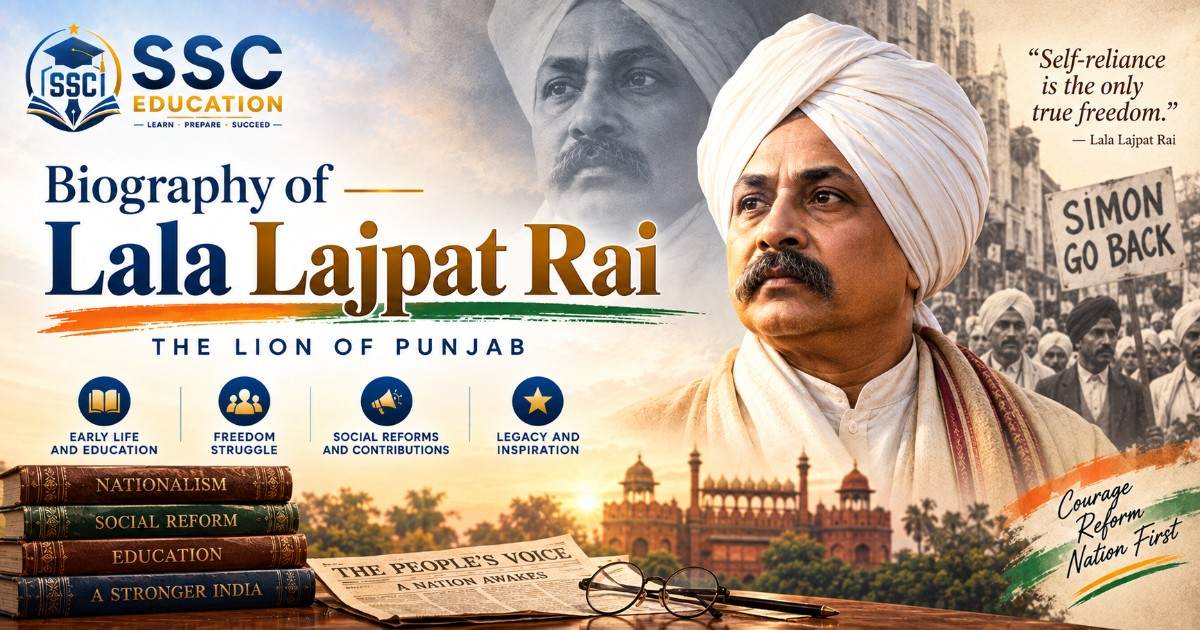
Biography of Lala Lajpat Rai
Rahul Kumar
SSC Exam Expert & Content Editor
Table of Contents
- 1.Introduction
- 2.Quick Facts: Lala Lajpat Rai
- 3.Early Life and Family
- 4.Education and Legal Career
- 5.Arya Samaj and the DAV Movement
- 6.Banker and Businessman: Punjab National Bank and Lakshmi Insurance
- 7.Entry into National Politics
- 8.The Punjab Unrest and Deportation to Mandalay (1907)
- 9.Years in the United States (1914–1920)
- 10.Congress President and the Non-Cooperation Movement (1920)
- 11.Imprisonment and Later Political Career
- 12.Writer and Thinker
- 13.Social Reform and Education
- 14.The Simon Commission and the Lathi Charge (30 October 1928)
- 15.Death and Its Consequences
- 16.The Pagri Sambhal Jatta Movement of 1907
- 17.Economic Nationalism: England's Debt to India
- 18.An Inspiration for the Youth
- 19.Lajpat Rai and the Question of National Unity
- 20.Reading Lala Lajpat Rai Today
- 21.The Lal-Bal-Pal Trio in Perspective
- 22.Lajpat Rai's Views on Education
- 23.The Simon Commission: Background
- 24.Personality and Values
- 25.Legacy and Memorials
- 26.Lesser-Known Facts about Lala Lajpat Rai
- 27.Timeline of Lala Lajpat Rai's Life
- 28.Why Lala Lajpat Rai Is Important for SSC and Other Competitive Exams
- 29.Related Reading
- 30.Conclusion
- 31.Frequently Asked Questions
Complete biography of Lala Lajpat Rai, the Lion of Punjab: early life, DAV and Punjab National Bank, Mandalay, USA years, Simon Commission lathi charge, legacy, timeline and 24 FAQs for SSC exams.
Introduction
Lala Lajpat Rai (28 January 1865 – 17 November 1928), known as Punjab Kesari (the Lion of Punjab), was one of the most fearless leaders of the Indian freedom struggle. A lawyer, educationist, social reformer, banker and writer, he was one-third of the celebrated Lal-Bal-Pal trio and the man whose death from a police lathi charge in Lahore in 1928 changed the course of the revolutionary movement. The words he spoke that day — that the blows struck at him would be the last nails in the coffin of British rule — became one of the most quoted statements of the freedom struggle.
Lajpat Rai's life was remarkable in its range. He helped build the Dayanand Anglo-Vedic (DAV) schools, co-founded the Punjab National Bank, spent months in Mandalay prison without trial, campaigned for India's freedom in the United States, presided over the Congress at the historic Calcutta special session of 1920 and gave his life at the age of sixty-three protesting against the Simon Commission. This detailed biography covers his life, work, writings, death and legacy, together with an exam-oriented revision guide and comprehensive FAQs for SSC and other competitive examinations.
Quick Facts: Lala Lajpat Rai
| Nationality | Indian |
|---|---|
| Best Known For | Freedom fighter known as "Punjab Kesari" (Lion of Punjab), part of the Lal-Bal-Pal trio |
| Born | 28 January 1865, Dhudike, Punjab (now in Moga district) |
| Died | 17 November 1928, Lahore (aged 63), from injuries received in a lathi charge on 30 October 1928 |
| Title | Punjab Kesari (Lion of Punjab); also called Lalaji |
| Father | Munshi Radha Krishna, a teacher of Urdu and Persian |
| Mother | Gulab Devi |
| Wife | Radha Devi |
| Education | Government College, Lahore; studied law |
| Profession | Lawyer (Hisar and Lahore); later full-time public worker |
| Institutions | DAV movement, Punjab National Bank, Lakshmi Insurance Company, Servants of the People Society (1921), National College, Lahore |
| Congress Role | President of the special session at Calcutta (1920) |
| Famous Books | The Story of My Deportation, Young India, England's Debt to India, Unhappy India |
| Famous Slogan | "Simon Go Back" |
Early Life and Family
Lala Lajpat Rai was born on 28 January 1865 in Dhudike, a village in the Malwa region of Punjab, in a family of the Agrawal community. His father, Munshi Radha Krishna, was a government schoolteacher who taught Urdu and Persian and who took a keen interest in religious ideas, while his mother, Gulab Devi, was a deeply devout woman who instilled in her son a strong sense of faith and duty. Lajpat was the eldest of six children, and his younger brother, Dhanpat Rai, later became a teacher and the first headmaster of the school that the family founded in Jagraon.
His early education took place in the schools where his father was posted, including Rewari in present-day Haryana. The family was not wealthy, but the household valued learning, and the young Lajpat grew up reading Urdu and Persian literature as well as English books. He was also drawn to the reform movements then sweeping Punjab. He married Radha Devi, and the couple had children; she stayed largely out of public life but supported his career throughout.
The turning point of his youth was his contact with the Arya Samaj, the reformist movement founded by Swami Dayanand Saraswati. The movement's emphasis on the Vedas, on education, on social reform and on national self-respect appealed to him enormously, and by his early twenties he had become one of its most dedicated workers.
Education and Legal Career
In 1880 Lajpat Rai joined the Government College in Lahore, the finest college in Punjab, where he studied law and also came into contact with a circle of students who would become leaders of the Arya Samaj, including Hans Raj. At college he took an active part in discussions on religion, politics and social reform, which sharpened his talent for public speaking.
After completing his law degree, he began practice in Hisar in 1886, a town in present-day Haryana. There he established himself as a successful lawyer and became a founder of the Bar Council. He was soon involved in public life: he helped set up the branch of the Indian National Congress in Hisar, and in 1888–89 he attended the Congress sessions at Allahabad as a delegate. In 1892 he moved to Lahore, the political and cultural capital of Punjab, and began to practise in the courts of Lahore, where his reputation grew rapidly. In 1914 he gave up his practice to devote himself to the freedom movement.
Arya Samaj and the DAV Movement
When Swami Dayanand died in 1883, his followers in Lahore decided to build a college in his memory that would combine modern education with the values of Vedic culture. Lajpat Rai, together with Hans Raj (later known as Mahatma Hansraj), played a leading role in establishing the Dayanand Anglo-Vedic (DAV) School in Lahore in 1886, and the DAV College soon followed. The DAV institutions were designed to give students an education in English, science and Western subjects alongside Sanskrit and Indian culture, at a time when the alternatives were mission schools or government colleges. Today the DAV network runs hundreds of schools and colleges across India.
Lajpat Rai was a committed Arya Samajist. He edited the Arya Gazette and wrote extensively on the Arya Samaj's ideals, and his book Arya Samaj (1915) remains an important account of the movement. Though he was devout, he opposed narrow sectarianism, and throughout his life he argued that Hindu society must reform itself — addressing caste inequality, the position of women and untouchability — without waiting for the government to do so.
Banker and Businessman: Punjab National Bank and Lakshmi Insurance
Lajpat Rai believed that political freedom needed economic strength. In 1894 he was among the group of Punjabi public figures who founded the Punjab National Bank in Lahore, one of the first banks in India to be managed entirely by Indians and to rely on Indian capital, with the support of leaders such as Dyal Singh Majithia. He also took a leading role in the Lakshmi Insurance Company, an early Indian-owned insurance firm, which was later merged into the Life Insurance Corporation of India in 1956. Punjab National Bank has since grown into one of the largest public-sector banks in India, and it is one of the enduring institutional memorials to his vision.
Entry into National Politics
Lajpat Rai's political career began in earnest at the turn of the century. He wrote regularly for The Tribune of Lahore and for Urdu papers and used them to speak of political and economic grievances, including famine relief, taxation and education. In 1905 he travelled to England with Gopal Krishna Gokhale as part of a Congress delegation to present the Indian case to the British public. Back in India, the partition of Bengal in that same year, the Swadeshi movement and the growing mood of protest pushed him closer to the group of leaders who believed that petitions were not enough. With Bal Gangadhar Tilak in Maharashtra and Bipin Chandra Pal in Bengal, he became one of the leaders of the Extremist wing of the Congress: the trio was known as Lal-Bal-Pal, a name that captured the emergence of a genuinely national movement with leaders in Punjab, Maharashtra and Bengal.
The Punjab Unrest and Deportation to Mandalay (1907)
In 1907 Punjab was in ferment. The government had proposed the Punjab Colonisation Bill, which would have imposed restrictive conditions on farmers in the canal colonies, and had raised water rates in the Bari Doab canal region. Peasants were angry, and Lajpat Rai, along with Ajit Singh (an uncle of Bhagat Singh), addressed meetings to protest. The authorities feared unrest and, in May 1907, arrested Lajpat Rai without trial under an old regulation of 1818 and deported him to Mandalay in Burma. It caused a storm of protest across India and even in Britain, where members of Parliament questioned the government's action.
He spent about six months in Mandalay before the Viceroy, Lord Minto, decided that the evidence against him was insufficient and released him in November 1907. He returned to Lahore to a hero's welcome, and the extremist group proposed his name for the presidency of the Congress at the stormy Surat session that December. He recorded the ordeal in The Story of My Deportation, published in 1908.
Years in the United States (1914–1920)
In 1914 Lajpat Rai travelled to Britain and then to the United States on a mission to inform the world about the Indian national movement. The outbreak of the First World War made it impossible for him to return, and the British government made it clear that he would face difficulties if he did so. He therefore stayed abroad for nearly six years. It was a period of remarkable activity.
In America, he toured the country, visited educational institutions such as Tuskegee University in Alabama, and met leading African American thinkers including Booker T. Washington and W. E. B. Du Bois, drawing parallels between the situation of Black Americans and that of the depressed classes in India. In October 1917 he founded the Indian Home Rule League of America in New York and started a monthly journal, Young India, to make the Indian case known to American readers. He petitioned the Foreign Affairs Committee of the US House of Representatives with a detailed statement on Indian conditions, and his writings were noticed in the Senate.
He wrote several books during this period: The United States of America: A Hindu's Impression (1916), Young India: An Interpretation and a History of the Nationalist Movement from Within (1916), and England's Debt to India (1917), a sharp economic critique of British rule. He returned to India in early 1920 to find a country in transformation, with Gandhi rising as the new leader.
Congress President and the Non-Cooperation Movement (1920)
In September 1920, the Indian National Congress met in a special session at Calcutta to decide the response to the Rowlatt Act, the Jallianwala Bagh massacre and the Khilafat question. Lala Lajpat Rai presided over this session, and it approved Gandhi's proposal for the Non-Cooperation Movement. The programme included the boycott of government schools, courts and titles, and promotion of swadeshi and national education. It was one of the most significant sessions in the history of the Congress because it marked the transition from petitions and reforms to mass civil disobedience.
Lajpat Rai threw himself into the movement in Punjab. He founded the National College in Lahore, housed in Bradlaugh Hall, as an alternative to government institutions, and it later attracted students such as Bhagat Singh. In 1921 he founded the Servants of the People Society (Lok Sewak Mandal), a non-profit organisation modelled on Gokhale's Servants of India Society, for training public workers dedicated to national service. After the partition, the Society shifted its headquarters to Delhi, and it continues to operate today.
Imprisonment and Later Political Career
The government arrested him in December 1921 for his role in the movement, and he was sentenced to about eighteen months' imprisonment. He was released in 1923 in poor health and was elected to the Central Legislative Assembly. In the years that followed, his political thinking went through changes. After the withdrawal of the Non-Cooperation Movement in 1922, he grew concerned about growing Hindu–Muslim tension and about what he saw as a decline in the protection of Hindu interests. He worked with Madan Mohan Malaviya in the Hindu Mahasabha and presided over its Calcutta session in 1925, and he helped to found the Independent Congress Party in the Assembly. Historians debate these choices: some see them as a response to communal tension, while others feel that they contributed to the polarisation of politics. Lajpat Rai himself insisted that he was a nationalist first and that he wanted a united, free India.
In 1928 he published Unhappy India, a reply to Katherine Mayo's controversial book Mother India, which had portrayed Indian society in extremely negative terms. Lajpat Rai defended India's civilisation while also acknowledging its social problems.
Writer and Thinker
Lajpat Rai was among the most prolific writers of the freedom movement. His works include:
- The Story of My Deportation (1908) — his account of the Mandalay deportation.
- Arya Samaj (1915) — a study of the reform movement.
- The United States of America: A Hindu's Impression (1916) — a travelogue and analysis.
- Young India (1916) — an interpretation of the nationalist movement.
- England's Debt to India (1917) — a critique of the economic effects of British rule.
- The Problem of National Education in India (1920) — ideas on education.
- Unhappy India (1928) — a response to Mother India.
- Biographies of Mazzini, Garibaldi, Shivaji and Krishna, which he wrote to inspire Indian youth with examples of national heroes.
He also wrote for The Tribune, edited The People and contributed to English, Urdu and Hindi periodicals. His writing combined economic argument with moral passion.
Social Reform and Education
Lajpat Rai considered social reform inseparable from the freedom struggle. He supported widow remarriage, women's education and the removal of untouchability, and he worked for famine relief and for the welfare of the poor. He also formed trusts in memory of his parents: the Gulab Devi Trust, which built the Gulab Devi Chest Hospital in Lahore (opened in 1934) as a tuberculosis hospital for women, and the R. K. Trust in memory of his father, which supported schools and colleges. His charity was quiet and practical, and he took great pride in institutions that would outlive him.
The Simon Commission and the Lathi Charge (30 October 1928)
In 1927 the British government appointed a commission of seven British members of Parliament, headed by Sir John Simon, to review the working of the constitution and to recommend further reforms. There was not a single Indian member. The Indian national movement saw this as an insult and decided to boycott the commission. Across the country, people prepared to greet it with black flags and the slogan "Simon Go Back".
The Commission reached Lahore on 30 October 1928. Lajpat Rai led a peaceful procession towards the railway station, carrying black flags and shouting slogans. The police, under the Superintendent of Police James A. Scott, ordered a lathi charge to disperse the crowd. Scott personally struck the elderly leader several times on the chest and shoulder. Lajpat Rai was injured but, refusing to be carried away, he addressed a huge public meeting the same evening at Mochi Gate. His voice was calm and determined: he declared that the blows struck at him that day would be the last nails in the coffin of British rule in India.
Death and Its Consequences
Lajpat Rai never recovered from his injuries. His health deteriorated over the next two and a half weeks, and he died on 17 November 1928 in Lahore at the age of sixty-three. Doctors believed that the blows he received on 30 October hastened his death, though the British government denied any connection when the matter was raised in Parliament.
The nation was shocked and angry. A group of young revolutionaries of the Hindustan Socialist Republican Association (HSRA), including Bhagat Singh, Sukhdev, Shivaram Rajguru and Chandra Shekhar Azad, vowed to avenge his death. On 17 December 1928, they shot dead John P. Saunders, an Assistant Superintendent of Police in Lahore, whom they mistook for Scott. The incident, followed by the Central Assembly bomb of April 1929, set in motion the events that led to the trial and execution of Bhagat Singh, Sukhdev and Rajguru in March 1931. In this way Lajpat Rai's death became a turning point in the story of the revolutionary movement.
The Pagri Sambhal Jatta Movement of 1907
The agitation in Punjab in 1907 is remembered in popular memory through a slogan and a song. The government had introduced or amended three laws affecting farmers: the Punjab Land Colonisation Act, the Doab Bari Act and the Punjab Land Alienation Act. Farmers saw them as an attack on their land rights and as a way of raising revenue. Ajit Singh, the uncle of Bhagat Singh, organised a series of rallies under the banner of the Anjuman-e-Mohibban-e-Watan, and at a large gathering at Lyallpur in March 1907 a poet named Banke Dayal recited a song whose refrain, Pagri Sambhal Jatta ("Take care of your turban, O farmer"), became the anthem of the movement.
Lajpat Rai spoke at some of these rallies and defended the peasants' cause in the press. The authorities' decision to deport him and Ajit Singh in May 1907 was a response to this growing mass agitation. The government withdrew the Colonisation Bill in the same year, which was a considerable success for the movement, and the song remains a symbol of peasants' resistance in Punjab even today.
Economic Nationalism: England's Debt to India
Lajpat Rai was among the leaders who combined political demands with economic analysis. In the tradition of Dadabhai Naoroji and R. C. Dutt, who had argued that British rule was draining India's wealth, he studied the economic effects of colonial policy and set out his conclusions in England's Debt to India (1917). The book examined how Indian taxes, trade and railways had been used to benefit Britain, and it argued that Britain owed India a moral and financial debt.
His faith in economic self-reliance also explains his work in banking and insurance. He believed that Indians would remain dependent as long as their savings were kept in foreign-owned institutions, and that a swadeshi bank and insurance company would be a practical form of national service. In this sense, the Punjab National Bank was not just a commercial venture but a statement of national confidence.
An Inspiration for the Youth
Among Lajpat Rai's most lasting influences was the way he drew young people into public life. At the National College in Lahore, students such as Bhagat Singh and Sukhdev discussed history, socialism, and the revolutions of Europe alongside Indian nationalism, in an environment that encouraged questions. Lajpat Rai himself was interested in the ideas of Mazzini and Garibaldi, whose lives he wrote, and he wanted young Indians to learn from the example of European nationalism while building an Indian model of their own.
His personal example was as important as his teaching. When he was struck in October 1928, many of his young admirers felt that an insult to him was an insult to the nation. It is a measure of his influence that a group of revolutionaries, who often disagreed with him on tactics, regarded him as their elder and moved to avenge him when he died.
Lajpat Rai and the Question of National Unity
Lajpat Rai's public positions on religion and community were often misunderstood in his own time and are still debated. As a member of the Arya Samaj he was proud of Hindu culture, but he insisted that his goal was a free and united India in which all communities would have their rights. In 1924 he wrote a series of articles that touched on the problem of communal representation and argued that the country needed guarantees for minorities as well as strong protection for the unity of the nation. Some readers were troubled by his tone, but others saw in them an honest attempt to face a difficult problem at a time of rising tension. What is clear is that he never gave up the ideal of a common struggle against colonial rule, and that he worked alongside Muslim leaders during the Khilafat and Non-Cooperation years.
Reading Lala Lajpat Rai Today
For a modern student, Lajpat Rai's life offers several practical lessons. He shows how a professional career can be combined with public service, since he helped create banks, schools and welfare trusts while working as a lawyer. He demonstrates the value of writing and communication, because his books and journals carried the Indian case to audiences at home and abroad. He shows the importance of institutions: the organisations he helped found have outlived him by almost a century. And he reminds us that peaceful protest, even when it meets violence, can move a nation. Those preparing for competitive exams will find that reading his life as a story — rather than as a list of dates — makes the facts easier to remember and the questions easier to answer.
The Lal-Bal-Pal Trio in Perspective
The trio of Lal-Bal-Pal deserves a closer look because it is the source of many exam questions. In the first decade of the twentieth century, the Congress was dominated by moderate leaders who believed in slow, constitutional progress. The younger extremist leaders argued that this policy had failed and that India needed a movement based on self-reliance, boycott and national education. Bal Gangadhar Tilak in Maharashtra, Bipin Chandra Pal in Bengal and Lala Lajpat Rai in Punjab became the three most visible leaders of this trend. Together they gave the movement a national character: it was no longer a matter of one province or one language.
Each brought something different. Tilak brought mass mobilisation through festivals and newspapers, Bipin Chandra Pal brought powerful oratory and the ideal of spiritual nationalism in Bengal, and Lajpat Rai brought organisational skill, the Arya Samaj network and a following among Punjab's educated middle class and peasantry. Their disagreements with the moderates led to the Surat split of 1907, but their ideas — Swaraj, Swadeshi, boycott and national education — became the programme of the Congress in the years that followed.
Lajpat Rai's Views on Education
Education was central to Lajpat Rai's thinking. He believed that a colonial education system produced clerks and not citizens, and that India needed schools that would teach science and modern subjects while rooting students in their own culture. He supported the DAV schools for this reason, and when the Non-Cooperation Movement was launched, he founded the National College in Lahore as an institution free from government control. In The Problem of National Education in India (1920) he argued for a system that would promote character, physical fitness, technical skills and a spirit of service. Students of the National College, including the young Bhagat Singh, were encouraged to read widely, debate political questions and think independently — an atmosphere that produced many of Punjab's revolutionaries and public workers.
The Simon Commission: Background
To understand the events of 1928 it helps to know why the Simon Commission was so unpopular. The Government of India Act of 1919 had promised that a commission would review the reforms after ten years, and the Conservative government in Britain decided to appoint it two years early, in 1927, fearing a Labour victory in the next election. It chose seven British members of Parliament, and no Indians, to decide the future of India. Indian leaders across the political spectrum saw this as a deliberate insult to the country's right to determine its own constitution. The Congress, the Muslim League (in most of its sections) and the Liberal Federation all decided to boycott the Commission. Its visits to different cities were met with black flags, demonstrations and the slogan "Simon Go Back", and Lahore was one of the most important of these protests because of Lajpat Rai's leadership. The response to the Commission also led Indian leaders to prepare their own draft constitution, the Nehru Report of 1928.
Personality and Values
Contemporaries described Lajpat Rai as a man of great physical courage, firm convictions and generous instincts. He was fond of arguing his case in public but rarely spoke ill of opponents, and even the British officials who imprisoned him acknowledged his sincerity. He lived a simple life, gave away much of his income to public causes and worked long hours. To the youth of Punjab he was a father-figure; the title Punjab Kesari, given by his admirers, expressed the affection and pride with which people regarded him.
Legacy and Memorials
Lala Lajpat Rai's memory is preserved in many institutions and places across India:
- Punjab National Bank: Founded in 1894 with his participation, it is still one of India's largest public-sector banks.
- Servants of the People Society: The organisation he founded in 1921 continues to work in Delhi.
- Lajpat Nagar, New Delhi: A well-known residential and market area, named in his honour.
- Educational institutions: The Lala Lajpat Rai University of Veterinary and Animal Sciences at Hisar, the Lala Lajpat Rai Memorial Medical College at Meerut, the Lala Lajpat Rai College of Commerce and Economics in Mumbai and many others carry his name.
- Stamp and monuments: India issued a commemorative postage stamp on 28 January 1965 on his birth centenary, and statues of Lalaji stand in Shimla, Hisar, Jagraon and other cities.
- Cinema and culture: Films, documentaries and books have depicted his life, and his sacrifice is a regular part of school curricula.
Lesser-Known Facts about Lala Lajpat Rai
- He was one of the founders of the Punjab National Bank, the first Indian bank to be founded on the strength of Indian capital.
- He toured the United States between 1914 and 1919 and founded the Indian Home Rule League of America in 1917.
- Bhagat Singh studied at the National College that Lajpat Rai founded in Lahore.
- He was deported to Mandalay in 1907 without trial, but was released after about six months.
- Even after being struck on 30 October 1928, he spoke to a public meeting the same evening.
- His death led directly to the revolutionary action of December 1928 in Lahore.
- He wrote a critical response, Unhappy India, to Katherine Mayo's Mother India.
- He shared a close association with the Arya Samaj and edited its journal, the Arya Gazette.
Timeline of Lala Lajpat Rai's Life
| Year | Event |
|---|---|
| 1865 | Born at Dhudike, Punjab, on 28 January |
| 1880 | Joined Government College, Lahore |
| 1886 | Started law practice at Hisar; helped found the DAV School at Lahore |
| 1888–89 | Attended Congress sessions as a delegate |
| 1892 | Moved to Lahore |
| 1894 | Took part in founding Punjab National Bank |
| 1905 | Visited England with Gokhale as a Congress delegate |
| 1907 | Deported to Mandalay in May; released in November |
| 1908 | Published The Story of My Deportation |
| 1914–1920 | Lived in Britain and the United States |
| 1917 | Founded the Indian Home Rule League of America |
| 1920 | Presided over the special Congress session at Calcutta |
| 1921 | Founded the Servants of the People Society; arrested in December |
| 1925 | Presided over the Hindu Mahasabha session at Calcutta |
| 1928 | Struck in the Simon Commission protest on 30 October; died on 17 November |
Why Lala Lajpat Rai Is Important for SSC and Other Competitive Exams
Lajpat Rai regularly appears in the modern history portion of General Awareness papers for SSC CGL, CHSL, MTS, GD Constable and Stenographer, as well as railway and state-level examinations. The following points are frequently tested.
- Known as Punjab Kesari (Lion of Punjab) and one of the Lal-Bal-Pal trio.
- Died on 17 November 1928 from injuries in the Simon Commission protest at Lahore (30 October 1928).
- Presided over the special session of the Congress at Calcutta in 1920, which approved Non-Cooperation.
- Co-founder of the Punjab National Bank (1894) and the DAV movement.
- Founded the Servants of the People Society in 1921 and the National College, Lahore.
- Founded the Indian Home Rule League of America (1917) and the journal Young India in New York.
- Books: The Story of My Deportation, Young India, England's Debt to India, Unhappy India.
- His death led to the killing of Saunders on 17 December 1928 by Bhagat Singh and Rajguru.
To fix these facts, link them in pairs: Lalaji and Lahore (30 October 1928, Simon Go Back), Lalaji and Calcutta (1920 Congress president) and Lalaji and Punjab National Bank (1894).
Related Reading
Conclusion
Lala Lajpat Rai's life can be read as a series of choices in favour of the difficult path: leaving a prosperous legal practice, accepting deportation instead of silence, going into exile to plead India's cause and finally facing the police lathis at the age of sixty-three because he believed in peaceful protest. He built banks, schools and societies that still exist, wrote books that still teach, and inspired a generation of young Indians who took up the struggle after him. For students, he offers a rich set of dates and facts; for everyone, he represents a courage that did not depend on comfort.
Frequently Asked Questions
Who was Lala Lajpat Rai?
Lala Lajpat Rai (1865–1928) was an Indian freedom fighter, lawyer, writer and social reformer, known as Punjab Kesari and one of the Lal-Bal-Pal trio.
When and where was Lala Lajpat Rai born?
He was born on 28 January 1865 in Dhudike, a village in Punjab (now in Moga district).
Why is Lala Lajpat Rai called Punjab Kesari?
He is called Punjab Kesari, meaning Lion of Punjab, because of his courage and leadership in the freedom struggle in Punjab.
Who are Lal, Bal and Pal?
Lal is Lala Lajpat Rai (Punjab), Bal is Bal Gangadhar Tilak (Maharashtra) and Pal is Bipin Chandra Pal (Bengal), the three prominent leaders of the Extremist wing of the Congress.
How did Lala Lajpat Rai die?
He died on 17 November 1928 in Lahore from injuries he suffered when police, led by James Scott, charged with lathis on a peaceful procession against the Simon Commission on 30 October 1928.
What slogan was raised against the Simon Commission?
The slogan was Simon Go Back, raised by protesters who carried black flags because the Commission had no Indian member.
What did Lajpat Rai say after the lathi charge?
He said that the blows struck at him that day would be the last nails in the coffin of British rule in India.
Which bank was founded by Lala Lajpat Rai?
He was one of the founders of the Punjab National Bank, established in Lahore in 1894 as an Indian-owned bank.
What was Lajpat Rai's role in the DAV movement?
With Hans Raj and other Arya Samaj leaders, he helped establish the Dayanand Anglo-Vedic School in Lahore in 1886, which grew into the DAV network of schools and colleges.
When was Lala Lajpat Rai the Congress President?
He presided over the special session of the Indian National Congress at Calcutta in September 1920, where the Non-Cooperation Movement was approved.
Why was Lala Lajpat Rai deported to Mandalay?
In 1907 the government deported him without trial to Mandalay in Burma for his role in the agitation against the Punjab Colonisation Bill and rising water rates; he was released after about six months.
Which books were written by Lala Lajpat Rai?
His books include The Story of My Deportation, Arya Samaj, The United States of America: A Hindu's Impression, Young India, England's Debt to India and Unhappy India.
What is the Servants of the People Society?
It is a non-profit organisation founded by Lajpat Rai in 1921 in Lahore to train public workers for national service; it later moved to Delhi after Partition.
What is the National College, Lahore?
It was an institution founded by Lajpat Rai in 1921 in Bradlaugh Hall, Lahore, as an alternative to government colleges; Bhagat Singh was one of its students.
What did Lajpat Rai do in the United States?
He stayed there from 1914 to 1920, founded the Indian Home Rule League of America in 1917, started the journal Young India and wrote books and petitions about India's freedom.
How is Lajpat Rai's death linked to Bhagat Singh?
To avenge his death, Bhagat Singh, Rajguru and others of the HSRA shot John Saunders, mistaking him for Scott, on 17 December 1928.
What is Unhappy India?
Unhappy India (1928) is Lajpat Rai's book written in reply to Katherine Mayo's Mother India, defending Indian society while acknowledging its problems.
Who was Lajpat Rai's wife?
His wife was Radha Devi, who supported his life and work though she remained largely out of public life.
Which hospital was set up in memory of Lajpat Rai's mother?
The Gulab Devi Chest Hospital in Lahore, opened in 1934 through a trust he created in her memory, was set up as a tuberculosis hospital for women.
What is Lajpat Nagar in Delhi named after?
Lajpat Nagar, a well-known area in South Delhi, is named in honour of Lala Lajpat Rai.
Which stamp was issued in memory of Lajpat Rai?
India issued a commemorative postage stamp on 28 January 1965 to mark his birth centenary.
What was Lajpat Rai's connection with the Arya Samaj?
He was a devoted member of the Arya Samaj, edited its journal Arya Gazette, wrote a book on the movement and worked for its educational programme.
Which dates related to Lala Lajpat Rai should I remember for SSC exams?
Remember 28 January 1865 (birth), 1894 (Punjab National Bank), 1907 (Mandalay), 1920 (Congress President), 1921 (Servants of the People Society), 30 October 1928 (lathi charge) and 17 November 1928 (death).
Why is Lala Lajpat Rai important in Indian history?
He helped popularise the demand for Swaraj, built institutions in banking and education, and his sacrifice in 1928 inspired the revolutionary movement.
Rahul Kumar
SSC Exam Expert & Content Editor
Rahul is a senior SSC exam strategist with 8+ years of experience helping aspirants crack CGL, CHSL and MTS exams. He writes in-depth notification breakdowns, exam pattern guides and preparation strategies.