
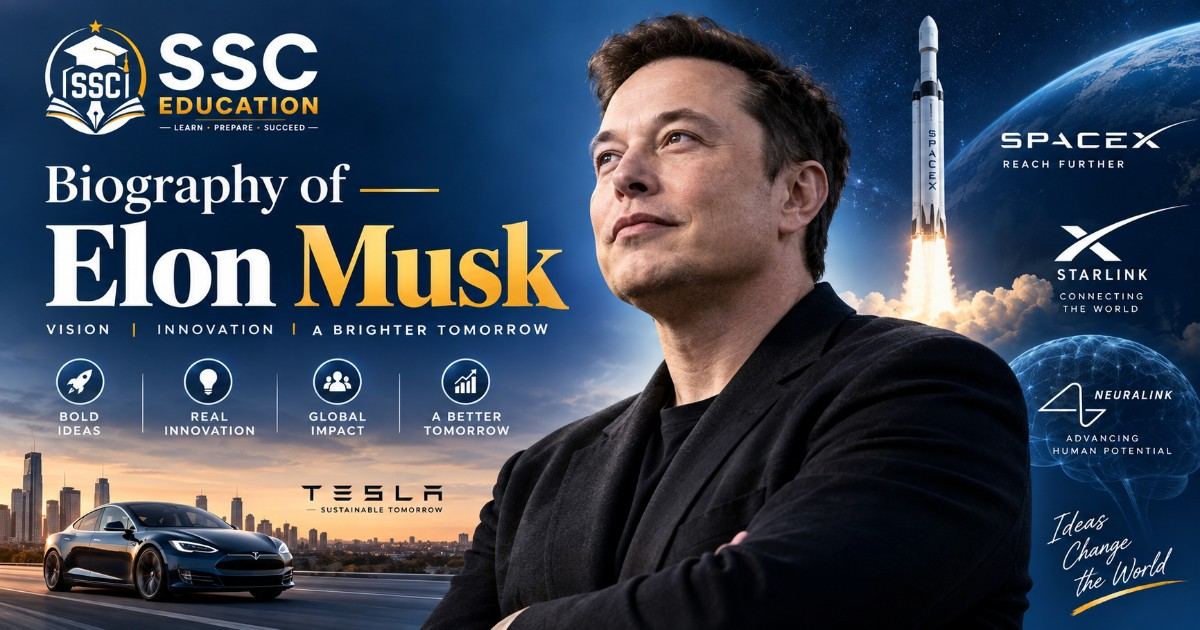
Biography of Elon Musk
Rahul Kumar
SSC Exam Expert & Content Editor
Table of Contents
- 1.Introduction
- 2.Quick Facts: Elon Musk
- 3.Early Life and Family
- 4.First Computer and First Software Sale
- 5.Leaving South Africa and Studying in Canada and the United States
- 6.Zip2 (1995–1999)
- 7.X.com and PayPal (1999–2002)
- 8.SpaceX: The Making of a Rocket Company (2002–present)
- 9.SpaceX, xAI and the Record IPO of 2026
- 10.Tesla: Electric Cars and Clean Energy
- 11.SolarCity and Tesla Energy
- 12.Neuralink, The Boring Company and Other Ventures
- 13.Buying Twitter and Creating X (2022–2023)
- 14.xAI and Grok
- 15.The Department of Government Efficiency (2025)
- 16.Elon Musk and India
- 17.Wealth and Net Worth
- 18.Musk's Vision: Sustainable Energy and a Multi-Planetary Future
- 19.Leadership and Work Style
- 20.Personal Life
- 21.Criticism and Controversies
- 22.Awards and Honours
- 23.Lesser-Known Facts about Elon Musk
- 24.Timeline of Elon Musk's Life and Career
- 25.Elon Musk's Companies at a Glance
- 26.Why Elon Musk Is Important for General Knowledge and Competitive Exams
- 27.Related Reading
- 28.Conclusion
- 29.Frequently Asked Questions
Complete biography of Elon Musk: early life, PayPal, SpaceX, Tesla, X (Twitter), xAI, the 2026 SpaceX IPO, Starlink in India, net worth, timeline and 25 FAQs for general knowledge and competitive exams.
Introduction
Elon Musk (born 28 June 1971) is a South African-born entrepreneur and engineer who has built, funded or led some of the best-known technology companies of the twenty-first century: SpaceX, Tesla, X (formerly Twitter), xAI, Neuralink and The Boring Company, among others. Starting with a small software business in the 1990s and a payments company that became PayPal, he went on to challenge two of the most established industries in the world — the car industry and the aerospace industry — and to do so with a stated purpose: to accelerate the world's transition to sustainable energy and to make humanity a multi-planetary species.
Few business leaders of the present day are as admired, as criticised or as closely followed as Musk. His companies have produced reusable orbital rockets, the world's largest satellite internet network and the best-selling electric cars, while his own statements, political involvement and management style have attracted intense debate. As of September 2026, he is widely reported to be the richest person in the world, after SpaceX's record-breaking stock market debut and its merger with his artificial-intelligence company, xAI. This biography covers his childhood, education, companies, controversies and recent developments up to September 2026, and includes a revision guide and detailed FAQs useful for general knowledge, current affairs and competitive examinations.
Quick Facts: Elon Musk
| Nationality | South African-born American (also holds Canadian citizenship) |
|---|---|
| Best Known For | CEO of SpaceX and Tesla; owner of X (formerly Twitter) |
| Full Name | Elon Reeve Musk |
| Born | 28 June 1971, Pretoria, South Africa (aged 55 in 2026) |
| Citizenship | South Africa, Canada and the United States |
| Parents | Errol Musk (engineer) and Maye Musk (model and dietitian) |
| Siblings | Kimbal Musk (brother) and Tosca Musk (sister) |
| Education | Queen's University (Canada); University of Pennsylvania (B.A. in Physics and B.S. in Economics from the Wharton School) |
| Companies | Zip2, X.com/PayPal, SpaceX, Tesla, SolarCity, Neuralink, The Boring Company, xAI, X Corp. |
| Current Roles (2026) | CEO and chief engineer of SpaceX; CEO and product architect of Tesla; owner of X |
| Major Achievements | Reusable orbital rockets, Starlink, mass-market electric vehicles |
| Government Role | Head of the Department of Government Efficiency (DOGE), January–May 2025 |
| Net Worth (September 2026) | Estimated at roughly $900 billion to over $1 trillion, depending on the source and the day's share prices |
| Honours | Fellow of the Royal Society; Time Person of the Year (2021) |
Early Life and Family
Elon Musk was born on 28 June 1971 in Pretoria, then the administrative capital of apartheid-era South Africa. His father, Errol Musk, was an electromechanical engineer, pilot and property developer; his mother, Maye Musk (born Maye Haldeman in Canada), was a model and dietitian who would become well known in her own right. Elon was the eldest of three children, with a brother, Kimbal, and a sister, Tosca. The children's early years were comfortable, though the household was marked by conflict, and the parents divorced when Elon was about nine or ten years old.
After the divorce, Elon chose to live with his father, a decision that he has since said he regretted. He has spoken of a difficult relationship with Errol and of a childhood in which he retreated into books. He was a shy, intensely curious boy who read voraciously — he has said that he read the entire Encyclopaedia Britannica at one point and devoured science fiction, especially the works of Isaac Asimov, Robert Heinlein and Douglas Adams. The last of these, particularly The Hitchhiker's Guide to the Galaxy, shaped his belief that the way to deal with the big questions of existence is to ask better questions and to expand the scope of human consciousness.
School was often painful. He was bullied severely at several schools in South Africa, and on one occasion he was hospitalised after being beaten and thrown down a flight of stairs by other boys. He also attended a rough wilderness-style survival camp as a teenager, which he has described in interviews as an experience not unlike Lord of the Flies. These experiences, he has said, left him with a very high tolerance for hardship and an unusual willingness to face risk.
First Computer and First Software Sale
Musk's interest in computers began early. At the age of about ten he got his first computer, a Commodore VIC-20, and taught himself to program. At twelve, in 1983, he wrote a simple space video game in BASIC called Blastar and sold the source code to a South African computer magazine for about five hundred dollars — his first commercial software sale. He was already dreaming about the ways in which technology could change the world, and he has said that he set himself the goal of working on problems that affected the future of humanity.
Leaving South Africa and Studying in Canada and the United States
After finishing school at Pretoria Boys High School, Musk briefly attended the University of Pretoria in 1989 but left after five months. His maternal grandfather was Canadian-born, and through his mother he was eligible for Canadian citizenship. Wishing to avoid compulsory service in the South African military, which was then enforcing apartheid, and hoping to move to the United States, he left for Canada in 1989. He worked at odd jobs, including farm labour and lumber-mill work, and then enrolled at Queen's University in Kingston, Ontario, in 1990.
In 1992 he transferred to the University of Pennsylvania, where he completed two bachelor's degrees: a Bachelor of Science in Economics from the Wharton School and a Bachelor of Arts in Physics. He has explained that he chose these subjects because physics provides the framework for understanding the universe, while economics helps to understand how businesses and societies work. In 1994 he held summer internships at Pinnacle Research Institute, which was working on energy storage in ultracapacitors, and at Rocket Science Games, a video game company in Palo Alto. He was accepted for a doctoral programme in materials science at Stanford University in 1995 but left after only two days to start a company during the early boom of the internet.
Zip2 (1995–1999)
In 1995, Musk, his brother Kimbal and a friend, Greg Kouri, founded Zip2, a company that provided online city guides and maps for newspapers. Musk wrote much of the early software himself, and the founders lived in the office, sleeping on a couch and showering at the local YMCA. The company signed deals with major newspapers, and in February 1999 it was sold to Compaq for about $307 million. Musk's share was about $22 million, a considerable sum for a twenty-seven-year-old, which he immediately reinvested in a new venture.
X.com and PayPal (1999–2002)
With the proceeds of Zip2, Musk co-founded X.com in 1999, an online financial services and payments company. In March 2000, X.com merged with Confinity, a rival company led by Peter Thiel and Max Levchin that had developed a payment service called PayPal, and Musk became the largest shareholder of the merged company. After disagreements with other executives over technology and management, Musk was replaced as CEO, and the company was renamed PayPal in 2001. In October 2002, PayPal was acquired by eBay for about $1.5 billion. Musk, who owned about 11.7 per cent of the company, received approximately $175 million. Years later, in 2017, he bought back the domain name X.com from PayPal, a hint of the importance he attached to the name.
The PayPal money gave Musk the resources to pursue an idea that had been forming in his mind for a long time: that human survival depended on becoming a multi-planetary species. It was to be the start of his most ambitious venture.
SpaceX: The Making of a Rocket Company (2002–present)
In May 2002, Musk founded Space Exploration Technologies Corp., or SpaceX, with about $100 million of his own money, and became its CEO and chief engineer. His goal was to dramatically reduce the cost of access to space and, ultimately, to enable human settlement on Mars. At the time, the idea of a private company building orbital rockets seemed almost absurd to many in the aerospace industry, since rockets had always been built by governments and large defence contractors, and each rocket was used only once.
The early years were extremely hard. SpaceX's first rocket, the small Falcon 1, failed in its first three launch attempts, in 2006, 2007 and August 2008. By then the company was almost out of money, and Tesla, Musk's other company, was also in financial trouble. On 28 September 2008, the fourth Falcon 1 launch succeeded, making it the first privately developed liquid-fuelled rocket to reach orbit. A few months later, in December 2008, NASA awarded SpaceX a $1.6 billion contract to carry cargo to the International Space Station using its new Falcon 9 rocket and Dragon spacecraft, which saved the company.
Falcon 9, Dragon and Reusability
Falcon 9 first flew in June 2010, and in May 2012 SpaceX's Dragon became the first commercial spacecraft to dock with the International Space Station. The company's greatest technical achievement, however, was the reuse of rockets. Conventional rockets are discarded after a single launch, but SpaceX developed technology to land the first stage of the Falcon 9 vertically. After several failed attempts to land on a floating platform, it succeeded in landing a booster on the ground at Cape Canaveral in December 2015, and later landed boosters on drone ships in the ocean. By reusing boosters many times, the company cut launch costs and made itself the dominant launch provider in the world.
In February 2018, SpaceX launched the Falcon Heavy, then the most powerful operational rocket in the world, with a red Tesla Roadster and a mannequin named "Starman" as its unusual payload, sent into orbit around the Sun. In May 2020, the company's Crew Dragon spacecraft carried NASA astronauts Bob Behnken and Doug Hurley to the International Space Station on the Demo-2 mission, the first crewed orbital flight launched from the United States since the end of the Space Shuttle programme in 2011 and the first by a private company. Since then SpaceX has flown many crewed missions for NASA and for private customers.
Starlink
Beginning in 2015, SpaceX worked on Starlink, a constellation of thousands of small satellites in low Earth orbit that provides broadband internet to customers around the world, including in remote areas. The first batch of operational satellites was launched in May 2019, and by mid-2025 there were more than seven thousand working Starlink satellites, which accounted for a very large share of all operational satellites in orbit. Starlink has become a major source of revenue for SpaceX, and its use in conflict zones, such as Ukraine, has also drawn political attention. The company has also developed a defence-oriented variant, Starshield.
Starship
The most ambitious SpaceX project is Starship, a fully reusable super-heavy-lift launch system that consists of a giant booster called Super Heavy and an upper stage called Starship. It is designed to carry around 100 tonnes to low Earth orbit and, in the long term, to carry people and cargo to the Moon and Mars. Starship has been developed through a series of test flights beginning in 2023, some of which ended in explosions, in what the company calls a "test, fail, fix" approach. In October 2024, SpaceX caught a returning Super Heavy booster with the mechanical arms of its launch tower, a feat that had never been attempted before. NASA has selected a version of Starship as the human landing system for its Artemis programme to return astronauts to the Moon, and in its 2026 public filing SpaceX said that it expected Starship to begin delivering payloads to orbit in the second half of 2026.
SpaceX, xAI and the Record IPO of 2026
The year 2026 was a landmark for Musk's business empire. On 2 February 2026, SpaceX agreed to acquire xAI, Musk's artificial-intelligence company, in an all-stock deal that made xAI a wholly owned subsidiary and combined SpaceX's rockets and Starlink with xAI's Grok chatbot, its large computing clusters and the X social media platform. The combined company was valued at well over a trillion dollars.
In May 2026 SpaceX filed to go public, and in June 2026 it completed what was reported as the largest initial public offering in history, raising about $75 billion at a valuation of roughly $1.75 trillion, according to news reports. Musk, who holds a large stake and serves as CEO, chief technology officer and chairman, briefly became the first person whose estimated net worth exceeded one trillion dollars. The stock later fell from its early highs, and his estimated fortune has fluctuated since. Analysts have pointed out that the company's valuation rests heavily on expectations about Starlink, Starship and artificial intelligence, and that these expectations carry risk.
Tesla: Electric Cars and Clean Energy
In February 2004, Musk joined Tesla Motors, a young company founded in 2003 by Martin Eberhard and Marc Tarpenning, as its lead investor and chairman, putting in about $6.35 million in the Series A round. He became involved in product design and strategy, and, after a period of internal disagreement and financial crisis in 2007–08, took over as CEO in 2008, a position he still holds along with the title of product architect. Legal disputes have led to the company's founders being recognised as co-founders alongside him.
Tesla's first product, the Roadster (2008), was an electric sports car built on a Lotus chassis and proved that electric vehicles could be fast and desirable. The Model S (2012), a luxury sedan, showed that they could be practical and won awards for its range and performance. The Model X (2015), Model 3 (2017), Model Y (2020) and Cybertruck (2023) followed. The Model 3 and Model Y made Tesla a mass-market manufacturer, and the Model Y became one of the best-selling cars in the world in several recent years. Tesla built large "Gigafactories" for batteries and cars in Nevada, Shanghai, Berlin and Texas, and it developed a network of fast chargers, called Superchargers, that other manufacturers have since adopted.
The company went public in June 2010, joined the S&P 500 in December 2020 and reached a market capitalisation of $1 trillion in October 2021. In November 2025, Tesla shareholders approved a pay package for Musk that could be worth up to roughly one trillion dollars over ten years if the company reaches very ambitious targets, including a market value of several trillion dollars. The package was among the largest ever proposed and drew both support and criticism.
SolarCity and Tesla Energy
Musk was also involved in solar energy. SolarCity, a solar installation company founded in 2006 by his cousins Lyndon and Peter Rive with his financial backing, was acquired by Tesla in August 2016 for about $2 billion and merged into Tesla Energy. The unit now sells home batteries called Powerwall, large grid-scale batteries called Megapack and solar products, and it has become a fast-growing part of Tesla's business. The acquisition led to a shareholder lawsuit, which the courts eventually decided in Musk's favour.
Neuralink, The Boring Company and Other Ventures
- Neuralink (founded 2016): A neurotechnology company developing brain-computer interfaces, with the aim of helping people with paralysis and, in the long run, connecting human brains with computers. It received approval to begin human trials in 2023, and its first human implant took place in January 2024. The company has also faced scrutiny over animal-testing practices.
- The Boring Company (2016–17): A tunnelling company started to reduce urban traffic by building low-cost underground tunnels. Its best-known project is the Las Vegas Convention Center Loop, completed in 2021, where Tesla cars carry passengers through tunnels.
- Hyperloop (2013): Musk published a concept for a high-speed vacuum-tube transport system between Los Angeles and San Francisco, which he offered as an open idea for others to develop, and SpaceX sponsored student pod competitions.
- OpenAI (2015–2018): Musk was a co-founder and early donor of OpenAI, the research organisation behind ChatGPT, but left its board in 2018 after disagreements. He has since criticised the organisation and been involved in legal disputes with it.
Buying Twitter and Creating X (2022–2023)
In April 2022, Musk became the largest shareholder of Twitter with a stake of about 9.2 per cent, and, after first being offered a seat on the board, made an offer to buy the whole company for about $44 billion. After months of legal wrangling, in which he tried to back out of the deal and was taken to court, the acquisition was completed on 27 October 2022. Musk immediately dismissed the company's chief executive and other senior officials, took over as CEO and carried out large layoffs, reducing the workforce sharply.
He introduced a paid subscription for verified status, changed content-moderation rules, restored many suspended accounts and released internal documents known as the "Twitter Files" concerning earlier moderation decisions. In July 2023 the platform was renamed X, as part of Musk's plan to create an "everything app" that would combine social networking, payments and other services. The changes were praised by supporters as a defence of free speech and criticised by others for an increase in hate speech and misinformation and for a large fall in advertising revenue. Musk later handed the CEO role to another executive and stayed on as executive chairman and chief technology officer. In 2026, X became part of SpaceX after the xAI merger.
xAI and Grok
In July 2023, Musk founded xAI to build advanced artificial intelligence, saying that he wanted to create an AI that seeks the truth. The company released its chatbot Grok in November 2023, integrated it with X and gradually released newer versions (Grok-2, Grok-3, Grok-4 and later releases). xAI built very large computing clusters in Memphis, Tennessee, to train its models. Grok has been praised for its speed of development and criticised for problematic outputs on several occasions, including the spread of conspiracy theories and offensive content, and for the creation of inappropriate images. In February 2026, xAI was merged into SpaceX, tying the future of Musk's AI ambitions to his space and satellite business.
The Department of Government Efficiency (2025)
Musk was one of the biggest donors to Donald Trump's campaign in the 2024 US election, supporting it through a political committee called America PAC. After Trump's victory, he was named to lead the Department of Government Efficiency (DOGE), a temporary body created to reduce federal spending and reorganise agencies. From 20 January 2025 until 30 May 2025, Musk served as a Senior Advisor to the President in that capacity. His work led to large cuts in staff and programmes in agencies including the US Agency for International Development, drew protests and lawsuits, and hurt Tesla's brand in some markets. Musk left the role in May 2025 to concentrate on his companies, and a public disagreement with Trump followed. The episode remains one of the most debated parts of his career.
Elon Musk and India
Musk's businesses have also entered the Indian market. Tesla opened its first showroom in India, at the Bandra Kurla Complex in Mumbai, on 15 July 2025, initially offering the Model Y at an ex-showroom price of about ₹60 lakh, with deliveries beginning later that year; the high price, caused partly by import duties, has limited its early sales. Starlink, SpaceX's satellite internet service, received a licence from India's Department of Telecommunications in 2025 to provide satellite communication services, and its launch depends on the allocation of spectrum and further approvals. Musk has expressed interest in India's market and has met Prime Minister Narendra Modi on more than one occasion. For Indian students, these developments make Musk a common subject in current affairs questions.
Wealth and Net Worth
Musk has been ranked as the world's richest person since 2025 in most lists. His wealth is largely made up of shares in SpaceX and Tesla, and it rises and falls with their prices. After the SpaceX IPO in June 2026, Musk briefly became the first person with an estimated net worth above one trillion dollars; the figure fell when the stock declined and stood at around $900 billion according to a Forbes estimate in September 2026, while some trackers put it higher. It is worth remembering that such estimates are approximate, that they differ across publications and that they change daily. Most of his wealth is tied up in company shares rather than held as cash.
Musk's Vision: Sustainable Energy and a Multi-Planetary Future
Behind Musk's varied businesses is a set of long-term ideas that he has described repeatedly. The first is that the world must move away from fossil fuels to sustainable energy, which he addressed through Tesla, SolarCity and later Tesla Energy. The second is that humanity should become a multi-planetary species, so that a disaster on Earth would not end civilisation, which he addresses through SpaceX and its plan to build a self-sustaining city on Mars. The third, more recent, is that artificial intelligence will be among the most powerful technologies of the century and must be developed carefully, which motivated his early role in OpenAI and later the creation of xAI. Critics point out that some of his timelines, such as those for full self-driving cars and for Mars missions, have been repeatedly delayed, and that his statements are sometimes more ambitious than his results. Supporters reply that his companies have achieved things that experts once considered impossible.
He has also described a "Master Plan" for Tesla, published in several parts since 2006, which laid out how the company would begin with expensive cars and use the profits to develop cheaper models, generate clean energy and eventually enable autonomous driving.
Leadership and Work Style
Musk is known for a demanding management style. He is closely involved in engineering details, holds staff to extremely high standards and pushes for aggressive schedules, and he often works very long hours. He has spoken about reasoning from "first principles" — breaking a problem down to its basic physical facts rather than reasoning by analogy — as the core of his approach. For instance, he has said that when he found that rockets were expensive, he asked what the raw materials cost and then designed a way of building rockets without the huge markup. His companies are known for vertical integration, meaning that they make many components in-house, and for a willingness to fail publicly during testing.
This style has produced both success and controversy. Former employees have described a high-pressure culture, and some of his companies have faced lawsuits about workplace conditions and management decisions. Musk manages several companies at once, a fact that has led investors and analysts to question whether he can give each of them enough attention. Yet he has repeatedly shown an ability to attract talented engineers and to inspire loyalty among many of them.
Personal Life
Musk has been married and in relationships several times and is reported to have around fourteen children. His first marriage, to the Canadian author Justine Wilson, lasted from 2000 to 2008; he later married and divorced the British actress Talulah Riley twice between 2010 and 2016, and he had a relationship with the musician Grimes from 2018 to 2021. He has generally kept his family life relatively private, although parts of it have been widely reported. He is an admirer of science fiction and has said that his interests include history, physics, engineering and video games. He was baptised in the Anglican church in South Africa but describes his own beliefs in more philosophical than religious terms.
Criticism and Controversies
Musk's rise has been accompanied by a good deal of criticism, and a fair biography should mention the main points. Regulators, courts and commentators have raised concerns in several areas:
- Social media and speech: After the takeover of Twitter, critics said that reduced moderation led to an increase in misinformation and hate speech on X, and accused Musk of amplifying conspiracy theories. He and his supporters say that he was defending free speech.
- Political involvement: His support for President Trump and involvement in DOGE, and his comments on politics in several countries, have been controversial, and have led to protests at Tesla showrooms and to a decline in Tesla's popularity in some markets.
- Regulatory disputes: In 2018 he settled with the US Securities and Exchange Commission over a tweet claiming that funding had been secured to take Tesla private, and stepped down as chairman of Tesla; Tesla's driver-assistance features have been subject to investigations and lawsuits over safety claims.
- Workplace issues: Companies including Tesla, SpaceX and X have faced lawsuits about working conditions, layoffs and discrimination claims.
- Grok and AI: The Grok chatbot has been criticised for generating offensive and false content and inappropriate images, prompting discussion about safeguards.
- Accuracy of forecasts: Many of his timelines and promises, such as for self-driving cars, Mars landings and the Hyperloop, have been delayed or unmet.
Musk's supporters argue that his critics underestimate what he has achieved and that many criticisms are politically motivated. The truth, as with many public figures, lies in weighing achievements and failures together.
Awards and Honours
- Fellow of the Royal Society (elected 2018)
- Time magazine's Person of the Year (2021)
- Numerous engineering and business awards for SpaceX, Tesla and related work
- Honorary doctorates and recognition by aerospace and industry organisations
Lesser-Known Facts about Elon Musk
- He sold his first computer game, Blastar, when he was twelve years old for about $500.
- He holds citizenship of three countries: South Africa, Canada and the United States.
- He nearly ran out of money in 2008, when both SpaceX and Tesla were close to bankruptcy, and reportedly invested his remaining personal funds to save them.
- SpaceX's Falcon 1 succeeded on its fourth attempt after three failures.
- The first payload of the Falcon Heavy was his own Tesla Roadster, which is now in orbit around the Sun.
- He bought back the domain X.com in 2017 and later renamed Twitter as X.
- He was the chairman of SolarCity, which was founded by his cousins.
- He is often described as a fan of Douglas Adams's The Hitchhiker's Guide to the Galaxy, and some of his projects are named with jokes from science fiction.
Timeline of Elon Musk's Life and Career
| Year | Event |
|---|---|
| 1971 | Born in Pretoria, South Africa (28 June) |
| 1983 | Sold the game Blastar at age twelve |
| 1989 | Moved to Canada |
| 1992–1995 | Studied at the University of Pennsylvania (degrees in physics and economics) |
| 1995 | Co-founded Zip2 |
| 1999 | Sold Zip2 to Compaq; co-founded X.com |
| 2002 | PayPal sold to eBay (October); founded SpaceX (May) |
| 2004 | Invested in Tesla and became chairman |
| 2008 | Became CEO of Tesla; SpaceX reached orbit with Falcon 1 (September); NASA contract (December) |
| 2012 | Model S launched; Dragon docked with the ISS |
| 2015 | Co-founded OpenAI; first Falcon 9 landing (December) |
| 2016 | Tesla acquired SolarCity; Neuralink founded |
| 2018 | Falcon Heavy launched; elected Fellow of the Royal Society |
| 2020 | Crew Dragon Demo-2 carried astronauts to the ISS |
| 2022 | Acquired Twitter (27 October) |
| 2023 | Founded xAI; Twitter renamed X; Grok launched |
| 2025 | Led DOGE (January–May); Tesla opened its first India showroom (July); Tesla shareholders approved his pay package (November) |
| 2026 | SpaceX acquired xAI (February); SpaceX IPO (June) |
Elon Musk's Companies at a Glance
- SpaceX (2002): Rockets and spacecraft (Falcon 9, Falcon Heavy, Dragon, Starship) and Starlink satellite internet; public since June 2026; owns xAI after the February 2026 merger.
- Tesla (joined 2004; CEO since 2008): Electric vehicles, batteries, solar and energy storage; Gigafactories; Autopilot and self-driving software.
- X Corp. (bought as Twitter in 2022): The social media platform X, now part of the SpaceX-xAI group.
- xAI (2023): Artificial intelligence company behind the Grok chatbot.
- Neuralink (2016): Brain-computer interfaces.
- The Boring Company (2016–17): Tunnelling and urban transport.
- Earlier ventures: Zip2 (1995), X.com/PayPal (1999–2002) and co-founder of OpenAI (2015).
Why Elon Musk Is Important for General Knowledge and Competitive Exams
Elon Musk is not part of the traditional history syllabus, but he appears very frequently in the current affairs, science and technology, and static general knowledge sections of SSC CGL, CHSL, MTS, GD Constable and Stenographer exams, as well as banking, railway and state-level tests. Questions are usually factual and can be answered by knowing which company he leads and what it does.
- He is the CEO of Tesla and SpaceX, and the owner of X (formerly Twitter).
- He founded xAI, which developed the chatbot Grok.
- Starlink (satellite internet) and Starship (reusable rocket) belong to SpaceX.
- Neuralink develops brain-computer interfaces; The Boring Company builds tunnels.
- He was born on 28 June 1971 in Pretoria, South Africa.
- He acquired Twitter for about $44 billion in October 2022 and renamed it X in 2023.
- He led the Department of Government Efficiency (DOGE) in the US in 2025.
- Tesla opened its first showroom in India in Mumbai (BKC) on 15 July 2025.
- SpaceX acquired xAI in February 2026 and held its record IPO in June 2026.
Since exam questions on him tend to mix old and new information, it helps to keep two lists in mind: the fixed facts (birth, companies, founders and products) and the changing facts (net worth, latest rockets and AI models), which should be revised from a current source just before an exam.
Related Reading
Conclusion
Elon Musk's career shows how a single person can influence several industries at the same time. In little more than two decades he has helped to make electric cars mainstream, turned rocket reuse into ordinary practice, connected remote parts of the world by satellite and, through X and xAI, entered the debate about the media and artificial intelligence. He is also one of the most controversial public figures of the age, and the same energy that has produced technical breakthroughs has also generated political and legal disputes. Whether one admires him, criticises him or does both, understanding his story is useful for anyone who wants to follow the direction of technology, business and space exploration. For students preparing for examinations, his life provides a compact set of facts and figures; for everyone else, it is a case study in ambition and risk.
Frequently Asked Questions
Who is Elon Musk?
Elon Musk is a South African-born entrepreneur and engineer, the CEO of SpaceX and Tesla, the owner of X (formerly Twitter) and the founder of xAI, Neuralink and The Boring Company.
When and where was Elon Musk born?
He was born on 28 June 1971 in Pretoria, South Africa, and is 55 years old in 2026.
Which companies has Elon Musk founded or led?
He co-founded Zip2 and X.com (which became PayPal), and founded SpaceX, Neuralink, The Boring Company and xAI; he leads Tesla as CEO and owns X.
What is SpaceX?
SpaceX is an aerospace company founded by Musk in 2002 that builds reusable rockets such as Falcon 9 and Starship, the Dragon spacecraft and the Starlink satellite internet network.
What is Starlink?
Starlink is SpaceX's satellite internet constellation in low Earth orbit that provides broadband service, including in remote areas; it has thousands of operational satellites.
What is Starship?
Starship is SpaceX's fully reusable super-heavy launch system, designed to carry large payloads to orbit and eventually people and cargo to the Moon and Mars.
When did Elon Musk join Tesla?
He joined Tesla in February 2004 as the lead investor and chairman, and became CEO in 2008.
Which Tesla models exist?
Tesla has produced the Roadster (2008), Model S (2012), Model X (2015), Model 3 (2017), Model Y (2020) and Cybertruck (2023).
How did Elon Musk buy Twitter?
He bought Twitter for about $44 billion, completing the deal on 27 October 2022, and renamed it X in 2023.
What is X?
X is the social media platform formerly known as Twitter, renamed in July 2023 by Musk as part of his plan for an everything app.
What is xAI and Grok?
xAI is Musk's artificial intelligence company, founded in 2023; Grok is its chatbot, first released in November 2023 and integrated into X.
Did SpaceX merge with xAI?
Yes. SpaceX acquired xAI in an all-stock deal announced on 2 February 2026, making xAI a subsidiary.
When did SpaceX go public?
SpaceX completed its initial public offering in June 2026, raising about $75 billion in what was reported as the largest IPO in history.
What is Neuralink?
Neuralink is a neurotechnology company founded by Musk in 2016 to develop brain-computer interfaces; its first human implant took place in January 2024.
What is The Boring Company?
It is a tunnelling company started by Musk to reduce traffic by building underground transport tunnels, such as the Las Vegas Convention Center Loop.
What was DOGE and what was Musk's role?
The Department of Government Efficiency was a US body created to cut federal spending; Musk led it as a senior adviser to the president from January to May 2025.
What is Elon Musk's net worth?
Estimates vary by source and change daily; in September 2026 most estimates put it between roughly $900 billion and over $1 trillion, and he is ranked the richest person in the world.
Was Elon Musk ever a trillionaire?
He briefly became the first person with an estimated net worth above $1 trillion after the SpaceX IPO in June 2026, before it fell below that level when the stock dropped.
What is the Tesla pay package approved in 2025?
In November 2025, Tesla shareholders approved a performance-based pay package worth up to about $1 trillion over ten years, tied to very ambitious targets for the company's value and operations.
Where did Elon Musk study?
He studied at Queen's University in Canada and then at the University of Pennsylvania, earning bachelor's degrees in physics and economics.
Which country's citizenship does Elon Musk hold?
He holds citizenship of South Africa, Canada and the United States.
Has Tesla started selling cars in India?
Yes. Tesla opened its first showroom in India at the Bandra Kurla Complex in Mumbai on 15 July 2025, starting with the Model Y.
Has Starlink been approved in India?
Starlink received a licence from India's telecom department in 2025, and the launch of its services depends on spectrum allocation and other approvals.
What were Elon Musk's early achievements?
At twelve he sold a computer game called Blastar, and in 1999 he sold his first company, Zip2, for about $307 million and later made about $175 million from the sale of PayPal.
Why is Elon Musk important for competitive exams?
He is frequently asked about in current affairs and science and technology sections, particularly regarding his companies, their products and major events such as the Twitter takeover, Starlink and the SpaceX IPO.
Rahul Kumar
SSC Exam Expert & Content Editor
Rahul is a senior SSC exam strategist with 8+ years of experience helping aspirants crack CGL, CHSL and MTS exams. He writes in-depth notification breakdowns, exam pattern guides and preparation strategies.