
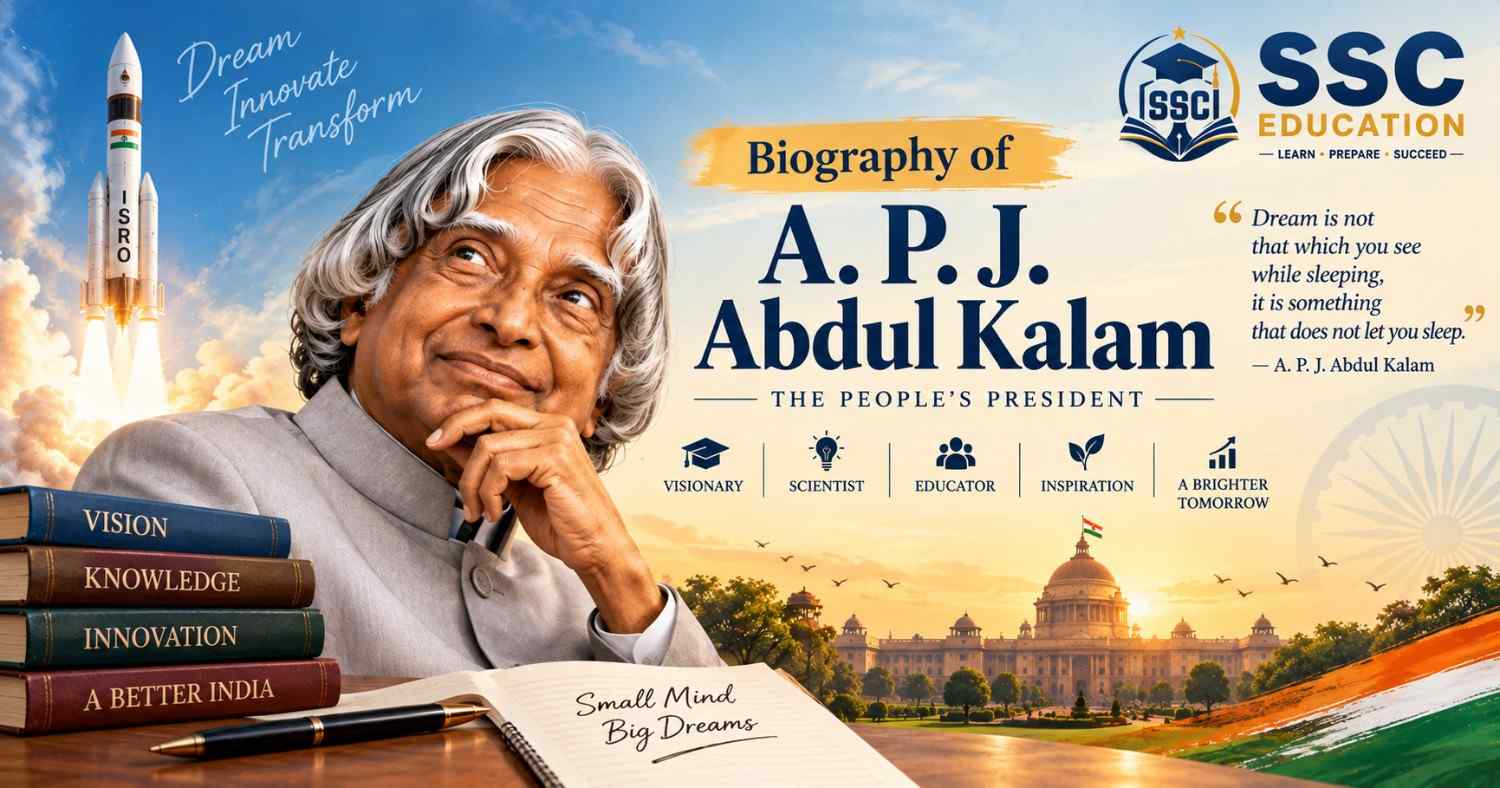
Biography of A. P. J. Abdul Kalam
Rahul Kumar
SSC Exam Expert & Content Editor
Table of Contents
- 1.Introduction
- 2.Quick Facts: A. P. J. Abdul Kalam
- 3.Early Life and Humble Beginnings
- 4.Education
- 5.Early Career: DRDO and ISRO
- 6.The "Missile Man of India"
- 7.Pokhran-II Nuclear Tests
- 8.Kalam's Approach to Leadership at DRDO and ISRO
- 9.The 11th President of India
- 10.Kalam's Presidency: Key Initiatives
- 11.Post-Presidency: Teacher and Mentor
- 12.Kalam's Relationship with Students and the Youth
- 13.Death
- 14.Kalam's Simplicity: Lessons in Personal Integrity
- 15.Personal Life and Philosophy
- 16.Kalam's Contribution to India's Nuclear and Defence Self-Reliance
- 17.Books and Writings
- 18.Kalam's Impact on India's Global Scientific Standing
- 19.Legacy and Influence
- 20.Kalam in Popular Culture and Public Memory
- 21.Awards and Honours
- 22.Timeline of Dr. A. P. J. Abdul Kalam's Life
- 23.Kalam's Vision for India: "India 2020"
- 24.Kalam's Spiritual Outlook and Communal Harmony
- 25.Interesting Facts about Dr. A. P. J. Abdul Kalam
- 26.Famous Quotes by Dr. A. P. J. Abdul Kalam
- 27.Kalam's Relationship with Other Leaders and Scientists
- 28.Why Dr. A. P. J. Abdul Kalam Still Matters Today
- 29.Frequently Asked Questions (FAQs) about Dr. A. P. J. Abdul Kalam
- 30.Related Reading
- 31.Conclusion
A. P. J. Abdul Kalam (1931-2015), the Missile Man of India and 11th President, inspired millions with his journey from newspaper boy to scientist and statesman. Read his full biography.
Introduction
Dr. A. P. J. Abdul Kalam was an eminent Indian aerospace scientist who went on to serve as the 11th President of India. Widely and affectionately known as the "Missile Man of India" and later the "People's President," Kalam rose from a humble background selling newspapers as a child to becoming one of the most respected scientists and statesmen in Indian history. His life is often held up as a powerful example of hard work, humility, and dedication to the nation.
In this biography, we cover Dr. Kalam's early life and education, his groundbreaking career in India's missile and space programmes, his tenure as President of India, his personal philosophy, his books, his death, and his enduring legacy — written in simple, easy-to-understand language, along with commonly searched facts and frequently asked questions.
Quick Facts: A. P. J. Abdul Kalam
| Nationality | Indian |
|---|---|
| Best Known For | Aerospace scientist and 11th President of India (2002–2007); known as the "Missile Man of India" |
| Full Name | Avul Pakir Jainulabdeen Abdul Kalam |
| Born | October 15, 1931, Rameswaram, Tamil Nadu, India |
| Died | July 27, 2015 (aged 83), Shillong, Meghalaya, India |
| Father | Jainulabdeen (boat owner) |
| Mother | Ashiamma |
| Known As | Missile Man of India, People's President |
| Famous For | Leading India's missile and space programmes; serving as the 11th President of India (2002–2007) |
| Famous Books | Wings of Fire, Ignited Minds, India 2020 |
| Major Awards | Bharat Ratna (1997), Padma Vibhushan (1990), Padma Bhushan (1981) |
Early Life and Humble Beginnings
Dr. A. P. J. Abdul Kalam was born on October 15, 1931, in the temple town of Rameswaram, in present-day Tamil Nadu. His father, Jainulabdeen, owned a small boat used for ferrying pilgrims, and his mother, Ashiamma, was a homemaker. The family was not wealthy, and young Kalam had to contribute financially from a very early age, famously selling newspapers after school to support his family's income.
Despite these modest beginnings, Kalam was an extraordinarily curious and hardworking student, deeply fascinated by flight and aeronautics from a young age, reportedly inspired by watching birds and seeing his first aircraft near his hometown. His teachers recognised his talent early, and with tremendous personal effort and family sacrifice, he pursued his education with determination.
Education
Kalam completed his early schooling in Rameswaram and Ramanathapuram, and went on to study physics at St. Joseph's College, Tiruchirappalli, graduating in 1954. He then moved to Madras Institute of Technology (MIT), where he specialised in aeronautical engineering, graduating in 1960. His education was made possible partly through financial help from his sister, who pawned her jewellery to support his studies, a sacrifice Kalam remembered and spoke about with deep gratitude throughout his life.
Early Career: DRDO and ISRO
Kalam began his professional career in 1960 as a scientist at the Aeronautical Development Establishment of the Defence Research and Development Organisation (DRDO). In 1969, he was transferred to the Indian Space Research Organisation (ISRO), where he served as the Project Director for India's first indigenous Satellite Launch Vehicle, SLV-III, which successfully placed the Rohini satellite into orbit in 1980, marking a major milestone for India's space programme.
The "Missile Man of India"
In 1982, Kalam returned to DRDO as its Director and led the Integrated Guided Missile Development Programme (IGMDP), which resulted in the successful development of a family of indigenous missiles, including Agni and Prithvi. This landmark achievement significantly boosted India's defence capabilities and self-reliance in missile technology, earning Kalam the enduring title of "Missile Man of India." He later served as the Chief Scientific Adviser to the Prime Minister and Secretary of the Department of Defence Research and Development from 1992 to 1999.
Pokhran-II Nuclear Tests
Dr. Kalam played a crucial and highly visible role in the Pokhran-II nuclear tests conducted in May 1998, in which India successfully detonated a series of nuclear devices in the Rajasthan desert, demonstrating the country's nuclear capability. As Chief Scientific Adviser, Kalam was one of the key figures coordinating this historic and technically demanding programme, which was carried out with strict secrecy, and it further cemented his reputation as one of India's foremost scientific leaders.
Kalam's Approach to Leadership at DRDO and ISRO
Throughout his decades-long scientific career, Dr. Kalam became known not only for his technical expertise but also for his distinctive, people-centred leadership style. He frequently credited the success of India's missile and space programmes to the collective effort of large teams of scientists, engineers, and technicians, rather than claiming individual credit, and he was known for personally mentoring young scientists and engineers, encouraging them to take risks and learn from failures rather than fear them. His famous account of the failure of India's first SLV-III launch attempt in 1979, and how he rebuilt team morale to achieve success the following year, is often cited in leadership and management courses in India as a model of resilience and accountability in the face of setbacks.
The 11th President of India
In 2002, Dr. Kalam was elected as the 11th President of India, with broad political support across party lines, reflecting his non-political, widely respected scientific stature. Serving until 2007, he became known as the "People's President" for his warm, humble, and approachable style, frequently interacting directly with students and citizens rather than remaining confined to formal ceremonial duties. He used his presidency to promote science education, national development, and youth empowerment, travelling extensively to schools and colleges to inspire young people, a practice he continued enthusiastically even after leaving office.
Kalam's Presidency: Key Initiatives
During his five years as President, Dr. Kalam used the largely ceremonial office in an unusually active and hands-on manner, particularly in the areas of science, education, and youth development. He launched initiatives such as "PURA" (Providing Urban Amenities to Rural Areas), a vision for balanced rural development that aimed to bring infrastructure and economic opportunity to India's villages without forcing migration to cities. He regularly held interactive sessions with school and college students both at Rashtrapati Bhavan and during his extensive travels across the country, answering their questions directly and encouraging them to pursue careers in science and innovation. His accessible, down-to-earth approach as head of state was widely seen as a departure from the more formal, distant image traditionally associated with the office of the President of India.
Post-Presidency: Teacher and Mentor
After completing his term as President in 2007, Dr. Kalam did not retire from public life. Instead, he devoted himself even more fully to what he considered his true passion: teaching and mentoring young people. He took up visiting professorships at several prestigious institutions, including the Indian Institute of Management Shillong, Indian Institute of Management Ahmedabad, and Indian Institute of Technology institutions across the country, and continued to travel tirelessly to schools and colleges throughout India to interact directly with students, whom he often called his greatest source of inspiration.
Kalam's Relationship with Students and the Youth
Perhaps no aspect of Dr. Kalam's public life is remembered more fondly than his relationship with students. He believed passionately that the future of India rested on its young people, and he dedicated an enormous portion of his time, both during and after his presidency, to direct interaction with school and college students across the country. He was known to personally answer thousands of letters from students over the years, and his talks frequently focused on themes of self-belief, hard work, and the importance of setting big, audacious goals. Many young Indians who grew up during his presidency and afterward cite him as their single biggest source of inspiration to pursue careers in science, engineering, and public service, a testament to the depth of his influence beyond his formal scientific and political achievements.
Death
Dr. A. P. J. Abdul Kalam passed away on July 27, 2015, at the age of 83, after collapsing from a cardiac arrest while delivering a lecture to students at the Indian Institute of Management Shillong. It was widely and movingly noted that he died doing what he loved most: teaching and inspiring the youth of India. His death was mourned across the nation, with a state funeral held in his hometown of Rameswaram, attended by dignitaries, political leaders, and thousands of ordinary citizens.
Kalam's Simplicity: Lessons in Personal Integrity
One of the most frequently discussed aspects of Dr. Kalam's life is the remarkable simplicity he maintained even at the highest levels of scientific and political power. Colleagues and biographers have recounted how, even as President of India, he insisted on personally packing his own suitcase for official trips and travelled with minimal personal belongings, reflecting the modest habits formed during his childhood in Rameswaram. He was known to decline unnecessary luxuries, kept his personal expenses extremely low, and directed that much of his savings and royalties from his books be donated to charitable causes, particularly those supporting the education of underprivileged children. This lived example of integrity, discipline, and financial modesty, maintained consistently from his early scientific career through the presidency and beyond, is frequently cited in Indian schools and public discourse as a model of ethical public service rarely matched by other high-profile leaders.
Personal Life and Philosophy
Dr. Kalam famously remained a bachelor throughout his life, devoting himself entirely to his scientific work, public service, and, later, teaching. Known for his extreme simplicity, humility, and discipline, he owned very few personal possessions and was frequently seen carrying his own small suitcase, even as President of India. He was deeply spiritual, drawing inspiration from multiple religious and philosophical traditions despite his own Muslim faith, and was known for playing the veena, a traditional Indian string instrument, as a way to relax. His optimism about India's potential and his ability to inspire hope in young people, regardless of their background, made him one of the most beloved public figures in modern Indian history.
Kalam's Contribution to India's Nuclear and Defence Self-Reliance
Beyond the missile programme, Dr. Kalam's broader contribution to India's defence and strategic self-reliance is considered one of his most significant legacies. During a period when India faced international technology-denial regimes restricting access to advanced defence and space technologies, Kalam was among the key scientific leaders who championed indigenous research and development as the only viable path forward. His work helped establish a domestic ecosystem of research laboratories, testing facilities, and technical expertise that reduced India's dependence on foreign defence suppliers over time. This philosophy of self-reliance, often summarised by Kalam's own belief that "India should become a nation which is not dependent on others for its needs," continues to inform India's defence and space policy discussions today.
Books and Writings
Dr. Kalam was also a prolific author who wrote extensively to inspire young readers. His major works include:
- Wings of Fire (1999): His widely read autobiography, tracing his journey from a modest background in Rameswaram to becoming one of India's leading scientists.
- India 2020: A Vision for the New Millennium: A book outlining his vision for transforming India into a developed nation by the year 2020.
- Ignited Minds: Unleashing the Power Within India: A motivational work aimed at inspiring young Indians to realise their potential.
- The Luminous Sparks, Turning Points, and My Journey: Later works continuing to reflect on his life, values, and vision for India's future.
Kalam's Impact on India's Global Scientific Standing
Dr. Kalam's decades of work in aerospace and defence research significantly contributed to raising India's profile as a serious and capable player in global science and technology. The successful indigenous development of satellite launch vehicles and missile systems under his leadership demonstrated that India could achieve advanced technological capabilities largely through domestic research, at a time when many advanced technologies were restricted from export to India by international agreements. This period of scientific self-reliance laid crucial groundwork for India's later achievements in space exploration, including subsequent missions by ISRO to the Moon and Mars, which built upon the technical foundations and institutional culture that Kalam and his generation of scientists helped establish. His career is frequently cited internationally as a case study in how developing nations can build advanced technological capacity through sustained investment in domestic scientific talent and infrastructure.
Legacy and Influence
Dr. Kalam's legacy extends far beyond his scientific and political achievements. He remains one of the most admired public figures in India, particularly among students and young people, for his message that hard work, education, and dreaming big can overcome even the most modest of beginnings. His birthday, October 15, has been observed in various forms as World Students' Day by the United Nations, in recognition of his lifelong commitment to youth education. Numerous institutions, awards, and even a Space Technology Cell at Anna University have been named in his honour, and his simple, humble lifestyle continues to be cited as a model of integrity in public life.
Kalam in Popular Culture and Public Memory
Dr. Kalam's life and personality have been widely celebrated in Indian popular culture, education, and public memory since his death. His image, often shown with his distinctive silver hair and gentle smile, remains instantly recognisable across India, and quotes from his speeches and books are widely shared on social media and printed in classrooms and motivational posters nationwide. Several biographical films, documentaries, and stage productions have been made about his life, and his hometown of Rameswaram now houses a memorial dedicated to him, drawing visitors from across the country who wish to learn more about his remarkable journey. His story is frequently featured in school textbooks and motivational literature as one of the most accessible and inspiring examples of personal achievement in modern Indian history.
Awards and Honours
Dr. A. P. J. Abdul Kalam received numerous national and international honours throughout his career, including India's three highest civilian awards: the Padma Bhushan (1981), the Padma Vibhushan (1990), and India's highest civilian honour, the Bharat Ratna (1997), awarded for his contributions to science and his role in India's defence research programmes. He also received honorary doctorates from numerous universities in India and abroad, and international recognitions from countries including the United States, Russia, and several others, for his contributions to science and global understanding.
Timeline of Dr. A. P. J. Abdul Kalam's Life
| Year | Event |
|---|---|
| 1931 | Born on October 15 in Rameswaram, Tamil Nadu. |
| 1954 | Graduated in Physics from St. Joseph's College, Tiruchirappalli. |
| 1960 | Graduated in Aeronautical Engineering from Madras Institute of Technology; joined DRDO. |
| 1969 | Moved to ISRO as Project Director for the SLV-III programme. |
| 1980 | SLV-III successfully launched the Rohini satellite into orbit. |
| 1982 | Returned to DRDO to lead the Integrated Guided Missile Development Programme. |
| 1992–1999 | Served as Chief Scientific Adviser to the Prime Minister. |
| 1998 | Played a key role in the Pokhran-II nuclear tests. |
| 1997 | Awarded the Bharat Ratna, India's highest civilian honour. |
| 2002 | Elected as the 11th President of India. |
| 2007 | Completed his presidential term; returned to teaching. |
| 2015 | Died on July 27 while delivering a lecture at IIM Shillong. |
Kalam's Vision for India: "India 2020"
One of Dr. Kalam's most influential contributions outside science was his articulation of a long-term vision for India's development, most notably expressed in his book "India 2020." He believed India had the potential to become a fully developed nation by the year 2020, driven by advancements in agriculture, technology, infrastructure, education, and self-reliance. While the exact timeline of this vision remains a matter of ongoing national discussion, his optimistic, achievable, and technology-driven roadmap for development continues to influence policy discussions, youth motivation programmes, and India's broader aspirations for economic and scientific growth.
Kalam's Spiritual Outlook and Communal Harmony
Despite being a devout, practicing Muslim, Dr. Kalam was widely celebrated for his deep respect for all religious traditions and his personal embodiment of India's pluralistic culture. He was known to read the Bhagavad Gita and the Quran with equal reverence, and he often spoke about how his early life in Rameswaram, a town with both a major Hindu temple and a significant Muslim community, shaped his belief that spirituality transcended any single religious label. He credited his childhood friendship with the local temple priest and his own father's teachings for instilling in him a broad, inclusive spiritual worldview. This aspect of his life is frequently cited as a powerful example of religious harmony in a diverse country, and it contributed significantly to his image as a unifying national figure who was respected across India's religious and political divides.
Interesting Facts about Dr. A. P. J. Abdul Kalam
- He sold newspapers as a child to help support his family financially.
- Despite being a devout Muslim, he was known to read the Bhagavad Gita and the Quran with equal interest and often played the veena, a traditional Hindu classical instrument.
- He never married and had no biological children, dedicating his entire life to science, education, and public service.
- He was known to carry his own small suitcase and lived an extremely simple lifestyle, even while serving as President of India.
- His birthday, October 15, is informally observed by some institutions as "World Students' Day" in recognition of his devotion to education.
- He passed away while doing what he loved most: delivering a lecture to students.
Famous Quotes by Dr. A. P. J. Abdul Kalam
- "Dream, dream, dream. Dreams transform into thoughts and thoughts result in action."
- "You have to dream before your dreams can come true."
- "All of us do not have equal talent, but all of us have an equal opportunity to develop our talents."
- "Failure will never overtake me if my determination to succeed is strong enough."
- "Thinking should become your capital asset, no matter whatever ups and downs you come across in your life."
Kalam's Relationship with Other Leaders and Scientists
Dr. Kalam worked closely with several other towering figures of Indian science and public life over the course of his career. He frequently credited senior scientists like Dr. Vikram Sarabhai, the father of India's space programme, and Dr. Satish Dhawan, former ISRO chairman, as key mentors who shaped his early scientific career and leadership philosophy. As President, Kalam worked alongside Prime Ministers from different political parties, maintaining a reputation for non-partisan, dignified conduct that earned him respect across the political spectrum, an unusual achievement in a role that can often become politically contentious. His ability to work collaboratively across scientific, political, and social boundaries is frequently cited as a key reason for his broad and lasting popularity among the Indian public.
Why Dr. A. P. J. Abdul Kalam Still Matters Today
Dr. Kalam's life continues to inspire millions of Indians, especially students and young professionals, as a powerful example of what can be achieved through hard work, curiosity, and integrity, regardless of one's economic background. His contributions to India's defence and space capabilities remain foundational to the country's strategic and scientific standing today, while his approachable, humble style as President reshaped public expectations of what a national leader could be. For students preparing for exams, essays, or simply seeking inspiration, Kalam's journey from a newspaper-selling boy in a small temple town to the highest constitutional office in India remains one of the most compelling and frequently cited success stories in modern Indian history.
Frequently Asked Questions (FAQs) about Dr. A. P. J. Abdul Kalam
1. Who was Dr. A. P. J. Abdul Kalam?
Dr. A. P. J. Abdul Kalam was an Indian aerospace scientist who played a key role in India's missile and space programmes and later served as the 11th President of India from 2002 to 2007.
2. When and where was Dr. Kalam born?
He was born on October 15, 1931, in Rameswaram, Tamil Nadu, India.
3. Why is Dr. Kalam called the "Missile Man of India"?
He earned this title for leading the Integrated Guided Missile Development Programme, which produced indigenous missiles like Agni and Prithvi, significantly boosting India's defence capabilities.
4. What is Dr. Kalam famous for?
He is famous for his contributions to India's space and missile programmes, his role in the 1998 Pokhran-II nuclear tests, and his tenure as India's "People's President."
5. What books did Dr. Kalam write?
His notable books include his autobiography "Wings of Fire," along with "India 2020," "Ignited Minds," and several other works aimed at inspiring young readers.
6. How did Dr. Kalam die?
He died of a cardiac arrest on July 27, 2015, while delivering a lecture to students at the Indian Institute of Management Shillong.
7. Did Dr. Kalam ever marry?
No, Dr. Kalam remained unmarried throughout his life, dedicating himself entirely to science, education, and public service.
8. What awards did Dr. Kalam receive?
He received India's three highest civilian honours: the Padma Bhushan (1981), the Padma Vibhushan (1990), and the Bharat Ratna (1997).
9. What was Dr. Kalam's role in the Pokhran-II tests?
As Chief Scientific Adviser to the Prime Minister, Kalam played a key coordinating role in India's 1998 Pokhran-II nuclear tests.
10. Why was Kalam called the "People's President"?
He earned this nickname for his humble, approachable style and his direct engagement with ordinary citizens and students throughout his presidency.
11. What did Dr. Kalam do after his presidency?
After 2007, he devoted himself to teaching, taking up professorships at institutions like IIM Shillong and IIM Ahmedabad, and travelling to inspire students across India.
12. What is Dr. Kalam's educational background?
He studied Physics at St. Joseph's College, Tiruchirappalli, and later graduated in Aeronautical Engineering from the Madras Institute of Technology.
13. What was the Integrated Guided Missile Development Programme?
It was a programme led by Dr. Kalam at DRDO starting in 1982 that developed a series of indigenous missiles, including Agni and Prithvi, significantly strengthening India's defence capabilities.
14. What was Dr. Kalam's PURA initiative?
PURA, or "Providing Urban Amenities to Rural Areas," was a vision Dr. Kalam promoted during his presidency for bringing infrastructure and economic opportunities to India's villages.
15. Where is Dr. Kalam's memorial located?
A memorial dedicated to Dr. Kalam is located in his hometown of Rameswaram, Tamil Nadu, which draws visitors from across the country.
Related Reading
Conclusion
Dr. A. P. J. Abdul Kalam's life is a remarkable journey from selling newspapers in a small temple town to becoming one of India's most respected scientists and its 11th President. His contributions to India's missile, space, and defence programmes transformed the nation's scientific capabilities, while his humility, simplicity, and deep commitment to inspiring young people made him one of the most beloved public figures in modern Indian history. His enduring message, that dreams combined with hard work and integrity can overcome any obstacle, continues to inspire generations of Indians long after his passing.
Rahul Kumar
SSC Exam Expert & Content Editor
Rahul is a senior SSC exam strategist with 8+ years of experience helping aspirants crack CGL, CHSL and MTS exams. He writes in-depth notification breakdowns, exam pattern guides and preparation strategies.