
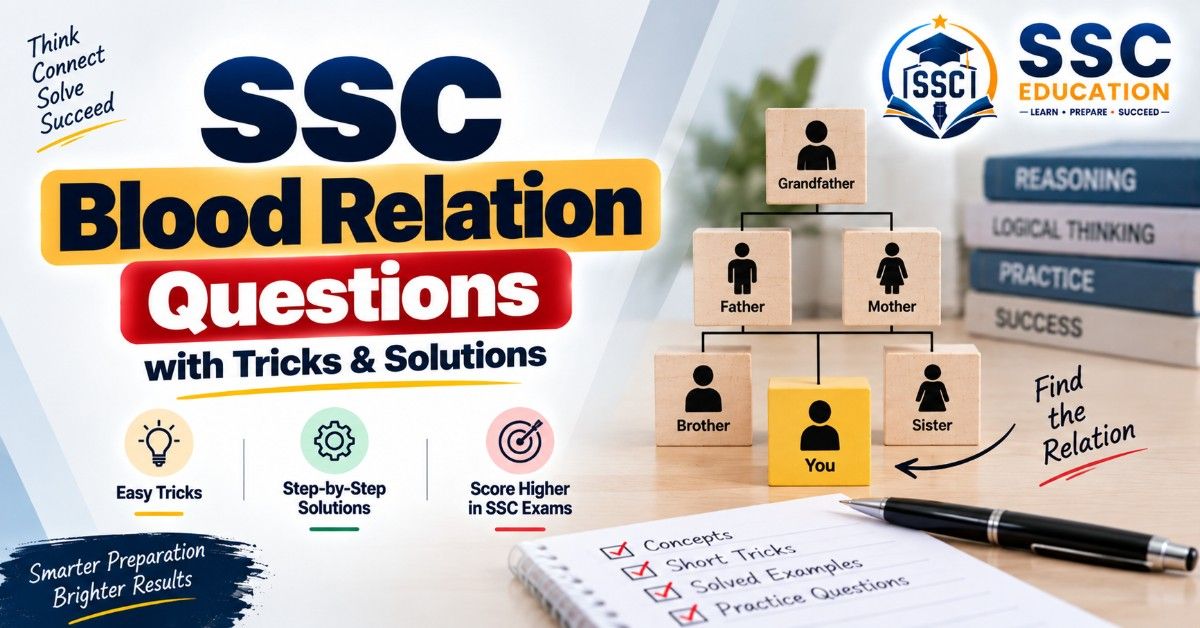
SSC Blood Relation Questions with Tricks & Solutions
Rahul Kumar
SSC Exam Expert & Content Editor
Table of Contents
- 1.SSC Blood Relation Questions with Tricks and Solutions: Quick Overview
- 2.Blood Relation Table: English and Hindi Terms
- 3.Generations and Gender: The Basics
- 4.Step-by-Step Method to Solve Blood Relation Questions
- 5.Tricks and Shortcuts for Blood Relation Questions
- 6.How to Solve Coded Blood Relation Questions
- 7.Blood Relation Practice Questions (30 Questions)
- 8.Answer Key at a Glance
- 9.Solutions with Explanations
- 10.How to Check Your Performance
- 11.Common Mistakes in Blood Relation Questions
- 12.Related SSC Reasoning Resources
- 13.Frequently Asked Questions (FAQs)
- 14.Conclusion
Learn the family-tree and symbol tricks for SSC blood relation questions, with a relation table (English and Hindi terms) and 30 practice questions with solutions.
SSC Blood Relation Questions with Tricks and Solutions: Quick Overview
Blood relation questions ask you to find how two people in a family are related from a few statements. This guide gives you the relation table (with Hindi terms), the family-tree and symbol tricks, and 30 practice questions with step-by-step solutions for SSC CGL, CHSL, MTS, GD and CPO. Most questions can be solved in 30 to 40 seconds once you draw the family tree.
Key Takeaways
- Draw a family tree instead of solving in your head.
- Mark males with (+) and females with (−); check the gender of every person.
- Learn the relation table once: paternal and maternal relations are the most common traps.
- For coded questions, first write the meaning of each symbol, then build the chain step by step.
- Practice the 30 questions below and revise the solutions of every mistake.
Blood Relation Table: English and Hindi Terms
Keep this table handy. Every question in the exam is built from these relations.
| Relation | English Term | Hindi Term |
|---|---|---|
| Father's father | Paternal grandfather | Dada |
| Father's mother | Paternal grandmother | Dadi |
| Mother's father | Maternal grandfather | Nana |
| Mother's mother | Maternal grandmother | Nani |
| Father's brother | Uncle | Chacha (younger) / Tau (elder) |
| Father's sister | Aunt | Bua |
| Mother's brother | Maternal uncle | Mama |
| Mother's sister | Maternal aunt | Mausi |
| Father's sister's husband | Uncle | Fufa |
| Mother's brother's wife | Aunt | Mami |
| Sister's husband | Brother-in-law | Jija |
| Brother's wife | Sister-in-law | Bhabhi |
| Wife's brother | Brother-in-law | Saala |
| Wife's sister | Sister-in-law | Saali |
| Husband's elder brother | Brother-in-law | Jeth |
| Husband's younger brother | Brother-in-law | Devar |
| Husband's sister | Sister-in-law | Nanad |
| Husband's or wife's father | Father-in-law | Sasur |
| Husband's or wife's mother | Mother-in-law | Saas |
| Son's wife | Daughter-in-law | Bahu |
| Daughter's husband | Son-in-law | Damad |
| Brother's son / daughter | Nephew / Niece | Bhatija / Bhatiji |
| Sister's son / daughter | Nephew / Niece | Bhanja / Bhanji |
| Children of uncle or aunt | Cousin | Cousin |
Generations and Gender: The Basics
| Generation | Members | Example |
|---|---|---|
| +2 (two above you) | Grandparents and their siblings | Paternal or maternal grandfather, granduncle |
| +1 (one above you) | Parents and their siblings | Father, mother, uncle, aunt |
| 0 (same as you) | You, siblings, cousins, spouse, brothers-in-law and sisters-in-law | Brother, sister, cousin |
| −1 (one below you) | Children and their spouses, nephews and nieces | Son, daughter, nephew, niece |
| −2 (two below you) | Grandchildren | Grandson, granddaughter |
Step-by-Step Method to Solve Blood Relation Questions
- Read the last statement first to know which two persons you need to relate.
- Start from the known person (the speaker or the person named in the question).
- Draw the tree: use (+) for male, (−) for female, an equals sign for a married couple, a horizontal line for siblings and a vertical line for children.
- Go one relation at a time and never skip a step.
- Check the generation and gender of the final answer before choosing the option.
Tricks and Shortcuts for Blood Relation Questions
- Only son / only daughter: the phrase points to one exact person. My mother's mother's only son = my mother's brother.
- Mother's side is maternal, father's side is paternal: mother's brother = maternal uncle; father's sister = paternal aunt.
- Child of my uncle or aunt is my cousin. Child of my brother or sister is my nephew or niece.
- Husband's or wife's family: add "in-law" (mother-in-law, brother-in-law), except for the spouse's children, who are your own children.
- Two-way check: if A is the father of B, then B is the son or daughter of A, so the gender of B decides the reverse relation.
- If the speaker has no brother or sister, "my father's son" is the speaker himself.
How to Solve Coded Blood Relation Questions
In coded questions the exam gives symbols for relations. The safest method:
- Write the meaning of every symbol on your rough sheet.
- Note the gender each symbol gives (mother = female, father = male, brother = male, sister = female).
- Solve the expression from left to right, joining two persons at a time.
- Read the final relation from the first person to the last person.
Example: If “A @ B” means A is the mother of B, “A # B” means A is the sister of B and “A $ B” means A is the father of B, then in “P $ Q # R” P is the father of Q and Q is the sister of R, so P is the father of R.
Solved Example: Pointing-to-Photograph Question
Pointing to a man, a woman said, “He is the only son of my mother’s mother.” How is the man related to the woman?
The woman’s mother’s mother has one son. That son is the brother of the woman’s mother. So the man is the woman’s maternal uncle.
Blood Relation Practice Questions (30 Questions)
Solve each question by drawing a quick tree and then check the solutions below.
Direct Relation Questions (10 Questions)
Q1. Pointing to a man, Ravi said, "He is the son of my father's only sister." How is the man related to Ravi?
(A) Cousin (B) Brother (C) Uncle (D) Nephew
Q2. Meena introduced Ramesh as "the son of the only brother of my father". How is Meena's father related to Ramesh?
(A) Father (B) Uncle (C) Grandfather (D) Brother
Q3. P is the brother of Q. Q is the sister of R. R is the father of S. How is P related to S?
(A) Father (B) Brother (C) Grandfather (D) Uncle
Q4. X is the son of Y. Y is the brother of Z. Z is the mother of W. How is W related to X?
(A) Brother (B) Cousin (C) Nephew (D) Uncle
Q5. What is the relation of a man to the wife of his brother?
(A) Sister (B) Aunt (C) Sister-in-law (D) Cousin
Q6. A is B's sister. C is B's mother. D is C's father. How is A related to D?
(A) Granddaughter (B) Daughter (C) Niece (D) Sister
Q7. The wife of my mother's brother is my ___.
(A) Sister-in-law (B) Mother-in-law (C) Cousin (D) Aunt
Q8. M is the father of N. N is the mother of O. O is the brother of P. How is M related to P?
(A) Paternal grandfather (B) Father (C) Maternal grandfather (D) Uncle
Q9. F is the brother of G. H is the sister of G. I is the son of F. How is H related to I?
(A) Mother (B) Sister (C) Aunt (D) Cousin
Q10. How is the only son of your mother's mother related to your mother?
(A) Brother (B) Uncle (C) Father (D) Cousin
Pointing-to-Photograph Questions (6 Questions)
Q11. Pointing to a photograph, Anil said, "She is the daughter of the only son of my mother's father." How is the girl related to Anil?
(A) Sister (B) Aunt (C) Cousin (D) Niece
Q12. Introducing a girl, Vivek said, "She is the only daughter of my mother's husband." How is the girl related to Vivek?
(A) Cousin (B) Mother (C) Sister (D) Wife
Q13. Pointing to a man, a woman said, "He is the only son of my mother's mother." How is the man related to the woman?
(A) Brother (B) Father (C) Cousin (D) Maternal uncle
Q14. Looking at a portrait of a man, Harsh said, "His mother is the wife of my father's son. I have no brother or sister." How is the man related to Harsh?
(A) Son (B) Father (C) Brother (D) Nephew
Q15. Pointing to a girl, Rekha said, "She is the sister of the son of my father's only brother." How is the girl related to Rekha?
(A) Sister (B) Niece (C) Aunt (D) Cousin
Q16. Pointing to a boy, a woman said, "He is the son of the only son of my father-in-law." How is the boy related to the woman?
(A) Nephew (B) Brother-in-law (C) Son (D) Husband
Family Statement Questions (7 Questions)
Q17. A and B are brothers. C is the father of A. D is the son of B. E is the brother of C. How is E related to D?
(A) Granduncle (B) Uncle (C) Grandfather (D) Cousin
Q18. In a family, P and Q are a married couple and P is the husband. R is the son of P. S is the wife of R. T is the daughter of S. U is the brother of R. How is U related to T?
(A) Father (B) Uncle (C) Brother (D) Grandfather
Q19. In the same family (P and Q are a married couple with P the husband, R is P's son, S is R's wife and T is their daughter), how is Q related to T?
(A) Maternal grandmother (B) Mother (C) Aunt (D) Paternal grandmother
Q20. Introducing a man, a woman says, "His mother is the wife of my father's only son." How is the man related to the woman?
(A) Son (B) Brother (C) Cousin (D) Nephew
Q21. Ritu says to Nisha, "Your mother's brother is my father." How is Nisha related to Ritu?
(A) Sister (B) Niece (C) Cousin (D) Aunt
Q22. Pooja's father is Ramesh. Ramesh's wife is Sunita. Sunita's father is Dinesh. How is Dinesh related to Pooja?
(A) Paternal grandfather (B) Uncle (C) Father (D) Maternal grandfather
Q23. If X is the mother-in-law of Y and Y is the wife of Z, how is X related to Z?
(A) Sister (B) Aunt (C) Mother (D) Grandmother
Coded Blood Relation Questions (5 Questions)
Q24. In a code, "A @ B" means A is the mother of B, "A # B" means A is the sister of B and "A $ B" means A is the father of B. In "P $ Q # R", how is P related to R?
(A) Brother (B) Father (C) Uncle (D) Grandfather
Q25. Using the same code ("A @ B" = A is the mother of B, "A # B" = A is the sister of B, "A $ B" = A is the father of B), in "K @ L $ M", how is K related to M?
(A) Mother (B) Aunt (C) Sister (D) Grandmother
Q26. Using the same code, in "X # Y @ Z", how is X related to Z?
(A) Mother (B) Sister (C) Grandmother (D) Aunt
Q27. Using the same code, which expression shows that A is the grandfather of C?
(A) A @ B $ C (B) A $ B # C (C) A $ B $ C (D) A # B $ C
Q28. If "A + B" means A is the brother of B, "A − B" means A is the daughter of B and "A × B" means A is the wife of B, then in "P + Q − R", how is P related to R?
(A) Son (B) Brother (C) Father (D) Nephew
Family Logic Questions (2 Questions)
Q29. In a family there are two fathers, two sons and one grandfather. What is the minimum number of members in the family?
(A) 4 (B) 5 (C) 3 (D) 6
Q30. A man says, "I have no brother or sister, but that man's father is my father's son." Who is the man he is pointing to?
(A) His father (B) His brother (C) His nephew (D) His son
Answer Key at a Glance
| Questions | Answers |
|---|---|
| Q1 to Q6 | 1-A, 2-B, 3-D, 4-B, 5-C, 6-A |
| Q7 to Q12 | 7-D, 8-C, 9-C, 10-A, 11-C, 12-C |
| Q13 to Q18 | 13-D, 14-A, 15-D, 16-C, 17-A, 18-B |
| Q19 to Q24 | 19-D, 20-D, 21-C, 22-D, 23-C, 24-B |
| Q25 to Q30 | 25-D, 26-D, 27-C, 28-A, 29-C, 30-D |
Solutions with Explanations
Direct Relation Questions
Q1. Answer: (A) Cousin — Ravi's father's sister is Ravi's paternal aunt, and her son is Ravi's cousin.
Q2. Answer: (B) Uncle — Ramesh's father is the brother of Meena's father. So Meena's father is Ramesh's (paternal) uncle.
Q3. Answer: (D) Uncle — P, Q and R are siblings. S is R's child, so P (a male sibling of R) is S's uncle.
Q4. Answer: (B) Cousin — Y and Z are siblings. X is Y's child and W is Z's child, so X and W are cousins.
Q5. Answer: (C) Sister-in-law — The wife of one's brother is one's sister-in-law.
Q6. Answer: (A) Granddaughter — C is the mother of A and B, and D is C's father. So D is A's maternal grandfather, and A is D's granddaughter.
Q7. Answer: (D) Aunt — The mother's brother is the maternal uncle, and his wife is one's (maternal) aunt.
Q8. Answer: (C) Maternal grandfather — N is the mother of both O and P. M is N's father, so M is P's maternal grandfather.
Q9. Answer: (C) Aunt — F, G and H are siblings. I is F's son, so H (a sister of F) is I's aunt.
Q10. Answer: (A) Brother — Your mother's mother's only son is your mother's brother.
Pointing-to-Photograph Questions
Q11. Answer: (C) Cousin — The only son of Anil's mother's father is Anil's maternal uncle. His daughter is Anil's cousin.
Q12. Answer: (C) Sister — Vivek's mother's husband is his father, so the girl is the only daughter of Vivek's father, i.e. Vivek's sister.
Q13. Answer: (D) Maternal uncle — The only son of the woman's mother's mother is the woman's mother's brother, i.e. her maternal uncle.
Q14. Answer: (A) Son — Harsh has no brother, so his father's son is Harsh himself. The wife of Harsh is the mother of the man in the portrait, so the man is Harsh's son.
Q15. Answer: (D) Cousin — The son of Rekha's father's brother is her cousin. His sister is also Rekha's cousin.
Q16. Answer: (C) Son — The only son of the woman's father-in-law is her husband, so the boy is her son.
Family Statement Questions
Q17. Answer: (A) Granduncle — C is the father of both A and B, so D (B's son) is C's grandson. E is C's brother, so E is D's granduncle (father's father's brother).
Q18. Answer: (B) Uncle — T is the daughter of R and S. U is R's brother, so U is T's (paternal) uncle.
Q19. Answer: (D) Paternal grandmother — Q is P's wife and therefore R's mother. T is R's daughter, so Q is T's paternal grandmother.
Q20. Answer: (D) Nephew — The woman's father's only son is her brother. His wife is her sister-in-law, and the man is their son, i.e. the woman's nephew.
Q21. Answer: (C) Cousin — Ritu's father is Nisha's maternal uncle. So Nisha's mother and Ritu's father are siblings, which makes Nisha and Ritu cousins.
Q22. Answer: (D) Maternal grandfather — Sunita is Pooja's mother and Dinesh is Sunita's father, so Dinesh is Pooja's maternal grandfather.
Q23. Answer: (C) Mother — Y is Z's wife, so X (the mother-in-law of Y) is the mother of Z, Y's husband.
Coded Blood Relation Questions
Q24. Answer: (B) Father — P $ Q means P is the father of Q, and Q # R means Q is the sister of R. So P is also the father of R.
Q25. Answer: (D) Grandmother — K is the mother of L and L is the father of M, so K is M's (paternal) grandmother.
Q26. Answer: (D) Aunt — X is the sister of Y, and Y is the mother of Z. So X is Z's aunt.
Q27. Answer: (C) A $ B $ C — A $ B $ C means A is the father of B and B is the father of C, so A is C's grandfather. (A @ B $ C makes A the grandmother, A $ B # C makes A the father, and A # B $ C makes A the aunt.)
Q28. Answer: (A) Son — P + Q means P is Q's brother, and Q − R means Q is the daughter of R. So P is also R's child, and since P is male, P is R's son.
Family Logic Questions
Q29. Answer: (C) 3 — One person can be a grandfather and a father, another a father and a son, and the third a son and a grandson. So only 3 members are needed.
Q30. Answer: (D) His son — Since the speaker has no brother, "my father's son" is the speaker himself. So the man's father is the speaker, and the man is his son.
How to Check Your Performance
| Correct Answers (out of 30) | Level | Next Step |
|---|---|---|
| 27 to 30 | Excellent | Try mixed reasoning sets under a timer. |
| 21 to 26 | Good | Revise the relation table and the questions you got wrong. |
| 15 to 20 | Average | Draw a tree for every question and repeat the set after three days. |
| Below 15 | Needs practice | Learn the relation table first, then start with direct questions. |
Common Mistakes in Blood Relation Questions
- Mixing maternal and paternal relations: always check whose side the relation is on.
- Guessing the gender: unless the statement tells you the gender, do not assume it.
- Skipping the diagram: long chains are easy to get wrong in the head.
- Answering with the wrong direction: if the question asks how A is related to B, do not answer for B to A.
- Confusing cousin with brother or nephew: cousins share grandparents, not parents.
Related SSC Reasoning Resources
- SSC reasoning practice set with answers (top 100 questions)
- SSC coding decoding questions with answers
- SSC seating arrangement practice set
- SSC CGL previous year question papers
Frequently Asked Questions (FAQs)
What are blood relation questions in SSC reasoning?
Blood relation questions give you a few statements about the relationships between people and ask you to find how two of them are related. They test your understanding of family relations, gender and generations.
How many blood relation questions come in SSC CGL and CHSL?
The number varies from shift to shift, but blood relation questions usually appear in small numbers (often one to three) in the reasoning section. They are quick to solve, so they are good scoring questions.
What is the easiest trick to solve blood relation questions?
Draw a small family tree. Mark males with a plus and females with a minus, connect couples with an equals sign, siblings with a horizontal line and children with a vertical line, and start from the person mentioned in the question.
How do I solve coded blood relation questions?
Write down what every symbol means, replace the symbols in the expression one by one, and build the relationship chain from left to right. Check the gender of every person from the symbol meanings before deciding the final answer.
What does "only son" or "only daughter" tell me in a question?
It tells you there is exactly one such child, which lets you identify the person without doubt. For example, "my mother's mother's only son" must be my mother's brother.
How is the wife of my mother's brother related to me?
She is your aunt, called mami in Hindi. The brother of your mother is your maternal uncle, and his wife is your aunt.
What is the difference between a cousin and a nephew?
A cousin is the child of your uncle or aunt, so you share a set of grandparents. A nephew or niece is the child of your brother or sister.
How do I find the gender when the question does not mention it?
Look for clues such as brother, sister, father, mother, son or daughter in the statements. If the gender of a person cannot be decided from the statements, the relation is usually not asked or the correct option is data inadequate.
What is the relation of the person who is my brother's son's father?
He is your brother. The father of your brother's son is your brother himself.
What is the minimum number of persons needed for a family with two fathers, two sons and a grandfather?
Three persons are enough: a grandfather (who is also a father), a father (who is also a son) and a son (who is also a grandson).
How much time should I spend on a blood relation question?
Aim for 30 to 40 seconds for a direct question and up to a minute for a coded or long family question. Drawing a quick tree is faster than solving in the head.
How many blood relation questions should I practice daily?
Solve 10 to 15 questions a day for two weeks, mixing direct, photograph, family and coded questions, and keep the relation table on this page for revision.
Are Hindi relation names important for solving these questions?
You do not need them to solve the questions, but knowing terms such as mama, mausi, bua and jija helps you understand questions quickly, especially when the question uses an English term that is unfamiliar.
Where can I practice more SSC reasoning questions?
You can practice SSC previous year papers on the PYQ section of SSC Education and use the practice papers section and the full SSC reasoning practice set for mixed topics.
Conclusion
Blood relation questions become simple once you know the relation table and draw the tree. Practice the 30 questions in this set, note the relations you get wrong and revise the table before every mock test. Within a week of regular practice, blood relation questions can turn into quick and safe marks in your SSC reasoning section.
Rahul Kumar
SSC Exam Expert & Content Editor
Rahul is a senior SSC exam strategist with 8+ years of experience helping aspirants crack CGL, CHSL and MTS exams. He writes in-depth notification breakdowns, exam pattern guides and preparation strategies.