
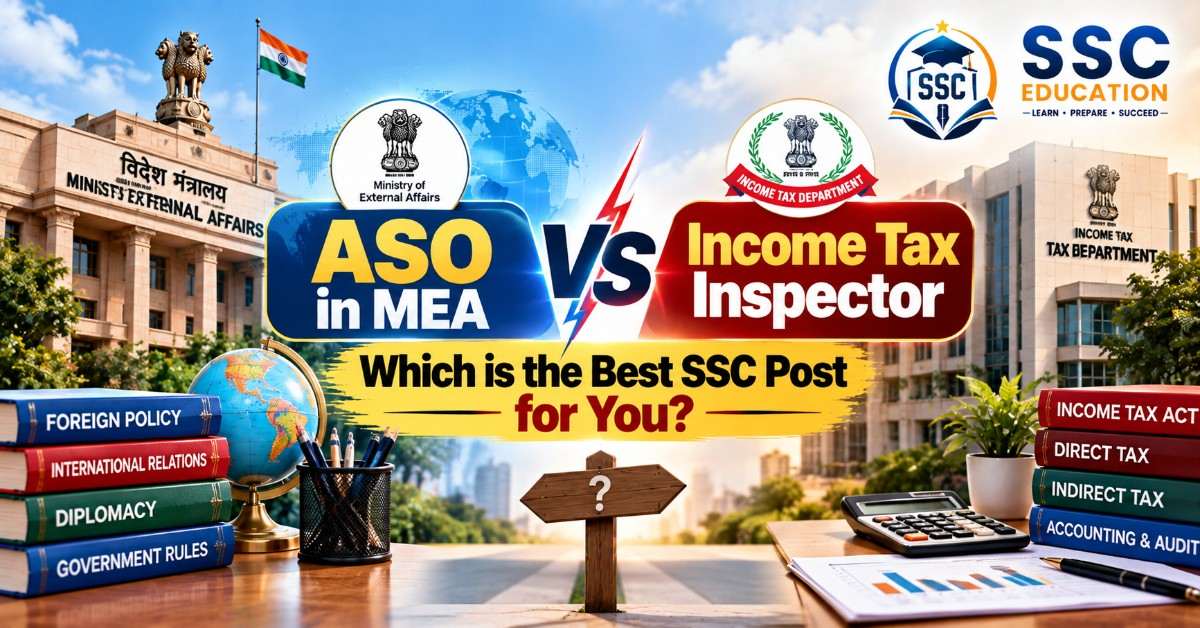
ASO in MEA vs Income Tax Inspector: Which is the Best SSC Post for You?
Rahul Kumar
SSC Exam Expert & Content Editor
Table of Contents
An honest ASO (MEA) vs Income Tax Inspector comparison — salary, job profile, career growth and rank requirement — to help you rank your SSC CGL post preferences.
Two names come up constantly when SSC CGL candidates discuss "best post" — Assistant Section Officer (ASO) in the Ministry of External Affairs (MEA) and Income Tax Inspector. Both sit at similar entry-level pay, yet the two careers look almost nothing alike after a few years. Here's an honest, side-by-side comparison to help you decide.
Starting Salary: Closer Than You'd Think
Both ASO and Income Tax Inspector start with the same basic pay of around ₹44,900, with in-hand salary typically in the ₹55,000–₹65,000 range after allowances. The real difference emerges later: an ASO posted abroad in an Indian embassy or mission can earn roughly triple the domestic salary through foreign allowances, government accommodation, and other overseas benefits — an advantage Income Tax Inspectors don't have.
Job Profile: Administrative Desk Work vs. Field + Desk Work
- ASO (MEA): A largely administrative, desk-based role handling files, coordination, and correspondence within the ministry. Selected ASOs may get postings to Indian embassies and missions abroad, working on diplomatic and administrative support functions.
- Income Tax Inspector: A mix of desk and field duties — tax assessment, verification, collection, and occasionally field inquiries or raids under the Income Tax Department.
If you prefer predictable administrative work with potential foreign exposure, ASO fits better. If you prefer more varied, occasionally field-based work with direct enforcement responsibility, Income Tax Inspector fits better.
Career Growth Path
- ASO career path: ASO → Section Officer → Under Secretary → Deputy Secretary → Director → Joint Secretary, following the Central Secretariat Service hierarchy.
- Income Tax Inspector career path: Inspector → promotions through the department's internal hierarchy, eventually progressing toward senior tax administration roles, with the long-term ceiling generally reaching Commissioner-level positions.
ASO's growth path is more clearly structured within central administrative services, while Inspector's growth depends more on departmental promotion cycles and vacancies.
Rank Requirement: Which Is Harder to Get?
Both posts are highly sought after and typically go to candidates with strong Tier 2 ranks. ASO (CSS/MEA) postings are generally allotted to top-ranking candidates (often within the first few hundred in the UR category), while Income Tax Inspector is also competitive but has historically been available across a slightly wider rank range depending on that year's vacancies and category-wise cutoffs.
Which Should You Choose?
- Choose ASO (MEA) if you value administrative stability, are interested in eventual foreign postings, and prefer a well-defined promotion ladder within central services.
- Choose Income Tax Inspector if you prefer more varied day-to-day work, don't mind occasional field duties, and want to work within tax administration and enforcement.
Neither is objectively "better" — the right choice depends on your own work-style preference, not just the post's reputation.
Frequently Asked Questions (FAQs)
1. Do ASO (MEA) and Income Tax Inspector have the same starting salary?
Yes, both start with a basic pay of around ₹44,900, with similar in-hand salary before allowances specific to each role.
2. Why does ASO (MEA) sometimes earn much more than an Inspector?
ASOs posted abroad in Indian embassies or missions receive foreign allowances and accommodation benefits that can push their effective earnings roughly three times higher than domestic postings.
3. What kind of work does an ASO in MEA actually do?
Mainly administrative desk work — coordination, file processing and correspondence — with the possibility of postings to embassies and missions abroad.
4. What kind of work does an Income Tax Inspector do?
A mix of desk-based tax assessment work and field duties like verification, collection and occasional enforcement-related field inquiries.
5. Which post has better long-term career growth?
ASO follows a clearly defined Central Secretariat Service ladder toward Joint Secretary, while Income Tax Inspector's growth depends on departmental promotions toward senior tax administration roles.
6. Which post requires a higher rank in SSC CGL?
ASO (CSS/MEA) is generally allotted to very high-ranking candidates, though Income Tax Inspector is also competitive and rank cutoffs vary year to year based on vacancies.
7. Does ASO guarantee a foreign posting?
No, foreign postings are not guaranteed for every ASO — they depend on ministry requirements, seniority, and internal selection processes.
8. Is Income Tax Inspector a field job or a desk job?
It's a mix of both — regular desk-based assessment work combined with periodic field duties depending on posting and department needs.
9. Which post is better for someone who prefers stable, predictable hours?
ASO generally offers more predictable administrative hours compared to the occasionally field-heavy schedule of an Income Tax Inspector.
10. Can I switch my preference between these posts after getting selected?
Post allotment is based on your submitted preference order, Tier 2 rank and category — always rank posts carefully during the preference form stage, since changes afterward may not be permitted.
Rahul Kumar
SSC Exam Expert & Content Editor
Rahul is a senior SSC exam strategist with 8+ years of experience helping aspirants crack CGL, CHSL and MTS exams. He writes in-depth notification breakdowns, exam pattern guides and preparation strategies.