
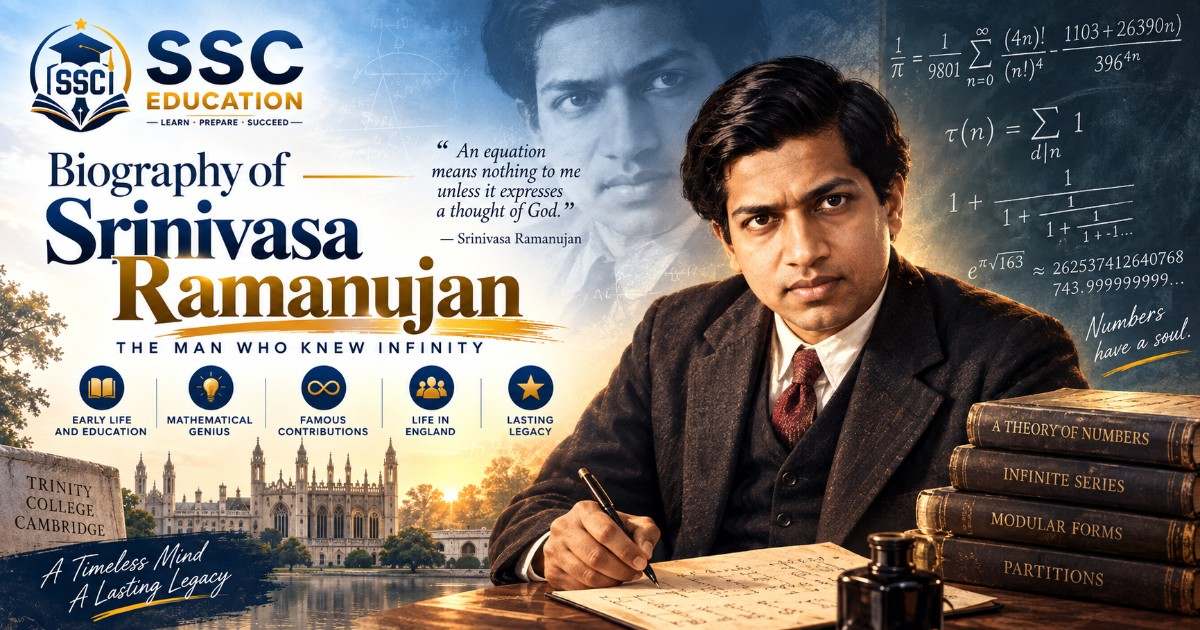
Biography of Srinivasa Ramanujan
Rahul Kumar
SSC Exam Expert & Content Editor
Table of Contents
- 1.Srinivasa Ramanujan Biography at a Glance (Quick Facts)
- 2.Who Was Srinivasa Ramanujan?
- 3.Srinivasa Ramanujan Early Life and Family
- 4.Srinivasa Ramanujan Education
- 5.Years of Struggle in Madras (1906–1912)
- 6.The Letter to G. H. Hardy (1913)
- 7.Ramanujan at Cambridge (1914–1919)
- 8.The Story of 1729 (the Taxi-Cab Number)
- 9.Ramanujan's Major Contributions to Mathematics
- 10.Illness and Return to India
- 11.How Did Srinivasa Ramanujan Die? (Death Reason)
- 12.The Lost Notebook
- 13.Srinivasa Ramanujan Timeline (Year-Wise History)
- 14.Srinivasa Ramanujan Awards and Honours
- 15.Personality and Beliefs of Srinivasa Ramanujan
- 16.Hardy's Rating of Ramanujan
- 17.Srinivasa Ramanujan Legacy: Why He Is Remembered
- 18.Interesting Facts About Srinivasa Ramanujan
- 19.Srinivasa Ramanujan Biography: Important Points for SSC and Other Exams
- 20.Common Confusions About Srinivasa Ramanujan
- 21.How to Remember the Story of Srinivasa Ramanujan for Exams
- 22.Lessons Students Can Learn from Srinivasa Ramanujan
- 23.Ramanujan's Magic Square: A Fun Example
- 24.People Who Helped Ramanujan Along the Way
- 25.How Ramanujan Worked: His Notebook Method
- 26.Related People and Topics
- 27.Key Takeaways
- 28.Srinivasa Ramanujan Biography: Frequently Asked Questions (FAQs)
Read the Srinivasa Ramanujan biography in simple words: early life, education, letter to Hardy, Cambridge years, 1729 story, partition function, mock theta functions, death and contribution to mathematics.
Srinivasa Ramanujan (22 December 1887 – 26 April 1920) was one of the greatest mathematicians India has ever produced. This Srinivasa Ramanujan biography tells his life story, history and contribution to mathematics in very simple words. He was a poor clerk from Tamil Nadu who had almost no formal training in advanced maths, yet he found thousands of new results on numbers, infinite series and partitions. He is famous for the number 1729 and for his work with G. H. Hardy at Cambridge. He was elected a Fellow of the Royal Society at the age of 31. India celebrates his birthday as National Mathematics Day.
Srinivasa Ramanujan Biography at a Glance (Quick Facts)
| Detail | Information |
|---|---|
| Full Name | Srinivasa Ramanujan (Ramanujan Iyengar) |
| Born | 22 December 1887 |
| Birthplace | Erode, Madras Presidency (now Tamil Nadu); grew up in Kumbakonam |
| Died | 26 April 1920 (aged 32) |
| Famous For | Number theory, infinite series, partition function, mock theta functions, the number 1729 |
| Father | Kuppuswamy Srinivasa Iyengar (a clerk in a cloth shop) |
| Mother | Komalatammal (a homemaker and temple singer) |
| Wife | Janaki (Janakiammal), married in 1909 |
| Education | Town Higher Secondary School, Kumbakonam; Government Arts College; Pachaiyappa's College; Trinity College, Cambridge (B.A. by Research, 1916) |
| Mentor | G. H. Hardy (Cambridge) |
| Honours | Fellow of the Royal Society (1918), first Indian Fellow of Trinity College (1918) |
| Number of Results | About 3,900 results in his notebooks and papers |
| National Mathematics Day | 22 December, his birthday |
| Film | The Man Who Knew Infinity (2015) |
Who Was Srinivasa Ramanujan?
Srinivasa Ramanujan was a self-taught mathematical genius. He did not have a university degree in India, and he did not have a proper teacher for higher maths. Still, by the time he was 23, he had filled notebooks with formulas that professional mathematicians found astonishing. Many of his results were new, and some were so deep that they are still being studied today.
He was a shy, simple and deeply religious man. He believed that his ideas came to him from his family goddess, Namagiri of Namakkal. He lived a vegetarian life and had little interest in money or comfort. His story is one of the most moving stories in the history of science, because it shows how talent can shine even in poverty.
If a student asks, "Who is Ramanujan?", the answer is: the Indian mathematician who discovered thousands of formulas on numbers and series, and who worked with G. H. Hardy at Cambridge.
Srinivasa Ramanujan Early Life and Family
Birth and Birthplace
Ramanujan was born on 22 December 1887 in Erode, at the house of his maternal grandparents. His family belonged to a Tamil Brahmin (Iyengar) community. Soon after his birth, the family moved to Kumbakonam, a temple town in Tamil Nadu, where he spent most of his childhood.
His father, Kuppuswamy Srinivasa Iyengar, worked as a clerk in a cloth (sari) shop and earned very little. His mother, Komalatammal, was a religious woman who sang in the local temple and looked after the home. The family was poor, and the small house was full of the sounds of prayer and daily work.
Childhood
As a child, Ramanujan was quiet and thoughtful. He did not like playing with other children much. He asked strange questions to his teachers, like where the first man was born or how far the distance between two clouds was. His mother told him stories from the Puranas and taught him religious songs. This gave him a strong faith that stayed with him for life.
He started school in October 1892. In 1897, at the age of 10, he stood first in the district in his primary exams and joined the Town Higher Secondary School in Kumbakonam. His teachers soon saw that he was much ahead of other students in mathematics.
Srinivasa Ramanujan Education
By the age of 12, Ramanujan had mastered trigonometry, and he found some of the formulas on his own. He borrowed books from senior students. When he was about 13, he read a difficult book on advanced trigonometry by S. L. Loney and solved every problem without help. His school gave him a scholarship and a prize for his brilliance.
In 1903, when he was 16, a friend lent him a book named A Synopsis of Elementary Results in Pure and Applied Mathematics by G. S. Carr. The book was a list of about 5,000 formulas and theorems, with very little explanation. Ramanujan started to prove each one on his own, and he began to write his own results in notebooks. This book changed his life.
He got a scholarship to the Government Arts College in Kumbakonam. But there was a big problem. Ramanujan was so obsessed with mathematics that he neglected other subjects, and he failed in them. He lost his scholarship. Later, he joined Pachaiyappa's College in Madras, but again failed in the other subjects and left without a degree. It is a sad example of how the exam system of those days could not hold a genius.
Years of Struggle in Madras (1906–1912)
After leaving college, Ramanujan lived through a hard time. He had no job and no degree. He did maths day and night on a slate, and he used to write only the final results in his notebooks to save paper. He is said to have used slates because paper was too costly. His family was worried.
In 1909, he married Janaki, a girl of about ten years, as per the custom of that time. The couple lived together later, after she grew up. To support his family, Ramanujan needed a job. He went from one office to another, showing his notebooks to important people.
In 1910, he met V. Ramaswamy Aiyer, the founder of the Indian Mathematical Society. Ramaswamy Aiyer was impressed by his notebooks and helped him. Ramanujan's first research paper, on Bernoulli numbers, was published in the Journal of the Indian Mathematical Society in 1911. With the help of well-wishers, in 1912 he got a job as a clerk in the Madras Port Trust. His boss and colleagues at the office saw that he was doing something extraordinary and encouraged him.
The Letter to G. H. Hardy (1913)
Friends advised Ramanujan to send his work to mathematicians in England. He wrote to a few, but most did not reply. On 16 January 1913, he wrote a letter to Godfrey Harold Hardy, a famous professor at Trinity College, Cambridge. He attached nine pages of results, over 100 theorems, without proofs.
Hardy first thought that the letter was a joke or the work of a crank. But when he and his friend J. E. Littlewood looked at the formulas, they were amazed. Some were known, some were wrong, but many were so beautiful and deep that Hardy said they "must be true, because if they were not true, no one would have the imagination to invent them". Hardy later called the letter the most romantic event of his life.
Hardy wrote back and invited Ramanujan to come to Cambridge. But at first Ramanujan refused, because he was a strict Brahmin and it was thought a sin to cross the sea. His mother also opposed the idea. It is said that his mother had a dream in which the goddess Namagiri told her not to stand in the way of her son. Finally, with the help of the University of Madras, which gave him a scholarship, he agreed to go.
Ramanujan at Cambridge (1914–1919)
Ramanujan sailed from Madras on 17 March 1914 and reached London on 14 April 1914. At Trinity College, Cambridge, he worked with Hardy and Littlewood. Hardy had to teach him modern ideas of proof, because Ramanujan used to arrive at results by intuition, without formal proof. In return, Hardy said that he learned more from Ramanujan than Ramanujan learned from him.
Their work together produced some brilliant results. One of the most famous is the Hardy–Ramanujan formula for the partition function (1918), which tells us how many ways a number can be written as a sum of smaller numbers. For example, the number 4 can be written as 4, 3+1, 2+2, 2+1+1, and 1+1+1+1, so it has 5 partitions. For big numbers, the count becomes huge, and Ramanujan and Hardy found a wonderful formula to estimate it.
In 1916, Ramanujan received his B.A. degree by research, for his paper on Highly Composite Numbers. In December 1917, he was elected to the London Mathematical Society. On 2 May 1918, at the age of 31, he was elected a Fellow of the Royal Society, one of the youngest ever. On 13 October 1918, he became the first Indian to be elected a Fellow of Trinity College, Cambridge.
The Story of 1729 (the Taxi-Cab Number)
One of the most famous stories about Ramanujan is about the number 1729. When Ramanujan was ill in a hospital, Hardy went to see him. Hardy said that he had come in a taxi with the number 1729 and that it seemed to be a dull number. Ramanujan replied at once that it was a very interesting number. It is the smallest number that can be written as the sum of two cubes in two different ways.
| Way | Calculation |
|---|---|
| First way | 1³ + 12³ = 1 + 1728 = 1729 |
| Second way | 9³ + 10³ = 729 + 1000 = 1729 |
Today, numbers of this type are called taxicab numbers or Hardy–Ramanujan numbers. The story shows how deeply Ramanujan knew and loved numbers.
Ramanujan's Major Contributions to Mathematics
It is not easy to explain all of Ramanujan's work in simple words, but here are the main areas where he made big discoveries.
| Area | Simple Explanation |
|---|---|
| Partition function | Counting the number of ways to write a number as a sum of smaller numbers |
| Infinite series for pi | Very fast formulas to compute the value of pi; they are used by computers even today |
| Continued fractions | Special ways of writing numbers as never-ending fractions |
| Highly composite numbers | Numbers that have more factors than any smaller number |
| Ramanujan prime | A special kind of prime number defined using a counting function |
| Ramanujan tau function and conjecture | A function linked to modular forms; the conjecture was proved in 1973 by Pierre Deligne |
| Mock theta functions | A new type of function he described in his last letter to Hardy in 1920; they are important in modern mathematics and even in physics |
| Magic squares | A square in which rows, columns and diagonals have the same sum; he made a famous magic square with his birth date |
His notebooks contain nearly 3,900 results. Mathematicians are still proving and using them more than a hundred years later.
Illness and Return to India
In England, Ramanujan had a hard time. He was a strict vegetarian and cooked his own food, but the war and its shortages made it hard to find what he needed. The cold climate and his poor eating habits weakened his health. In late 1917 he became very ill and was in and out of hospitals. Doctors suspected tuberculosis, and he also suffered from a serious lack of vitamins. Later studies suggest that he may have had a liver infection called hepatic amoebiasis.
In February 1919, he returned to India. He was received with honour, but his health did not improve. Even in his sickness, he kept writing maths. In his last letter to Hardy in January 1920, he described a new discovery: the mock theta functions.
How Did Srinivasa Ramanujan Die? (Death Reason)
Srinivasa Ramanujan died on 26 April 1920 at his home in Chetput, near Madras (now Chennai). He was only 32 years old. His death was due to a long illness, most probably a liver infection, made worse by his weak health and poor diet in England. His young wife Janaki, who lived until 1994, stayed loyal to his memory and got a small pension from the University of Madras.
The world lost a great mathematician too early. Hardy said that Ramanujan could have done much more if he had lived longer, but that what he did in his short life was extraordinary.
The Lost Notebook
After Ramanujan's death, his notebooks were kept in Madras and Cambridge. In 1976, the American mathematician George Andrews found a bundle of about 87 pages in the Wren Library of Trinity College, Cambridge. These pages, in Ramanujan's handwriting, contained many results from his last year, including the mock theta functions. They are now known as Ramanujan's Lost Notebook. Mathematicians like Bruce Berndt have spent decades proving the statements in the notebooks.
Srinivasa Ramanujan Timeline (Year-Wise History)
| Year | Event |
|---|---|
| 1887 | Born on 22 December in Erode |
| 1892 | Starts school |
| 1903 | Reads Carr's Synopsis; starts to write his own results |
| 1906 | Leaves Pachaiyappa's College without a degree |
| 1909 | Marries Janaki |
| 1911 | His first paper is published |
| 1912 | Starts work as a clerk at the Madras Port Trust |
| 16 January 1913 | Writes his first letter to G. H. Hardy |
| 1914 | Sails to England and joins Trinity College, Cambridge |
| 1916 | B.A. by research at Cambridge |
| 1918 | Elected Fellow of the Royal Society; becomes a Fellow of Trinity College |
| 1919 | Returns to India |
| 26 April 1920 | Dies at the age of 32 |
| 1976 | The Lost Notebook is found by George Andrews |
Srinivasa Ramanujan Awards and Honours
| Honour | Details |
|---|---|
| Fellow of the Royal Society (1918) | One of the youngest Fellows ever |
| Fellow of Trinity College, Cambridge (1918) | First Indian to be so elected |
| National Mathematics Day (22 December) | Celebrated in India since 2012 on his birthday |
| Postage stamps | Issued by India in 1962, 2011, 2012 and 2016 |
| SASTRA Ramanujan Prize | An annual prize for young mathematicians under 32, given in Kumbakonam |
| ICTP Ramanujan Prize | A prize for young mathematicians from developing countries |
| The Ramanujan Journal | A research journal named after him |
| Film | The Man Who Knew Infinity (2015), with Dev Patel as Ramanujan |
Personality and Beliefs of Srinivasa Ramanujan
Ramanujan was gentle, humble and polite. He never asked for fame. He said that a formula had no meaning for him unless it expressed a thought of God. This deep faith was a central part of his life. He did not care about clothes, comfort or money. But he cared very much for numbers.
He worked with intuition. He often wrote a result down first and left the proof for later. This was a big difference from Western mathematicians who insisted on step-by-step proof. Hardy helped him to learn the modern way of proving things without killing his special way of thinking.
Ramanujan was also very modest. When he was asked how he found his results, he said that they came to him in dreams or in a flash. This is one of the reasons why people call him a "natural" genius.
Hardy's Rating of Ramanujan
G. H. Hardy once made a fun scale to rate mathematicians on a scale from 0 to 100, based on their natural ability. He gave himself 25 and his friend Littlewood 30. He gave the great German mathematician David Hilbert 80. To Ramanujan he gave a full 100. This story is often told to show how high Hardy placed Ramanujan.
Srinivasa Ramanujan Legacy: Why He Is Remembered
Ramanujan's ideas are used today in many areas: in number theory, in physics (string theory and black holes), in computer science and in cryptography. The formulas for pi that he found are used in fast computer programs. His mock theta functions have helped scientists to understand black holes.
In India, he is a national hero and a symbol of talent from humble beginnings. In 2011, on his 125th birth anniversary, the Government of India declared 22 December as National Mathematics Day, and 2012 as the National Mathematics Year. His house in Kumbakonam is kept as a memorial, and there is a museum for him in Chennai.
Interesting Facts About Srinivasa Ramanujan
- He failed in college because he did not study any subject except maths.
- He wrote on slates to save paper in his young days.
- His first letter to Hardy had over 100 results.
- He was elected FRS at 31, one of the youngest ever.
- He was the first Indian to become a Fellow of Trinity College.
- The number 1729 is called the Hardy–Ramanujan number.
- He described his last discoveries, the mock theta functions, in a letter written a few months before death.
- His Lost Notebook was found in 1976 in the Cambridge library.
- He died at 32 years of age.
- Hardy gave him 100 out of 100 on his own scale.
Srinivasa Ramanujan Biography: Important Points for SSC and Other Exams
- Born on 22 December 1887 in Erode, Tamil Nadu; died on 26 April 1920.
- National Mathematics Day is celebrated on 22 December.
- Worked with G. H. Hardy at Trinity College, Cambridge.
- Elected Fellow of the Royal Society in 1918.
- 1729 is known as the Hardy–Ramanujan (taxicab) number.
- Known for the partition function, infinite series for pi, continued fractions and mock theta functions.
- Read G. S. Carr's Synopsis of Elementary Results in Pure Mathematics at the age of 16.
- Film: The Man Who Knew Infinity (2015).
Practice Questions (with Answers)
| Question | Answer |
|---|---|
| Which day is celebrated as National Mathematics Day? | 22 December (Ramanujan's birthday) |
| Who was the mentor of Ramanujan at Cambridge? | G. H. Hardy |
| What is special about 1729? | It is the smallest number that is the sum of two cubes in two different ways |
| In which year was Ramanujan elected FRS? | 1918 |
| Which book did Ramanujan read at the age of 16? | A Synopsis of Elementary Results in Pure and Applied Mathematics by G. S. Carr |
Common Confusions About Srinivasa Ramanujan
- Ramanujan is not the same as Aryabhata, who lived in ancient India and wrote about astronomy and maths.
- He did not win a Nobel Prize. There is no Nobel Prize in Mathematics.
- He was not a college graduate in India. His B.A. was awarded by Cambridge for his research.
- The number 1729 was noticed by Ramanujan, not discovered by Hardy.
How to Remember the Story of Srinivasa Ramanujan for Exams
- Who: Srinivasa Ramanujan, a self-taught mathematician.
- Born: 22 December 1887, Erode; grew up in Kumbakonam.
- Book: Carr's Synopsis at 16.
- Letter: Wrote to Hardy on 16 January 1913.
- Cambridge: 1914–1919; FRS in 1918.
- Died: 26 April 1920 at the age of 32.
Lessons Students Can Learn from Srinivasa Ramanujan
- Follow your passion. Ramanujan gave his life to what he loved.
- Never let poverty stop you. He worked on slates and in a small house.
- Do not be afraid to write to experts. One letter changed his life.
- Be humble. He never boasted.
- Balance is important. He failed in college because he ignored other subjects; a good student needs a balance.
Ramanujan's Magic Square: A Fun Example
Ramanujan loved magic squares. In a magic square, all the rows, columns and diagonals add up to the same number. He made a famous 4 × 4 magic square in which the first row shows his own date of birth: 22, 12, 18 and 87, which stands for 22-12-1887. Every row, every column and both the long diagonals add up to 139.
| 22 | 12 | 18 | 87 |
| 88 | 17 | 9 | 25 |
| 10 | 24 | 89 | 16 |
| 19 | 86 | 23 | 11 |
You can check it yourself: 22 + 12 + 18 + 87 = 139, and also 22 + 88 + 10 + 19 = 139. This small example shows how playful and creative his mind was.
People Who Helped Ramanujan Along the Way
Ramanujan's genius was not seen by many people in the beginning, but a few kind persons helped him at important moments.
| Person | How They Helped |
|---|---|
| V. Ramaswamy Aiyer | Founder of the Indian Mathematical Society; recognised his talent in 1910 |
| R. Ramachandra Rao | A district collector who supported him with money for some time |
| Sir Francis Spring and S. Narayana Iyer | Officers of the Madras Port Trust who gave him a job and encouraged his research |
| Gilbert Walker | A scientist at Madras who wrote in support of a scholarship |
| G. H. Hardy and J. E. Littlewood | Cambridge mathematicians who understood his genius and brought him to England |
| E. H. Neville | A Cambridge mathematician who visited Madras and helped to convince Ramanujan to go |
How Ramanujan Worked: His Notebook Method
Ramanujan kept his results in three big notebooks (and later a fourth). In the notebooks, he wrote the statements of theorems and formulas, but hardly any proofs. This was partly because paper was expensive and partly because he saw the results in a flash. Later mathematicians had to prove each statement to make sure that it was true. Most of them turned out to be correct, and a few were wrong. Even the wrong ones were interesting. This is why scholars spent almost a century studying the notebooks.
Related People and Topics
You can also read about G. H. Hardy, J. E. Littlewood, Aryabhata, Bhaskaracharya, Harish-Chandra, Srinivasa Iyengar, Trinity College, Cambridge, National Mathematics Day.
Key Takeaways
- Srinivasa Ramanujan (1887–1920) was a self-taught Indian mathematical genius.
- He wrote to G. H. Hardy in 1913 and went to Cambridge in 1914.
- He was elected FRS in 1918.
- He is famous for the partition function, pi formulas, mock theta functions and the number 1729.
- He died at 32 on 26 April 1920.
Srinivasa Ramanujan Biography: Frequently Asked Questions (FAQs)
Q1. Who was Srinivasa Ramanujan?
Srinivasa Ramanujan was a great Indian mathematician who found thousands of results in number theory and infinite series, with almost no formal training. He worked with G. H. Hardy at Cambridge.
Q2. When and where was Ramanujan born?
He was born on 22 December 1887 in Erode, Tamil Nadu, and grew up in Kumbakonam.
Q3. Who were the parents of Ramanujan?
His father was Kuppuswamy Srinivasa Iyengar, a clerk, and his mother was Komalatammal, a homemaker and temple singer.
Q4. Who was the wife of Ramanujan?
His wife was Janaki (Janakiammal). They married in 1909. She lived until 1994.
Q5. What was the education of Ramanujan?
He studied at the Town Higher Secondary School in Kumbakonam, and joined the Government Arts College and Pachaiyappa's College, but did not get a degree because he failed in other subjects. Cambridge later gave him a B.A. by research in 1916.
Q6. Why is Ramanujan famous?
He is famous for his brilliant work in mathematics, including the partition function, infinite series for pi and mock theta functions, and for the story of the number 1729.
Q7. What is special about the number 1729?
1729 is the smallest number that can be written as the sum of two cubes in two different ways: 1³ + 12³ and 9³ + 10³. It is called the Hardy–Ramanujan number.
Q8. How did Ramanujan meet G. H. Hardy?
Ramanujan wrote a letter to Hardy on 16 January 1913 with over 100 results. Hardy was amazed and invited him to Cambridge.
Q9. When did Ramanujan go to England?
He sailed from Madras on 17 March 1914 and reached London on 14 April 1914.
Q10. What did Ramanujan achieve at Cambridge?
He worked with Hardy on partition formulas, got a B.A. by research in 1916, was elected FRS in 1918 and became a Fellow of Trinity College.
Q11. At what age did Ramanujan become FRS?
He was elected a Fellow of the Royal Society on 2 May 1918 at the age of 31.
Q12. What is the partition function?
It counts the number of ways in which a whole number can be written as a sum of smaller whole numbers. Ramanujan and Hardy found an amazing formula for it in 1918.
Q13. What are mock theta functions?
They are special functions that Ramanujan described in his last letter to Hardy in 1920. They are important in modern maths and physics.
Q14. What is Ramanujan's Lost Notebook?
It is a bundle of about 87 pages of Ramanujan's work from his last year, found by George Andrews in 1976 in the Wren Library of Trinity College, Cambridge.
Q15. How many results did Ramanujan discover?
He recorded nearly 3,900 results in his notebooks and papers during his short life.
Q16. How did Ramanujan die?
He died on 26 April 1920 at the age of 32, after a long illness. Modern doctors think it may have been a liver infection, made worse by his weak health.
Q17. Why is 22 December celebrated as National Mathematics Day?
It is the birthday of Ramanujan. The Government of India declared it National Mathematics Day in 2011, on his 125th birth anniversary.
Q18. Which film is based on the life of Ramanujan?
The Man Who Knew Infinity (2015), starring Dev Patel, is based on his life and his friendship with Hardy.
Q19. What was Ramanujan's religious belief?
He was a devout Hindu who believed that his ideas came from his family goddess Namagiri. He was also a strict vegetarian.
Q20. Did Ramanujan get a Nobel Prize?
No. There is no Nobel Prize in Mathematics. He got the Fellowship of the Royal Society and many honours after his death.
Q21. What is the SASTRA Ramanujan Prize?
It is an annual prize given to young mathematicians under the age of 32, who have done outstanding work in areas influenced by Ramanujan. It is given in Kumbakonam.
Q22. Where is the house of Ramanujan?
His house in Kumbakonam is kept as a memorial. There is also a Ramanujan Museum in Chennai.
Q23. What can students learn from Ramanujan?
Students can learn passion, hard work, humility and the fact that talent can grow even in poverty. They should also remember to balance all subjects.
Rahul Kumar
SSC Exam Expert & Content Editor
Rahul is a senior SSC exam strategist with 8+ years of experience helping aspirants crack CGL, CHSL and MTS exams. He writes in-depth notification breakdowns, exam pattern guides and preparation strategies.